
AI is no longer a competitive advantage reserved for large enterprises. For startups, it has become an essential tool for building leaner operations, making faster decisions, and scaling without dramatically increasing costs.
Rather than replacing people, artificial intelligence empowers teams by automating routine tasks, uncovering valuable insights, and giving employees more time to focus on strategy, creativity, and innovation. Success depends on balancing AI with human judgment.
In this blog, we'll explore how AI in the workplace is transforming startups, the opportunities and challenges it presents, and the best practices for adopting AI responsibly to support long-term business growth.
What Is AI in the Workplace?
The global AI in the workplace market was valued at $7.594 billion in 2024, highlighting how quickly businesses are embracing AI to improve efficiency and remain competitive.
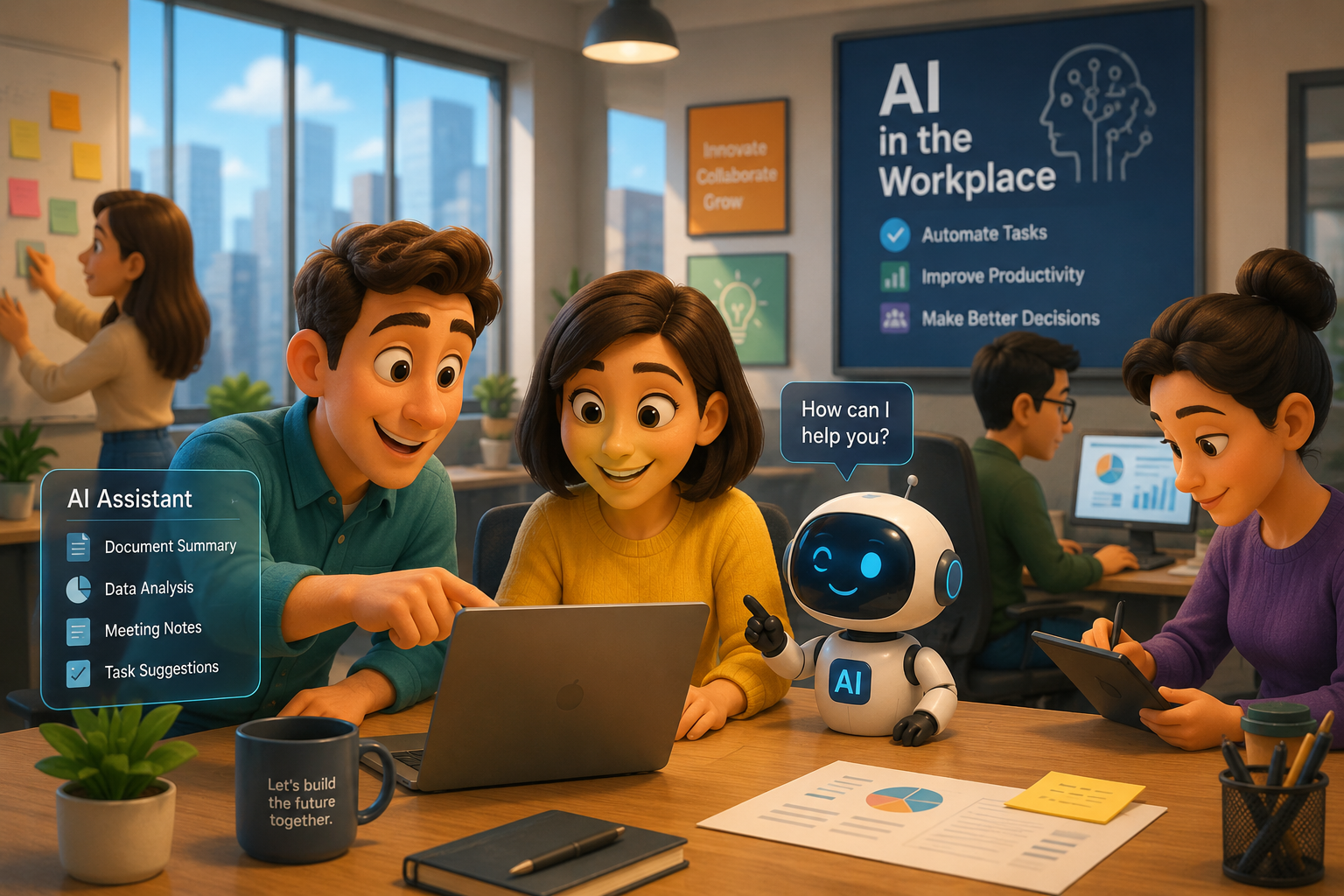
It has become a strategic capability for startups that helps teams scale operations, make faster decisions, and deliver better customer experiences with fewer resources.
Understanding AI Systems and AI Technologies
AI in the workplace combines several technologies that work together to automate processes and support better decision-making.
- Artificial intelligence – The broader field of computer science that enables machines to perform tasks requiring human intelligence, including learning, reasoning, and problem solving.
- Machine learning – AI models that analyze data, recognize patterns, and improve performance over time without explicit programming.
- Generative AI – AI capable of creating original content such as text, images, code, and reports from simple prompts.
- AI systems vs. AI tools – AI systems integrate multiple capabilities into business workflows, while AI tools are standalone applications designed for specific tasks.
- AI assistants and virtual assistants – Intelligent assistants that help employees research, summarize information, schedule work, and answer questions in real time.
How AI Is Used Across Modern Businesses
Successful startups embed AI into everyday workflows instead of treating it as a separate technology initiative.
- Data analysis – Converts large datasets into actionable business insights for improved efficiency.
- Automating routine tasks – Reduces manual work and improves productivity.
- Data entry – Minimizes human error while accelerating administrative processes.
- Invoice processing – Automates financial workflows and approvals.
- Supply chain operations – Improves forecasting demand, inventory management, and logistics.
- Customer support – Uses AI-powered chatbots and assistants to deliver faster, more accurate responses, boost customer satisfaction, and support personalized customer experiences.
- Human resources – Supports recruitment, onboarding, employee training, and workforce planning, including streamlining the hiring process and eliminating bias.
7 Benefits of AI in the Workplace
When implemented strategically, AI becomes more than a productivity tool. It helps startups scale efficiently, improve decision-making, and build stronger experiences for both employees and customers.
1. Boosting Productivity by Automating Repetitive Tasks
AI automates routine administrative work, allowing employees to focus on higher-value activities. Studies show AI tools can boost individual productivity by around 30%. AI can automate routine tasks, improving employee efficiency, and save the top 5% of Teams users one full workday per month.
2. Improving Decision Making Through Data-Driven Insights
AI analyzes large datasets faster than humans, helping business leaders make informed decisions, which can also give startups a competitive edge. Today, 25% of organizations make nearly all strategic decisions using data, for example using AI for risk management as well as decision making.
3. Enhancing Employee Experience and Employee Engagement
AI personalizes onboarding, training, and employee support, creating a more engaging and productive workplace by analyzing surveys and other employee feedback to spot sentiment patterns, while also helping people build new skills through more tailored onboarding or training. AI adoption can lead to improved work life balance by reducing unnecessary administrative tasks.
4. Creating Better Customer Experiences
AI delivers faster responses, personalized recommendations, and consistent customer service across multiple channels.
5. Improving Operational Efficiency Across Business Operations
From inventory management to invoice processing, AI replaces manual processes to streamline workflows while reducing costs and human error, helping with optimizing operations across the business. It also automates routine tasks, reducing operating errors by 60–85% in the first year.
6. Supporting Innovation and Human Creativity
By handling repetitive work, AI gives teams more time to solve problems, test ideas, and support the development process by freeing capacity for experimentation and product work, helping teams in driving innovation rather than only saving time.
7. Helping Employees Achieve Better Work-Life Balance
Smarter workload management and automation reduce unnecessary administrative tasks, helping employees maintain a healthier work-life balance while they enhance productivity with less low-value admin work.
Challenges of AI in the Workplace
AI delivers significant business value, but only when organizations address its risks with clear governance and responsible implementation.
1. Job Security and Job Displacement
Employees are more likely to embrace AI as AI takes on more repetitive work and roles shift toward higher-value contributions. However, AI could displace up to 300 million workers globally by 2030. Leaders should position AI as a tool for upskilling and expanding human capabilities, with the human workforce reskilled and repositioned rather than reduced.
2. Data Privacy and Employee Data Protection
Strong data governance, transparent policies, responsible data collection, and secure AI systems are essential for protecting sensitive employee and business information. 43% of IT leaders worry about AI exposing sensitive data.
3. Human Error, AI Outputs, and Human Oversight
AI can generate inaccurate or biased outputs. Critical decisions should always include human oversight and the human element when reviewing sensitive decisions to ensure accuracy and accountability, with human judgement guiding nuanced calls.
4. Skills Gaps and AI Adoption
Successful AI adoption depends on continuous training and company culture. Equipping employees with practical AI skills builds confidence, accelerates adoption, and helps organizations maximize long-term value, with the right culture helping many businesses move from experimentation to sustained adoption. Only 10% of U.S. employees use AI tools weekly, highlighting the need for better training and adoption efforts.
5. Data Usability Limitations
Currently, only about 41% of enterprise data is usable by AI systems, limiting the potential impact of AI in many organizations. Improving data quality and integration is essential to unlocking AI's full value.
Responsible AI Integration: Best Practices for Businesses
Successful AI implementation isn't defined by how many tools a startup adopts. It's measured by how effectively AI supports business goals while strengthening human decision-making.
1. Start with Clear Business Goals
Identify specific business challenges before investing in AI. Effective AI deployment starts by aligning use cases with measurable business outcomes. A focused strategy delivers measurable results and prevents unnecessary technology adoption.
2. Invest in AI Skills and Employee Training
Technology is only as effective as the people using it. The AI training dataset market, valued at $3.2 billion in 2025, is projected to reach $16.3 billion by 2033, reflecting the growing demand for AI education and workforce readiness.
3. Maintain Human Oversight and Emotional Intelligence
AI should inform decisions, while people provide context, empathy, and critical judgment that technology cannot replicate.
4. Prioritize Explainable AI, Legal Compliance, and Responsible AI
Build trust through transparent AI systems, strong data governance, and compliance that covers ethical use, privacy, and responsible adoption as regulations and standards evolve in the near future. Companies must audit AI tools for fairness to avoid discrimination.
5. Develop and Document AI Usage Policies
About 81.8% of IT leaders have documented AI usage policies, which help organizations manage risks and ensure responsible AI adoption.
How Leading Companies Use AI in the Workplace: Just a Few Examples
AI is already transforming how some of the world's most successful companies operate. Rather than replacing employees, leading organizations use AI to automate repetitive work, improve decision-making, and free teams to focus on higher-value tasks. Their success demonstrates that competitive advantage comes from combining intelligent technology with skilled people.
- Microsoft – Integrates AI assistants into everyday productivity tools to help employees write, analyze data, and collaborate more efficiently.
- Amazon – Uses AI to optimize inventory management, demand forecasting, and warehouse operations for faster order fulfillment.
- Salesforce – Embeds generative AI into customer relationship management, helping sales and service teams personalize customer interactions.
- Unilever – Applies AI to recruitment by screening candidates and improving hiring efficiency while reducing administrative workloads.
- Siemens – Leverages AI for predictive maintenance, identifying equipment issues before failures occur to minimize downtime and operational costs.
- Shopify – Uses AI to help merchants create product descriptions, answer customer inquiries, and gain insights that improve e-commerce performance.
- JPMorgan Chase – Leverages AI to analyze contracts, detect fraud, and automate routine financial processes, allowing employees to focus on strategic decision-making.
AI in the Workplace: Put AI Into Practice With Georgia
AI can automate tasks, analyze data, and support better decision-making, but it cannot replace confident communication when conversations become challenging. Whether handling price objections, delivering difficult feedback, or resolving customer issues, employees still need the judgment, empathy, and verbal skills that only practice can develop.
That is where Georgia complements AI in the workplace. It provides a safe environment where teams can practice high-pressure workplace conversations until effective communication becomes second nature. Instead of relying on one-off workshops, Georgia builds lasting habits that improve performance, strengthen leadership, and protect business outcomes.
Modern AI Training Solutions
Beyond traditional training methods, modern tools like the Georgia app offer innovative solutions that integrate AI to deliver personalized, interactive learning experiences tailored to individual employee needs. These platforms use AI to adapt content dynamically, provide real-time feedback, and simulate workplace scenarios, helping employees build critical skills more effectively and confidently. Startups adopting such AI-powered training tools can accelerate workforce readiness and foster continuous development in a rapidly evolving digital workplace.
Explore Georgia's modern training solutions here.
The Future of AI in the Workplace
AI is no longer a trend to watch. It is becoming a fundamental part of how startups operate, compete, and grow across the global economy. Businesses that view AI as a long-term capability instead of a short-term tool will be better positioned to adapt to future market demands and stay resilient in the near future.
- Expanding AI capabilities – AI will continue evolving, handling increasingly complex business functions beyond simple automation.
- Embedded into everyday workflows – AI will become a seamless part of daily work across communication, operations, and decision-making, much like the tools people already use in their everyday lives.
- AI assistants supporting employees – Human employees will increasingly collaborate with AI assistants to improve productivity and problem-solving.
- Responsible AI creates competitive advantage – Organizations that adopt AI ethically while maintaining transparency and human oversight will earn greater trust, preserve a long-term competitive edge, and outperform competitors.
- Human-first innovation – The future belongs to businesses that use AI to augment human expertise, creativity, and judgment rather than replace the workforce.
Final Thoughts
AI in the workplace is transforming how businesses operate by improving productivity, strengthening decision-making, and streamlining everyday operations. However, lasting success depends on addressing challenges such as responsible AI adoption, data privacy, and employee readiness.
The most successful organizations recognize that AI performs best when it enhances human judgment instead of replacing it. Technology can process information faster, but people remain essential for creativity, leadership, and meaningful communication.
Businesses that adopt AI strategically, invest in employee development, and maintain ethical practices will be better positioned to innovate, compete, and grow in an increasingly digital economy.
Ready to build an AI-powered workplace? Contact KB&G Consulting to develop a practical AI strategy and discover how Georgia can strengthen your team's communication, leadership, and performance alongside intelligent technology.