
Employee training is evolving rapidly as businesses adapt to changing technologies. AI for training is helping organizations move beyond one-size-fits-all learning by delivering personalized development in line with measurable business outcomes.
In this blog, we'll explore how AI for training is transforming employee development, the key benefits it offers, and the best practices for implementing AI-powered training programs that prepare organizations for the future.
What Is AI for Training?
AI for training is the use of artificial intelligence to deliver smarter, more personalized corporate learning. As the corporate e-learning market is projected to reach $44.6 billion by 2028, organizations are increasingly adopting AI to improve how employees learn and develop.
a. AI-Powered vs. Traditional Training
Traditional eLearning follows a fixed learning path. AI-powered training adapts courses based on individual skills, performance, and learning needs, making learning more relevant and engaging.
b. How AI Personalizes Learning
Using machine learning, natural language processing (NLP), and generative AI, this AI technology analyzes learner data to identify skills gaps, recommend relevant content, and personalize each learning path. This helps organizations improve training outcomes while supporting long-term business goals.
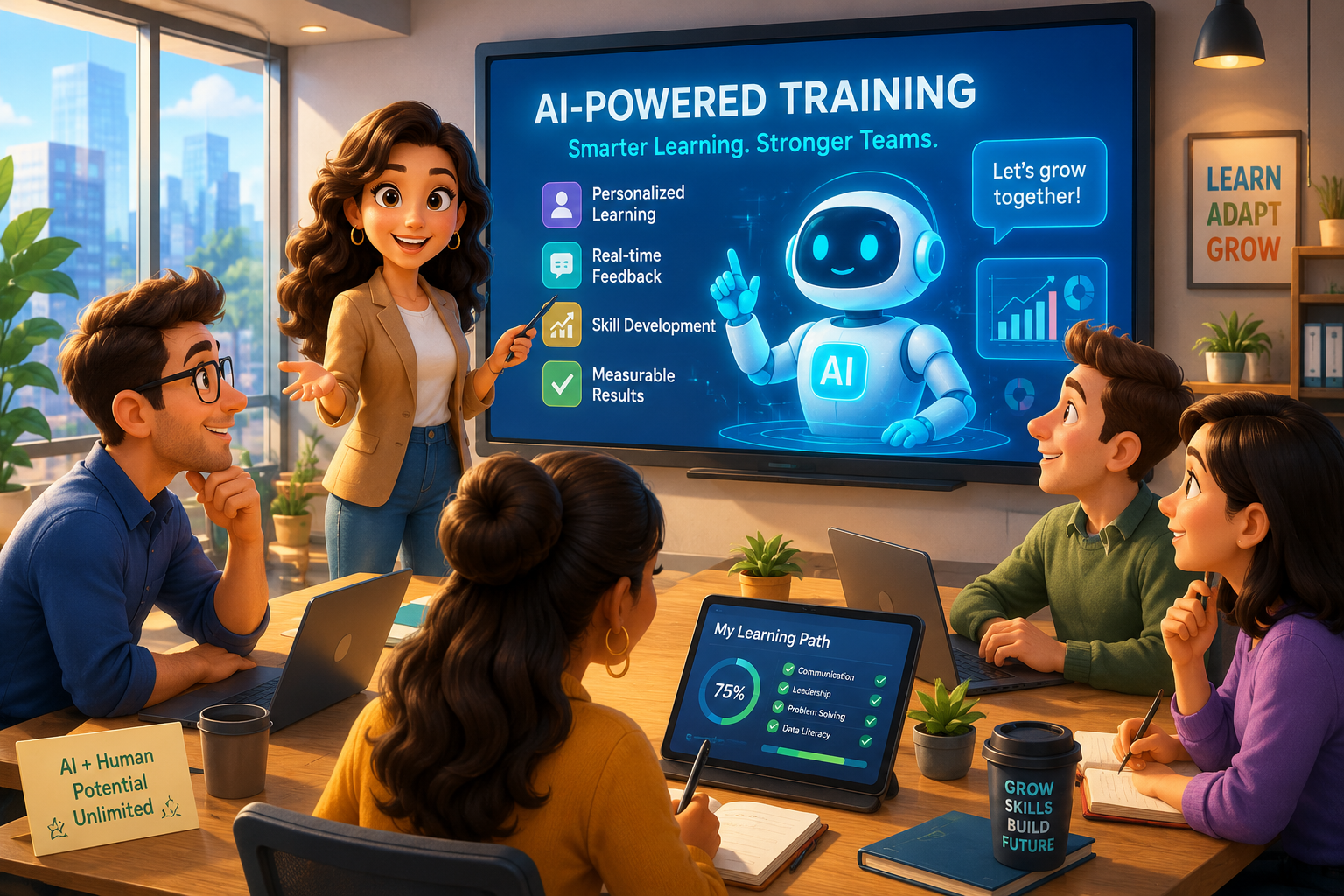
Why Businesses Are Investing in AI Training
Organizations are investing in AI because it helps build a workforce that can adapt faster, close capability gaps, and remain competitive as business needs evolve.
1. Close Skills Gaps
Skills shortages continue to outpace traditional training. In 2026, 90% of companies expect skill shortages, making AI a valuable tool for identifying gaps early and delivering targeted learning before they affect business performance.
2. Upskill Existing Employees
Hiring alone cannot meet the demand for emerging skills. AI helps organizations develop existing employees through personalized learning paths, which is especially important as 30% of hours worked in the US could be automated by 2030 and AI-driven change may require 12 million job switches by 2030, making talent development essential as more workers prepare for new jobs and gain new capabilities faster while maximizing internal talent.
3. Build an Agile Workforce
Organizations that cannot adapt quickly risk falling behind. The Agility Institute found that 71% of companies have low business agility, highlighting the need for continuous, AI-powered learning that helps teams respond confidently to changing technologies, new technologies, and market demands. With 80% of knowledge worker jobs set to be influenced by AI, building a more agile workforce is becoming essential.
3. Maintain a Competitive Advantage
Organizations that leverage AI can continuously develop workforce capabilities, accelerate innovation, and respond to change more effectively. This enables businesses to stay competitive while preparing employees for future roles and evolving customer expectations.
6 Ways AI Improves Employee Training
AI is transforming corporate learning in measurable ways. Here are six ways it helps organizations build smarter, more capable workforces.
1. Personalized Learning Paths
One-size-fits-all training no longer works for today's workforce. AI builds personalized learning paths based on each employee's role, performance, and career goals, making learning more relevant and improving engagement.
Example:Schneider Electric uses AI to deliver personalized development through its Open Talent Management platform, helping employees build new skills and boost productivity.
2. AI-Powered Skill Gap Analysis
Businesses cannot close skills gaps they cannot see. AI continuously analyzes workforce capabilities, surfaces meaningful insights from workforce data, identifies missing competencies, and recommends targeted training before gaps affect business performance.
Example:Amazon uses AI to identify employees with adjacent skills and reskill them for machine learning and cybersecurity roles.
3. AI Coaches and Virtual Learning Assistants
Learning should not stop when a training session ends. AI coaches provide real-time guidance, answer questions, and reinforce learning whenever employees need support.
Example: Deloitte's Project 120 uses AI to personalize learning experiences and support continuous employee development at scale.
4. Automating Routine Administrative Tasks
L&D teams create more value when they focus on strategy instead of administration. AI can streamline tasks and automate routine tasks involved in enrollment, progress tracking, reporting, and course management, improving efficiency while reducing manual work.
Example: Many AI-enabled learning management systems such now automate learner administration, freeing teams to focus on higher-value initiatives.
5. Personalized Recommendations and Adaptive Learning
Employees learn faster when training evolves with them and helps them apply AI in their day to day work, not just complete courses. AI recommends relevant courses, adjusts content difficulty, and delivers learning based on individual progress and changing business needs.
Example: Government workforce development programs have used AI to personalize training, reducing training time while improving learning relevance.
6. Learning Analytics That Improve Training Effectiveness
Training should be measured by business impact, not course completion. AI-powered analytics turn training data into meaningful insights, revealing engagement trends, measuring learning outcomes, and predicting future capability needs for better decision-making and to optimize workflows.
Example:Johnson & Johnson uses AI to assess future-ready skills, helping employees benchmark their capabilities and prioritize continuous development.
The Best AI Tools Used in Corporate Training
Not every AI tool serves the same purpose. The most effective organizations combine multiple AI solutions to support learning, improve productivity, and deliver measurable training outcomes.
1. Generative AI and AI-Powered Learning Platforms
Generative AI tools help L&D teams create quizzes, learning materials, assessments, and course content in minutes. Teams often start with a comprehensive list of role- or industry-specific use cases to guide how Generative AI is applied in learning design. Many teams also use these tools in marketing and other functions, which makes AI training programs easier to tailor by role. Meanwhile, AI-powered Learning Management Systems personalize learning paths, automate course delivery, and track employee progress.
Use case: Build role-specific onboarding programs and continuously adapt learning based on employee performance.
2. Microsoft Copilot and Natural Language Processing
AI assistants like Microsoft Copilot make learning part of everyday work by helping employees summarize documents, answer questions, and apply new knowledge faster. Natural language processing also powers chatbots that provide instant support throughout the learning experience.
Use case: Reinforce compliance training or technical documentation while supporting daily tasks without disrupting daily workflows.
3. AI Training Assistants
AI training assistants are transforming employee development by providing personalized guidance long after formal training ends. They answer questions, recommend learning resources, reinforce key concepts, and deliver real-time feedback based on an employee's progress.
Use case: Support sales teams with product knowledge, coach new managers on leadership skills, or guide employees through complex workflows without waiting for an instructor. For real-world examples, AI can also improve retail tasks like merchandising and demand prediction. This creates continuous learning at scale while reducing the burden on trainers.
Build Better Conversations With Georgia
Most training teaches employees what to say. Georgia helps them practice saying it under pressure. Through realistic AI-powered conversation simulations, teams can rehearse difficult workplace scenarios repeatedly until better communication becomes a habit.
Georgia helps sales teams handle price objections, improve follow-ups, and protect margins. It enables managers to practice performance conversations before issues escalate, while customer-facing teams can build confidence in de-escalating complaints and resolving conflicts. Instead of relying on one-off workshops that are quickly forgotten, Georgia reinforces learning through continuous practice in a safe environment.
Want to see how Georgia can strengthen communication across your organization? Book a call with KB&G Consulting to experience a live demo and discover how AI-powered conversation practice can improve sales performance, leadership effectiveness, and customer interactions.
Challenges of Incorporating AI Into Training Programs
AI delivers the greatest value when it complements a sound learning strategy. Organizations that overlook governance and change management risk creating training that is efficient, but not effective.
- Data Privacy: AI relies on learner data to personalize training. Organizations must protect sensitive information through secure data practices and compliance with privacy regulations.
- Responsible AI Use: AI should support fair and transparent learning decisions, and responsible use depends on clear governance that keeps recommendations explainable, consistent, and aligned with business objectives. The EU AI Act also outlines obligations for deployers of high-risk systems.
- AI Risks and Ethics: AI-generated content should always be reviewed for accuracy, bias, and relevance. Ethical oversight helps maintain trust and training quality.
- Human Oversight: Instructional designers and trainers remain essential. Human expertise ensures learning content is accurate, contextual, and aligned with organizational needs.
- Change Management: Successful AI adoption requires more than new technology. Employees and leaders need clear communication, training, and support to encourage adoption.
- Avoiding Overreliance on Automation: AI should enhance learning, not replace human judgment. The strongest training programs combine AI-driven efficiency with expert facilitation and coaching.
Best Practices for Successfully Implementing AI Training
Adopting AI is only the first step. Long-term success depends on how well organizations align AI with their learning strategy, workforce needs, and business priorities.
- Start with Clear Business Goals: Implement AI to solve specific challenges, such as closing skills gaps, improving onboarding, or increasing training efficiency. Generative AI could automate 30% of US work hours by 2030, which is why organizations need a deliberate plan. Employers have a short window to build AI skills before disillusionment, so avoid adopting AI simply because it's available.
- Focus on Measurable Outcomes: Track KPIs such as course completion, skill development, employee performance, and business impact to demonstrate training effectiveness and guide future improvements, especially as companies invest across AI, cloud, and big data.
- Prioritize Employee Adoption: Equip employees with the knowledge and support they need to confidently use AI-powered learning tools, including ai training for employees that is accessible across the entire workforce and not limited by advanced credentials. Adoption drives value, not technology alone, and hr leaders play a key role in shaping the policies and learning culture that support it.
- Choose Integrated AI Tools: Select AI solutions that connect seamlessly with your existing learning platforms and HR systems to reduce complexity and improve the learner experience, and support implementation with other resources like policies or supplemental materials. This matters because over half of AI training programs require a bachelor's degree, and executive teams need simple systems they can evaluate and support without added friction.
- Continuously Evaluate Learning: Use AI-powered analytics to refine content, identify emerging skills gaps, and keep training aligned with changing business needs. Application volume for AI programs grew by 800% in the last year, signaling rising demand for structured upskilling.
- Keep Humans in the Loop: AI should enhance instructional designers and trainers, not replace them. Human expertise remains essential for strategy, quality assurance, and meaningful learning experiences, especially as teams build technical skills.
Final Thought
AI for training is not about replacing instructional designers, trainers, or learning professionals. It is about giving them better tools to deliver learning that is more personalized, scalable, and measurable.
Organizations that implement AI strategically can close skills gaps faster, improve employee engagement, and make more informed learning decisions. Success comes from combining AI-powered insights with strong learning strategies and human expertise.
As workforce demands continue to evolve, AI will become an essential part of corporate training. Businesses that embrace AI while keeping people at the center of learning will be better equipped to build adaptable workforces, strengthen performance, and stay competitive in a rapidly changing business landscape.