
The last article made the case that founder-led sales does not scale. The fair objection is that you are still closing deals. The cost sits in the ones you discounted to win, the ones that went quiet after a strong first call, and the ones you lost to a worse product with a better angle. Those are pitch problems, and they are cheap to fix.
In this episode of Startup Witch with Julia Georgi of KB&G Consulting, we explore the four buyer profiles behind most B2B decisions, the pitch angle each one responds to, the slides Julia built for her own product, and the exercise that shows you which deals you misread.
Sales Is Pattern Recognition Before It Is Charisma
You do not need charisma to sell well. You do not need ten years of experience. Personality recognition sales is the skill of identifying a buyer’s personality profile early in a sales conversation and adjusting your pitch to how they prefer to decide, so good deals do not stall for avoidable reasons; when teams systematise it, that recognition can draw on behavioral psychology and natural language processing as well as live pattern recognition. This works at 22, and it works for technical founders who have spent their whole career avoiding the sales conversation. As Julia puts it, "the only thing you actually need is the ability to recognise patterns."
Sales gets described as empathy, storytelling, and reading the room, which makes it sound like a personality trait you either have or lack. Broad personality traits matter, but role-specific selling behavior matters more in the moment: personality recognition in sales is less about labeling someone and more about spotting the decision pattern in front of you and responding to it. Research on individual differences often links Conscientiousness to both sales performance and general job performance, where it remains one of the strongest predictors, while Extraversion tends to show a positive relationship with job performance more broadly. A large part of selling is simpler than it looks. People make decisions for a small number of predictable reasons, and those reasons are often visible within minutes of meeting someone; when you recognise them early and match the pitch sooner, personality recognition in sales helps shorten sales cycles, improve win rates, and make conversations move forward faster.
Julia is direct about her own standing here. She does not claim to be a great marketer or a great salesperson. Early stage founders do not get that luxury: with a strong technical team behind her, what is left is marketing, selling, and strategy, so basic competence across all three is the job. What follows is a practical breakdown for early-stage founders, technical founders, and B2B salespeople: four buyer personality profiles in B2B sales, how to spot their decision patterns, how to tailor your pitch to Drivers, Analyticals, Persuaders, and Craftsmen, and how to use that framework to look back at stalled deals and analyze sales performance.
Build Every Pitch Around Problem, Insight, Value
Julia demonstrates on her own product, Georgia, a simulation-based training tool that helps teams practise soft skills, prospecting, and difficult conversations. One of her ideal customer profiles is the independent sales trainer who wants to modernise their method and scale beyond their calendar.
Each version of the pitch runs the same four beats: the problem, the insight that reframes it, the value her product delivers, and what the buyer walks away with. The slides label those beats explicitly for teaching purposes. In a live conversation the structure stays and the labels disappear.
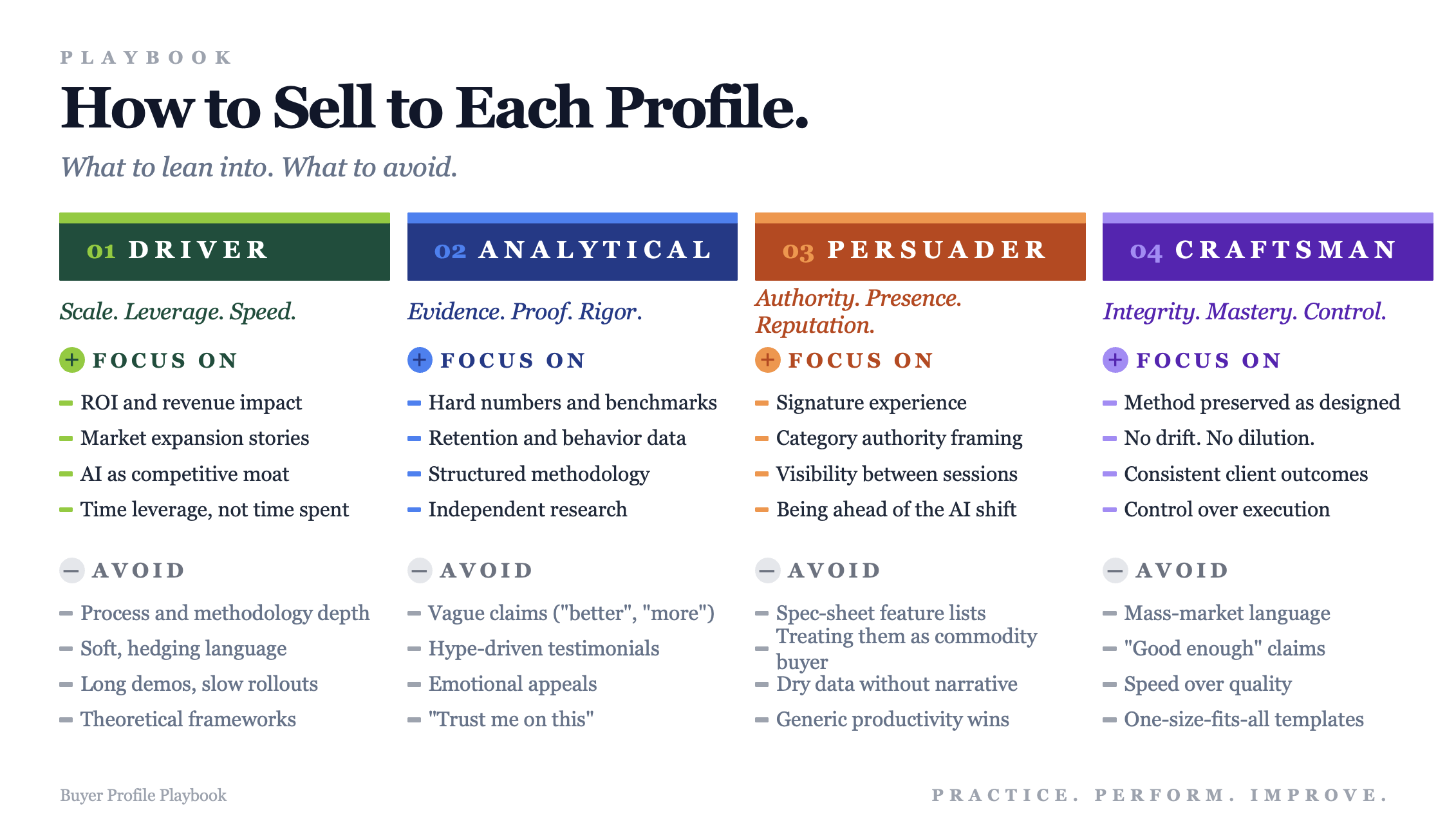
Drivers and Analyticals Buy Advantage and Proof
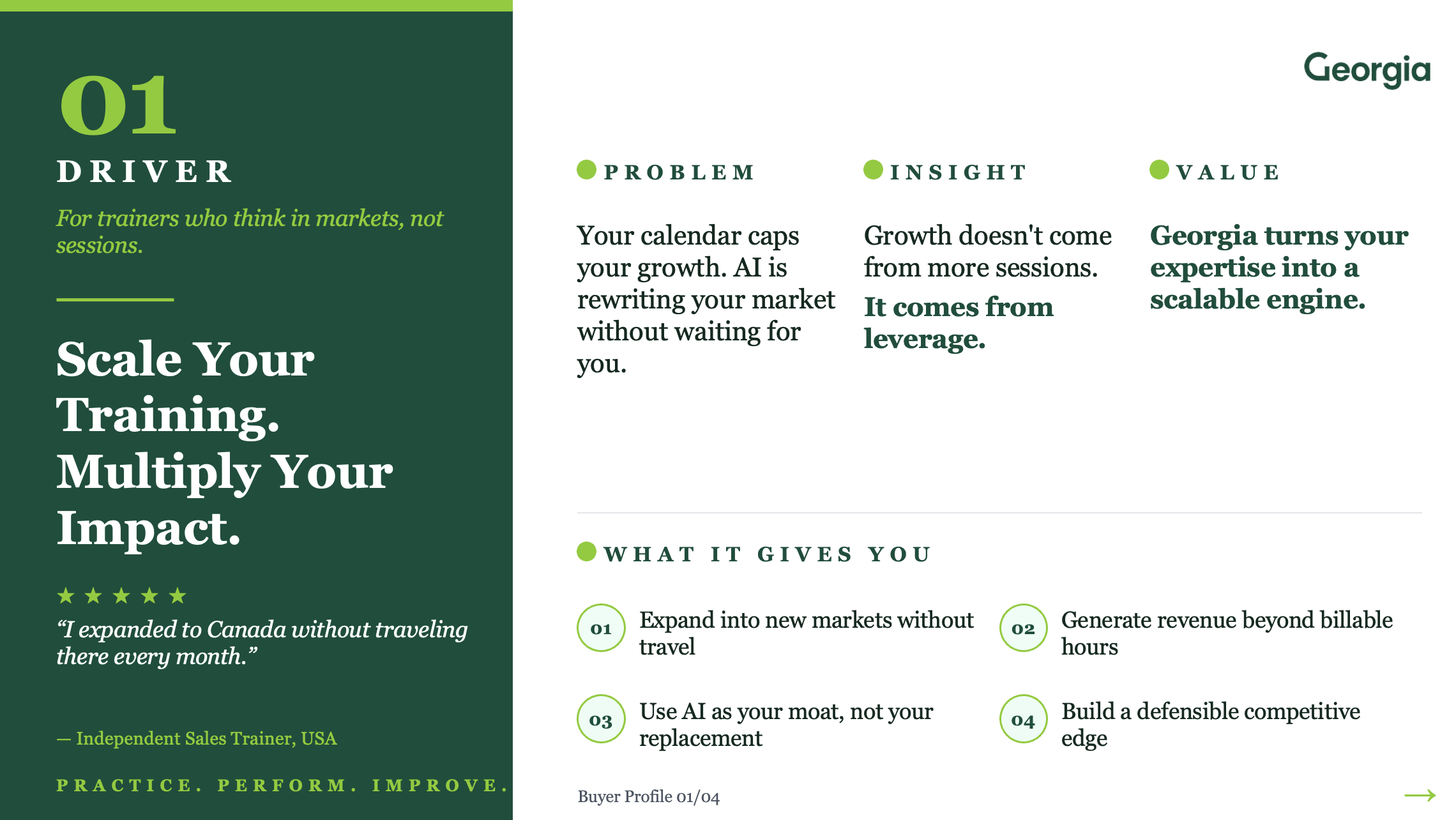
1. The Driver Buys Scale, Leverage and Speed
Drivers think in markets, not in sessions. The question running in their head is whether this gives them an advantage. That buyer-facing style also fits proactive sales roles, where high urgency and drive tend to matter most. Lead with revenue impact, market expansion, AI as a moat, and time leverage rather than time spent. Julia's driver headline is about expanding into new markets without getting on a plane every month.
Skip the methodology depth, the long demo, and the theory. Drivers want the result, and detail reads to them as delay, which aligns more naturally with new business development and business development work focused on generating leads. For this profile, high assertiveness can help in outbound motion.
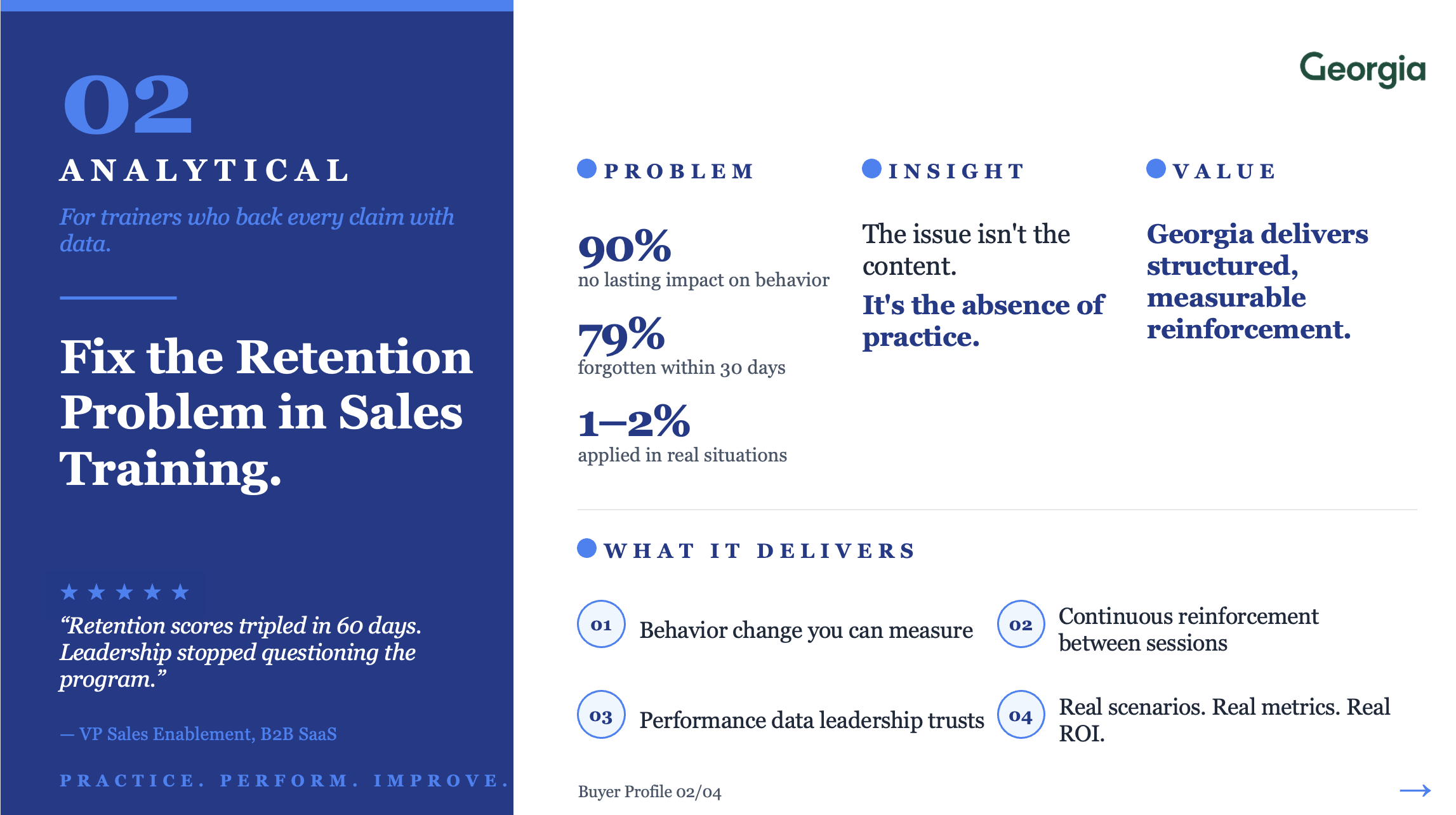
2. The Analytical Buys Evidence
Analytical buyers open with proof, so the pitch does too, and they often ask technical questions before they trust the recommendation. Not all sales roles reward the same traits, especially when inbound work values a different mix than outbound. Julia's version starts with three numbers on training outcomes: 90% produces no lasting change in behaviour, 79% is forgotten within 30 days, and 1% to 2% gets applied in a real situation. For a sales trainer, that is a brutal opening slide, and it earns the next two minutes. The underlying pattern is well documented: a published replication of Ebbinghaus' forgetting curve found retention falling to roughly 4% after a month without reinforcement.
Then comes the insight, that the content was never the problem and the absence of practice was, followed by structured, measurable reinforcement as the fix. Hard numbers, benchmarks, and a named methodology carry this pitch. Research-backed tools such as the APQ draw on applied psychology to validate workplace assessments and measure nine core behavioral traits for sales performance rather than leaning on a generic personality test alone. In some employee performance assessments, lower scores on problematic-behavior scales can indicate stronger job performance. It also avoids flattening people into broad labels, since frameworks like the Five-Factor Model use traits such as emotional stability to understand resilience at work. Vague comparatives, hype-driven testimonials, and any sentence beginning with trust me will lose it. She says it plainly: "analytical buyers don't buy confidence. They trust proof." Lower emotional stability is commonly associated with more frequent negative emotions, which can affect performance under pressure. High extraversion can hurt inbound sales performance when buyers want responsiveness and careful listening more than forceful direction.
Persuaders and Craftsmen Buy Identity and Integrity
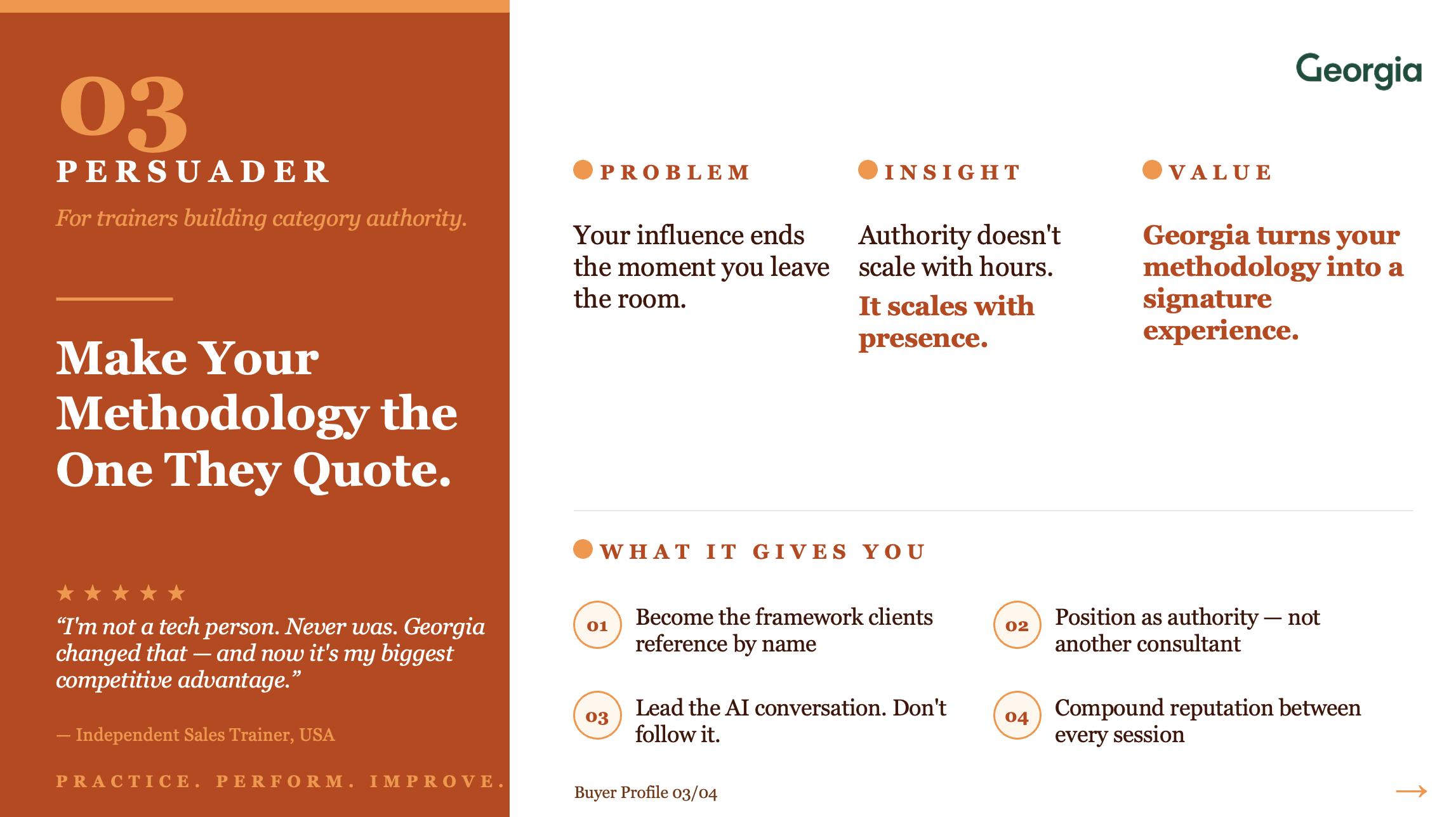
3. The Persuader Buys Authority and Reputation
Persuaders care about presence and reputation, and the question they are asking is what this makes them become; ethical sales behavior helps build trust, increases buyer trust and commitment, and makes that authority more durable. Strong sales professionals in this mode are genuinely curious about how buyers want to be seen. The pitch turns their methodology into something clients quote by name, keeps them visible between sessions, and puts them ahead of the AI shift rather than behind it.
Feature lists, dry data, and generic productivity claims land flat here. Persuaders are buying the identity they get after using your product, so sell the position, not the specification; this sales style works best when authority and visibility matter more than product detail alone.
4. The Craftsman Buys Consistency and Control
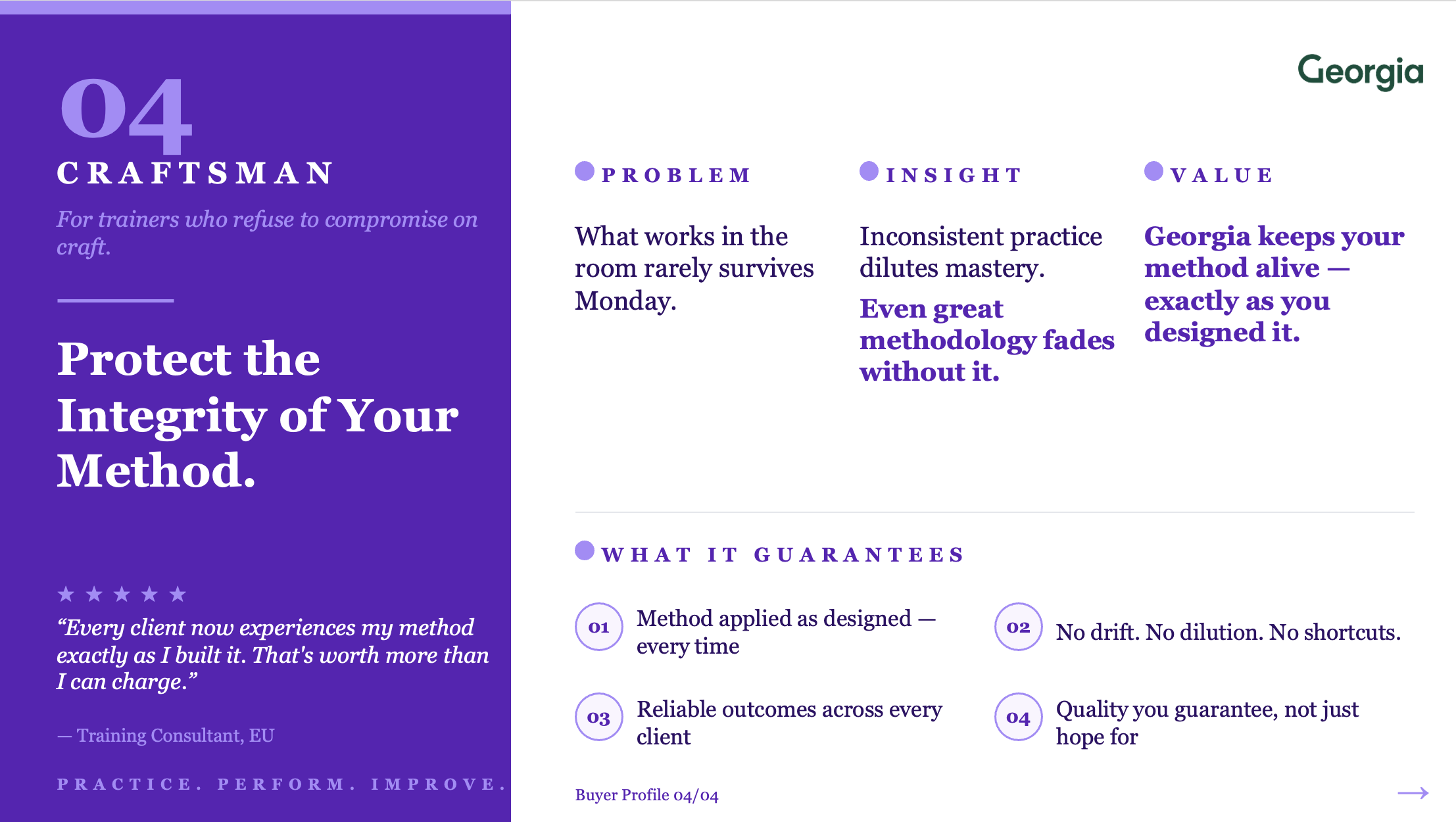
Craftsmen care about integrity, mastery, and control, and they want to know whether this preserves their standards. Julia calls this her favourite profile, and this profile often supports more consistent performance because buyers experience the process as reliable and controlled, which also strengthens relationship building. Empathetic, often more introverted salespeople tend to excel at listening and understanding customer needs, which helps them align with customer expectations and stay patient through long sales cycles. The pitch promises the method stays exactly as designed, with reliable outcomes, no dilution, and control over execution, a steady approach that also supports customer relationships, long term relationships, and long-term customer loyalty.
Mass-market language kills it. So does anything that sounds like good enough, or speed traded against quality. Craftsmen dislike change and, in Julia's words, "they want quality that holds." They also tend to work at a steadier pace, which helps with follow-up and building trust with potential customers over time, and certain types of buyers respond better to that measured style than to a more aggressive approach. This profile can fit account management or order takers better than highly aggressive hunting roles.
Expect Different Sales Personality Types in Every Room
The four types above are deliberately exaggerated to make the differences visible. Real people usually sit somewhere between two of them, and the second profile is what you adjust for once the first is obvious.
Different personality types in a sales team matter more than most founders account for. Different roles on the same team can call for different personality traits and individual strengths. Sales teams can improve rapport when they adjust tone, detail level, and communication style to the buyer. Gartner's research puts a typical B2B buying group at six to ten decision makers, each arriving with their own research and their own reasons to say no. When roles and communication match those personality types, teams with different personalities often see higher close rates and lower turnover, and diverse sales teams tend to outperform homogeneous ones. Convincing the person who invited you is one part of the job.
In B2B, most decision makers lean driver. Julia's approach when pitching to a group is to aim at the driver and one other profile chosen by industry. The same personality insight also helps when planning a sales kickoff, because sales leaders can tailor motivation and team coordination to different people. Different sales environments may call for different personality mixes across the room, so she speaks to the trigger that actually moves the decision while letting the sales team use varied personalities to cover different buyer concerns in the room. Some of the best salespeople are not the most extroverted ones; they win by adapting to the buyer and the context. In practice, some sales reps focus on new leads while other team members are better suited to relationship continuity and administrative tasks. That kind of role fit also tends to support higher job satisfaction across the team.
Run Your Last Five Deals Through the Cheat Sheet to Improve Sales Performance
Reduced to one line each, this is the whole model:
- Driver: results and leverage.
- Analytical: data and proof.
- Persuader: identity and recognition.
- Craftsman: quality and control.
In sales, performance data often follows a power-law distribution rather than a normal distribution.
Now take your five most recent sales conversations, especially the ones that stalled without a clear reason, and name the profile you were talking to. Then name the version of the pitch you delivered. Because sales data often shows that about 20% of salespeople generate roughly 50% of total sales, a few top performers can drive a disproportionate share of results, so reviewing performance metrics by pattern helps you spot what high performers do differently, and those trends often appear in a similar pattern across repeated deal reviews, not just one-off anecdotes. Where those two disagree, you have your answer, and Julia's framing is worth keeping: "you just spoke to the wrong version of the buyer." AI speech analytics can assess live sales calls and flag communication style adjustments.
Some of those deals are still alive. A stalled conversation reopened with a different angle costs one email.
Need a Second Opinion on Your Pitch?
Reading buyer profiles is a skill you can build alone. Deciding which version of your positioning to lead with, across a whole pipeline rather than one meeting, is harder from inside the business. What matters is matching people, pitch, and role instead of assuming one personality theory explains all sales success, because different sales environments reward different traits in varying degrees.
Founders default to pitching from their own personality. Visionaries pitch vision, technical founders pitch benchmarks, and the person who has lived the problem for two years tries to charm buyers with it. An outside operator will spot that pattern in your deck in about ten minutes. That is why overreliance on the Myers-Briggs Type Indicator or other generic personality measures is risky when predicting job performance, and applied psychology research does not support reducing sales success to just four traits. Strong performance also depends on emotional resilience and the ability to handle rejection over time.
If you are building something and your conversion rate is swinging without an explanation, the team at KB&G Consulting works with founders on positioning and sales structure at exactly this stage. This kind of outside review can help sales leaders keep focus on the patterns that actually help teams succeed.
Final Thought
Good sales is saying the right thing to the right person. Your product, your features, and your value stay the same across all four conversations. The angle changes, and the angle is what the buyer hears. Run the exercise on your own product this week, then rebuild one pitch for the profile you keep missing. Once you start seeing the pattern, you cannot unsee it.
Watch the full episode on Startup Witch, or get in touch with KB&G if you want a read on your positioning before your next pitch.
The concepts presented in this article are based on Ron Sticker's book, "Reach & Exceed Your Sales Goals: Using Pro$perity Personality Recognition," which explores how recognizing and adapting to different personality types can significantly improve sales outcomes and help salespeople meet and exceed their targets.