
Most Startup Advisors Are a Waste of Equity
Bring an experienced advisor in too early, and you risk wasting valuable equity. Bring one in too late, and you may miss the guidance that could have helped when it mattered most.
In this episode of Startup Witch with Julia Georgi of KB&G Consulting, we explore the patterns behind how successful startups use advisors, when to bring them in, the type of advisor each stage requires, and how to benefit from their expertise without burning equity or momentum.
Find the Sweetspot for Your Advisor
Many founders look for advisors before they’ve given an advisor anything meaningful to work with. According to Julia, experienced advisors become valuable only once your startup has real data instead of just an idea, because the right startup advisor combines relevant experience with a strong network once the company has enough traction to benefit from both. As she explains, **“**Advisors are most valuable when you have real data, not a dream or just an idea.”
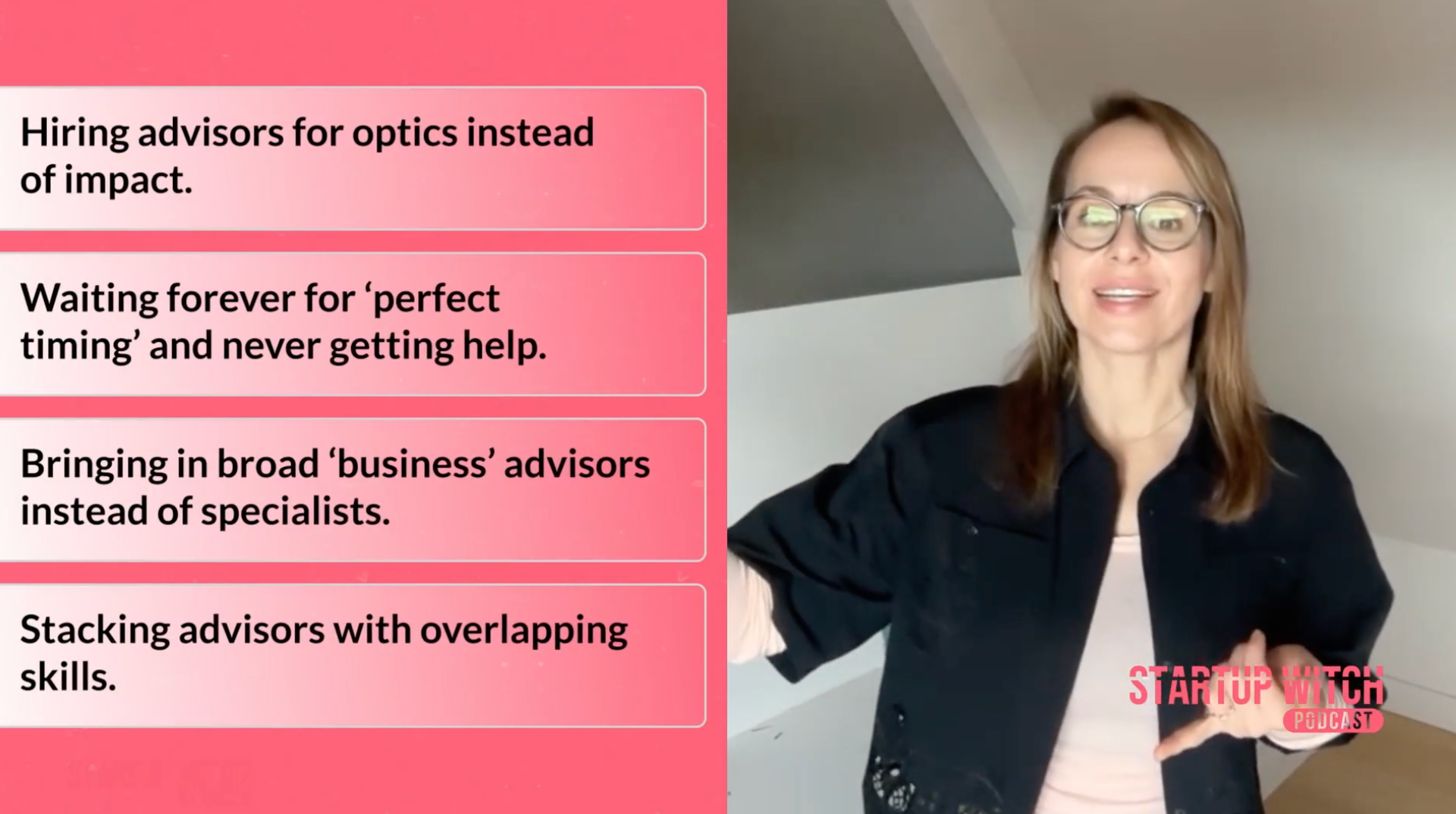
Watch Now: https://youtu.be/SDC-J47_lwc?si=klj93o8ySc6cQbpS
That means having a functioning MVP, genuine customer feedback, early market signals, clarity on your company name, and a clear understanding of where your team needs help, whether in business, go-to-market, finance, or sales. Without those fundamentals, founders often struggle to define what they actually need an advisor to do. Founders should start by leveraging their existing network and looking for people with useful industry connections.
Unless your industry depends heavily on early funding or connections, Julia does not recommend recruiting advisors before reaching the MVP stage. Instead, she advises founders to focus on shipping, learning, and validating the business before seeking experienced guidance.
Use Advisors to Plug Critical Skill Gaps
Once your startup has an MVP and early traction, Julia recommends identifying your biggest challenges first. "Then, and only then, bring in older, experienced advisors specifically to attack those problems." She emphasizes that advisors should fill critical skill gaps, not act as therapists or brainstorming partners.
Business Expertise
Business advisors strengthen go-to-market strategy, pricing, positioning, operations, and financial planning by providing strategic guidance tied to the startup’s current skill set and business needs. As Julia says, "Advisors with targeted experience create outcomes." This is an advisory role, not consulting work where people are hired for specific tasks and paid in cash.
Industry Expertise
Industry advisors bring knowledge of regulations, buyer behavior, competitive dynamics, and market-specific use cases. Their deep industry knowledge and industry experience help them advise on specific challenges such as regulation and buyer behavior. That credibility can also strengthen fundraising by improving pitches and reducing perceived risk for investors.
Fundraising and Sales
Fundraising and sales advisors help with investor targeting, pitch structure, round strategy, and enterprise sales where specialized expertise matters most: fundraising advisors can open doors to venture capitalists and future investors, while sales advisors support strategic partnerships and entering new markets.
Reminder: Audit Your Team Before You Recruit a Startup Advisory Board
Before looking outside your company, Julia recommends auditing your founding team to identify the most critical business gaps. As she advises, "Audit your founding team by function and identify the most business-critical gaps you have." For each gap, define one or two measurable outcomes an advisor should help achieve, then seek someone who has solved that exact problem. Founders should screen advisors much like key staff, using interviews and reference checks to confirm track record and fit.
Julia also reminds founders that advisor fit changes as a startup grows. "The advisor you need at pre-seed may slow you down at 1 million ARR and vice versa." Experience only creates value when it aligns with the challenges your business is solving today. It also helps to build relationships before offering any formal role, since advisors are not pre selected for the company and should be chosen deliberately.
Good Advisors Can Hurt Your Business at the Wrong Stage
Every stage of a startup demands different expertise. Julia warns that first-time startup founders often need startup advice on legal, compliance, and product market fit issues at this stage. When advisors are misaligned with a company's stage, they encourage the wrong priorities, including "overbuilding, overraising, and overoptimizing." She adds that her strength lies in advising startups before $1 million ARR, because early-stage companies require connecting product, positioning, and constraints all at once. If founders create a startup advisory board, it should stay lean and focused, often around three to seven members.
Identify Your Stage as Early Stage Startups
For early-stage startups, Julia recommends keeping one or two advisors focused on product validation, technical architecture, performance, early market fit, and securing interest from first large customers; at the pre-seed stage, most advisors provide the most value around validation and early customer learning, so compensation should stay modest, with median equity for a pre-seed advisor at 0.25%. Mentors can help in an informal capacity before founders grant equity.
Name Your Core Problem
Julia explains that advisor needs evolve quickly as a startup grows, especially as a startup grow challenge shifts with key hires, new markets, and other stage-specific problems. By Series A, founders should build a small group of advisors with experience in operations, hiring, go-to-market execution, and early board dynamics. Their role is “to turn chaos into repeatable systems.”
Beyond roughly $1 million ARR, Julia says general advice is no longer enough. Founders need specialists who have scaled specific growth channels and understand expansion. Her rule is simple: identify your stage, define your core problem, then choose advisors whose expertise matches what comes next.
Choose Advisors Whose Last 5-10 Years Match Your Next 18-24 Months
Experience should reflect where your startup is headed, not where it has been. Advisors from big tech or operators from Silicon Valley are most useful when that recent experience matches your next phase, not when it serves only as a status signal.
She also notes that many founders lose good advisors before the first conversation. Clear communication, professionalism, and a concise explanation of your startup help demonstrate that you’re worth an experienced operator’s time. Spending time on thoughtful outreach and being ready to answer questions clearly also helps establish credibility with potential advisors.
Most Founders Lose Good Advisors Before the First Call
Julia argues that many founders lose great advisors before the first conversation, not only because of poor timing or a bad fit, but because they fail to prepare. Experienced operators are busy, and “clarity and professionalism signal you’re worth being on.” Good preparation also prevents vague conversations where no one knows what success should look like.
Before reaching out, prepare a clear one-sentence explanation of your startup, identify the specific areas where you need help, and draft a startup advisory agreement that defines responsibilities, advisor compensation, and the expected time commitment, along with a fair equity range, vesting plan, and success metrics for the advisor’s involvement. A good rule of thumb for many arrangements is 12-15 hours per quarter. As Julia explains, these expectations should be thought through before the relationship begins, even if the advisor helps refine them later. Advisors usually have formal agreements outlining their roles. That clarity also helps avoid common pitfalls by making clear what the advisor will and will not do.
Advisor Equity Compensation Is More Expensive Than You Think
Julia cautions founders against underestimating the true cost of advisor equity. As she says, "Advisor equity is much more expensive than you think." If you're wondering how much equity founders typically pay, startup advisors often receive equity compensation in roughly 0.25% to 1% depending on the company's stage and the advisor's level of involvement. When advisor shares are allocated poorly, they can reduce flexibility for future hires and investors while creating confusion through misaligned incentives.
The cost extends beyond equity alone. Advisors typically receive equity or cash compensation, and later-stage startups may offer cash instead of or alongside shares. Misaligned advisors can slow decision-making, waste valuable founder time, and add legal expenses.
Julia shares that one advisor agreement recently cost her around $3,000 in legal fees, underscoring why founders should approach advisory relationships with careful planning rather than treating them as low-risk commitments. Compensation should also be documented with clear equity distribution terms and a vesting schedule, often over two years.
Common Advisor Mistakes That Cost You Growth
Julia argues that advisors only create value when they solve a clearly defined problem. Otherwise, they become an unnecessary cost in time, equity, and focus. Her advice is to set clear goals, review timelines, limit advisors by function, and regularly assess whether they still fit your company's current stage.
Common Advisor Mistakes
- Hiring advisors for optics instead of impact.
- Waiting forever for "perfect timing" and never getting help.
- Bringing in broad business advisors instead of specialists.
- Stacking advisors with overlapping skills.
- Confusing mentors, consultants, and advisors; mentors support founders informally, while consultants handle due diligence or other defined workstreams for cash.
- Using a weak advisor agreement that creates costly mistakes around intellectual property, responsibilities, and compensation.
Julia's rule is simple: "Always ask what problem this advisor solves. If it's unclear, don't proceed." Many founders should also avoid building an oversized advisory board when one specialist would solve the immediate problem. She also reminds founders that "experienced advisors aren't magic." Their value depends on timing, fit, and managing the relationship by setting expectations and reassessing it as the company evolves.
Final Thought
Experienced advisors are not a shortcut to startup success. Their value depends on choosing the right expertise at the right stage and managing the relationship with clear expectations.
Watch Startup Witch for more founder insights, and if you’re looking for practical startup guidance, connect with Julia Georgi at KB&G Consulting for experienced startup advisorship, then keep building your network through online communities, startup ecosystem events, and programs like Founder Institute if you want to grow into advisory relationships over time, especially if you may also meet investors who can connect you with portfolio companies.