
Startup decision making is now less about whether you can ship and more about whether your judgment, experience, and business acumen are pointing you to the right thing to build. For early-stage SaaS founders who are past the idea stage and trying to decide what deserves their next phase of work, that shift changes the job: the constraint is no longer building fast, but choosing well before you build.
Founders often face decision fatigue, where repeated high-stakes choices erode clarity and increase the odds of rushed, expensive mistakes. Cognitive biases make that harder. Confirmation bias can push founders toward evidence that supports what they already believe, groupthink can suppress dissent, and anchoring can lock a team onto early signals long after better information shows up. Recognizing those traps helps leadership teams keep decisions grounded in open debate and data rather than intuition alone.
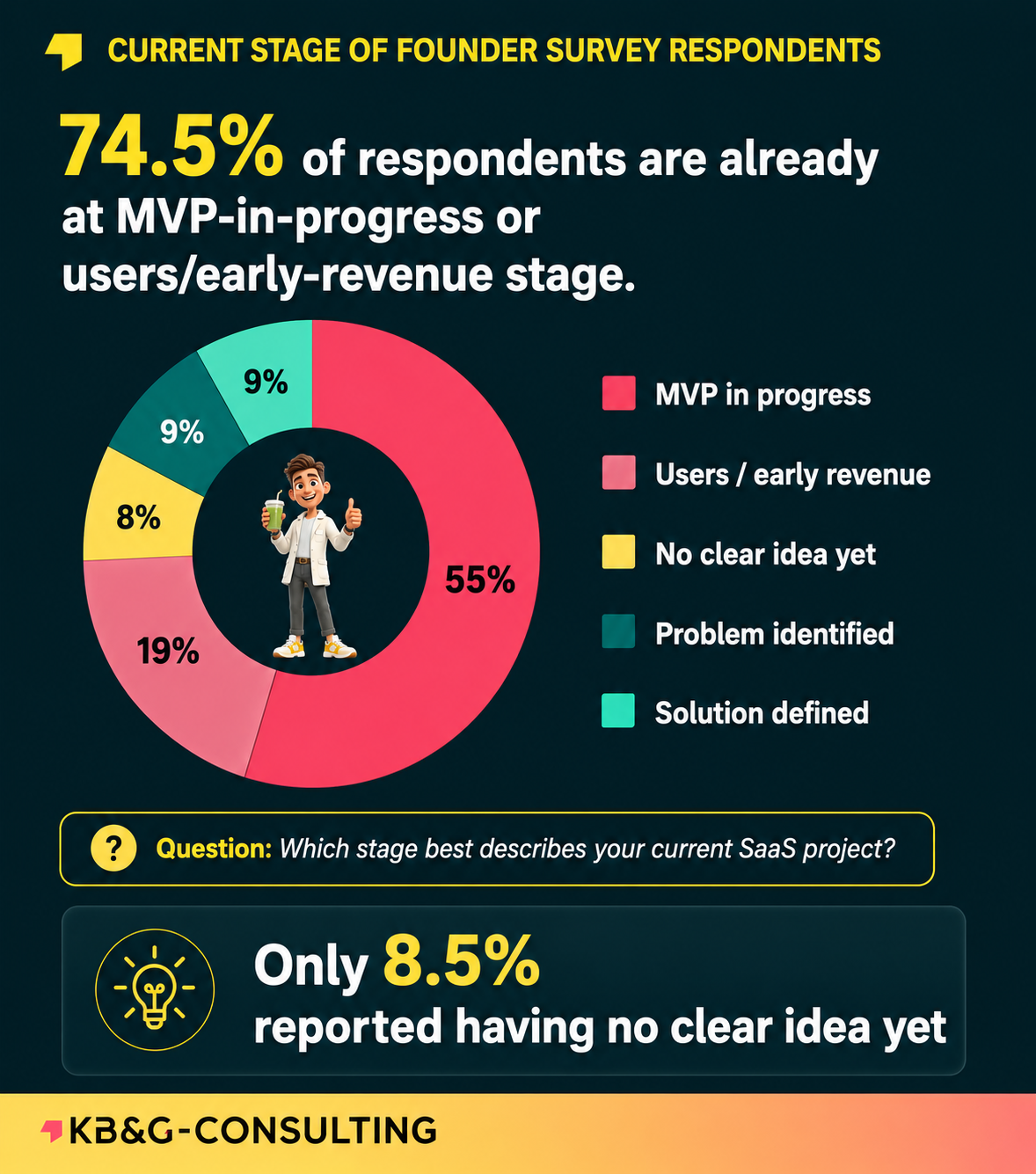
Julia expected the survey to show founders stuck at the idea stage. Almost three quarters were already building, with an MVP live or early users on it. They were not asking for motivation or more information. They kept asking what to do next. Building had stopped being the hard part for them, and the advice they were being given had not caught up.
Software is cheaper and faster to build than ever, which makes bad startup decisions more expensive in practice: you can ship quickly, get noisy feedback, and still spend months building something people do not want. In this episode of Startup Witch with Julia Georgi of KB&G Consulting, we look at what 50 SaaS founders said they actually need, why the bottleneck has shifted from building to decision making, how validation frameworks and pre-build risk assessment help founders test what is worth doing, and the five-question framework Julia uses to align choices with strategic goals before committing time to anything.
What 50 SaaS Founders and Their Founding Team Asked For
The KB&G team surveyed around 50 SaaS founders earlier this year. The expected finding was a population stuck at the idea stage. The actual finding was a population already shipping: roughly three quarters had an MVP running or early users on it.
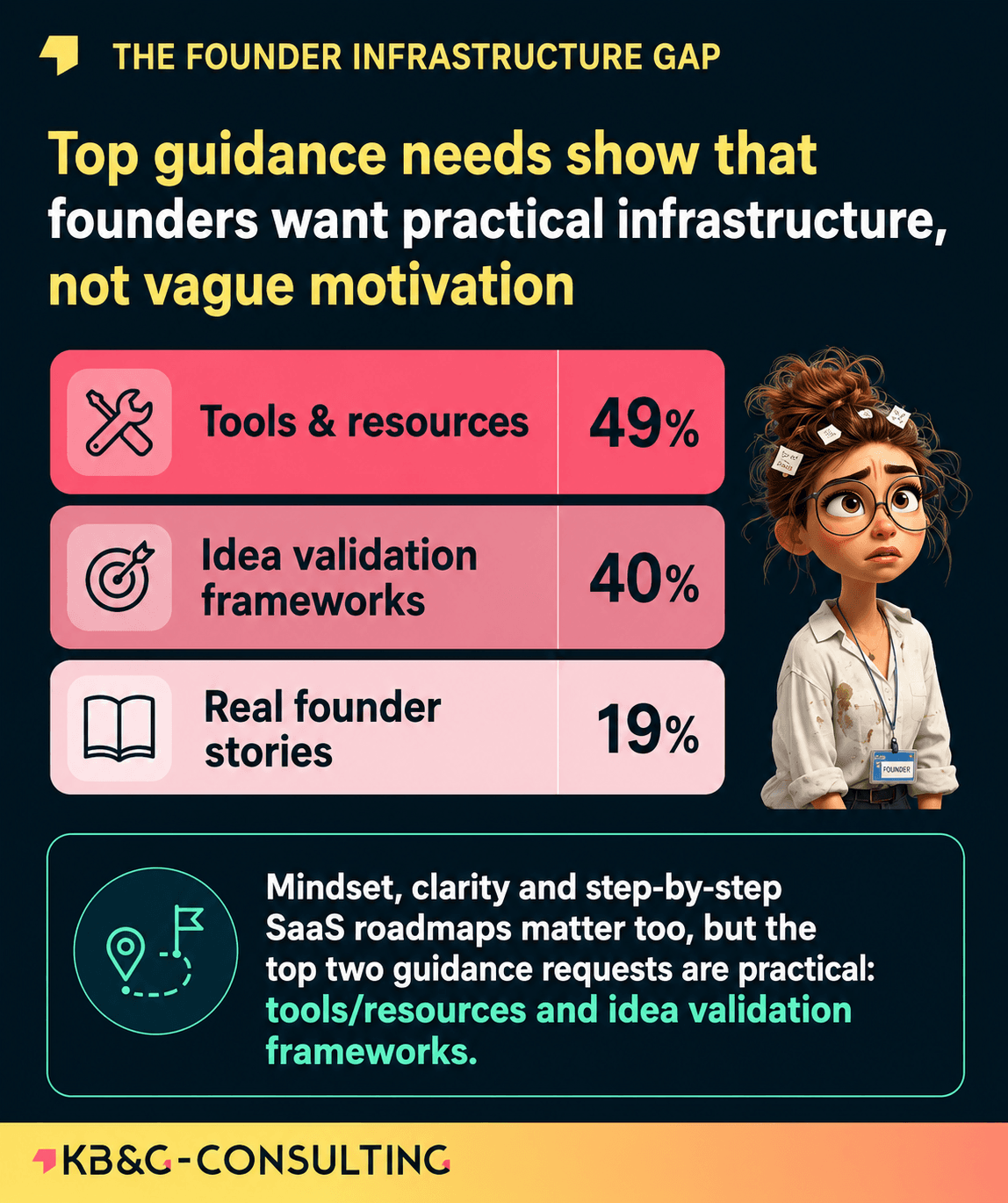
What they wanted was more specific than encouragement. Validation frameworks. Practical tools. Roadmaps. Examples from founders who had already made the mistake they were about to make. Every item on that list is a decision aid rather than a motivation aid.
Julia reads the gap bluntly: "the startup ecosystem is preparing founders for a world that no longer exists." The standard sequence, build an MVP, launch fast, talk to customers, raise, repeat, was excellent advice for a period when the first step was the expensive one.
The Decision Making Process That Moved Georgia Forward Required No Code
Julia saw the same pattern inside her own product. At the start, the team assumed each breakthrough would arrive with another feature. Looking back, the breakthroughs were business calls.
They focused on heavy industry. They treated entering a new market as a risk question, not a product excuse. They stopped leading with AI and started leading with expensive business problems their buyers already recognised. They worked out that sales trainers were partners rather than competitors, which changed the go-to-market entirely.
None of those decisions needed a single additional line of code. Some were strategic decisions, and one was a big decision about where to place the next bet. Each one needed judgment, including the willingness to make tough decisions, making every item on that list a better startup decision aid rather than a motivation aid, and part of a deliberate course of action shaped by a well-crafted strategic plan that serves as a roadmap for startups; regular reviews help the startup stay competitive and aligned as decisions change.
The Bottleneck Moved While the Advice Stayed Still
Consider what building software cost 15 years ago. You needed developers, which meant recruiting a technical co-founder or raising enough to hire a team. You needed designers, infrastructure, hosting, testing. Getting a simple prototype into someone's hands took months. Telling founders to just build an MVP was close to radical, because building was the scarce, slow, risky part.
The economics have inverted. One capable technical founder with Claude, Cursor, Lovable, and a handful of other modern tools can produce in a weekend what used to occupy a team for months. The scale of the shift is visible at the top of the market: a quarter of Y Combinator's Winter 2025 batch had codebases that were 95% AI generated, and those were highly technical founders who could have written it all themselves a year earlier.
Removing that bottleneck removed the excuse alongside it. What remains is judgment, experience, and business acumen. In early-stage startups, that raises the premium on effective decision making under incomplete information. For a startup founder, the real leverage is often a repeatable process for making strategic decisions quickly. Looking back, the breakthroughs were strategic decisions. Sometimes the big decision was to treat incumbents as partners instead of competitors. Choices like positioning or entering a new market changed outcomes without requiring code.
Bad Ideas Are Cheaper Than Ever
Twenty years ago a weak idea often died before reaching the market, because nobody had the time or money to build it. Today you can ship the wrong product in a fortnight, with a clean interface and a landing page.
"Bad ideas are now cheaper and faster than ever," as Julia puts it, and the failure data has always pointed at that risk. In CB Insights' post-mortem analysis, no market need is the most cited reason startups die, well ahead of competition or team problems. Faster building does nothing to reduce that number and quite plausibly raises it.
The headlines promising that AI will create ten times more startups are probably right. They say nothing about founder quality. AI magnifies whoever you already are. Disciplined founders move faster. Curious founders learn faster. Founders with poor judgment now make expensive mistakes far more efficiently than before. What remains is judgment, experience, and business acumen. Early-stage teams now win by using a clearer process for effective decision making. A founder is operating in high-uncertainty conditions and must make calculated bets with incomplete information. That is why risk assessment matters before building, not after. It helps weigh the potential impact of being wrong against the potential rewards of being right, which is essential for long term success.
Shipping Feels Like Progress, Which Is Why the Trap Holds
Look at your own week. You redesigned a screen, wrote tests, improved onboarding, built a dashboard, and closed the laptop feeling competent. That feeling is real and it is earned.
Now compare it with two hours of customer interviews. Nobody congratulates you. Your confidence takes a hit because people challenge you. There is no screenshot worth posting on LinkedIn. Sometimes the pilot client you built half your roadmap for tells you they no longer need it, which lands like failure. If no market need is still the top reason startups die, founders need a basic risk assessment before building, weighing potential rewards against potential impact. Long term success comes from a structured approach to risk management, with mitigation strategies for the highest-priority risks, so teams can keep moving forward with more confidence.
Those two hours can be worth more than two weeks of coding, because the two activities do different jobs. Building clears a backlog you assumed someone wanted. Validation reduces the risk that nobody wanted it. Founders conflate the two because code is visible and judgment is not, and because the old management line about measuring what you manage quietly pushes everyone toward the countable work. That is how teams drift into analysis paralysis or burn precious time chasing work that only looks productive.
Ambiguity Is Why Founders Retreat to the Product
There is a deeper reason the habit sticks. Building supplies certainty. Customers supply the opposite.
Ask five people the same question and you get five answers. One calls the idea brilliant. One says they would never use it. Another asks for a feature you had never considered. Validation reduces the risk that nobody wanted it. But waiting for 100% certainty is a trap in fast-moving markets and often leads to analysis paralysis. Dealing with people is messy, emotional, and ambiguous, and ambiguity is uncomfortable for the analytical mind that most technical founders bring to the job. That discomfort also makes cognitive biases harder to spot, so transparent decision-making helps build trust among team members, makes dissent easier to surface, and gives teams a better shot at open debate before they commit to the decision made. So the product gets another afternoon, because the product does what it is told. Avoiding that trap saves precious time and helps founders keep moving forward. Julia's warning on that instinct is four words: "safe means dead."
Answer These Five Questions Before You Commit Time
Judgment takes knowledge, practice, and real experience, and there is no shortcut on offer. What Julia does have is a habit she runs before allocating serious time to anything: coding, branding, sales, marketing, or hiring. Startups should document decision-guiding principles for clarity. Successful companies often turn that habit into a lightweight decision system, documenting those principles so the startup team stays aligned in deciding who has responsibility, testing potential solutions, and putting choices into action.
- Does this move me closer to my strategic objective? Founders run on tunnel vision, and this question forces a zoom out.
- What will I postpone or give up to do this? Every yes is also a list of nos, and you carry the consequences of both, which makes the trade offs visible in manageable steps.
- Does it damage a strategic objective somewhere else? Most founders are running several projects at once.
- Does it fit my budget? Time, money, and energy are all scarce, and scarcity is what forces prioritisation.
- What assumption am I trying to validate, and is there a cheaper way to test it? Building because something feels like a good idea is gambling with extra steps; the point is to make decisions with relevant data, test against new data, and improve the decision making process.
They look like ordinary project management questions. The difference is when you ask them: before the work starts, when changing your mind is still free. Used consistently, they become a simple decision making framework that helps you make the right decision without overcomplicating execution. For the vast majority of calls, that kind of structure supports informed decision making without pretending there is always one right answer.
A few founders have close to supernatural intuition, and sometimes yours will be right. Julia's position on relying on it is firm: "intuition is not a business strategy." Customers supply the opposite, but confirmation bias can distort mixed feedback by favoring information that supports existing beliefs, and groupthink can suppress dissenting opinions when teams discuss those signals. Companies get built by making thousands of better decisions than the competition. Founder burnout and cognitive load also affect the speed and clarity of strategic choices.
Need Customer Feedback as a Sounding Board for the Next Big Call?
The decisions that matter most tend to arrive without a deadline attached. Which segment to focus on, what to build next, what to stop building, how to price, when to raise, or how a marketing campaign should change when the market shifts. Nothing forces you to make them well, and nothing tells you when you have made them badly until two quarters later.
That is the point where an outside view earns its cost, because the person asking the questions has no stake in the roadmap you have already fallen in love with. A good advisor also brings a simple decision making framework into a broader decision making process, so complex choices get broken into manageable steps, trade offs get evaluated, transparent results can help the entire company understand why a choice was made, and clear ownership does not get lost in discussion when a single person is responsible for the final call.
If you are past the MVP and unsure which direction deserves your next quarter, KB&G Consulting works with founders on validation, segment choice, and positioning decisions at exactly that stage. They help identify the right decision maker for critical decisions, clarify who has the final decision, and give founders a structure for making the final call on high-stakes decisions. Founders can test assumptions with relevant data first, watch market trends, then refine the choice as new data comes in.
Most decisions should be made with about 70% of the information rather than waiting for certainty.
It also helps to classify choices as reversible or irreversible, and to use Type 1 and Type 2 decisions to prevent bottlenecks. Fast decisions matter here because reversible choices can be corrected quickly.
Successful entrepreneurs still make decisions by balancing data with intuition, using data-informed frameworks where possible, and seasoned leaders often rely on pattern recognition when time is short. Involving a wider range of viewpoints can improve collaborative decision making and consensus building without removing accountability from the final decision maker. The leadership team should only be pulled into the exceptions, not more decisions than necessary for routine issues.
Final Thought
Building has become the cheap part of running a startup, and the skill that separates founders now is making the next big decision when the stakes are real. Ask the five questions before the work starts, spend the uncomfortable two hours with customers, and treat every yes as a decision about what you are giving up. High stakes decisions and other critical decisions improve when a single decision maker has clear ownership of the final decision. The key takeaway is that leadership gets stronger when teams know who makes the final call, because that clarity leads to good decisions as a company grows. "Your startup will rarely outperform the quality of your decisions."
Watch the full episode on Startup Witch, or get in touch with KB&G if you want a second opinion that helps you reach a final call faster before your next big decision.