
What Does It Take to Sell Software to Mining Companies?
If you want to know how to sell software to mining companies, here's the short version: you sell by going on site, finding an operational or safety pain that costs real money per ton or per shift, quantifying it, running a tight pilot with clear success metrics, and then using those results to convince corporate to scale. Selling tech to mining is slow, often a year or more from first conversation to signed contract, so everything about your approach (runway, pricing, outreach and expectations) must be designed around that reality.
This article is focused on B2B SaaS and AI tools selling into medium and large mining companies: metals, coal, aggregates and bulk commodities. It's not about small contractors, generic manufacturing or consumer software. If you're a founder or early GTM lead of a software or AI startup trying to land your first one to five mining logos, usually pre-Series B and running founder-led sales, this is written for you.
The winning pattern is repeatable: go on site, identify a real operational pain, quantify it in cost per tonne or risk reduction, design a de-risked pilot, win site-level adoption, then use those results to persuade corporate to standardize across multiple sites. That pattern navigates the committee-driven purchasing decisions, safety gates and procurement bureaucracy that define this sector.
Here's what you'll walk away with:
Who actually buys software inside mining organizations and what motivates each stakeholder
How buying decisions are made (and why they take so long)
How to structure pilots that convert into full production contracts
How to price and package your product for industrial buyers
What language earns trust with operators, and what kills credibility instantly
Understanding How Mining Companies Buy Software
The mining sector is risk-averse, capital-intensive and operationally complex. Mining organizations often consist of corporate headquarters and remote mine sites, each with different priorities, budgets and decision makers. Decisions in mining companies are made by committee, which slows everything down. With major producers, expect a deal to take a year or more to close. If you come from a world where a SaaS deal closes in a month, recalibrate immediately.
Why does mining behave differently from generic SaaS buyers? Production risk is existential: unplanned equipment failure or supply chain bottlenecks are enormously expensive over a project lifecycle. Mining companies scrutinize every dollar spent. Worker safety isn't a nice-to-have; it's a legal and moral obligation tied directly to a mine's licence to operate. Remote sites with limited access and variable connectivity make deployment harder. Unionised labour means workflow changes require consultation. And capital-intensive assets mean budgets are locked annually or biannually, leaving little room for impulse purchases.
Site vs Corporate: Two Very Different Worlds
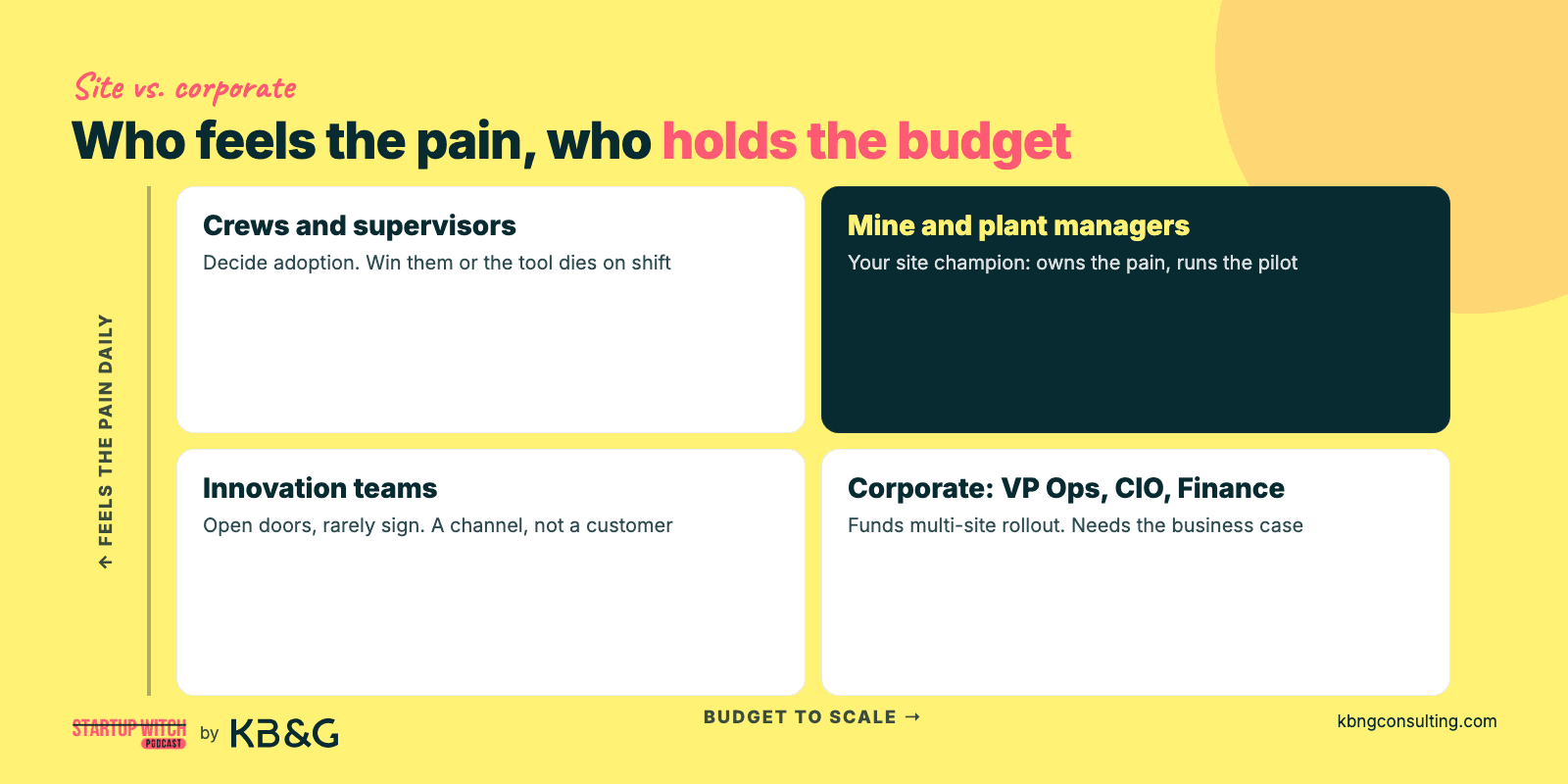
You need to understand two distinct buying environments. "Site" means the individual mine, processing plant or quarry: the place where ore gets moved, crushed and processed. Key roles here include the Mine Manager, Process Plant Manager, HSE Manager, Safety Supervisors and Shift Foremen. "Corporate" means head office or regional hub, where you'll find the CIO, VP Operations, Digital Transformation Lead, Finance and Procurement.
What each level optimises for is fundamentally different. Site cares about today: production throughput, safety incidents this week, crew adoption, and whether your tool makes the current shift easier or harder. Corporate cares about portfolio-level metrics, standardization across multiple mining operations, risk exposure, regulatory compliance and total cost of ownership.
This split shapes your entire deal. Pilots almost always start at a site, because that's where operational pain is visible and where you can prove value. But budget for scale usually lives at corporate. You must win both. A site champion who loves your product can't authorize a multi-site rollout. A corporate sponsor who sees the business case can't force adoption on a crew that hates the interface.
Core Buying Stakeholders and Their Motives
Your sales strategy should target multiple stakeholders across mining organizations. Here's who matters and what they care about:
Operations (Mine Manager, Process Plant Manager): More tonnes per shift with fewer delays. They want to streamline operations, reduce costs and hit production targets. They'll evaluate your tool on whether it actually removes bottlenecks.
Maintenance: Reducing unplanned downtime, improving asset availability, enabling predictive maintenance. Enterprise asset management systems such as IBM Maximo are the category they think in.
HSE/Safety: Fewer recordable incidents, better near-miss reporting, safety compliance, audit trails. In the U.S., the mining all-injury rate reached 1.74 per 200,000 hours worked in 2025, the lowest MSHA has recorded, and mining companies want tools that help continue that trajectory.
IT/OT: Network security, data residency, integration with existing systems (SCADA, fleet management, historians), offline capability. They're gatekeepers, not budget holders, but they can kill your deal.
Finance/Procurement: Total cost of ownership, contract terms, vendor qualification, financial risk. Procurement processes in mining are often long and bureaucratic.
Innovation/Digital Transformation: These teams often open doors: they run innovation challenges, scout technologies and connect you to operations. But while they evaluate new ideas, their budgets are limited and they rarely sign the cheque for full deployment. Treat them as a channel, not a customer.
Mining buyers prioritize measurable impact over technology features. Every stakeholder wants to know: does this reduce risk, reduce costs or increase output in terms I can measure?
Why Sales Cycles Are Long and How That Changes Your Approach
Sales cycles in mining are stretched by multi-layered committee approvals and procurement processes. Here's what drives that:
Annual budget cycles: If you miss the planning window, you wait a year.
Vendor qualification: NDAs, safety pre-qualification, financial checks and reference checks can take weeks or months on their own.
Safety and IT reviews: Any tool that touches frontline workflows or OT networks must pass rigorous evaluation.
Union consultation: If your software changes how crews work, unions may need to weigh in.
Multi-site standardisation: Corporate won't approve something that only works at one site.
A realistic sequence looks like this: discovery and relationship building first, then a signed pilot agreement, then pilot results and a production contract negotiation. For majors, add more time again for multi-site rollout approvals.
Design your cash flow and runway around this. If you have a year of runway and zero mining customers, you need to start pipeline today and potentially find bridge revenue elsewhere while deals mature.
You can't shorten the physics of regulation and committee approvals, but you can compress time-to-yes by targeting the right accounts and doing proper field discovery.
Targeting the Right Mining Customers and Use Cases
If you spray generic outreach at "mining companies," you'll disappear into the noise alongside every other software product pitching digital transformation. Account selection and use-case focus are the only levers you fully control at the start.
Defining Your Mining ICP (Commodity, Region, and Mine Type)
Start by narrowing your Ideal Customer Profile along three dimensions:
Commodity: Different commodities have different economics and market dynamics. Copper and iron ore operations are bulk, high-volume and logistics-intensive, which makes them great for haulage optimization or processing bottleneck tools. Precious metals (gold, silver) involve different extraction economics. Lithium and rare earths are expanding, with new companies entering the sector. Aggregates and quarries are simpler operationally but price-sensitive.
Mine type: Open-pit mines have truck/shovel fleets, haul roads, dust and dispatching challenges. Underground mines have ventilation, gas monitoring, limited access and communications black spots. Processing-only sites focus on throughput, recovery rates and environmental compliance. Each type has different OT/IT constraints and different operational problems worth solving.
Region: Regulation, unionization, language and data sovereignty vary enormously. Mining companies operating in Australia face different environmental compliance requirements than those in Latin America or West Africa. Canada has strong safety regulators; some jurisdictions require local data storage. Pick one or two regions where you can build depth rather than spreading thin across every geography.
Focus on one or two segments where your product's value is clearest. If you've built voice-to-data intelligence, target large open-pit truck/shovel operations where radio communications drive delay reporting. If you've built computer vision for PPE detection, target underground mines or processing plants with strict access control. Specificity is your competitive advantage as a startup.
Picking Operational Problems That Actually Get Budget
Not every mining problem gets funded. Here are the categories that reliably get attention and investment:
Safety and incident prevention: Near-miss reporting, serious injury and fatality (SIF) prevention, safety compliance automation. This is the most defensible budget line because it ties directly to licence to operate.
Unplanned downtime and predictive maintenance: Identifying root causes of delays, reducing breakdowns, increasing asset availability.
Haulage and processing bottlenecks: Delays in haul trucks, queuing at crushers, stockpile management, throughput optimization.
Regulatory and environmental reporting: Emissions, dust, water, tailings management, environmental impact monitoring. Regulatory processes for mining permits can take months or years, so tools that simplify compliance reporting have clear value.
Contractor performance and workforce compliance: Tracking competencies, access control, PPE compliance and training records across large, distributed workforces.
Connect your feature set to these categories using hard numbers: lost tonnes per hour of downtime, cost of rework, risk of regulatory shutdown, insurance premium implications. Mining companies want risk reduction and cost per ton metrics, not feature lists.
Specific example use cases a founder could target: automate radio-logged delays into structured data so dispatchers get real-time data instead of guesswork; detect missing PPE at access points via computer vision; digitize shift handover documentation to eliminate information loss between crews.
Signals That a Mining Company Is Ready for New Software
Not every mining business is ready to buy. Look for these readiness signals:
Recent safety incidents or near-misses that attracted public or regulatory attention, which creates urgent demand for solutions
Public sustainability commitments or new ESG targets, environmental compliance goals or carbon reduction pledges
New hires in digital or innovation roles: a new "Head of Digital Mining" or "Chief Innovation Officer" on LinkedIn signals new budget and mandate
Capital expansion projects: new mines opening, processing plants being built, mining projects in development phase
Innovation challenges or RFPs issued: some mining companies run open calls for technology, which are direct growth opportunities
You can spot these via press releases, LinkedIn job postings, conference agendas and local regulatory agency filings.
Once you know who and what to target, you have to get out of your office and onto site to see the actual workflow.
Field Discovery: Going On Site and Speaking Mining
Slide-deck discovery fails in mining. You can't understand the real value chain of a mine from a Zoom call. Site visits and ride-alongs with supervisors, dispatchers and safety reps are non-negotiable. Successful mining software addresses operational realities rather than just features, and you can't know the realities without standing in the dust.
Planning and Running a High-Value Site Visit
Preparation matters because mines are not offices. Here's what to handle before you arrive:
Safety induction: Every mine requires one, and it can take hours. Plan for it.
PPE: Steel-toed boots, hard hat, high-visibility vest, safety glasses at minimum. Underground sites may require additional equipment.
Insurance and vendor paperwork: NDAs, supplier registration, sometimes union/management sign-offs for visitor access.
Shift schedules: Understand when crews change, when the control room is busiest and when maintenance windows happen. Plan your visit around the activity you need to observe.
Pre-reading: Get access to site maps, shift reports and data flows if possible. Know what systems they run (ask whether they're on SAP, Oracle or something else).
On site, observe everything:
How data is collected and recorded: paper logs, radio calls, manual data entry into terminals
What informal tools crews use: WhatsApp groups, whiteboards, handwritten notes
Control room operations: what screens are watched, what's ignored, where operators toggle between systems
Where delays happen: trucks queuing, equipment sitting idle, crews waiting for permits or parts
What gets double-entered into different systems
After the visit, debrief immediately. Map the current workflow end to end. Mark every failure point. List every manual step your software could remove or automate. This becomes your pilot proposal.
Asking Operators Questions That Actually Uncover Value
Talk to frontline roles (dispatchers, supervisors, safety reps, maintenance crew leads), not just management. Here are questions that work:
"What slows you down on night shift?"
"When something goes wrong, what's the chain of handover or escalation?"
"How do you track incidents or near misses right now?"
"What information do you double-enter?"
"Which delays get blamed but never actually tracked?"
"Who makes the call to stop work for a safety or equipment issue?"
"What paperwork takes the longest at the end of shift?"
"If you could fix one thing about how information flows, what would it be?"
When someone says "we lose a truck per shift here," translate that. Ask the site what an operating hour of that truck is worth, then multiply it across every shift in a year. That's the kind of number that gets a Mine Manager's attention, and it's the customer data you need to build your business case.
Common mistakes: leading with AI buzzwords and machine learning capabilities before you understand the problem; ignoring informal workarounds that crews have built (these tell you where the system fails); talking only to management and never hearing from the people who actually use the tools.
The Language That Earns Trust in Mining Operations
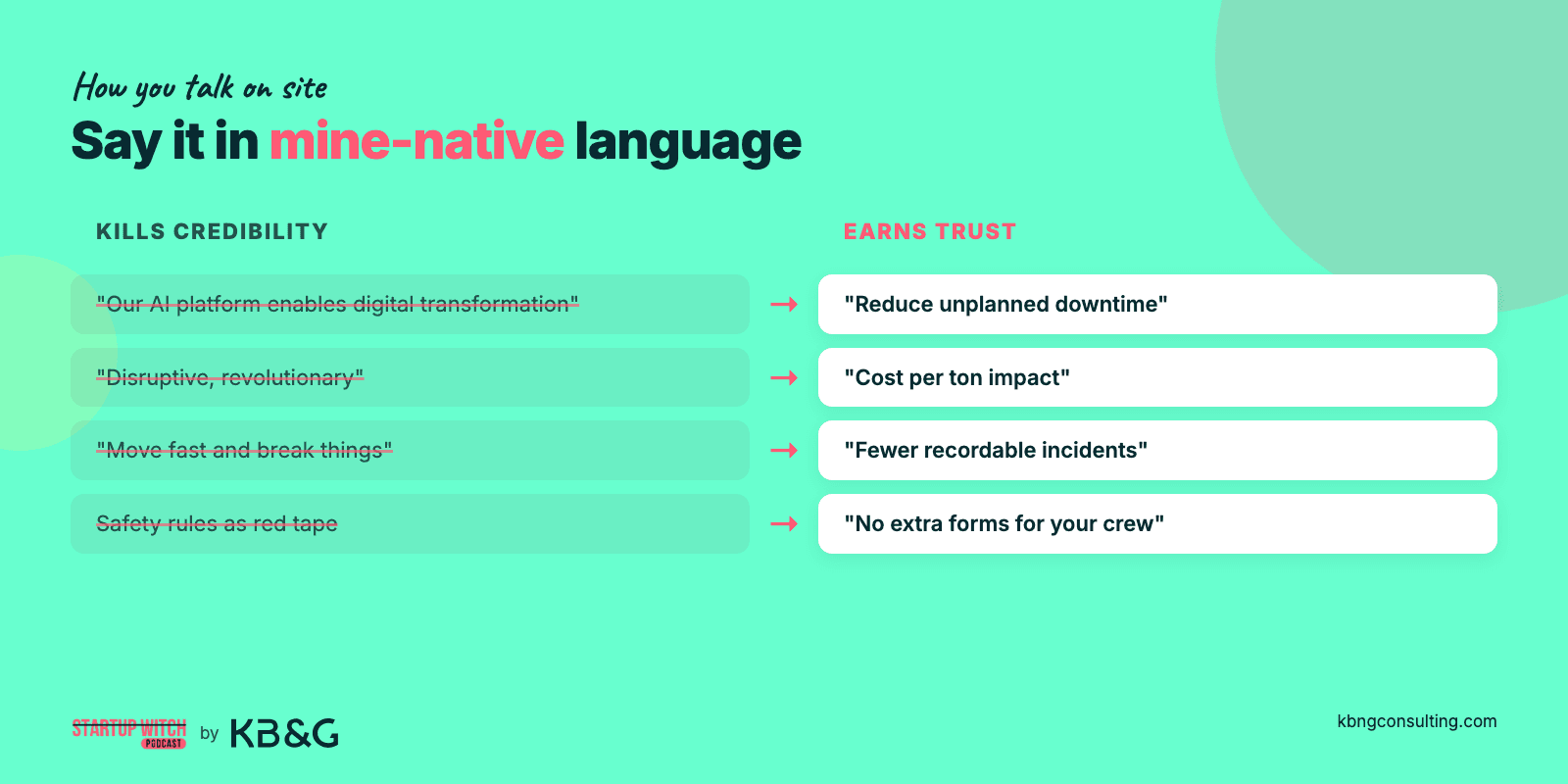
Mining engineers, supervisors and operators have a finely tuned radar for outsiders who don't understand their world. The phrases that resonate:
"Reduce unplanned downtime"
"Fewer hand injuries, fewer recordable incidents"
"Less time doing paperwork after shift"
"No extra forms for your crew"
"Better visibility into what's actually happening on the ground"
"Cost per ton impact"
"Operator-friendly: works even when connectivity drops"
What kills credibility instantly:
Generic "digital transformation" without specifics
"Move fast and break things" (in a safety-critical environment, this is offensive)
Dismissing safety rules as bureaucratic red tape
Leading with "our AI" or "our machine learning model" before explaining what problem it solves
Buzzwords like "disruptive" or "revolutionary" without evidence
With real workflow insight and operator language, you can now frame and structure a pilot that has a chance of getting approved.
Designing Pilots With Mining Companies That Actually Convert
Proof of concept pilots help reduce perceived risk in software adoption, but only if they're designed to force a clear commercial decision at the end. "Pilot purgatory" is where good mining software goes to die: the trial runs indefinitely, nobody signs off, the champion moves to another site, and your startup burns cash with nothing to show for it.
This section is the practical playbook for going from first conversation to signed pilot to multi-site rollout.
Step-by-Step Pilot Process for Mining Software
Move to a formal pilot after a clear use case is mapped and one or two internal champions are identified, typically the site-level operational leader and someone in safety or IT who sees the value. Here's the process:
Co-define success metrics in the language of the site: reduction in unplanned downtime, number of near-misses captured that were previously unreported, time saved per shift on data entry, accuracy of incident capture. These must be metrics the site already tracks or can easily measure.
Select a narrow pilot area: one haulage fleet, one processing line, one shaft, one shift crew. Keep scope tight enough that you can deliver results in weeks, not months.
Lock scope, timeline and responsibilities in a short pilot charter with a fixed end date. Define what you provide (software, training, support) and what the site provides (data access, network access, crew time, a named internal project owner).
Secure IT/OT approval and safety sign-off before you start. This means network access, any hardware deployment (radios, cameras, edge devices), data access agreements, and confirmation that the pilot doesn't violate any safety procedures.
Train supervisors and crew in short, on-shift sessions. Minimal disruption. No mandatory extra tasks. Show them how this reduces their pain, not adds to it.
Run the pilot with weekly check-ins and visible metrics. Put dashboards in the control room or on safety boards where crews can see progress.
Produce a clear before/after report in mine-native units: cost per ton improvement, incidents captured, delays reduced, hours saved. This is the document your champion uses to make the case internally.
Present the scale-up proposal while pilot results are fresh and your internal champion is motivated. Include options: single-site full deployment versus multi-site rollout, with pricing for each.
Structuring Pilot Commercials: Paid, Free, or Co-Funded?
Three options, each with trade-offs:
Free pilot: Useful when the site is a marquee reference, when data access is uniquely valuable for your product development, or when you need to prove the concept before anyone will pay. The risk: lack of financial commitment often means lack of organizational commitment. Nobody internally owns a free project.
Discounted paid pilot: Even a small fee, enough to require a purchase order, signals seriousness from the buyer and creates internal accountability. Someone had to approve that spend, which means someone owns the outcome.
Co-funded pilot: Through government innovation grants, R&D tax incentives or corporate venture arms. This reduces upfront financial risk for both sides and can be politically easier for the site to approve. If your tool aligns with existing compliance spend, co-funding becomes easier to justify.
Regardless of model, keep pilot contracts simple: limited scope, clear IP ownership, a defined decision date for production rollout, and explicit pricing for what happens after the pilot succeeds.
Avoiding Pilot Purgatory and Forcing a Decision
Common failure patterns:
"Let's keep the pilot running another quarter" (no decision date was ever set)
Your internal champion leaves the site or changes roles
No single person owns the rollout decision
Pilot results are good but nobody connects them to budget approval
Specific tactics to prevent this:
Include a decision deadline in the pilot contract. For an 8-week pilot, the decision meeting happens in week 10, not "sometime after."
Pre-book the decision meeting and make sure it includes operations, IT and procurement, not just your champion.
Define scale-up options during the second month of the pilot, before results are final. This means the commercial conversation runs in parallel with the technical proof.
Use contractual milestones: in that 8-week example, a midpoint review at week four, final deliverables at week eight and the decision meeting at week ten. Each milestone forces accountability.
Strong pilots still die if you can't get through IT, safety and procurement, so you need to design for those gates from the start.
Navigating IT, Safety, and Procurement in Mining Enterprises
Mining is safety-critical and heavily regulated. Vendors must help mining companies meet compliance standards, not create new compliance problems. Your software must clear more gates than typical SaaS, and ignoring this kills deals late, sometimes after months of investment in the relationship.
IT and OT Requirements You Need to Meet
Mining operations typically separate networks between IT (corporate, ERP, email) and OT (control systems, SCADA, PLCs, fleet dispatch). Between them sits a DMZ or industrial DMZ, often aligned with the Purdue Model and governed by standards such as ISA/IEC 62443 for industrial automation security.
Mining software must account for harsh environments with variable connectivity. Expect these requirements:
Network security: Compliance with ISA/IEC 62443, sometimes ISO 27001/27002. Architecture diagrams, encryption, access control models, identity management and audit logs must be documented and ready.
Data residency: Many jurisdictions require data to remain physically in-country. Know where your servers are and what data sovereignty laws apply.
Integration: Can your solution integrate with, or at least export/import data from, existing SCADA, historian, fleet management or maintenance systems like SAP or IBM Maximo?
Offline capability: Remote sites with intermittent connectivity need systems that work without persistent internet. Edge compute, local caching and graceful sync when connectivity returns are not optional; they're expected.
Penetration testing and third-party audits: Often required, especially when your software sits close to OT or impacts safety-critical workflows.
Have your security questionnaire responses, architecture diagrams, access control model, incident response process and data flow documentation ready before you're asked. Being slow to produce these signals immaturity and kills confidence.
Safety, Compliance, and Change Management
Safety departments evaluate new tools through the lens of risk:
Does this tool distract operators during safety-critical tasks?
Does it require changes to existing procedures that need formal review?
Does union consultation need to happen before workflows change?
Does it create new data that must be retained for regulatory audits?
Mining operations face intense regulatory oversight, and your product becomes part of that compliance environment the moment it touches frontline operations. Position your product as reducing risk and paperwork rather than adding tasks. Auto-captured data instead of extra forms. Simplified reporting instead of new reporting layers. The phrase "no extra forms for your crew" is worth more than any feature slide.
Your logs, access records and data retention policies matter because mines must produce audit trails for regulatory bodies. If your software captures safety data, that data may become legally discoverable. Design for this from day one.
Procurement and Vendor Approval in Mining Companies
A typical vendor onboarding path in mining:
NDA and supplier/vendor registration
HSE/safety pre-qualification (sometimes including safety audits of your company)
Financial checks and legal/tax compliance verification
Reference checks, especially from similar mine types and commodities
Review of standard terms and conditions, including liability, indemnification and data ownership clauses
Larger companies have more gates. Ask early: "What does vendor approval involve here and how long does it usually take?" Build that timeline into your deal forecast. Your site champion has to push procurement for approval, so make sure they know the internal process and are actively shepherding your paperwork.
Once you know the internal machinery, you still need a front-door strategy (outreach, events and innovation programs) to meet the right people.
Finding and Reaching Mining Buyers
Most mining decision makers are not actively searching for new software on social media or through inbound marketing campaigns. You have to go to them through the channels they already use. This requires both digital and in-person outreach, calibrated to a sector where trust is earned slowly.
Founder-Led Outreach: LinkedIn, Email, and Warm Intros
For early-stage founders, your personal brand is your marketing engine. Build a focused LinkedIn presence:
Post field-tested learnings from site visits (without breaching NDAs)
Share short videos explaining specific mining problems you've observed and how software can address them
Write about pilots you're running, results you're seeing, or lessons learned from the mining industry
Personalized emails work far better than generic pitches. Craft concise messages that reference concrete operational pains. "I noticed your operation runs a large haul fleet on long circuits. We're working on queuing delays at the primary crusher and would like to understand how you track them today" lands better than "Our AI platform enables digital transformation."
Use warm intros through OEMs, engineering firms or innovation hubs that already serve the mine. People who already work with a site can open doors you'd never get through cold. Contact databases help, but the intro matters more than the channel.
Conferences, Site Visits, and Industry Networks
The types of events that matter for mining leads:
Major international conferences: Large expos and mining conventions where industry leaders gather. These are expensive but useful for meeting corporate-level buyers across multiple companies in a few days.
Regional mining forums: Smaller, more focused events where you can have real conversations with operational decision makers rather than fighting for attention in a massive expo hall.
Invite-only innovation days: Some mining majors run these specifically to scout technologies. If you get an invite, treat it as a sales meeting, not a showcase.
Use events strategically: pre-book meetings, aim for a single use-case conversation per target company, and follow up with a site visit proposal, not just a demo link. The goal is to get on site, not to hand out brochures.
For tight budgets, visiting nearby mines and attending local industry association meetings can outperform expensive trade-show booths. Research which operations are within driving distance and request site tours through industry connections.
Innovation Challenges, Accelerators, and Corporate Venture Arms
Many mining companies use innovation programs, challenge calls and corporate venture units to scout new technologies. These can be a valuable entry point: they give you access to operations teams, real site data and sometimes co-funding.
But be careful: treat these as channels to reach operations and negotiate for real pilots on operating sites. Watch out for "showcase but no deployment" traps where you demo endlessly for an innovation team that has no authority or budget for full production rollout.
Concrete advice: when entering an innovation program, negotiate for defined pilot terms on an operating site, access to operational data, and a clear path to commercial engagement if the pilot succeeds. If the program can't offer that, it's a marketing exercise for the mining company, not a sales channel for you.
Once you're in conversation, you still need to price, package and negotiate in a way that fits mining budgets and risk appetite.
Pricing and Packaging Software for Industrial Buyers
Typical SaaS per-seat pricing often misaligns with how mines operate. Crews share terminals. Shifts rotate. Sites are the unit of production, not individual users. Mining buyers look to reduce risk in every purchasing decision, so your pricing needs to reduce perceived risk, not amplify it.
Common Pricing Models That Make Sense on Mine Sites
Several pricing models work for this market:
Per site license: One contract per mine or processing plant, covering all users. Easy to budget, easy to explain internally. Works well when your tool serves an entire site.
Per asset or equipment: Per haul truck, per processing line, per crusher. Good when your value is tied to specific high-value assets, especially for predictive maintenance or equipment monitoring.
Tonnage or usage bands: Price tied to throughput volume or hours of operation. Aligns your revenue growth with the mine's production, which feels fair to buyers.
Bundle tiers: Pilot / Single Site / Multi-Site, with standard feature sets rather than granular per-feature pricing. Simplicity matters: mining procurement teams don't want to negotiate dozens of line items.
Per-seat pricing is hard because crews share devices and terminals. Site-based or asset-based pricing is easier for a mine's finance team to model and approve. Suggest simple bundles early in the conversation.
Building a Business Case in Cost per Ton and Risk Terms
Mining companies don't buy "platforms" or "dashboards." They buy outcomes. Translate your product's impact into mine-native units:
Cost per ton improvement: If your tool reduces delays by X hours per shift, calculate the tonnage impact and multiply by the mine's revenue per ton.
Cost per hour of downtime avoided: On a large open-pit operation, an hour of unplanned downtime on a primary crusher is expensive in lost production. Get the site's own figure.
SIF risk reduction: Reducing the probability of serious injuries has direct value in insurance premiums, regulatory penalties and workers' compensation costs.
Regulatory penalties avoided: Non-compliance fines, permit delays and environmental compliance violations carry quantifiable costs.
Use conservative assumptions. Build three scenarios (best case, base case, worst case) so your internal champion can defend the numbers in a budget meeting without looking like they're selling snake oil. Link your value to existing KPIs like OEE (Overall Equipment Effectiveness), TRIFR (Total Recordable Injury Frequency Rate), MTTR (Mean Time To Repair) or lost-time injuries. Don't invent numbers; use the mine's own data wherever possible.
Contract Lengths, SLAs, and Support Expectations
After a successful pilot, expect multi-year agreements, especially with majors. These often include renewal or expansion clauses for additional sites.
Typical expectations:
Uptime SLAs: Defined availability targets with penalties for extended outages
Response time: Especially for onsite or remote support. Mines operate 24/7, and a system failure at 2 AM on a Sunday still needs resolution
Local or time-zone-compatible support: Mines don't want to call a support line that's asleep when they're running night shift
Clear scope of support: What's "standard" versus what requires a change order. Be explicit about this in contracts to avoid scope creep that erodes your margins
Don't over-promise on customisation or onsite presence. Be honest about what's included and what costs extra. Mining companies respect clarity and punish ambiguity.
Even with good pricing and packaging, deals still get stuck, so you need specific tactics for the usual failure modes.
Common Challenges When Selling to Mining Companies (and How to Beat Them)
The same few problems show up in almost every mining deal. They can be anticipated and designed around if you plan for them from the start.
Challenge 1: Stalling in "We're Interested, But Not Now"
"Not budgeted this year" is the most common soft no in mining. The underlying issue is usually timing: annual budget cycles, competing capital projects, or commodity price uncertainty affecting strategic decision making.
Tactics: Ask about budget timing early in the relationship. Align your proposals with upcoming shutdowns, expansion projects or the next capital planning window. Offer a small, low-cost pre-pilot proof of value that fits the current quarter's discretionary budget: something that demonstrates impact without requiring a major investment decision. Increasing ESG pressure and regulatory tightening can also create urgency where none existed before.
Challenge 2: Losing Your Internal Champion
Reorgs, promotions and site transfers are common in mining. The person who championed your tool may move to a different role or site mid-deal.
How to protect yourself: Build a coalition early: operations plus IT plus safety, across site and corporate. Don't rely on a single relationship. Document your value in shareable one-pagers that someone new can pick up and understand without context. Schedule regular multi-stakeholder check-ins so your presence isn't tied to one person's calendar. If your champion does move, ask for an introduction to their successor before they leave.
Challenge 3: Operator Pushback and Low Adoption
Software that is "done to" crews rather than "done with" them fails. Operators who see another system that adds forms, clicks or tasks to their shift will resist, silently or loudly.
Solutions: Involve supervisors in design. Minimise taps and clicks during shift. Run training on paid time, not before or after shift. Make the tool obviously useful to the person using it: saving them time, reducing their paperwork, giving them information they actually want. Turn early operator wins into peer-to-peer advocacy: when one supervisor says "this actually saves me time at the end of every shift," that's more persuasive than any metric you can cite.
Challenge 4: Getting Crushed by Compliance and Legal
Committee decisions slow down even further when legal and compliance teams get involved late. Contract negotiations over liability, data ownership, indemnification and insurance can stall deals for months.
Advice: Treat legal and compliance as a parallel workstream, not an afterthought. Have template data processing agreements, safety documentation and security packs prepared before they're requested. Be willing to negotiate within guardrails rather than taking rigid stances on every clause. Know which terms you can flex on (often liability caps, insurance amounts) and which are non-negotiable for your business (IP ownership, data use rights). Providing policies and documents proactively signals maturity.
Once you understand these pitfalls, the path is still hard, but repeatable.
Conclusion and Next Steps
Selling software to mining companies is slow but tractable. The mining industry rewards founders who pick a sharp use case, do real field discovery, design de-risked pilots with clear commercial decision points, and respect the safety, IT and procurement realities that define this sector. Mining companies buy software that solves operational pains in their language (cost per ton, incidents prevented, hours saved), not in yours.
Here are your immediate next steps:
Choose one segment: Pick a commodity, mine type and region where your product's value is clearest
Book two to three site visits: Get onto operating mine sites, do ride-alongs, observe workflows, talk to crews
Map one pilot offer: Define a specific use case, success metrics, timeline and pricing for a narrow pilot
Prepare your security and compliance pack: Architecture diagrams, access control model, data flow documentation, safety positioning. Have these ready before you're asked
Identify three to five target accounts showing readiness signals and start personalized outreach to decision makers at both site and corporate level
If you're building an industrial AI product and want a partner who has actually been on mine sites, KB&G's Innovation Studio co-builds industrial AI products with founders. Our own Canary Waves, a voice-to-data safety intelligence product KB&G co-founded, was proven in early MVP pilots on real mine sites. It's worth a conversation if you're serious about this sector.
Frequently Asked Questions
How Long Does It Really Take to Close a Mining Software Deal?
Longer than almost any other B2B market. Junior or single-site companies move fastest because fewer people sign off. Mid-tier miners take longer, and majors take longest, especially when a deal involves multi-site standardization. Deal complexity, commodity price cycles and internal politics all stretch the timeline.
Plan your cash flow accordingly. If you're pre-revenue, you may need bridge revenue from adjacent sectors, services or co-funded research projects to survive the cycle.
Do I Need a Mining Background to Sell Into This Sector?
Mining experience helps but isn't required. What is required: spending serious time on site, learning the operational language, understanding the safety culture, and building relationships with people who work in the pit and the plant. Partnering with a domain expert, such as a former mine manager or someone with OEM relationships, can compensate for gaps in your team's direct experience. The research you do during field discovery is far more valuable than a generic industry background.
Should I Build a Generic Product or a Mining-Specific One?
Generic tools (enterprise EHS platforms, general analytics dashboards) can penetrate mining but often need heavy customisation to handle offline capability, OT integration, harsh environment deployment and mining-specific regulatory compliance. Mining-specific tools, built with an understanding of IT/OT separation, crew workflows, safety culture and the language of operators, tend to get earlier acceptance and create stronger competitive advantage. Start with a sharp vertical wedge for your first mining wins. You can always broaden later once you have reference customers and revenue in the sector.