Interpersonal Communication Skills Workplace: Why They Matter
Interpersonal communication skills in the workplace shape how employees communicate, collaborate, and build relationships within the workplace environment. Skills like active listening, emotional intelligence, and conflict resolution influence everyday interactions.
Workplace communication is becoming more difficult due to remote work, cross-generational teams, and fast-paced collaboration. These challenges often create misunderstandings and reduced productivity.
Today, strong interpersonal skills are a competitive advantage for employees and managers alike. Companies like KB&G Consulting help organizations strengthen workplace communication through soft-skills training and AI-powered role-play tools like Georgia.
What Are Interpersonal Communication Skills?
Strong interpersonal communication skills define workplace interpersonal communication, shaping how employees exchange ideas and cues as they collaborate, resolve conflicts, and build trust in the workplace.
More Than Just “People Skills”
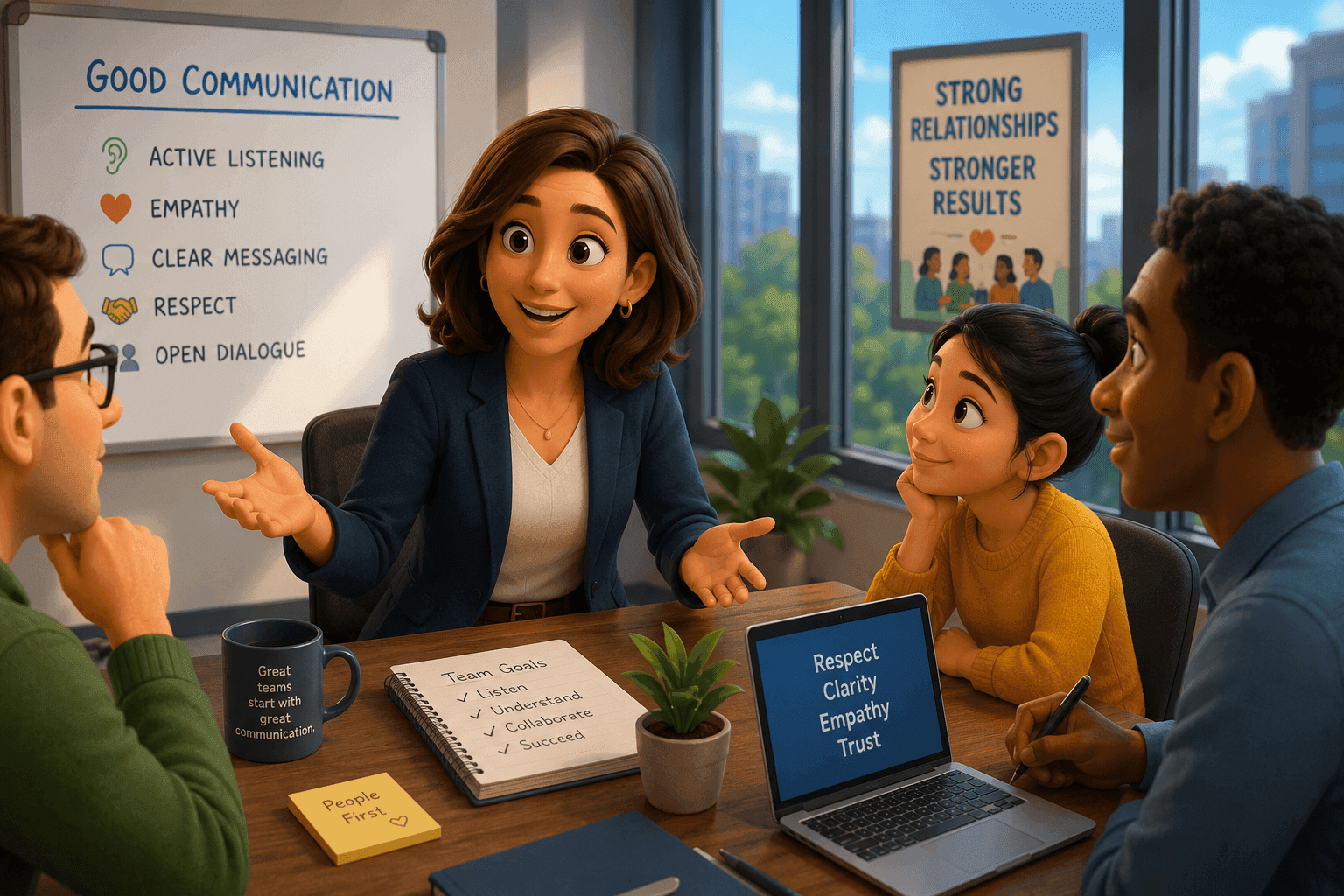
Effective interpersonal communication skills are the ability to communicate clearly through many forms in professional settings, including verbal communication and nonverbal cues. This includes everyday conversations, meetings, feedback sessions, and conflict discussions, where people use various forms of exchanging information and exchange ideas to shape workplace relationships and outcomes.
Communication Skills vs. Interpersonal Skills
Communication skills take many forms, and one of the core forms is verbal communication focused on delivering information clearly. These interactions involve exchanging information and help teams exchange ideas in meetings, feedback sessions, and conflict discussions. Interpersonal skills go further by influencing how people collaborate, build trust, and respond emotionally during interactions, which makes them important interpersonal skills for relationship building. Emotional intelligence and self-awareness are critical because communication is not only about what you say, but how you say it, and that is why interpersonal skills important to teamwork and trust.
Why They Matter at Work
Tone of voice, body language, eye contact, facial expressions, nonverbal cues, and communication style are important interpersonal skills that directly shape effective communication, collaboration, trust, emotional responses, and professional relationships at work. Poor interpersonal communication creates friction faster than most companies realize, while emotional intelligence and self-awareness support relationship building and more successful relationships.
Why Are Interpersonal Communication Skills Important in the Workplace?
Strong workplace communication is often the difference between high-performing teams and constant workplace friction, because communication in the workplace depends on good interpersonal skills that support effective communication at work and shape professional relationships and more successful relationships across teams.
Communication Directly Impacts Team Performance
Strong interpersonal skills improve teamwork, alignment, and shared goals. In communication in the workplace, good interpersonal skills often mark the difference between strong teams and friction. In professional settings, poor communication creates delays, misunderstandings, and workplace friction that slow decision-making, derail business goals, and weaken effective collaboration. Effective communication skills also depend on clear communication, attention to important details, and knowing when face to face meetings help provide feedback, avoid distractions, and strengthen problem solving skills.
Better Communication Builds Stronger Work Relationships
Open communication helps team members solve problems faster and navigate difficult conversations more effectively. Whether giving constructive feedback, resolving tension between coworkers, or managing communication between senior and junior employees, strong interpersonal communication supports effective collaboration, keeps business goals on track, and limits delays and productivity loss. Poor communication costs U.S. businesses an estimated $1.2 trillion annually. Effective communication skills include clear communication, the ability to provide feedback, and attention to important details during teamwork and meetings. Teams also work better when they avoid distractions and choose the right channel, including face to face meetings when clarity matters. These habits strengthen professional relationships, support problem solving skills, and build positive working relationships rooted in trust. They also help employees provide constructive feedback in ways that build stronger working relationships, and stronger communication can increase employee satisfaction by 20%.
Modern Workplaces Demand Strong Interpersonal Skills
The benefits of interpersonal communication are even more visible in leadership, customer-facing roles, and remote teams, where open communication supports stronger working relationships and positive working relationships. Employees who communicate effectively are better at conflict resolution, collaboration, and maintaining good relationships under pressure, especially as social skills are tested by remote work and artificial intelligence in daily workflows. That is exactly why interpersonal skills are important at work today: they support career success, belong in professional development, and give people practical ways to improve interpersonal skills and improve interpersonal communication skills, including when teams provide constructive feedback focused on specific behaviors rather than personal traits, which helps build healthier professional relationships and trust.
The 7 Most Important Interpersonal Communication Skills in the Workplace
The strongest professionals are not just technically skilled. In modern teams, remote work and artificial intelligence have made human social skills even more valuable. They also know how to communicate clearly under pressure in practical ways that help improve interpersonal communication skills at work and support ongoing professional development for long-term career success.
1. Active Listening
Most employees confuse hearing with active listening. The following sections cover practical ways to communicate clearly under pressure. Active listening requires full attention, emotional awareness, and genuine effort to understand the speaker's concerns.
In workplace conversations, many managers jump straight into problem-solving instead of listening actively. An employee may be expressing burnout or frustration and sharing emotions verbally, but the manager focuses only on fixing the task instead of hearing the important details. The result is often disengagement rather than support.
An active listener pays attention without interrupting, observes nonverbal cues, and asks follow-up questions for clarity. They also reflect back what they heard and provide feedback so the speaker knows they were understood. That skill matters more than companies realize. Around 85% of employees feel more valued when leaders practice active listening, yet only 2% of people have truly mastered it.
2. Emotional Intelligence and Self Awareness
Technical skills may get employees hired, but emotional intelligence often determines who becomes trusted, respected, and promotable. Around 90% of top performers have high EQ, while 71% of employers now value it more than IQ in professional environments. An active listener gives full attention, checks understanding, and helps build stronger working relationships.
Self-awareness helps employees manage their emotions and avoid reactive communication during stressful conversations. This becomes especially important during feedback discussions, leadership communication, and high-pressure meetings where frustration, anxiety, and emotions verbally expressed can quickly shift the emotional climate and, when handled well, avoid conflict.
Strong communicators recognize those emotional shifts early and respond with clarity instead of defensiveness. They listen by paraphrasing key points, confirming important details, and using that understanding to provide feedback more effectively when resolving conflicts. Leaders who lack emotional intelligence often create workplace tension through poor tone, timing, and emotional reactions.
3. Nonverbal Communication
Many workplace communication problems are caused less by words and more by nonverbal communication. Employees often communicate more through body language, tone of voice, facial expressions, eye contact, posture, and other nonverbal signals than through actual speech.
A manager saying “good job” with an irritated tone or distracted posture sends mixed signals that reduce trust and credibility. When verbal and nonverbal communication do not match, employees usually believe the nonverbal cues first.
Strong communicators understand that emotional consistency and self-awareness shape workplace relationships, and that emotional control helps employees avoid conflict during stressful conversations. This becomes even more important in leadership communication and remote work environments, where misunderstandings can occur more quickly. Professionals who manage their presence well create more openness, confidence, and psychological safety within teams, helping with resolving conflicts and building stronger working relationships.
4. Conflict Resolution
Most workplace conflicts begin as small misunderstandings, unclear expectations, or unresolved frustrations that employees avoid discussing until tension escalates. One of the biggest communication mistakes in professional environments is confusing conflict avoidance with professionalism.
Strong interpersonal communication skills help employees address issues early through emotional control and constructive disagreement, while nonverbal signals like body language, tone, and posture shape trust and credibility. Healthy conflict is not about winning arguments. It is about problem-solving while maintaining professionalism under pressure in a collaborative work environment.
This is where negotiation skills matter. High-performing teams challenge ideas without attacking people, clarify expectations, and focus on shared goals to support effective collaboration instead of personal frustration. Employees who can navigate tension professionally are often trusted with leadership, collaboration, and higher-stakes responsibilities.
5. Assertiveness
Many employees mistake assertiveness for aggression, when it actually means communicating clearly, confidently, and respectfully. Strong assertive communication helps employees express ideas, set boundaries, and give direct feedback without creating unnecessary tension.
Strong conflict resolution skills can reduce workplace turnover by 25%.
Despite this, assertiveness remains uncommon in professional environments. Around 88% of people believe they are assertive at work, yet 55% admit they have missed career opportunities because they failed to speak up.
This often appears during meetings where employees stay silent despite having valuable insights or concerns. Over time, passive communication affects visibility, leadership perception, and decision-making influence.
In high-pressure workplaces, unclear communication creates more bottlenecks than disagreement. Teams move faster when expectations and concerns are communicated directly through clear communication. Addressing issues early also supports a more collaborative work environment and improves effective collaboration.
6. Empathy
Empathy is often misunderstood as simply being nice at work. In reality, it is the ability to understand the perspectives, concerns, and emotional state of team members without immediately judging or dismissing them, while assertiveness is a form of clear communication that is confident and respectful.
In professional environments, empathy strengthens interpersonal relationships because employees feel heard, respected, and understood. That directly improves employee trust, engagement, collaboration across teams, and positive working relationships.
This becomes especially important in leadership and management roles. Employees rarely disengage because of workload alone. More often, they disengage because they feel ignored or misunderstood by leadership.
Strong communicators balance empathy with accountability. They can deliver direct feedback, manage conflict, and maintain professionalism while still recognizing the human side of workplace communication.
7. Adaptability and Communication Flexibility
One communication style does not work for every workplace situation. Strong interpersonal communication requires adaptability, especially in remote teams, cross-functional collaboration, and multigenerational work environments.
Professionals who communicate effectively know how to adjust their communication style based on their audience. The way someone speaks with executives, peers, clients, or new hires should not sound exactly the same.
This also applies to technical language. Overcomplicated communication often creates confusion instead of credibility. Strong communicators simplify complex ideas without sounding condescending.
Communication flexibility has become even more important with remote work, where tone and clarity are easier to misinterpret. Employees who adapt quickly build stronger relationships, reduce misunderstandings, and collaborate more effectively across teams.
Why Traditional Soft-Skills Training Often Fails
Many companies still rely on one-time workshops to solve long-term communication challenges. The problem is that interpersonal communication skills improve through repetition, not passive learning.
* No real practice — Employees quickly forget communication techniques without realistic application in professional environments.
* Conflict avoidance culture — Many teams avoid difficult conversations instead of resolving issues directly, weakening collaborative work environments over time.
* Managers feel unprepared — Around 70% of managers report feeling unprepared for high-pressure discussions and emotionally charged conversations.
* Fear blocks communication — Nearly 70% of employees admit to avoiding important conversations due to anxiety or fear of conflict.
Soft-skills training fails when companies treat communication as knowledge instead of a skill that requires continuous practice.
How Georgia Helps Teams Improve Workplace Communication
Georgia by KB&G Innovation Studio helps employees strengthen interpersonal communication skills through AI-powered role-play scenarios designed for real workplace situations. Instead of generic theory-based learning, Georgia focuses on practical communication training through repetition, feedback, and realistic conversations.
Employees can practice conflict resolution, assertiveness, empathy, negotiation skills, and emotionally charged discussions in a safe environment without real-world consequences. Georgia also helps teams improve cross-generational communication, manage tension between coworkers, rehearse feedback conversations, and build confidence before leadership discussions or job interviews.
To improve workplace communication through practical soft-skills training, book a call with KB&G Consulting.
Final Thoughts
Interpersonal communication skills are no longer optional in modern workplaces. Strong interpersonal skills improve teamwork, leadership, conflict resolution, and overall workplace culture, especially in high-pressure professional environments.
Most communication problems do not come from a lack of knowledge. They come from a lack of practice during difficult, emotionally charged conversations. Companies that invest in communication development build stronger teams, healthier work relationships, and more confident leaders.
To help employees practice real workplace conversations, explore how Georgia delivers AI-powered role-play training designed for modern teams.