What Is Near Miss Reporting in Mining?
Near miss reporting in mining is the systematic capture and analysis of unplanned events that did not cause injury, illness, or damage but had realistic potential to do so. It matters because near misses are one of the strongest leading indicators for preventing serious injuries and fatalities (SIFs), they support the incident-reporting expectations of standards like ISO 45001 and the hazard focus of regulators such as MSHA, and they strengthen the safety culture that keeps people alive in high-energy environments.
This article focuses on surface and underground mining and quarrying operations: the day-to-day operational near misses around powered haulage, mobile plant interactions, ground control, and maintenance, rather than high-level corporate compliance frameworks or academic research design. It is written for safety managers, mine managers, operations superintendents, and innovation or digital transformation leads who are responsible for safety programs and the technology choices that support them.
If you recognise any of these pain points, this article is for you: chronic under-reporting, hearing about close calls only when they become serious incidents, paperwork fatigue among crews, production pressure crowding out safety processes, or the frustration of seeing the same hazards reappear without visible fixes.
The direct answer: A strong near miss reporting culture is essential for effective safety management in high-hazard industries like mining. It requires a blame-free environment where workers report hazards without fear, low-friction ways for frontline crews to capture basic information, visible follow-through that proves reports lead to change, and better use of existing data sources, especially two-way radio traffic, where many near misses are already spoken aloud but never logged.
By the end of this article, you will have:
A clear definition of near misses in mining and how they differ from incidents, hazards, and unsafe conditions.
An understanding of why near miss reporting often fails in mining and what that costs in terms of SIF exposure.
A practical framework to design or refine a near miss reporting process that crews actually use.
Ideas for combining human reporting and industrial AI (including voice-to-data from radio) to catch more close calls without adding admin.
Practical next steps to strengthen reporting culture in the next 90 days.
Understanding Near Misses in Mining
A near miss is an unplanned event that did not result in injury or damage but had the potential to do so. In mining, these events cluster around mobile equipment interactions, energy isolation failures, ground control issues, explosives handling deviations, and contractor interfaces. Near misses can be seen as free lessons that allow operations to learn without real-world consequences, but only if they are captured, understood, and acted on.
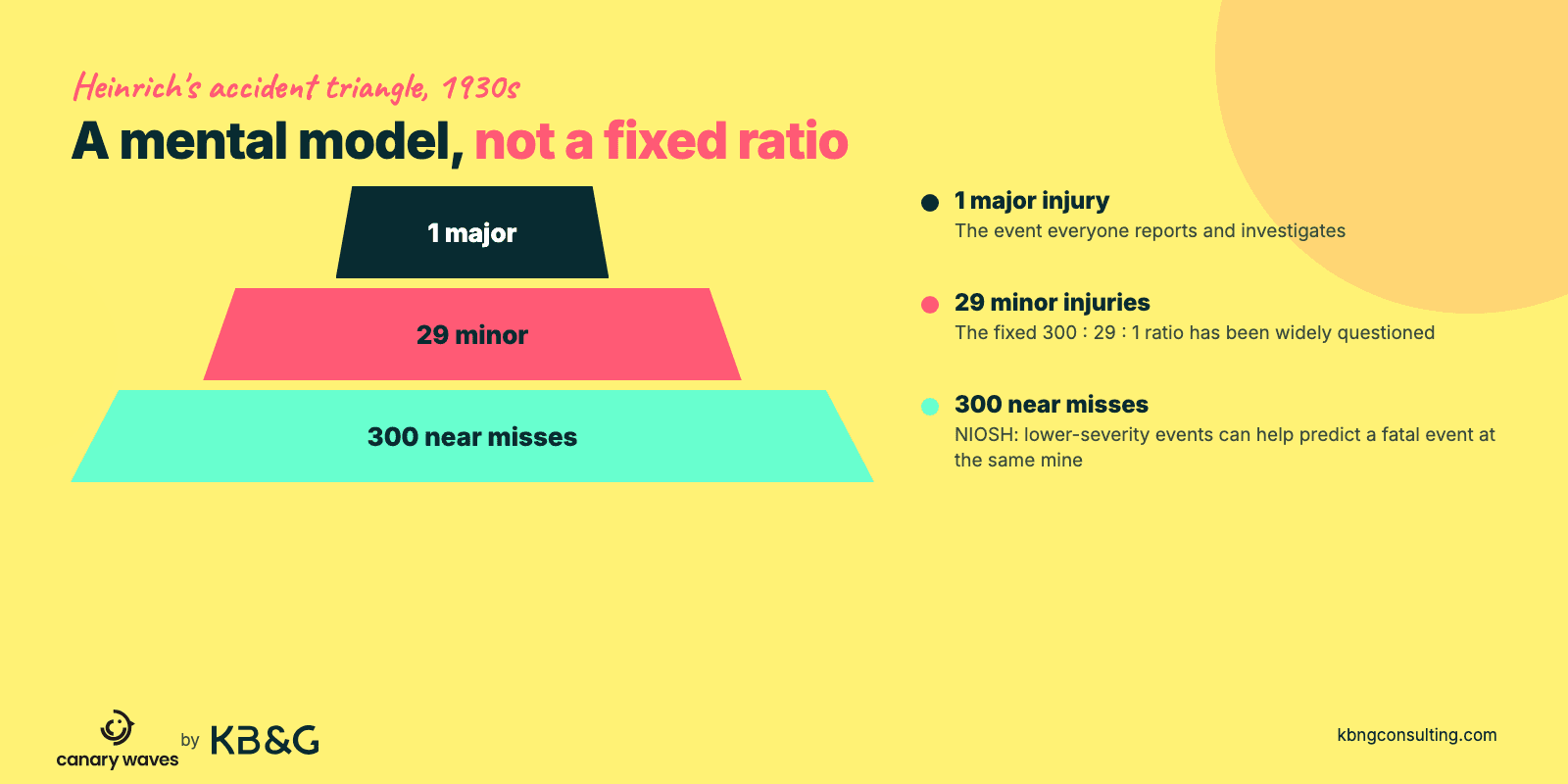
Heinrich's safety pyramid (also called the accident triangle) is a model, not a law. In the 1930s Herbert Heinrich proposed that serious injuries sit on top of a much larger base of minor injuries and near misses, in a fixed ratio of 300 near misses to 29 minor injuries to 1 major injury. That fixed ratio has been widely questioned. A NIOSH study using MSHA records from 27,446 mining establishments between 2000 and 2012 found that lower-severity events within a mine can help predict a future fatal event at the same mine, but that the triangle shape held only for some ways of defining severity. The practical takeaway for mining: treat the pyramid as a useful mental model, and treat near miss data as a leading indicator worth analysing, especially near misses with serious-injury or fatality potential.
Without shared definitions and consistent categories, "near miss" means different things to different people on site. That inconsistency undermines data quality, weakens trend analysis, and makes cross-site benchmarking unreliable. Getting the definitions right is not academic: it directly affects whether your reporting system produces actionable intelligence or noise.
Defining Near Miss, Incident, and Hazard for Mining Sites
Before asking anyone to report, everyone on site needs to understand what they are reporting. The following definitions, grounded in common occupational safety usage, provide a practical starting point for mining operations:
Near miss: An unplanned event at a mine or quarry that did not result in injury, illness, or damage but had realistic potential to do so. Example: a haul truck's brakes fade on a loaded ramp but the operator brings it to a stop before collision.
Incident: An event that did result in minor injuries, equipment failure, property damage, or production loss, for example tyre damage from a berm contact, a bent handrail, or a first aid case.
Accident / serious incident: An event causing serious injury, fatality, or significant damage, typically reportable to MSHA or the relevant national regulator.
Hazard / unsafe condition: An underlying condition or exposure with potential to cause harm that exists independently of a specific event: an unguarded nip point, an unmaintained berm, poor lighting in a decline, or inadequate personal protective equipment.
To make these distinctions concrete, consider three related scenarios: a missing wheel chock on a light vehicle parked on a grade is a hazard. If that vehicle rolls three metres before the driver jumps in and stops it, that is a near miss. If it rolls into a parked water cart and causes property damage, that is an incident. The circumstances surrounding each share common contributing factors, but the outcomes differ by degrees of luck and timing.
A practical rule of thumb that crews can use: "If you would feel different about this event if luck had gone the other way, it's a near miss. Report it."
Why Near Misses Matter More in High‑Hazard Mining Environments
In mining, the energy involved in everyday work is enormous. Highwall collapses, ultra-class haul trucks, explosives, conveyors, and heavy mobile plant mean that many near misses sit only one or two failed controls away from a fatality. The safety pyramid model suggests that behind every major incident sit many near misses that could have been addressed, and in mining those near misses often involve life-threatening energy levels.
In a recent informational alert, MSHA identified fall protection, powered haulage, machinery, and roof and rib control as areas where the mining industry should increase its focus. Near miss data in these categories exposes weak controls before they fail catastrophically, making it possible to prevent future incidents rather than investigate them after the fact.
Near miss events also reveal where "work as done" diverges from "work as imagined" in the safety management system. They surface gaps in supervision, procedure design, contractor management, and equipment maintenance that formal audits rarely catch. And because no injury has occurred, they provide a safer space to learn: less legal exposure, no case management, and more room for honest conversation about what went wrong.
Despite this value, near miss reporting in mining is often patchy and biased. Understanding why requires looking at the human and cultural barriers that make under-reporting a rational choice for many workers.
How Near Miss Reporting Currently Works on Many Mine Sites
On most mining operations, the near miss reporting workflow looks solid on paper: cards or digital forms, supervisor review, safety department coding, and periodic trend reports. In practice, many sites see low volumes, narrow types of events reported, spikes after a serious incident followed by a rapid drop-off, and data that tells leadership more about reporting habits than about actual risk. Understanding the current state honestly is the first step toward designing improvements that will hold.
Typical Near Miss Reporting Workflows in Mining and Quarrying
A common workflow across mining operations follows this pattern:
A frontline worker notices a close call and either discusses it on the radio or mentions it to a supervisor at shift change.
The worker or supervisor fills out a near miss report form (paper card or app) capturing date, time, pit or plant area, activity, a short description, and any immediate action taken.
The safety department codes the event by hazard type, risk rating, and possible root causes, entering it into a database, spreadsheet, or HSE platform.
Monthly or quarterly reviews identify top hazards and recommend corrective actions, which may or may not be implemented before the next review.
This workflow varies significantly. Contractor-operated sites may use different systems from owner-operators. Underground operations face connectivity challenges that surface quarries do not. Small quarries may rely entirely on paper, while major mining houses run integrated digital platforms. But the friction points are remarkably consistent: language barriers, shift change timing, lack of terminals underground, fatigue at the end of 12-hour shifts, and the sheer distance between where close calls happen and where reporting tools sit.
What "Good" Near Miss Reporting Looks Like in a Mining Context
Effective near miss reporting systems share several characteristics:
High volume of reports relative to headcount, particularly from high-risk areas like ramps, dumps, loading faces, and maintenance workshops.
Diverse inputs from operators, maintenance crews, contractors, supervisors, and technical services, across day and night shifts, surface and underground.
Consistent classification using a simple risk ranking aligned to the site's existing risk assessment tools, with SIF-potential tagging for near misses that could have resulted in fatal or life-changing outcomes.
Clear linkage from each near miss report to a visible corrective action, communicated back to the crew that reported it.
Integration with the broader health and safety management system and ISO 45001 processes, so near miss data feeds risk registers, hazard reviews, and decision making.
Good systems also combine formal reports with informal channels: pre-start talks, radio calls, supervisor debriefs, and safety representative observations. Regular analysis across all of these can highlight recurring patterns that formal reports alone would miss.
Most sites are reasonably strong on formal structure but weak on culture and friction, and that gap is where most near miss information falls through.
From Forms to Intelligence: Using Near Miss Data as a Leading Indicator
Near miss data becomes truly valuable when it moves beyond simple counts into trend analysis by location, activity, and equipment type. For example, tracking near misses by specific pit benches, dumps, crusher areas, or shop locations reveals concentrations of risk that aggregate numbers hide. Separating SIF-potential near misses from low-consequence events allows safety teams to focus resources where they matter most.
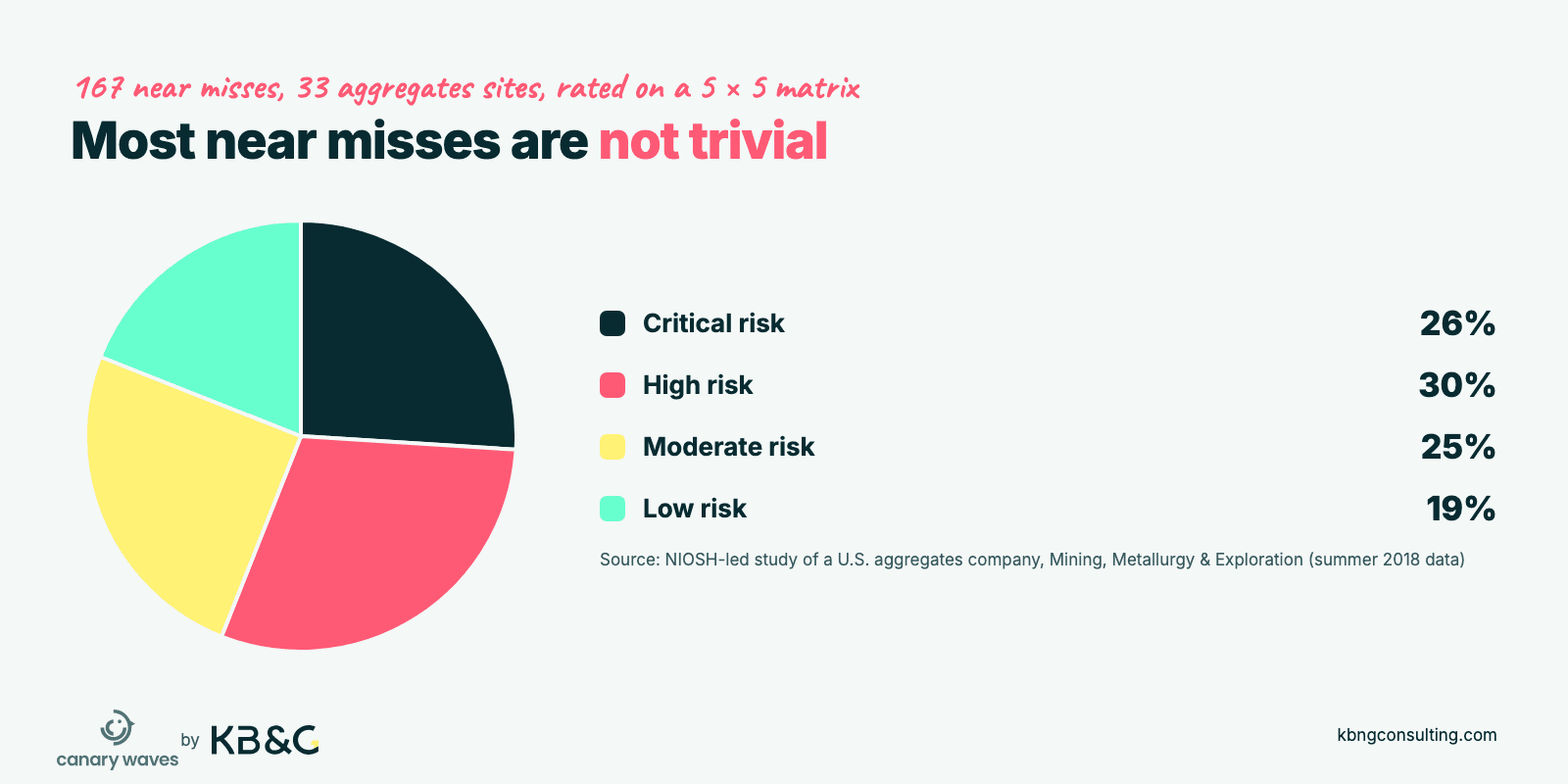
A NIOSH-led study of a U.S. aggregates company, published in Mining, Metallurgy & Exploration, looked at 249 near misses reported across 33 locations over one quarter in summer 2018. After cleaning the data, researchers rated the remaining 167 near misses with a 5 × 5 risk matrix: 26% were critical risk, 30% high, 25% moderate, and 19% low. That distribution challenges the assumption that most near misses are trivial, and some of the patterns only became visible after researchers re-sorted reports that had been filed under a vague "other" category.
Cross-checking near miss patterns with lagging indicators like MSHA reportables and lost-time injuries can confirm whether the near miss program is capturing the right signals. But meaningful analysis depends on capturing more than a small, biased subset of events, which brings us to the human and cultural barriers that keep most near misses unreported.
Human and Cultural Barriers to Near Miss Reporting in Mining
Under-reporting is usually rational from the worker's perspective. Employees weigh the effort and perceived risk of filing a near miss report against the likelihood that anything will change. When past experience tells them that reporting leads to scrutiny rather than improvement, the calculation is simple: stay quiet and get on with the job.
Fear of Blame, Discipline, and Reputation Damage
Operators fear being labelled "unsafe" or having their competency questioned if they report their own close calls. Supervisors worry that near misses on their crew will make them appear to be weak leaders. Contractors fear losing work if they surface too many issues at a client's site.
Even when management commitment to a "no blame" policy exists on paper, crews watch what actually happens after reports are filed. If investigations feel like interrogations, if retraining is used as a soft punishment, or if people involved in reported near misses face increased scrutiny, the message is clear, regardless of what the posters say. A blame-free reporting culture encourages workers to report hazards without fear, but that culture has to be demonstrated consistently in practice, not just declared in policy.
In remote mining camps, social dynamics add another layer. Peer pressure not to be the one who creates "extra paperwork," jokes about "paperwork heroes," and the unspoken code of not reporting a mate's mistake all suppress reporting. These are human factors that no form design can overcome without deliberate cultural intervention.
Production Pressure and "Just Get It Done" Mindset
Shift targets, dispatch screens, digger and truck productivity KPIs, and cycle time metrics create constant pressure to keep moving. When a near miss occurs during a busy shift, the calculus is immediate: stopping to report means falling behind, and falling behind means explaining the gap at shift end.
Typical scenarios play out every day: a close pass between a haul truck and a light vehicle at shift change, quickly resolved and forgotten because the crew is behind on the plan. A near miss during breakdown recovery at the plant, where everyone is focused on getting back online. In each case, the event is noticed, sometimes discussed, but never logged. The message crews hear, despite official safety messaging, is "safety first, but don't miss your tonnes," which translates in practice to "tonnes first, paperwork if you have time."
Supervisors often feel torn. They personally value safety but are measured on tonnes, cycle times, and downtime. Until production KPIs and safety practices carry genuinely equal weight in performance conversations, production pressure will continue to suppress reporting.
Reporting Friction: Complexity, Access, and Effort
Concrete friction points suppress near miss reporting across mining operations:
Paper forms kept in crib rooms while work happens in pits, declines, and workshops hundreds of metres away.
Digital systems that only run on office PCs, or browser-based tools that are slow on mine networks and unusable underground.
Long near miss report forms asking for root cause analysis and corrective actions that workers don't feel qualified (or motivated) to define after a 12-hour shift.
Shift work patterns, fatigue, and limited English literacy among some crews further reduce the likelihood of voluntary reporting. Any extra step beyond the immediate work context (walking back to a computer, navigating a login screen, completing a lengthy form) drastically lowers reporting volumes. In the NIOSH aggregates study, researchers had to re-sort reports filed under "other" before they could use them, a sign that the forms were not capturing what crews actually meant.
Normalisation of Risk and "Near Miss Fatigue"
When the same close call happens repeatedly without consequence, it stops feeling like a close call. This normalisation of deviance is well documented in high-hazard industries and especially present in mining, where certain risks become part of the landscape.
Regular tyre contacts with berms on a certain ramp that no one logs because "that's just how that ramp is." Frequent rocks sliding off haul roads or highwalls treated as normal. Poor housekeeping can lead to slip, trip, and fall hazards, but when the same conditions persist for months without incident, crews mentally downgrade the risk.
Near miss fatigue interacts with experience in counterintuitive ways: more experienced workers sometimes take more risks precisely because they have navigated those same hazards many times before without harm. This makes their near miss experiences feel routine rather than reportable.
To design better systems, we need to recognise that crews already talk about close calls constantly, just not in forms. The next section explores where that spoken information lives today.
Where Near Misses Already Live: Radios, Pre‑starts, and Informal Conversations
Most near miss information already exists in spoken form: over two-way radio, in crib rooms during pre-starts, in post-incident debriefs, and in informal conversations in the pit. The goal is not to ask crews to invent new behaviours but to capture and structure what they already say out loud. Near miss reporting turns a reactive safety program into a proactive one, but only when it taps into the channels where risk information naturally flows.
Two‑Way Radio Traffic as a Near Miss Goldmine
Mining radio channels carry near miss information every shift. Exchanges like these happen daily on most operations:
"Truck 23, that was too close on that last pass, mate."
"Light vehicle on ramp 4, watch your speed coming down. Nearly missed him."
"Loader 5, rock overhanging above your bucket. Back out and we'll scale it."
These radio calls reflect real near miss events across multiple categories: proximity events in powered haulage and loading, blind declines and intersections underground, ground control warnings and rockfall close calls, and maintenance or lockout/tagout deviations spotted by others. They represent the living, unfiltered record of how crews experience risk in real time.
Yet these events rarely make it into formal near miss databases. The result is a persistent blind spot between how crews experience risk on the ground and what leadership sees in safety reports. Near misses can serve as early warning signals, but only if someone captures them.
Pre‑start Meetings, Toolbox Talks, and Safety Shares
Operators routinely share "war stories" of yesterday's close calls during daily pre-starts or weekly safety meetings. These are powerful learning moments: specific, vivid, and immediately relevant to the crew's work.
Current practice varies. Some supervisors note these stories on whiteboards or in shift logs, but they are rarely structured, coded, or entered as data. The learning stays local and doesn't travel between crews, shifts, or sites. Systematically capturing these shares (through a quick capture app, a photo of the whiteboard, or a facilitator logging key themes) would turn anecdotal knowledge into trend data without requiring additional effort from crews.
Supervisors and Dispatch: The Hidden Safety Observers
Supervisors, dispatchers, and control room operators see patterns in close calls across an entire pit or plant that no individual operator can observe. Dispatch sees frequent last-minute reroutes to avoid congestion at a specific dump. Supervisors find themselves repeatedly reminding crews to slow down on particular corners or to maintain berm height at certain locations.
These roles are ideally placed to identify hazards and log observations as near misses, but they often lack a simple, quick way to do so within their existing workflow. Their observations are often the highest-value near miss data on site because they reflect patterns, not just single events.
Designing a Near Miss Reporting System That Works for Mining Operations
Technology alone does not solve under-reporting. The system must fit the rhythms of mining work, handle remote and harsh environments, and respect production realities. This section provides a practical framework combining process, culture, and tools, designed to be adapted to specific site conditions rather than imposed as a rigid template.
Step‑by‑Step: Building or Refreshing Your Near Miss Reporting Process
Clarify definitions and scope. Align leadership, frontline crews, and contractor representatives on what counts as a near miss. Use concrete, mining-specific examples in training materials (haul truck proximity events, ground control close calls, energy isolation deviations) so people can recognise reportable events in their own work.
Map current information flows. Document where near miss information is already discussed: radio channels, dispatch logs, pre-starts, shift handovers, contractor meetings. Identify where it is currently lost (spoken but not written up) and where simple capture opportunities exist.
Simplify the front-end. Redesign the near miss report form to capture only essentials from frontline crews: what happened, where, when, who could have been harmed, and what immediate controls were taken. Leave coding, root causes, and detailed analysis to safety staff. Fewer mandatory fields mean less friction and more, better reports.
Embed reporting into existing routines. Add structured prompts into pre-starts ("Any close calls yesterday?"), shift handovers, and supervisor field tours. This normalises reporting as part of daily work rather than an additional administrative task.
Prioritise SIF-potential near misses. Use a simple risk matrix to flag near misses that could have led to a fatality or life-changing injury, ensuring rapid follow-up and resource allocation where it matters most.
Close the loop visibly. Communicate back to crews how near miss reports have led to engineering changes, traffic redesigns, or procedure updates. Swift corrective actions and visible outcomes build trust and sustain reporting volumes.
Review and iterate quarterly. Use near miss data and worker feedback to refine the process: remove friction, adjust categories, update communication channels, and improve the feedback loop.
Aligning Near Miss Reporting with Site Risk Assessment Practices
Near miss reporting should integrate with tools crews already use: Job Safety Analyses (JSAs), Take 5s, site-wide risk registers, and bow-tie analyses. Alignment means that near miss categories map to the same hazard taxonomy used in risk assessment, so data flows naturally between systems.
A classification scheme specific to mining hazards (powered haulage, falls of ground, confined spaces, lifting operations, explosives, maintenance, and environmental conditions) keeps reports relevant and analysable. Near misses should be analysed with the same risk management frameworks applied to other health and safety decisions.
Comparison: Simple vs. Detailed Near Miss Classification in Mining
The choice between a simple and a detailed classification system involves real trade-offs. The following comparison can help site managers and safety teams make a practical decision:
Criterion | Simple 5–7 Category System | Detailed 15–20 Category System |
|---|---|---|
Ease of use for frontline crews | High: fewer choices, faster selection | Lower: more options can cause hesitation |
Data richness for analysis | Moderate: shows broad trends | High: enables granular pattern detection |
Training and rollout effort | Low: quick to explain, easy to remember | Higher: requires more training and reference aids |
Consistency between sites | Easier to maintain across a multi-operation group | Harder: interpretation varies without governance |
Most mining operations benefit from starting simple to drive adoption, then gradually adding granularity where analysis shows it would be useful. Consistency matters more than perfection for trending and cross-site learning. The NIOSH aggregates study illustrates this: researchers had to reclassify near misses that had been placed into a vague "other" category before the data yielded useful insights, a problem that a well-designed simple taxonomy can prevent.
Once the process is in place, sustaining near miss reporting depends on leadership behaviour and speak-up culture far more than on forms and systems.
Leadership, Culture, and Speak‑Up Behaviour on Site
Near miss reporting reflects overall safety culture, not just the safety department's processes. Workers don't report to systems; they report to people. The site manager, supervisors, and frontline leaders set the real tone for whether near miss reporting is valued or viewed as a bureaucratic exercise.
The Role of Supervisors and Frontline Leaders
Supervisors are the interpretive layer between corporate messages and crew reality. Practical behaviours that drive reporting include:
Opening every pre-start with a genuine question about recent close calls and thanking those who speak up, publicly and sincerely.
Sharing their own mistakes and near miss experiences to normalise reporting ("I had a close one yesterday on the ramp. Here's what happened").
Protecting time for reporting even when behind schedule: "We're going to log this properly; we'll manage the tonnes afterwards."
Targeted training for supervisors in coaching, non-punitive feedback, and psychological safety has a direct impact on reporting. When supervisors respond well to the first few reports, the crew learns that speaking up is safe. When they respond poorly, even once, the crew learns the opposite just as fast.
Moving from Blame to Learning: Just Culture Principles for Mining
A "just culture" differentiates between human error, at-risk behaviour, and reckless behaviour, and responds proportionally:
Human error: Misjudging distance in low visibility at shift change. Response: system improvement, no blame.
At-risk behaviour: Regular short-cuts around lockout/tagout under time pressure. Response: coaching, understanding contributing factors, addressing system pressures.
Reckless behaviour: Intentional disabling of safety interlocks. Response: accountability, disciplinary process.
This framework encourages reporting of honest mistakes and system weaknesses while still holding people accountable for unsafe acts that are genuinely reckless. Addressing near misses before they escalate into accidents requires employees to trust that honest reports will be treated fairly.
Policies must be matched by consistent decisions in disciplinary cases. If one crew member is punished for a reported near miss while another's unreported incident goes unnoticed, credibility is destroyed.
Recognising and Rewarding Near Miss Reporting Without Gaming the System
Effective recognition options include:
Highlighting impactful near miss reports in site communications (newsletters, town halls, digital boards) with credit to the reporting crew.
Non-financial recognition such as involvement in improvement projects or extra training opportunities.
Team-level incentives that reward quality and learning impact rather than raw volume.
Unintended consequences to watch for: incentives that push people to log trivial events to hit targets, or league tables that create competition rather than learning. Periodic audits or spot-checks help ensure reports remain meaningful and aligned with risk priorities.
Using Technology and Data to Enhance Near Miss Reporting in Mining
Technology should lower reporting friction and capture existing signals, like voice and video, rather than replace human judgment. Mining environments impose real constraints: limited connectivity, dust, noise, PPE requirements, and contractor diversity. Any tool that ignores these realities will fail on site regardless of how well it works in a demo.
Digital Near Miss Tools: Forms, Apps, and Integrated HSE Systems
Common digital options for mining operations include:
HSE modules within existing ERP or mining fleet management systems.
Standalone safety apps for near miss and hazard reporting with offline capability for remote pits and underground headings.
Tablets or kiosks in crib rooms and workshops for quick input at natural pause points.
Key requirements for mining: offline functionality with later sync, minimal mandatory fields for frontline staff, the ability to attach photos or short voice notes, and simple dashboards for supervisors and safety teams. Effective near miss systems include prompt investigations and corrective actions, so the technology must support triage and follow-up workflows, not just data capture.
Involving operators, maintainers, and contractors in selecting and testing tools before full rollout is essential. Tools only improve reporting if they fit the people who need to use them.
Voice‑to‑Data and Computer Vision: Capturing Near Misses Passively
Industrial AI offers the possibility of surfacing near misses without adding work for frontline crews:
Voice-to-data: Converting radio or voice communications into searchable text, then scanning for patterns in near miss and proximity language. This captures events that are spoken but never formally logged.
Computer vision: Monitoring haul roads, intersections, and loading areas for unsafe proximity, speeding, or missing PPE, providing objective data independent of human reporting.
The advantages are significant: no extra steps for operators when AI uses existing radios and cameras, the ability to detect high-risk patterns over time even when no one files a near miss report, and more objective data to support conversations with crews and contractors about risk.
These systems should support, not replace, human reporting. Passive capture technologies must be introduced transparently to maintain trust. Privacy, data ownership, and consent are real concerns that need to be addressed upfront, particularly in unionised workplaces.
Common Challenges in Mining Near Miss Programs and Practical Solutions
Even well-designed near miss programs encounter recurring failure modes. The following challenges appear consistently across mining operations of all sizes, along with practical mitigation strategies.
Problem 1: Low Reporting Volumes from Operators and Contractors
The situation: Only a handful of near misses per month, often logged by supervisors or safety staff rather than frontline employees.
Solutions:
Reset expectations publicly: high volumes of near miss reports are a sign of a healthy reporting culture, not a "bad" site. Leadership should communicate this clearly and repeatedly.
Run short, scenario-based training that helps crews recognise what counts as a reportable event in their specific work, using real examples from the operation.
Make first reports as easy as possible: QR codes at fuel bays, short paper forms in crib rooms, or verbal capture via supervisors who log the essential details.
Problem 2: Lots of Reports, Little Action, and Crews Lose Faith
The situation: Near miss data accumulates, but workers see few tangible changes and start disengaging. Crews care about visible results, not compliance statistics.
Solutions:
Introduce a transparent triage process that prioritises SIF-potential near misses and communicates decisions: "We did X," "We will do Y by this date," "We are not doing Z, and here's why."
Assign each significant near miss to a named leader with a due date for follow-up. Ownership drives action.
Regularly share "Before/After" examples where near miss reports resulted in changed road layouts, new berm standards, or redesigned tasks.
Problem 3: Data Is Too Messy to Analyse Across Sites
The situation: Inconsistent categories across sites, multiple platforms, contractor data silos, and vague descriptions that can't support trend analysis. In the NIOSH aggregates study, 167 of the 249 recorded near misses were usable after cleaning, and some required manual reclassification before the data yielded usable patterns.
Solutions:
Define a small, standard taxonomy of mining hazards and risk ratings that all sites use, even if front-end forms differ.
Centralise data into a single repository or BI tool for trend analysis across the group.
Use periodic cross-site reviews to compare patterns and share controls. For example, powered haulage near misses across several quarries may reveal a common road design issue.
Problem 4: Technology Fatigue and Tool Overload
The situation: Multiple apps, platforms, and forms have been introduced over time, creating confusion and resistance among crews who feel overwhelmed by competing systems.
Solutions:
Rationalise tools: where possible, integrate near miss reporting into platforms crews already use daily, such as dispatch systems, maintenance apps, or radios.
Involve crews in the selection and design of new tools. Run small, well-supported pilots instead of big-bang deployments.
Make it clear what is mandatory versus optional, and retire obsolete tools decisively.
With culture, process, and technology aligned, near miss reporting can meaningfully reduce harm and improve safety performance and operational discipline across mining operations.
Conclusion and Next Steps
Near miss reporting in mining is one of the most powerful leading indicators available for preventing workplace accidents, but only if crews feel safe to speak up, reporting is easy, and follow-through is visible. Many near misses are already present in daily work, in radio calls, pre-starts, and supervisor observations, yet they never reach formal safety management systems. By focusing on culture, friction reduction, and smarter use of existing data, mining operations can reduce their exposure to serious injuries and fatalities. But the system has to earn the trust of the people it depends on.
Concrete next steps for the next 90 days:
Run a short workshop with supervisors to align on near miss definitions and expectations, using real site examples and near miss data from your operation.
Audit where near miss information currently appears informally (radios, pre-starts, dispatch logs) and identify simple capture opportunities that don't add administrative burden.
Redesign the near miss report form or digital workflow to remove unnecessary fields and add SIF-potential tagging as a standard element.
Start a monthly "Near Miss to Change" spotlight, showcasing one report that led to a meaningful control improvement, making the feedback loop visible to all crews.
Explore passive data options like voice-to-data or computer vision at high-risk locations to capture near misses that are spoken but never formally reported.
If radio is where your close calls are already being said out loud, that is the gap Canary Waves by KB&G is built for. It runs passively on your existing two-way radio, with no new hardware and no change for crews, transcribes radio traffic tuned to site slang, and flags near-miss and proximity language, hazards, and protocol breaches so they can feed your near miss process. It has been proven in early MVP pilots on real mine sites.
Related topics worth exploring:
Serious Injury and Fatality (SIF) prevention strategies specific to the mining industry.
Integrating near miss reporting with behavioural safety observations for a more complete picture of site safety.
Using analytics to prioritise high-risk work fronts and tasks based on combined leading and lagging indicator data.