What Is Sales Training ROI?
Sales training ROI is the measurable commercial gain (higher win rates, stronger margins, shorter deal cycles, faster rep ramp) you get back for every dollar spent on training. You calculate sales training ROI by comparing baseline performance metrics against post-training results, then dividing the net financial benefit by the total training cost, including hidden costs like rep time out of selling.
This article is for you if you're a founder or early B2B leader who still sells yourself but is now trying to build and train a sales team. You need to justify every dollar in your training budget to your finance team, your board, or yourself, and right now most of what you've tried probably feels like expense, not investment. That's not surprising: workshops are forgotten within days, there's rarely a baseline to compare against, and nobody can point to what actually changed.
This piece focuses specifically on measuring and improving ROI for B2B sales training, not generic L&D programs or broad culture initiatives. By the end, you'll have:
A clear definition of sales training ROI in numbers your finance team will recognise
The specific metrics to baseline before training (win rates, average discounts, ramp time, cycle length)
An understanding of why the forgetting curve kills training ROI and why practice-based training beats one-off workshops
A simple step-by-step process to track ROI over 90–180 days
Practical ways to use AI role-play to make reinforcement and measurement easier
Understanding Sales Training ROI
Sales training ROI is a metric used to evaluate the financial return from a sales training program. It measures the monetary benefits of improved sales performance relative to the total cost of training. This is not "the team feels more confident" or "everyone liked the facilitator." It's commercial performance change (revenue growth, cost savings, productivity gains) linked directly to what you spent. It's usually expressed as a percentage or a ratio.
What "Return" Really Means In Sales Training
In B2B SaaS, AI products, and industrial tech, "return" means specific, trackable business outcomes: higher win rates on qualified deals, stronger margins because your reps hold price instead of discounting, shorter deal cycles that speed up cash flow, faster ramp time so new hires hit their targets sooner, and better renewal or upsell performance.
Here are concrete KPI examples you can pull from your CRM right now:
Opportunity-to-close win rate for new business, compared across equal periods before and after training
Average discount % on closed-won deals over a 90-day window: how steeply your reps are giving away margin
Median days from first qualified meeting to signed contract
Months to first quota hit for reps hired before vs. after the new training
These are better returns to track than attendance, trainer NPS, or number of slides consumed, because they map directly to cash, profitability, and growth. Engagement scores and course completion measure what you hope happens, not what did happen.
What "Investment" Includes (Beyond The Invoice)
The "investment" side of the equation isn't just the invoice from your trainer. Here's what you should actually count:
Direct fees: external trainer or platform subscription, travel for in-person sessions, training materials
Indirect time cost: number of reps × hours in training × average loaded hourly cost. Five reps out for two days is ten rep-days of lost selling
Preparation and management time: your time (or your sales manager's) designing, customising, and running follow-up sessions
The simple ROI formula in words: the financial value gained from better sales results, minus training costs, divided by total training cost. But this formula is useless without the right performance metrics and a clean before/after baseline, which is exactly what most companies skip.
Why Founders Struggle To See Sales Training ROI
Here's what typically happens. You've been selling on instinct and founder credibility. You hire two to five sales reps. They struggle. You buy a two-day generic sales workshop hoping it "professionalises" the team. A month later, you look at revenue and can't tell what, if anything, changed.
The problem is structural: no baseline metrics before training, no reinforcement after, and no clear connection between what was taught and what you're trying to fix. You might see revenue rise that quarter, but other things changed too: your product improved, the market shifted, you adjusted pricing. Without isolating variables, you can't attribute gains to training.
The training cost is obvious. The return isn't. Without sharp measurement, you're budgeting an expense, not making an investment with a predictable payoff.
The Mechanics of Sales Training ROI: What To Measure
Let's walk through the specific ROI metrics that matter for B2B founders. You can start with data you already have in your CRM and finance tools, even if your reporting is messy. Baseline metrics establish the pre-training benchmark, and that's the foundation of everything here.
Core Outcome Metrics: Win Rate, Margin, Cycle Length, Ramp Time
These are the four metrics that most directly show whether your training is producing real ROI:
Win rate: closed-won ÷ total qualified opportunities in a defined period. A move from 18% to 24% is a 33% relative increase in deals closed from the same pipeline.
Discounting / margin held: average discount % per deal, or gross margin per deal by rep. If average discounts fall from 15% to 10%, that's revenue you keep on every single deal.
Deal cycle length: days from first qualified conversation to signed contract. Shorter cycles mean faster revenue recognition and better cash flow.
Ramp time: months from start date until a new rep reaches full quota. Shaving off even one month is substantial in both cost and revenue pulled forward.
A simple worked example: if your win rate is 20%, your average deal is $50,000, and your reps work 100 qualified opportunities per year, lifting win rate to 25% means five more closed deals, or $250,000 in additional revenue. If the total training cost was $50,000 (including hidden costs), that's a 5:1 return on revenue alone, before any margin improvement.
Leading Indicators: Behaviours That Predict ROI
Outcome metrics are lagging indicators; they can take 60–180 days to move, especially in longer B2B sales cycles. You can't wait that long to know if training is working. Leading indicators give you early signals.
Practical leading indicators you can track weekly after training:
Discovery quality: percentage of discovery calls with a written agenda and a recap email
Pipeline discipline: percentage of opportunities with a defined next step and date in the CRM
Multi-threading: number of deals with 2+ stakeholders engaged on the buyer side (single-threaded deals die fast)
Pricing discipline: how often reps hold list price vs. discounting early in the process
These behaviours tie directly to better win rates, margins, and shorter cycles over time. If leading indicators move in weeks 2–4, you have early evidence that outcomes will follow.
Baseline vs After: Setting Up A Clean Comparison
To prove ROI, you need a clean "before." Capture your metrics for at least 60–90 days before any new training block begins:
Export key metrics per rep for a chosen timeframe (win rate, discount %, cycle length), segmented by territory or deal size so you don't mix apples and oranges
Capture qualitative notes on common deal losses: losing on price, going dark after proposal, delayed decision, competitor wins
Document current onboarding time for reps hired in the last 12 months
After training, measure the same metrics over comparable timeframes and segments. If you have enough reps, compare those who completed the full training with those who joined later. Watch for confounding changes: product launches, pricing shifts, or market moves that might muddy the picture.
Once measurement is clear, you need to tackle the deeper problem: most sales training is forgotten before it can change these numbers.
Why Most Sales Training ROI Vanishes: The Forgetting Problem
One-off workshops produce a temporary spike in enthusiasm. Your team leaves feeling sharp and motivated. Then behaviour snaps back, often within days. This is the single biggest reason training spend doesn't produce measurable business impact.
The Forgetting Curve In Real Sales Teams
The forgetting curve, first described by Hermann Ebbinghaus, shows that without practice and review, recall drops steeply in the hours and days after learning something new. Retention takes active effort; it doesn't happen passively.
Here's what this looks like week by week in a startup sales team:
Week 1: reps experiment with new questioning frameworks and discovery approaches on a few calls. Energy is high.
Weeks 2–3: under pressure (pipeline reviews, end-of-month targets, a tough negotiation) they revert to old habits. Discount-first conversations return. Discovery gets skipped.
Week 4+: dashboards look the same as before training. The new skills are gone.
The link is direct: if behaviour doesn't change consistently, there is no real ROI, no matter how polished the materials or how expensive the facilitator.
Workshops vs Practice: Why Format Determines ROI
Contrast the two dominant formats:
Traditional one-off workshop: one or two days, heavy on theory, frameworks, acronyms, and slides. Low practice, low feedback. Most teams leave inspired but without embedded new skills.
Ongoing practice-based training: short, frequent sessions with role-plays on real scenarios. Reps rehearse the exact conversations they'll face: price pressure, "we're happy with our current supplier," "we need to think about it." They get immediate course-correction, not vague encouragement, and managers can coach against repeatable scenarios.
RAIN Group's research reports 4x higher adoption of new behaviours when training is backed by effective coaching and reinforcement. That's the difference between a cost and a growth engine.
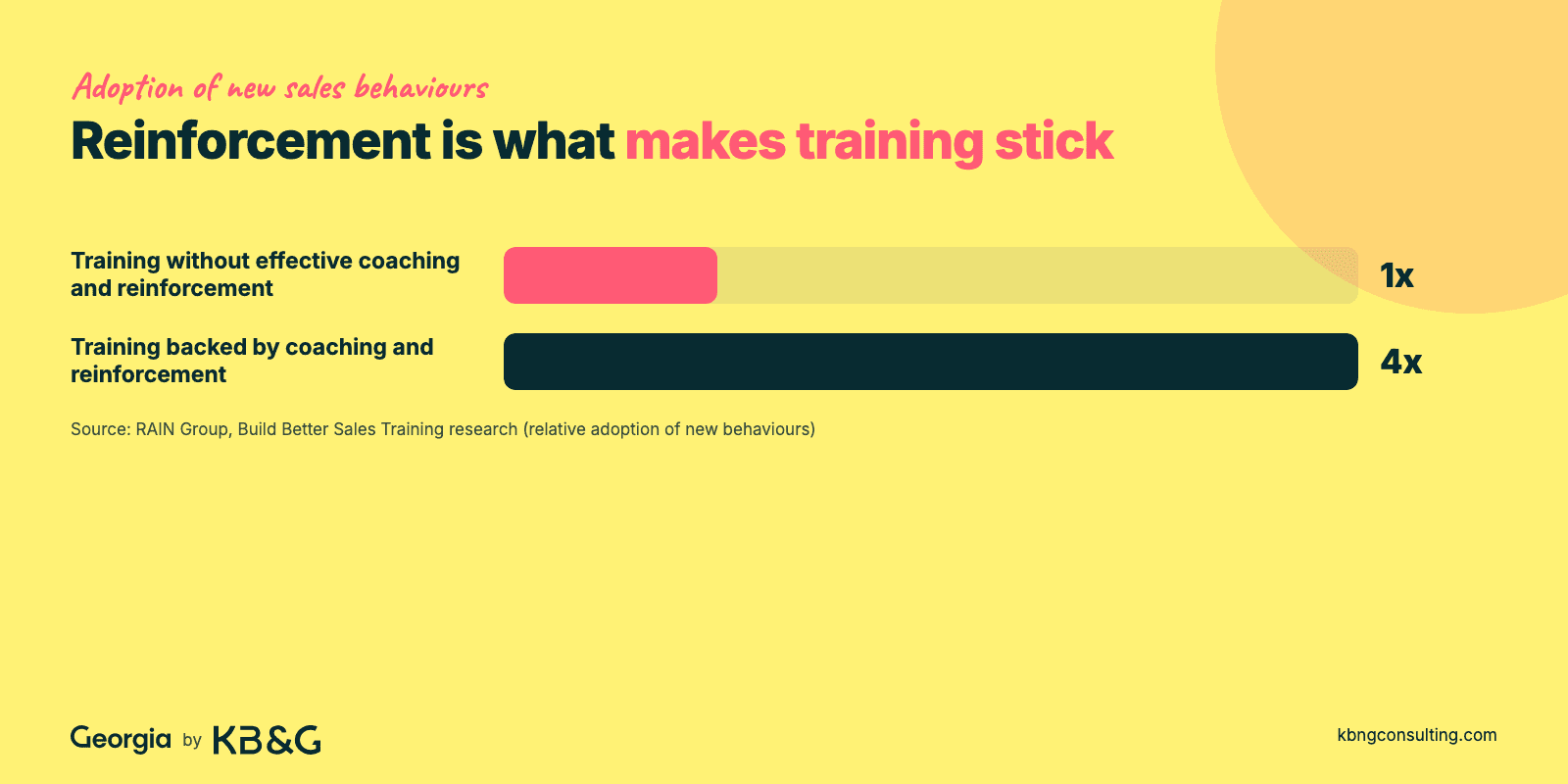
You're not buying inspiration. You're buying new behaviours you can measure.
The Role Of Sales Managers And Founders In Reinforcement
No training sticks without manager or founder reinforcement, especially in teams under 20 people. Managers are the mechanism through which training either becomes real or evaporates.
Here's what you need to do:
Run weekly pipeline reviews that inspect the same behaviours you trained: discovery notes, next steps set, pricing discipline
Listen to 2–3 call recordings per rep per week and give specific feedback in the training's language: not "good job" but "you skipped the value frame before giving a price"
Model the behaviours yourself in founder-led sales conversations
Celebrate small early wins: a rep who held price on a tough deal, a new hire who ran a strong discovery call
A Wilson Learning review found that training sales managers adds roughly 24% improvement on top of what general sales training delivers, likely because managers drive reinforcement. Leaving them out is one of the fastest ways to destroy training effectiveness.
Designing Sales Training For Measurable ROI
Real ROI is designed in from day one, not "discovered" in a dashboard months later. Here's how to make your next round of training produce improvements you can actually see.
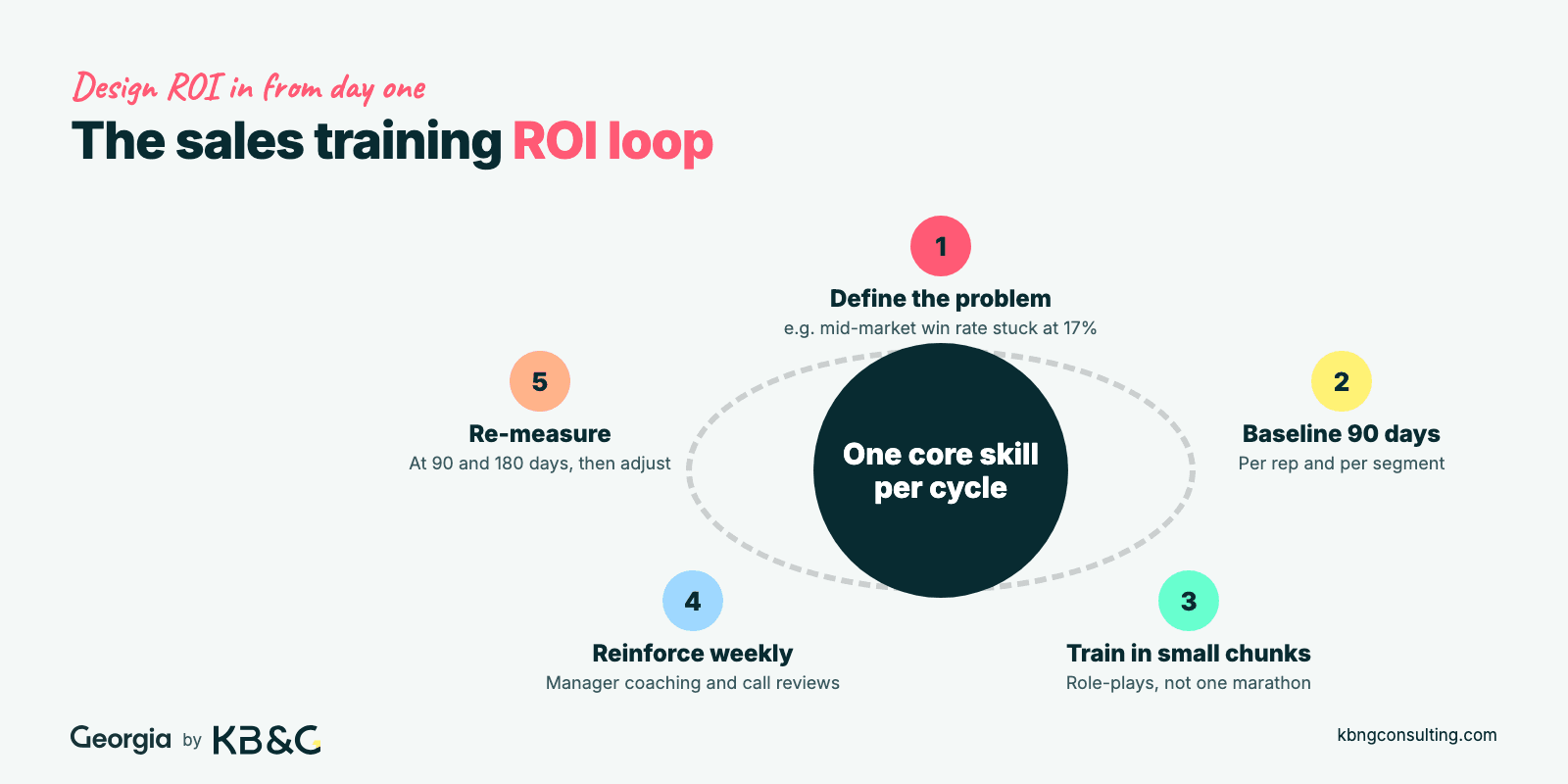
A Simple 7-Step ROI Process For Your Next Sales Training
Define the business problem in concrete terms: "mid-market win rate stuck at 17%," "average discount over 15%," or "new hires take 5 months to close their first deal."
Pick 1–2 primary outcome metrics and 2–3 leading indicators you will track. Don't try to measure everything.
Capture a 90-day baseline for those metrics, per rep and per segment. This is your "before" snapshot.
Design or select training that directly attacks that problem: negotiation training for discounting; discovery training for stalled deals. Strong sales training is targeted, not generic.
Deliver in small, spaced chunks with role-plays, not a single marathon session.
Reinforce weekly via manager coaching, call reviews, and micro-practice.
Re-measure at 90 and 180 days, compare against baseline, adjust.
Keep the scope tight: one core skill per cycle. Trying to fix everything at once is how training becomes unfocused and ROI becomes impossible to prove.
Comparing Training Approaches Through An ROI Lens
When you're deciding how to spend your training budget, here's how the two main approaches stack up:
Criterion | Traditional One-Off Workshop | Ongoing Practice-Based Training |
|---|---|---|
Cost profile | Lower upfront price; high hidden cost from little behaviour change | Ongoing investment; less wasted spend |
Behaviour change likelihood | Low: enthusiasm fades within days | High: practice and coaching embed new habits |
Measurability | Hard to attribute outcomes to a single event | Easier: practice frequency, leading indicators, and outcomes line up |
Impact on win rate / discounting | Rarely sustained | Trackable improvements in win rate and margin held |
Support for new hires | One-time orientation, slow ramp | Structured practice paths, faster ramp |
Long-term success | Unlikely without follow-up investment | Built into the team's operating rhythm |
The second option usually yields higher real ROI even when the upfront price looks similar, because you're paying for sustained behaviour change, not a motivational event.
Using Data From Small Teams Without Getting Lost In Statistics
If you have 2–10 reps, you might worry your data set is too small to prove anything. That's fair. You don't need statistical significance to make smart decisions:
Track per-rep trends, not just team averages. Individual trajectories tell you more than aggregates in small teams.
Focus on mid-performers. Your top closer was going to close anyway. Mid-performers are where training creates the most leverage.
Look for consistent directional changes: if 3 out of 4 reps hold higher margins after training, that's a meaningful signal, even without a p-value.
Directional improvement plus clear behaviour change is enough to justify continued investment at this stage. You're not publishing a research paper; you're deciding where to put your next dollar.
Common Sales Training ROI Pitfalls (And How To Avoid Them)
Here are the mistakes founders and sales leaders repeatedly make when trying to get real ROI from training.
Counting Hours, Not Outcomes
The mistake: reporting "20 reps trained for 8 hours" as success. Hours consumed is not a business outcome.
The fix: always report behaviour and outcome metrics in the same update. "20 reps trained; 90 days later, mid-tier win rate up 4 points and average discounts down 3 points." That's how you prove ROI and get buy-in for the next training budget.
Measuring Too Soon (Or Only Once)
Snap judgments at 30 days miss reality, especially when deals take 60–120 days to close. Leading indicators move first; outcome metrics need time.
Recommended measurement cadence:
30 days: quick pulse on leading indicators (discovery quality, next steps set, pricing conversations)
90 days: primary review for early shifts in win rate, discounting, cycle length
180 days: follow-up for more mature pipeline impact, especially with longer enterprise cycles
Some benefits, like better rep retention and faster onboarding, only become visible over quarters, not weeks, and they add real cost savings when you factor in the price of replacing a rep.
Ignoring External Factors
Market changes, pricing moves, product improvements, or a new competitor can move your metrics independently of training. If you don't account for them, you misattribute gains or miss real ones.
Document major external changes as they happen ("new competitor launched," "new pricing plan introduced")
Compare cohorts when possible: reps who completed full training vs. those who joined later
Note product or market shifts in your ROI report so readers can weigh the results fairly
Leaving Managers Out Of The Loop
If your managers aren't equipped to coach and track the specific behaviours from the program, ROI collapses the moment the trainer walks away.
Run a separate manager session on how to coach the new skills
Build the new behaviours into 1:1 templates and pipeline review agendas
Give managers a short observation checklist tied to the 3–4 key behaviours, not a 30-item form
Practice-Based Training And AI: Making Sales Training ROI Tangible
You increase ROI when reps can safely rehearse high-stakes conversations repeatedly, without risking real deals or burning real pipeline. Regular practice is the antidote to the forgetting curve. A well-trained sales team is built through repetition, not revelation.
What Effective Practice Looks Like In B2B Sales
Short, realistic reps: 3–8 minute sessions on real scenarios: "Your buyer wants a 20% discount," "The incumbent is cheaper," "We need to think about it"
Immediate, specific feedback: not "good job" but "you gave the price before establishing value; lead with the business case next time"
Repetition over weeks: a single role-play at the end of a workshop changes nothing. Spaced practice over 6–8 weeks changes behaviour.
You can do this with or without technology: weekly live role-plays with peer feedback, recorded calls for review, or dedicated practice time in your 1:1s. The key is making it a rhythm, not an event.
How AI Role-Play Can Boost Sales Training ROI
AI role-play makes the practice-and-measurement loop faster, cheaper, and more consistent. It also gives you data you've never had: who is practising, how often, and on which scenarios.
Practice frequency and quality are logged per rep, so you know who's actually doing the work
You can correlate practice data with changes in win rates, discounting, and cycle length in your CRM
New hires can ramp through structured practice paths, shortening time to first closed deal
Practice becomes part of the weekly rhythm, not a one-time event
The evidence is building. In a ZS pharma case study, reps using a virtual practice simulator were 27% more likely to reach the top performance tier. In a longitudinal study of nearly 2,000 salespeople, AI role-play training lifted job performance on average, with much larger gains among low performers and reps with strong supervisors. Your results will depend on who you train, how you reinforce, and how seriously managers take the coaching.
Linking Practice Metrics To Commercial Outcomes
Practice data must map to behaviour, which then maps to business outcomes:
Track reps who complete at least 3 negotiation role-plays per week over 8 weeks vs. those who don't
Compare average discount given, win rate on price-challenged deals, and cycle length for negotiation-heavy deals
Look for consistent patterns, not perfect proof: if reps who practise more consistently hold higher margins and close faster, you have a compelling signal
Georgia by KB&G is built for exactly this loop. It's an AI role-play coach where reps practise real sales conversations (holding price, answering "the other supplier is cheaper," defending value against procurement pushback) in 3 to 8 minute sessions with real-time coaching, so practice becomes a weekly habit you can measure.
Conclusion And Next Steps
Sales training ROI is real, but only if you define it in commercial terms, design for behaviour change, and reinforce with practice. Most sales training fails not because the content is wrong, but because there's no measurement, no reinforcement, and no connection to the business goals that matter.
Here's your "do this next" list:
Pick one sales problem that's costing you money this quarter: heavy discounting, slow ramp, deals stalling after proposal, low win rates in a key segment
Baseline the key metrics for that problem over the last 90 days, by rep and segment
Choose training that attacks that specific problem and includes weekly practice, not just a single workshop
Commit to a 90-day reinforcement and measurement window before judging success. Track leading indicators weekly and outcomes monthly.