
Why Bullying and Harassment in Mining Matter
Bullying and harassment in mining are persistent, controllable psychosocial risks that directly undermine safety performance, workforce retention, and an operation's licence to operate. They are not peripheral HR issues. They are safety hazards embedded in the remote, hierarchical, and production-driven cultures that define many mine sites, quarries, and processing plants across Australia and similar jurisdictions.
These behaviours persist because they are woven into closed social systems: fly-in fly-out (FIFO) camps, rigid chains of command, legacy "toughen up" norms, and channels leaders rarely see, such as secondary radio frequencies and informal group chats. They erode speak-up culture, increase fatigue and distraction, and contribute to incidents and near misses. Leaders can act by establishing clear behavioural standards, building supervisor capability to intervene, creating safe and confidential reporting channels, following through visibly on complaints, and using better data from site radio traffic to surface patterns that traditional audits miss.
This article focuses on workplace bullying and harassment in mining and quarrying operations, with particular relevance to Australian regulatory settings and comparable jurisdictions such as Canada. It addresses psychosocial risk management and critical controls as they apply to these behaviours on site. Detailed criminal law, EEO procedure, and sexual assault response protocols fall outside this scope; they are specialist topics requiring separate treatment.
The intended audience is safety managers, HR leaders, operations managers, superintendents, and site leaders working in mining, quarries, and processing plants. The realities you manage (production pressure, contractor-heavy workforces, FIFO rosters, multiple languages and cultures) are central to how bullying and harassment take root and why they are so difficult to address.
This subject matters now more than ever. A Western Australian parliamentary inquiry heard accounts of sexual assault and severe harassment in mining, culminating in the 2022 "Enough is Enough" report into sexual harassment against women in the FIFO mining industry. Rio Tinto's 2022 Everyday Respect report and its 2024 progress review exposed systemic bullying across global operations, prompting a public apology and ongoing cultural reform. "Business as usual" is no longer acceptable.
By the end of this article, you will understand:
How to recognise bullying and harassment early on site, including in places supervisors rarely look
Why these behaviours persist in mining even where formal policies exist
How to link bullying and harassment into your psychosocial risk register alongside physical hazards
Practical steps to improve reporting, build supervisor capability, and track cultural progress
How voice-to-data technology can surface abusive conduct on radio channels before it escalates
Understanding Workplace Bullying and Harassment in Mining
Workplace bullying is repeated, unreasonable behaviour directed at a worker or group of workers that creates a risk to health and safety. Harassment is unwelcome conduct that demeans, intimidates, or discriminates, often on the basis of gender, race, or other protected attributes. In mining, these behaviours play out in specific settings: shift handovers, crib rooms, haul roads, workshops, camp corridors, wet and dry messes, and on the radios that connect every part of an operation. Legal definitions vary by jurisdiction, but the practical reality is the same: conduct that would be unacceptable in any workplace is often normalised on mine sites under the guise of "banter," hazing, or simply "the way things are done."
Bullying and harassment are systemic challenges within the global mining industry. They are not isolated to one company or one country; they reflect structural conditions common across operations in Australia, Canada, and beyond.
Types of Bullying, Sexual Harassment and Harassment Seen on Site
The forms of bullying and harassment found on mine sites are varied, but they share a common thread: they exploit power imbalances and operate in environments where oversight is limited.
Verbal abuse: Shouting, insults, or disparaging remarks. A supervisor who berates haul truck operators over the radio shift after shift is a recognisable example.
Social exclusion and humiliation: Ignoring crew members, excluding people from breaks or pre-shift briefings, or publicly ridiculing mistakes. Women, First Nations workers, and new starters are frequently affected.
Racist and sexist conduct: Derogatory jokes, slurs, or graffiti in crib rooms and camp facilities. In Rio Tinto's review, 39.8% of men and 31.8% of women who identify as Aboriginal or Torres Strait Islander in Australia reported experiencing racism.
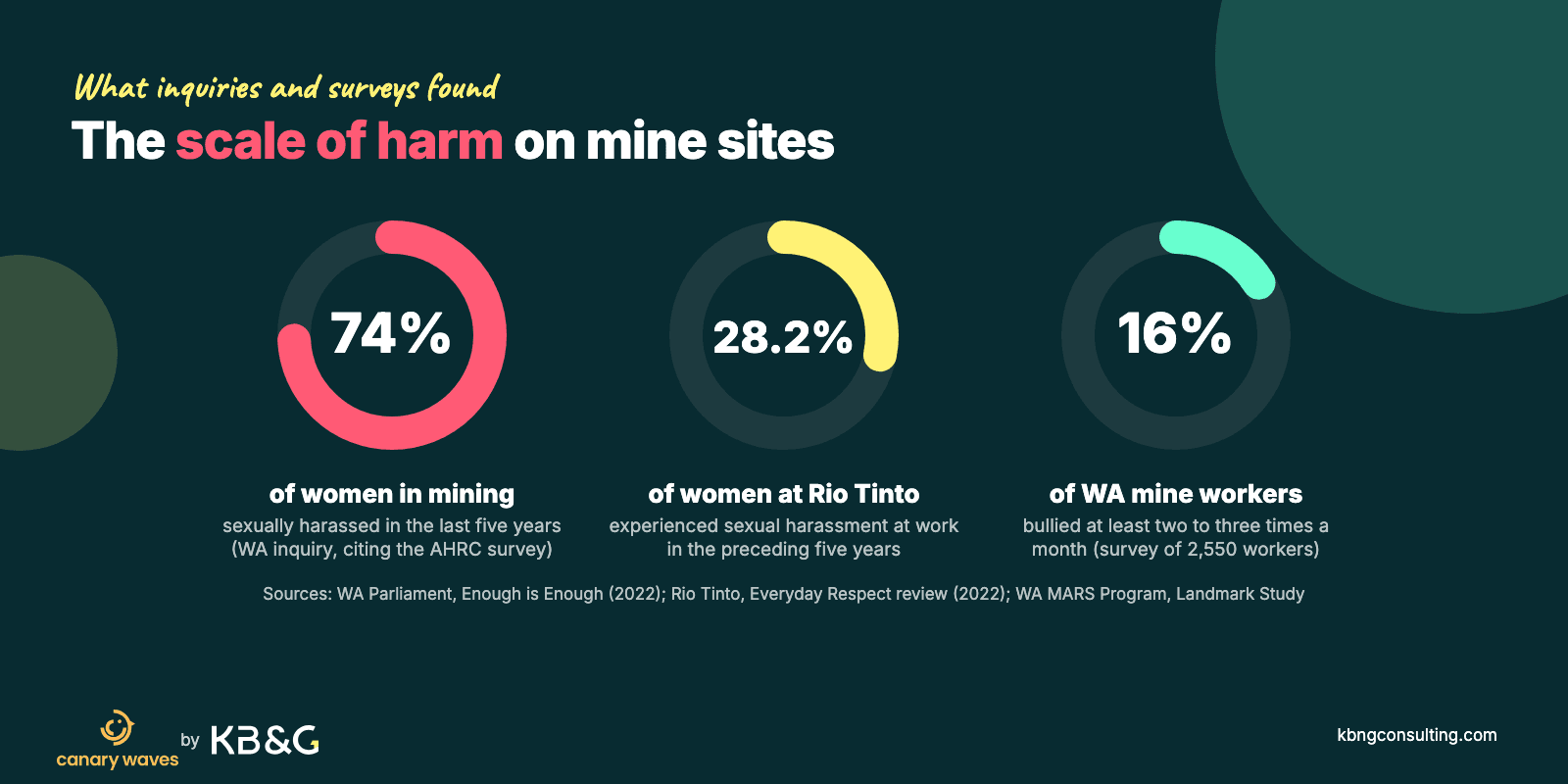
Sexual harassment: Unwanted sexual remarks, advances, or physical contact. The WA inquiry found sexual harassment was prevalent across the industry and described it as "an open secret." Its report notes that 74 per cent of women workers in mining reported being sexually harassed in the last five years, drawing on the Australian Human Rights Commission's national survey. At Rio Tinto, almost half of people had experienced bullying, and 28.2% of women and 6.7% of men had experienced sexual harassment at work in the preceding five years.
Mobbing: Coordinated targeting of a single person by multiple crew members, particularly apprentices, graduates, or contractors. A group mocking a new engineer's errors loudly in the crib room or over open radio is a recognisable pattern.
Abuse of reporting lines and power: Supervisors or leading hands using their authority to assign punitive tasks, withhold overtime or roster preferences, or block career progress for workers who challenge them.
Power imbalances at isolated work sites discourage reporting of misconduct. The gap between permanent employees and contractors, between locals and FIFO workers, and between male-dominated leadership and an increasingly diverse workforce means that the person being bullied often has less power, fewer options, and more to lose by speaking up. Single high-profile incidents usually sit on top of many smaller, normalised behaviours that have gone unchecked for months or years.
Psychosocial Hazards and Safety Risk Link
Psychosocial hazards are organisational or social factors in the workplace that can cause psychological harm and contribute directly to physical incidents. Under frameworks such as ISO 45003 and modern WHS regulation in Australia, these hazards include high job demands, low control, poor support, role ambiguity, and social exclusion. Psychosocial risks in mining should be treated with the same rigour as physical safety risks.
Bullying and harassment increase fatigue, distraction, anxiety, and risk-taking. A bullied operator may stop asking clarifying questions before a heavy lift. A harassed apprentice may be too scared to challenge an unsafe isolation. Workers who have been ridiculed over the radio for raising concerns learn to stay quiet, and when speak-up culture dies, near misses go unreported and unsafe conditions persist until someone is hurt.
Victims and witnesses of harassment can suffer lasting mental health effects, including anxiety and trauma, and the harm extends well beyond absenteeism or low engagement scores. The link runs from poor culture to serious injury and fatality risk.
Psychological safety is critical in mining operations. Bullying and harassment should sit in the same risk framework as working at heights, vehicle interactions, or confined space entry. They are controllable hazards, and leaders have both a legal duty and a moral responsibility to manage them.
Why Bullying and Harassment Persist in Mining Environments
Understanding what bullying and harassment look like on site is essential, but it does not explain why these behaviours persist even in companies with formal policies, training programs, and stated commitments to respectful workplaces. The answer lies in the structural conditions of mining work itself.
Remote locations, male-dominated crews, high contractor turnover, long shifts, production bonuses, and entrenched "toughen up" cultures create an environment where systemic bullying can take root and remain invisible to formal systems for years.
Remote, FIFO and Camp-Based Cultures
FIFO and drive-in drive-out (DIDO) rosters place workers in closed social systems for extended periods. Remote camp environments isolate workers from their usual support networks. Limited privacy, shared accommodation, communal dining, and repetitive routines create an intensity of social interaction that amplifies both good and bad behaviour.
Closed camp communities generate strong in-group and out-group dynamics. New starters, minority groups, and workers who don't conform to dominant crew norms can quickly become targets. Gossip spreads fast. Alcohol use in some camps adds further risk. A WA Government-funded study of FIFO worker mental health found that 33 per cent of FIFO workers experienced high psychological distress, compared to 17 per cent of non-FIFO workers, and that FIFO workers also experienced higher levels of workplace bullying.
Long swings, fatigue, and loneliness amplify the impact of even "low-level" bullying on mental health and retention. What might be shrugged off in a day-shift urban workplace becomes corrosive when there is no escape, no external support, and no separation between work and living space.
Hierarchy, Production Pressure, Systemic Bullying and "Old School" Norms
Mining operations typically run on traditional command-and-control structures. Supervisors, shift bosses, and superintendents hold significant power over rosters, overtime, promotions, and daily work allocation. A hierarchical, traditional culture can normalise hazing and aggressive management.
Production KPIs and efficiency bonuses can unintentionally reward abrasive supervisors: the person who "gets results" may be tolerated or promoted even when their behaviour is well known to be harmful. This creates a culture where reporting bullying is seen as a threat to the team's performance, not a contribution to safety.
Entrenched norms ("if you can't handle the banter, you don't belong here") directly conflict with modern WHS expectations and the growing diversity of the mining workforce. The "Enough is Enough" report identified the protection of "high value" workers above others and the misuse of alcohol among the features of an industry culture that has failed to protect women.
Hidden Channels: Radios, Group Chats and Informal Power
Much of the bullying and harassment on mine sites occurs where leaders are not present and formal systems cannot reach. Secondary radio channels, away from dispatch, are commonly used for crew-to-crew communication. These channels can carry insults, mocking, aggressive instructions, and racially or sexually charged language that no one in leadership ever hears.
Group chats among crews serve similar functions: gossip, discriminatory jokes, rumours, and social exclusion happen in informal digital spaces that no toolbox talk or safety walk will capture. Camp corridors, bus rides to site, and night-shift crib rooms are physical locations where peer pressure dominates and supervision is weak.
These behaviours are transient, often unrecorded, and invisible to standard audits. Without early detection and a genuine culture of psychological safety, much of this conduct remains hidden until a major complaint, a worker's departure, or media exposure forces it into the open.
Impact of Bullying and Harassment on Safety, Retention and Performance
The persistence of bullying and harassment on mine sites is not merely a cultural problem. It produces real harm to safety outcomes, workforce stability, and organisational reputation. These impacts compound: lost production, rework, near-miss under-reporting, turnover of experienced operators, and damaged community and regulatory relationships can all flow from the same root cause.
Safety Incidents, Near Misses and Speak-Up Culture
When workers are bullied, especially by a supervisor or leading hand, they are far less likely to stop a job, challenge unsafe instructions, or admit mistakes. An offhand "harden up and just get it done" from a supervisor can lead directly to bypassed procedures. Radio ridicule of an operator who raised a concern teaches the entire crew that speaking up brings punishment, not recognition.
The Landmark Study, funded by WA's MARS Program, surveyed 2,550 mine workers. It found that 16% of workers reported experiencing bullying at least two to three times per month in the last six months, and nearly 4 in 10 reported feeling burnt out at work. It also found that under-reporting of notifiable safety incidents and near misses, while low, continues to exist in the industry.
The pattern is consistent: where psychological safety is low, workers are less likely to report near misses or stop unsafe work, and that silence can precede serious injury or fatality.
Turnover, Skills Loss and Cost to Operations
Bullying and harassment drive people out of the mining sector. The groups most affected (apprentices, graduates, women in non-traditional roles, First Nations workers, and experienced operators who can find work elsewhere) are precisely the people the industry most needs to retain.
Many professionals who experience harassment leave the industry entirely. The cost is not only recruitment expense but lost tacit knowledge, disrupted crew dynamics, training overhead for constant new starters, and contractor churn. Rio Tinto's own reporting shows how these cases translate into departures: its myVoice program received 1,942 reports in 2025, and the company substantiated 88 allegations of bullying and harassment that year. Disciplinary outcomes from reports closed in 2025 resulted in 126 employees leaving the business through dismissal or resignation, 85 of them related to harmful behaviours.
Regulatory, Legal and Reputation Risk: Lessons from Rio Tinto
Modern WHS laws in Australia now explicitly require companies to manage psychosocial hazards. Codes of practice in jurisdictions like Queensland and Western Australia, aligned with ISO 45003, treat bullying and harassment as health and safety risks requiring formal risk management, not just grievance handling or policy statements.
Rio Tinto's 2022 Everyday Respect report, led by former Sex Discrimination Commissioner Elizabeth Broderick, drew on more than 10,000 survey responses and exposed the scale of systemic issues. The company apologised publicly and committed to implementing all 26 recommendations.
Reputational risk extends beyond individual companies. Mining companies that fail to address bullying and harassment face scrutiny from regulators, unions, media, and investors, and harder conversations with communities. These impacts justify a structured, risk-based response rather than reliance on policies alone.
Building a Risk-Based Approach to Bullying and Harassment in Mining
The same discipline that mining operations apply to physical hazards (identifying, assessing, controlling, and reviewing risks) must be applied to bullying and harassment as psychosocial hazards. This is not a theoretical proposition; it is a regulatory expectation and an operational necessity. The following framework is designed for safety, HR, and operations leaders working across open-cut, underground, processing, and logistics operations.
Step-by-Step Psychosocial Risk Process
Mining companies must establish clear, zero-tolerance policies for bullying and harassment, but policy alone is not a control. A structured process is needed:
Map your psychosocial context: Review roster patterns, camp arrangements, workforce demographics (gender, age, Indigenous status, contractor vs permanent), cultural mix, and off-shift social norms. Identify where power imbalances and isolation are most acute.
Identify bullying and harassment hazards: Combine survey data, incident reports, exit interviews, and informal feedback from crew representatives and safety delegates. Include questions about radio channels, group chats, and camp interactions. Don't rely on a single data source.
Assess likelihood and consequence: Rate risk with attention to high-vulnerability groups: night shift crews, young workers, FIFO-only workers, and contractor teams. A behaviour that occurs in an isolated setting with a significant power imbalance carries higher risk than the same behaviour in a supervised area.
Design and implement controls: Prioritise structural and leadership controls over awareness campaigns and e-learning alone. Clear policies are essential, but they must be translated into daily practice through supervisor capability, work design changes, and reporting systems.
Monitor, learn and adjust: Establish measurable indicators: number of reports (anonymous vs named), substantiation rates, response times, turnover by crew and demographic, absenteeism, camp security logs, and patterns from site radio channels. Consistent monitoring helps you track and address issues over time.
This process should be applied during annual risk register reviews, before ramp-up of a new mine, during contractor mobilisation, or after a culture incident.
Controls: From Policy to Daily Practice
Most mining companies already have bullying and harassment policies. The gap is almost always in implementation at crew level. Key categories of controls include:
Clear behavioural standards: Specific, plain-English definitions of unacceptable conduct, including examples relevant to radio use, camp life, crib room behaviour, and social media, backed by accountability and transparency.
Leadership capability: Regular training for supervisors on recognising and intervening in bullying, plus bystander intervention training so any worker can act against inappropriate behaviour. Leaders must model respectful behaviour to set the cultural tone.
Work design: Review rosters to reduce fatigue, rotate high-conflict crews, ensure camp facilities support inclusion (privacy, mixed dining options), and identify "isolated worker" roles that carry heightened psychosocial risk.
Systems and technology: Confidential reporting channels, including hotlines, apps, union channels, and in-person options with clear anonymity choices. Security presence in high-risk areas and insights from site radio traffic add further layers.
Contractor alignment: Labour hire and contractor policies on bullying and harassment must match principal mine standards, with shared reporting paths and induction into site culture expectations, so inclusion does not stop at contractor boundaries.
Measuring Culture and Tracking Change
Mining leaders need both perception measures (surveys, listening sessions) and behavioural data (actual incidents, reports, observations) to understand where they stand and whether progress is real.
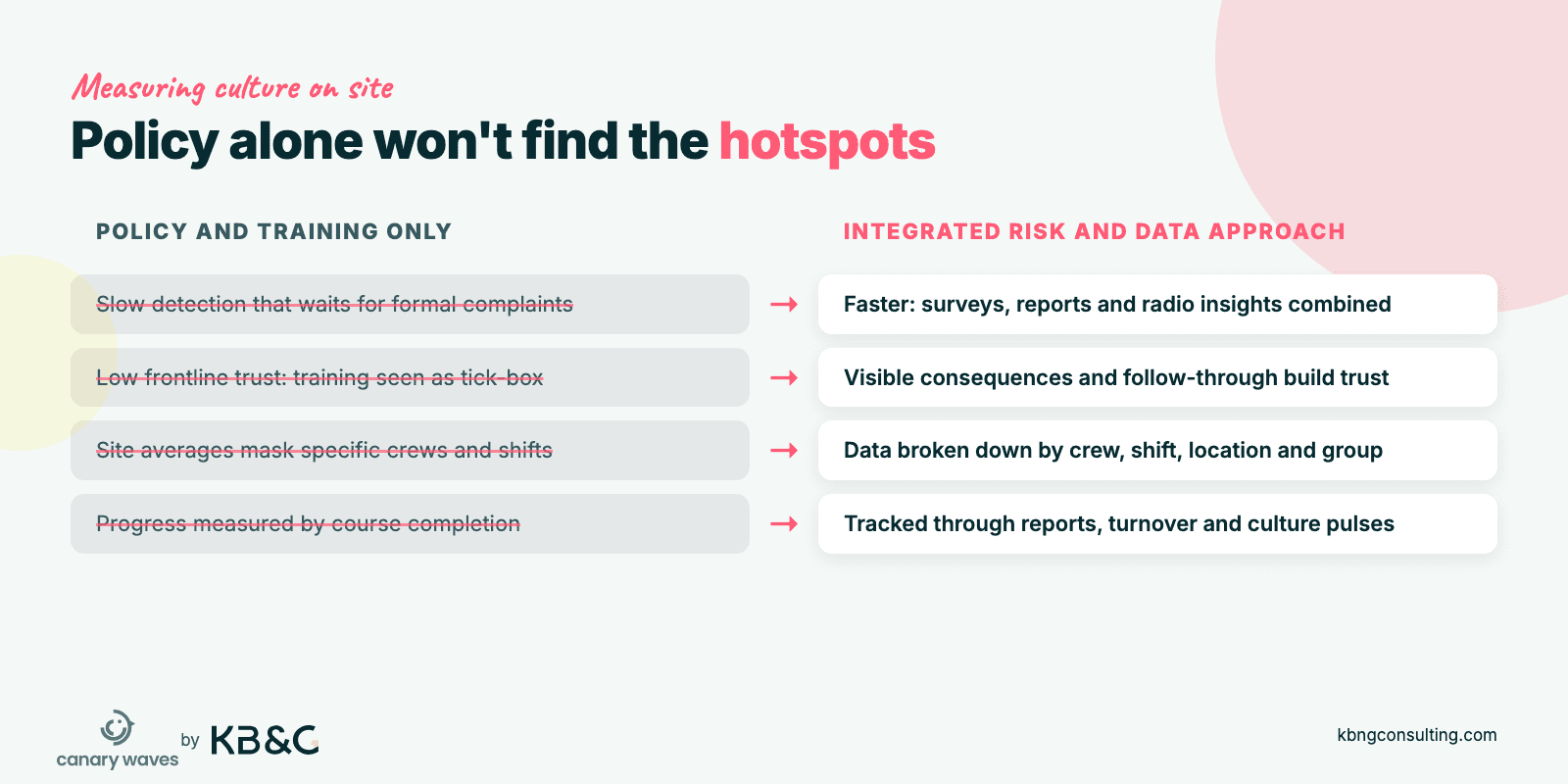
Criterion | Policy and Training Only | Integrated Risk and Data Approach |
|---|---|---|
Detection speed | Slow: relies on formal complaints | Faster: combines survey data, reports, and communication insights |
Frontline trust | Often low: workers see training as tick-box | Higher: visible consequences and follow-through build credibility |
Ability to target hotspots | Limited: aggregate data masks specific crews or shifts | Strong: analysis by crew, shift, location, and demographics |
Tracking improvement over time | Difficult to measure beyond completion rates | Measurable through multiple indicators: reports, turnover, culture pulses |
Regular review cycles matter. Annual psychosocial risk register reviews should be synced with safety management system reviews, supplemented by quarterly culture pulse checks on key sites. Data should be disaggregated so that improving averages do not mask persistent problems in specific areas.
Common Challenges in Tackling Bullying and Harassment on Site (and How to Solve Them)
Many mining and quarrying operations have already committed time and resources to training, campaigns, and policy updates, yet still see under-reporting, repeat offenders, or pockets of toxic behaviour. The following roadblocks are common and addressable.
Problem 1: Under-Reporting and Fear of Reprisal
Workers fear being labelled "soft," losing shifts, or damaging their career if they speak up, especially in close-knit FIFO and contractor communities where everyone knows everyone.
Solutions:
Provide multiple reporting options: in-person, hotline, app, union channels, each with clear anonymity choices.
Make protections against reprisal visible: take prompt action when retaliation is suspected, and discipline leaders who punish complainants.
Regularly publish de-identified case summaries showing that issues raised lead to real consequences. When people see that reporting works, they are more likely to use it.
Problem 2: Supervisors Lacking Skills to Intervene
Many leading hands, charge-ups, and supervisors were promoted for technical competence, not people leadership. They may recognise that a person on their crew is being targeted but feel out of their depth in managing conflict or responding to a complaint.
Solutions:
Deliver practical, scenario-based training using real mining examples: challenging racist "jokes" in the crib room, shutting down radio abuse, supporting a targeted worker without escalating risk.
Provide coaching and mentoring from senior leaders who model calm, fair, and respectful intervention.
Establish clear escalation pathways so supervisors know when and how to involve HR or site managers, and are not left to handle complex situations alone.
Problem 3: Isolated Hotspots That Don't Show Up in Surveys
Site-wide surveys may show "average" or improving scores while specific crews, shifts, or contractors experience serious issues that remain invisible in aggregate data.
Solutions:
Break data down by crew, shift, location (pit vs plant vs port), contractor vs permanent, and demographic profile. Information averaged across a whole site can mask the experience of the most affected groups.
Conduct targeted listening sessions or safety stand-downs with high-risk crews, facilitated by trusted internal or external people.
Augment survey results with behavioural data: incident and complaint patterns, camp security logs, and insights from site radio traffic. Without these added layers, leaders may believe progress is being achieved while the most vulnerable workers continue to be subject to harmful conduct.
Technology and Early Detection: Surfacing What Leaders Can't See
Traditional methods such as surveys, walk-arounds, and toolbox talks are necessary but often miss real-time behaviour on radios. Early detection should be understood as a critical control for psychosocial risk, analogous to real-time monitoring for physical hazards such as vehicle telemetry or environmental sensors.
Using Voice and Communication Data to Spot Bullying Early
Mining operations run on two-way radio: dispatch, pit operations, maintenance, emergency responses. Patterns in radio traffic can indicate psychosocial risk before formal complaints are lodged:
Frequent shouting, insults, or mocking on certain channels or shifts
Repeated humiliating nicknames, or gendered or racist language
Persistent one-way aggressive communication on a crew's channel
These patterns provide evidence that surveys and audits cannot. Privacy, consent, and ethics must be addressed from the start: the focus should be on patterns and safety risk on site work channels, not on individuals' private conversations or on micromanaging personalities. Unions and workers should be engaged early so that radio insights are understood as a safety tool, not a surveillance measure.
Conclusion and Next Steps
Bullying and harassment in mining are controllable psychosocial risks that directly affect safety, retention, and licence to operate. They require the same discipline, rigour, and leadership commitment as physical hazards. A combination of clear standards, skilled supervisors, safe reporting pathways, and better data on real behaviour is needed to shift culture sustainably.
Progress is possible. In Rio Tinto's 2024 progress review, around half of survey respondents reported a perceived improvement in relation to bullying (50%) and sexual harassment (47%), while the same review found that harmful behaviours persisted in some areas. Committed, sustained effort produces progress, and lasting change requires continued vigilance.
Practical next steps for mining leaders:
Review your current bullying and harassment policy against remote and FIFO realities and the psychosocial regulations in your jurisdiction.
Map high-risk areas and groups on your sites based on roster, camp, role, and contractor status.
Run a focused culture pulse or listening sessions with at-risk crews, separately from management.
Select two to three concrete behavioural standards (for example, radio etiquette and camp conduct) and train supervisors to enforce them consistently.
Evaluate voice-to-data options that can surface abusive exchanges on site radio channels earlier.
Establish regular review cycles (quarterly pulses and annual psychosocial risk register reviews) and report outcomes transparently.
Radio is one place where abusive exchanges are said out loud yet rarely reach leaders. Canary Waves by KB&G runs passively on existing two-way radio, with no new hardware and no change for crews. It transcribes radio traffic, tuned to site slang, and surfaces abusive or bullying exchanges across radio channels so leaders can act, alongside the safety signals it already flags. It has been proven in early MVP pilots on real mine sites.