
What Is Fatigue in Mining?
Fatigue in mining is a state of impaired alertness, judgment, coordination, and communication caused largely by how work is organised: shift patterns, night rosters, long commutes, monotonous tasks, and environmental stressors. It is one of the most significant yet under-managed safety hazards in the mining industry. It matters because fatigue slows reaction times, narrows attention and degrades judgment, which raises the risk of serious accidents and drags on productivity.
This article focuses on the human and cultural dimensions of fatigue in surface and underground mining and quarrying operations: the shift schedules, commute realities, site conditions, and behavioural and communication patterns that create and reveal fatigue risk. It does not cover clinical sleep medicine or consumer wellness. The target audience is safety managers, operations leaders, and innovation leads responsible for keeping people safe and operations running across mining and quarrying sites worldwide.
Fatigue in the mining industry is a major safety and health hazard. It is not simply feeling tired after a long day, but a predictable, systemic condition that can be mapped, measured, and managed through organisational design, cultural leadership, and the right supporting tools.
By reading this article, you will be able to:
Recognise the operational and environmental factors that drive worker fatigue on your site
Spot early behavioural and communication signs of fatigue in haulage, processing, and underground crews before incidents occur
Understand where wearable and monitoring technologies help and where they fall short
Sketch a practical fatigue risk management approach tailored to your operation
Identify common sticking points in fatigue management and how to move past them
Understanding Fatigue in Mining
Fatigue in mining refers to a suboptimal mental and physical state that impairs alertness, judgment, coordination, and communication among mine workers. NIOSH describes fatigue in mining as common, driven by a combination of shiftwork, long hours, repetitive tasks, demanding jobs and poor lighting. Fatigue is not a personal failing or a diagnosis. It is a workplace hazard that requires structural solutions, just as heat stress, ground instability, or traffic management do, and it belongs in the same process of identifying, assessing and controlling risk.
Fatigue is more than feeling tired. It encompasses multiple dimensions: acute fatigue from a single long shift or missed sleep versus chronic fatigue from accumulated sleep debt across many shifts. It includes physical exhaustion from muscular effort, vibration, or heat, as well as cognitive fatigue from sustained vigilance, monotonous monitoring, or complex decision-making. Emotional and behavioural dimensions (irritability, withdrawal, lower tolerance) are equally important. And fatigue has both individual drivers (age, health, sleep habits) and organisational drivers (rosters, production pressure, commute expectations) that interact to shape actual risk on site.
Types and Sources of Fatigue on Mine Sites
Different roles across mining operations experience fatigue differently. Mine haulage operators face long, repetitive drive cycles. Underground crews work in environments that misalign the body's internal biological clock, contending with darkness, heat, humidity, and constrained movement. Control room and remote operations staff manage hours of passive monitoring punctuated by rare, high-stakes interventions. Maintenance teams alternate between physically demanding work and waiting. Supervisors carry the cognitive load of coordinating across all these groups.
The mining-specific sources of fatigue include:
Shift patterns: Long shifts, rotating day/night rosters, extended overtime, and rapid turnarounds where a night shift is quickly followed by a day shift with minimal recovery. The industry is increasingly adopting extended workdays of 10–12 hour shifts, and extended shifts disrupt circadian rhythms and build chronic sleep debt.
Night work and circadian disruption: Working against natural sleep–wake cycles, early-morning starts, and extended sequences of night shifts undermine circadian rhythms and reduce sleep quality. Underground crews can spend most of their waking hours away from daylight, especially in winter, compounding circadian misalignment.
Remote operations and commutes: FIFO (fly-in, fly-out) and DIDO (drive-in, drive-out) arrangements involve long commutes, bus transfers and travel days that cut into rest. NIOSH lists long commutes to remote areas among the fatigue risks specific to mining.
Monotonous and sedentary tasks: Multi-hour haul truck runs with minimal variation, repetitive plant tending, and passive monitoring of automated systems.
Environmental stressors: High ambient temperatures and excessive noise increase physical exhaustion. Poor lighting underground, vibration, dust, and glare in surface pits all compound the problem.
Psychosocial factors: Production pressure, job insecurity, family separation on remote rosters, and limited control over work schedules all contribute to stress and fatigue.
How Fatigue Shows Up: Cognitive, Physical, and Emotional Effects
Fatigue affects workers across three interconnected domains, each with direct consequences for safety in the mining environment.
Cognitive effects include slower reaction times, reduced vigilance, impaired decision-making, and tunnel vision. A fatigued operator may miss subtle hazards (loose ground, a changed traffic pattern, an unusual instrument reading) that an alert worker would catch immediately. Fatigue reduces the ability to respond to abnormal operating conditions, and cognitive and motor impairment increase the likelihood of equipment collisions and safety violations.
Physical effects include heavy eyelids, micro-sleeps (especially when seated or driving haul trucks), clumsiness, and slower coordination when climbing, handling tools, or operating heavy machinery. Fatigued workers need more unscheduled breaks and work at a slower pace, directly affecting both efficiency and safety.
Emotional and behavioural effects include irritability, withdrawal from colleagues, flat affect, and lower tolerance for frustration. These signs often precede more visible errors but are easy to dismiss as personality traits rather than indicators of fatigue.
These effects map directly to mining tasks: an excavator driver responding slowly to radio instructions, a maintenance technician skipping steps in a lock-out/tag-out sequence, a haulage operator misjudging right-of-way at an intersection, or an underground crew member misreading ground conditions. Recognising these early signals before they escalate into incidents is where effective fatigue management begins.
How Fatigue Appears in Behaviour and Communication on Site
Most workers will not say "I'm fatigued." Instead, fatigue leaks out through small, observable changes in behaviour, tone, and communication patterns well before a serious event. These subtle shifts are the earliest and most accessible warning signs available to supervisors and safety representatives on any site.
Learning to read these signals in radio traffic, pre-start meetings, and informal face-to-face interactions is a practical skill that does not require technology, investment, or new procedures: just attention and a willingness to act early.
Observable Behaviours in the Field
Concrete, mining-specific behaviours that often precede fatigue-related incidents include:
Slower responses at controlled points: Hesitation at intersections, delayed pull-away after stops, uncertainty when given right-of-way in a loading zone.
Missed procedural steps: Incomplete pre-start checks, skipped isolation or lock-out steps, superficial documentation. Tasks done on autopilot rather than with attention.
Increased minor errors: Dumping in the wrong location, misidentifying load IDs, misreading signage or markings on site.
Physical signs: Frequent stretching or shifting in the seat, head nodding, resting head on hand in control rooms, unsteady posture on ladders or platforms.
Near misses and bumps: Low-speed berm strikes, minor property contacts, scrapes. Each one is a precursor to more serious accidents.
Consider a haul truck operator on a fourth consecutive night shift. Approaching a dump zone in the early morning, the operator hesitates before proceeding, arms heavy on the steering wheel, movements sluggish. The pre-dump safety check is skipped. Dispatch asks for confirmation over radio; the operator responds only after a long pause, then asks dispatch to repeat. Minutes later, the truck clips a berm while reversing. No injury, but a clear near miss, and every signal was visible before the contact occurred.
Changes in Radio and Face‑to‑Face Communication
Fatigue strongly affects how people speak and listen, and two-way radio is the communication backbone of most mining operations. Safety managers and supervisors can watch for specific patterns:
Slower response times: Longer pauses before answering dispatch or supervisors. Repeated "say again?" requests that are unusual for that operator.
Tone shifts: Snappy, impatient replies from normally calm operators, or unusually flat, monotone speech from workers who are typically engaged and vocal.
Repeated instructions: Messages needing to be sent two or three times because they were not fully heard or processed.
Missed or unacknowledged calls: Later explained as "didn't hear" or "was busy," but forming a pattern.
Reduced proactive communication: Fewer hazard reports, fewer voluntary check-ins, less initiative in calling out observations.
In pre-start meetings and toolbox talks, fatigue shows up as less participation, shorter answers, fewer questions, avoidance of eye contact, and more attention on phones than on discussion. These are not signs of poor attitude. They are signs of people experiencing fatigue.
Early Warning vs. Post‑Incident Signals
There is a meaningful difference between early warning signs (the subtle behavioural and communication shifts that can be noticed in daily operations) and post-incident red flags, such as documented micro-sleep events on in-cab cameras, incident investigations that cite fatigue as a contributing factor, or formal fatigue-related reports.
The value of early signals is that they create opportunities for low-friction interventions: a supervisor suggesting a micro-break, rotating a fatigued operator to a different task, or simply asking "how are you going?" in a genuine way. In a just safety culture, workers can report fatigue without fear of retaliation. Waiting until after a serious event to address fatigue means responding reactively to a hazard that was visible well in advance.
The question then becomes: what systemic factors are creating these fatigue patterns in the first place?
Operational Drivers of Fatigue in Mining
Individual fatigue symptoms are visible on the surface, but the root causes sit deeper, in the design decisions that mining companies and operations leaders control. Rosters, commute expectations, task design, overtime policies, and production pressure shape fatigue risk far more than individual resilience or personal habits. Fatigue management should not rely on individuals recognising their own tiredness, and crews should be consulted when fatigue controls are designed.
Shift Rosters, Night Work, and Overtime
Mining operations commonly use rosters such as 7-on/7-off, 4-on/4-off, 2-on/1-off, or 8-on/6-off configurations, each with distinct implications for fatigue. On top of the rostered hours, overtime can push actual working time well beyond what the roster suggests.
Key roster pitfalls that drive fatigue include:
Long sequences of night shifts without adequate recovery days, causing cumulative sleep debt that cannot be recovered with a single day off.
Quick turnarounds ("quick flips") where a late night finish is followed by an early day start, compressing sleep opportunity below safe thresholds.
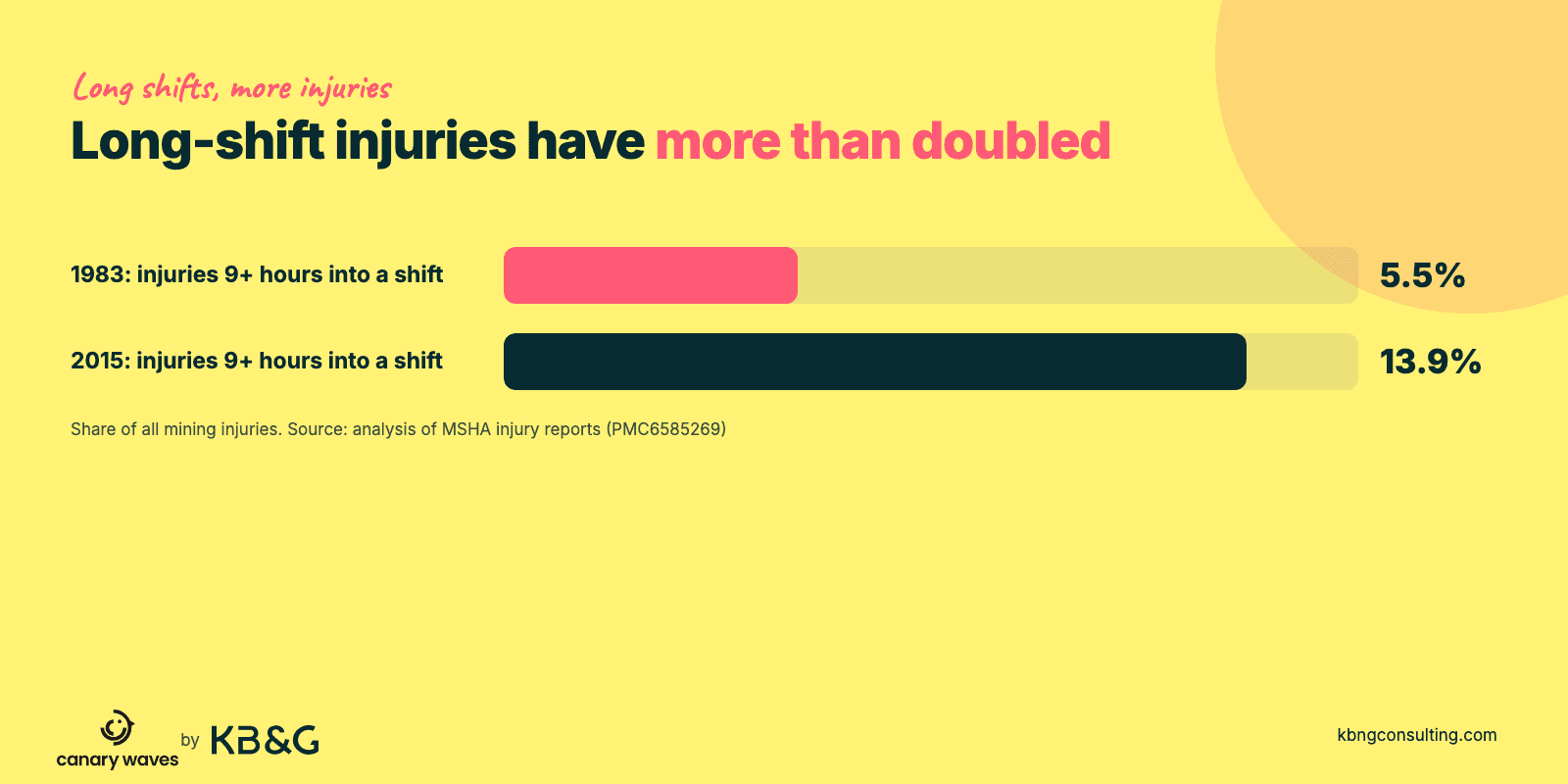
Unplanned overtime layered on top of already-long shifts, creating duty periods that exceed safe limits. An analysis of MSHA injury reports found that the share of mining injuries occurring nine or more hours into a shift grew from 5.5% in 1983 to 13.9% in 2015, and that these long working hour injuries were associated with higher odds of death.
Operations leaders should compare their current patterns to best-practice principles: limiting consecutive nights, building in genuine recovery days, and using forward-rotating rosters where feasible.
Remote Operations, FIFO, and Long Commutes
FIFO and DIDO patterns are standard across much of the mining industry, but the fatigue costs of travel are often under-counted. Long commutes, combined with bus transfers or light vehicle drives before and after shift, mean the total work-related duty period often far exceeds the rostered shift length. An exploratory analysis of public data sets by NIOSH researchers names commute duration and time of day alongside weekly work hours, shift work, work tasks and sleep as fatigue risk factors, and finds elevated risk among coal and metal mining workers.
Cumulative fatigue from remote operations comes from multiple sources:
Travel days that effectively become extra shifts, reducing recovery time at the start and end of a swing.
Camp accommodation with noise, light intrusion, shared facilities, and routine disruptions that degrade sleep.
Driving home fatigued at the end of a rotation, with elevated road crash risk.
Policies on travel time accounting, camp environment standards, and end-of-roster task loading can meaningfully reduce or worsen this exposure.
Monotony, Automation, and Cognitive Load
As the mining industry continues to automate haulage, drilling, and processing, there is a well-known irony: reducing manual labour can increase mental fatigue. When haul trucks, shovels, and plant operations become more automated, the remaining human roles shift toward monitoring: watching screens, waiting for alarms, intervening only when something goes wrong. This vigilance-heavy work is cognitively demanding in ways that are easy to underestimate.
Concrete examples include:
An operator in a remote operations centre watching multiple screens for hours with few active interventions, struggling to maintain alertness against the pull of monotony.
A haulage operator driving long, repetitive circuits in a surface pit with minimal variation in scenery, terrain, or tasks.
Design levers that can address fatigue from monotony include task variation (rotating workers between active and monitoring roles), regularly scheduled rest breaks, active monitoring interfaces that require periodic input rather than passive observation, and environmental design (lighting, layout, even music policies) that supports sustained attention.
These operational drivers are not inevitable. They are design choices, and they can be redesigned.
Building a Fatigue Risk Management Approach for Mining Operations
Regulators and industry bodies increasingly expect mining operations to implement fatigue risk management systems (FRMS): structured, evidence-based approaches to assessing fatigue risks and controlling them, rather than relying solely on awareness posters or individual responsibility. NIOSH's work on working hours and fatigue points in the same direction. This section outlines a practical approach that any operation can start, whether beginning from scratch or refreshing existing initiatives.
Step‑By‑Step: Designing or Refreshing Your Fatigue Program
Map your fatigue risks: Review incident and near-miss reports for time of day, hours into shift, and recent overtime. Examine roster patterns: number of consecutive nights, turnaround times, planned versus actual overtime. Identify known "tired zones" in the shift cycle where fatigue-related risks concentrate.
Involve crews: Run focused toolbox sessions or small-group discussions to gather practical input on when and where fatigue bites hardest. Operators may identify pre-dawn periods, specific haul legs, or particular roster transitions. Qualitative input from crews is essential alongside quantitative metrics.
Set clear controls: Define controls across scheduling (limit consecutive nights, cap overtime), task design (rotate between active and monitoring roles), breaks (mandatory micro-breaks during long tasks), supervision (fitness-for-duty check-ins), and training (fatigue awareness, sleep hygiene education).
Enable early reporting: Establish low-consequence ways for workers and supervisors to flag fatigue concerns: call-up codes on radio, confidential reporting channels, or simple verbal check-ins built into pre-starts. Protect workers from negative consequences when they raise concerns in good faith.
Monitor and learn: Define a small set of leading indicators: overtime hours, consecutive night counts, near-miss rates in extended-shift periods, radio communication anomalies, training participation. Review these monthly and adjust controls.
Integrate into safety management: Embed fatigue into risk registers, Job Hazard Analyses (JHAs), pre-start checklists, and critical control verification. Fatigue should sit alongside other critical safety risks in your management system, not in a separate silo.
Controls Across the Fatigue Hierarchy of Controls
Managing fatigue follows the same hierarchy of controls used for any safety risk: eliminate first, then substitute or engineer, then administer, and only then rely on individual strategies.
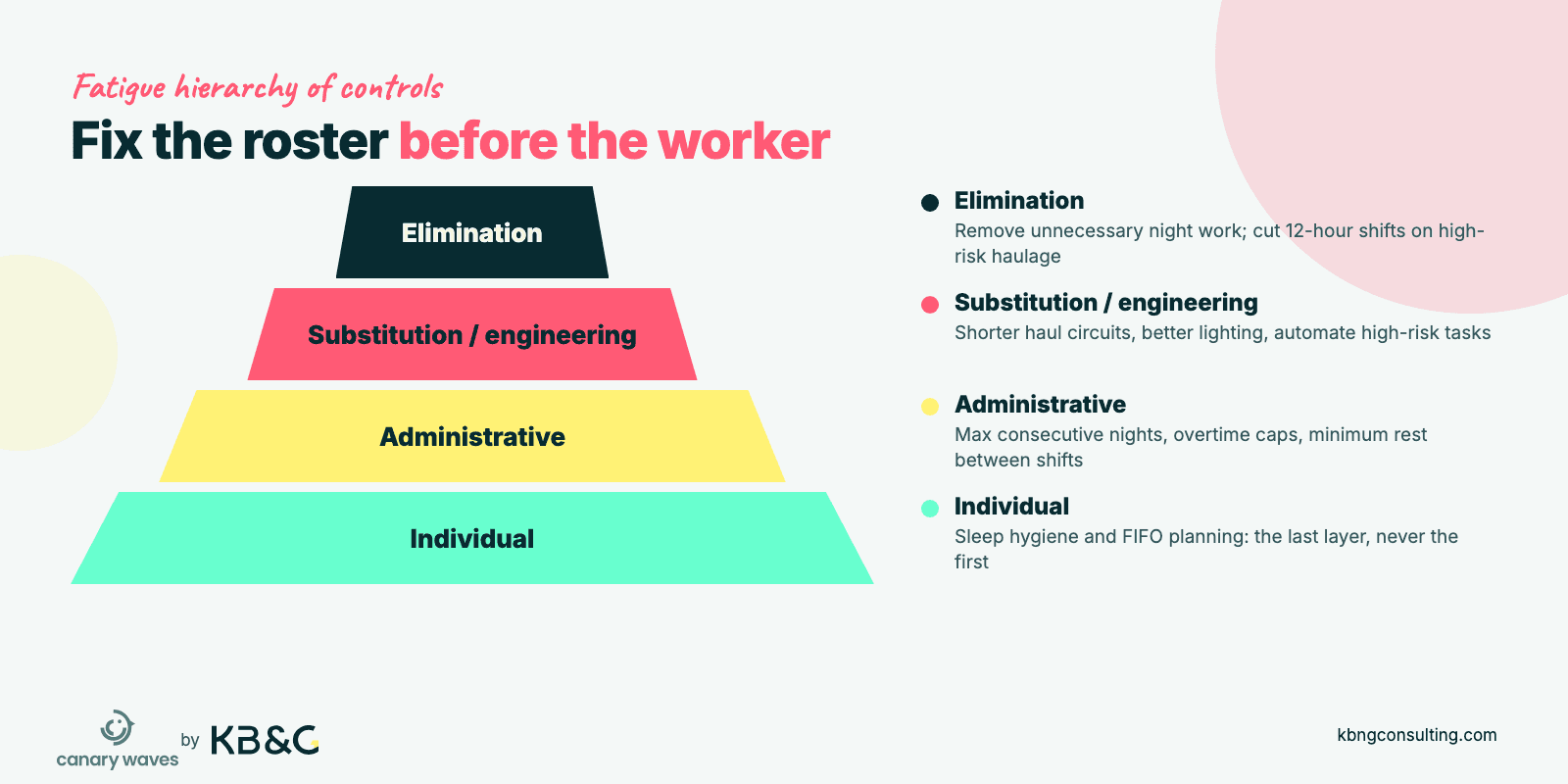
Control Level | Example in Mining Operations | What to Watch For |
|---|---|---|
Elimination | Remove unnecessary night work; reduce 12-hour shifts in high-risk haulage tasks | Whether "essential" night work is genuinely essential or simply inherited from old rosters |
Substitution / Engineering | Redesign haul routes to shorten circuits; improve underground lighting; automate high-risk manual tasks | Whether engineering changes create new monotony or cognitive load risks |
Administrative | Enforce roster rules (max consecutive nights, recovery days), overtime caps, minimum rest between shifts, fitness-for-duty assessments | Whether rules are consistently applied or quietly overridden under production pressure |
Behavioural / Individual | Sleep hygiene education, nutrition and hydration guidance, personal planning for FIFO swings | Whether individual strategies are treated as the primary control rather than a last layer |
The critical point: culture and leadership behaviours determine whether these controls are used as intended. If senior leaders publicly endorse adequate breaks and then privately pressure supervisors to skip them for production, the controls fail. Sleep hygiene education helps, but it cannot substitute for organisational accountability.
Where Technology Helps, and Where It Doesn't
A growing range of fatigue detection technologies is available to mining operations:
Wearable devices (wrist-based actigraphy, smart caps, glasses) that track sleep patterns, heart rate, movement, and eye behaviour.
In-cab cameras and alertness systems for haulage fleets that flag drowsiness indicators like eyelid closure or head position.
Predictive fatigue models that forecast fatigue risk before shifts start, using biomathematical models based on rosters and sleep data.
Real-time monitoring systems that alert supervisors when thresholds are breached during a shift.
These technologies can add a genuine safety layer. A study of fatigue management in Queensland mining identified greater use of fatigue detection technologies as one of several supplementary controls, alongside better consideration of mental health outcomes and processes to monitor longer-term health effects.
However, limits and challenges are real:
Privacy and trust: Crews and unions may distrust wearable or camera monitoring, especially if data is perceived as punitive rather than protective.
Device fatigue: Too many gadgets create charging, maintenance, and compliance burdens. Inconsistent use undermines data quality.
False positives and negatives: Camera-based systems often only detect fatigue at critical levels (such as extended eye closure), which may be too late. False alarms erode trust; missed detections create false confidence.
Context blindness: Technology without human interpretation and cultural context generates data, not understanding.
Technology is best positioned as one input into a fatigue risk management system, not a silver bullet. Combining it with human observation, speak-up norms, and cultural measures delivers far more than any device alone. The question is not "what technology should we buy?" but "how do we build a system where fatigue is visible, reportable, and actionable?"
Common Challenges in Managing Fatigue in Mining (and What To Do About Them)
Most mining operations face similar sticking points when they try to move beyond awareness campaigns to genuine fatigue management. These challenges are practical, cultural, and organisational, and each has workable responses.
Production Pressure vs. Rest Breaks
Problem: Supervisors and crews feel they cannot take regular breaks or rotate tasks because of truck queues, processing targets, or contractor schedules. The perception is that pausing costs production.
Solution:
Set non-negotiable minimum break standards in procedures, endorsed visibly by senior leadership. Rest breaks are a control, not a reward.
Align performance metrics and KPIs so that supervisors are not penalised for using adequate breaks when fatigue risk is elevated. Measure safety outcomes alongside production.
Reference the cost of not pausing: a single fatigue-related incident (equipment damage, serious injury, regulatory investigation) can far exceed the cost of short, scheduled breaks. Managing fatigue protects both people and output.
Stigma and Under‑Reporting of Fatigue
Problem: Workers worry that admitting to fatigue will be seen as weakness or poor attitude, especially on FIFO sites or in contractor workforces. This hides the true scale of fatigue across the operation.
Solution:
Leaders model speaking up about their own fatigue and limitations, normalising the conversation. If a supervisor can say "I'm running flat today, I'm taking a break and adjusting my plan," it signals permission for everyone.
Protect workers from negative consequences when they raise fatigue concerns in good faith. A just safety culture makes this explicit and enforced.
Embed fatigue questions into regular safety conversations and pre-starts, not just annual campaigns or training days. Make it routine, not exceptional.
Fragmented Data and Blind Spots
Problem: Fatigue information is scattered across roster tools, incident reports, in-cab camera systems, and anecdotal supervisor notes. Patterns are hard to see, and no one person owns the full picture.
Solution:
Nominate an owner (typically the safety or operations lead) for fatigue data, analysis, and reporting.
Define a small set of leading indicators to track consistently: overtime hours, consecutive night shift counts, minor vehicle contacts, missed radio calls, training attendance, and fatigue flags from any monitoring system in use.
Establish a simple monthly review where fatigue patterns and responses are discussed at the same level as other critical controls: ground stability, traffic management, isolation procedures.
These challenges are not reasons to delay action. They are the normal friction points of building a mature fatigue risk management approach, and each one yields to practical, sustained effort.
Conclusion and Next Steps
Fatigue in mining is a predictable, manageable hazard driven primarily by how work is organised: shift schedules, commute expectations, task design, and cultural norms around rest and reporting. Early signs appear in behaviour and communication: slower responses, flat or sharp tone, missed procedures, reduced engagement. Effective control demands integrated cultural, organisational, and technical responses rather than reliance on any single measure.
Within the next 30–90 days, a safety or operations leader can take these concrete steps:
Run a quick fatigue risk review using the last 6–12 months of incidents, rosters, and overtime data. Look for time-of-day and hours-into-shift patterns.
Brief supervisors on specific early communication and behaviour signs to watch for this month, using the signals described in this article.
Pilot one low-cost roster or break adjustment in a high-risk crew and measure impact on near misses and worker feedback.
Open a simple fatigue speak-up channel (a call-up code on radio, a confidential reporting option) and communicate clearly how it will be used and protected.
One way to close the gap between what is said on site and what leadership can see is voice-based safety intelligence. Canary Waves by KB&G runs passively on existing two-way radio, with no new devices for crews to wear, charge, or maintain. It tracks tone and communication patterns on the radio, which can be an early signal of strain, so supervisors can check in with a crew before a pattern becomes an incident.
Fatigue risk management is not a side project. It is central to serious injury and fatality prevention and to the long-term health and safety of every person on site. As the mining industry adopts more automation and AI, the role of these tools is to support, not replace, frontline judgment, human observation, and a culture where addressing fatigue is everyone's responsibility.