
Introduction
A founder audit is a structured evaluation of your skills, decisions, habits, and blind spots as the founder, not just a review of your business metrics. If you've shipped an AI or SaaS product but conversions aren't coming, the bottleneck is almost certainly something you're doing, avoiding, or not seeing. A founder audit systematically exposes those patterns across positioning, pricing, founder-led sales, decision-making, team dynamics, and the systems investors actually look at.
This article is for AI and SaaS founders between pre-seed and Series A who have a product in the market but aren't converting consistently. It won't cover tax compliance, legal audits, or financial accounting. If you're stuck in the place where you feel like you've tried everything (more features, more LinkedIn posts, more calls) and still don't have real traction, this is for you.
Direct answer: A founder audit is a structured evaluation of a founder's skills and readiness that identifies personal blind spots and operational bottlenecks, then provides a roadmap to improve business readiness and execution. It typically takes one to two weeks and outputs a single primary constraint you can fix in 90 days, plus an action plan to address it.
Here's what you'll walk away with:
A clear understanding of what a founder audit is and how it differs from coaching, therapy, or a funnel review
The six dimensions every founder audit should cover, with concrete checklists
A step-by-step process to run your own audit in under two weeks
How to interpret your findings without spiralling into self-blame or analysis paralysis
When to bring in an external diagnostic to challenge your own conclusions
Most "free audit" offers you'll find online are a sales call in disguise. This one you can run yourself, for free, with nothing but honesty and two weeks of attention.
Understanding the Founder Audit
A founder audit is a structured review of how your decisions, habits, strengths, and blind spots are driving or stalling your company's growth. It evaluates personal motivations, long-term vision, leadership style, and time allocation, then connects those things directly to business outcomes like revenue, conversion rates, and investor readiness.
This matters more in AI and SaaS startups than in most other businesses. At the early stage, you're the CEO, the salesperson, the product architect, and often the operations lead. Every choice about who you serve, how you price, how you sell, and what you build next flows through you. A small mismatch in any of those areas compounds fast into long sales cycles, low close rates, and investors telling you to "come back with more traction."
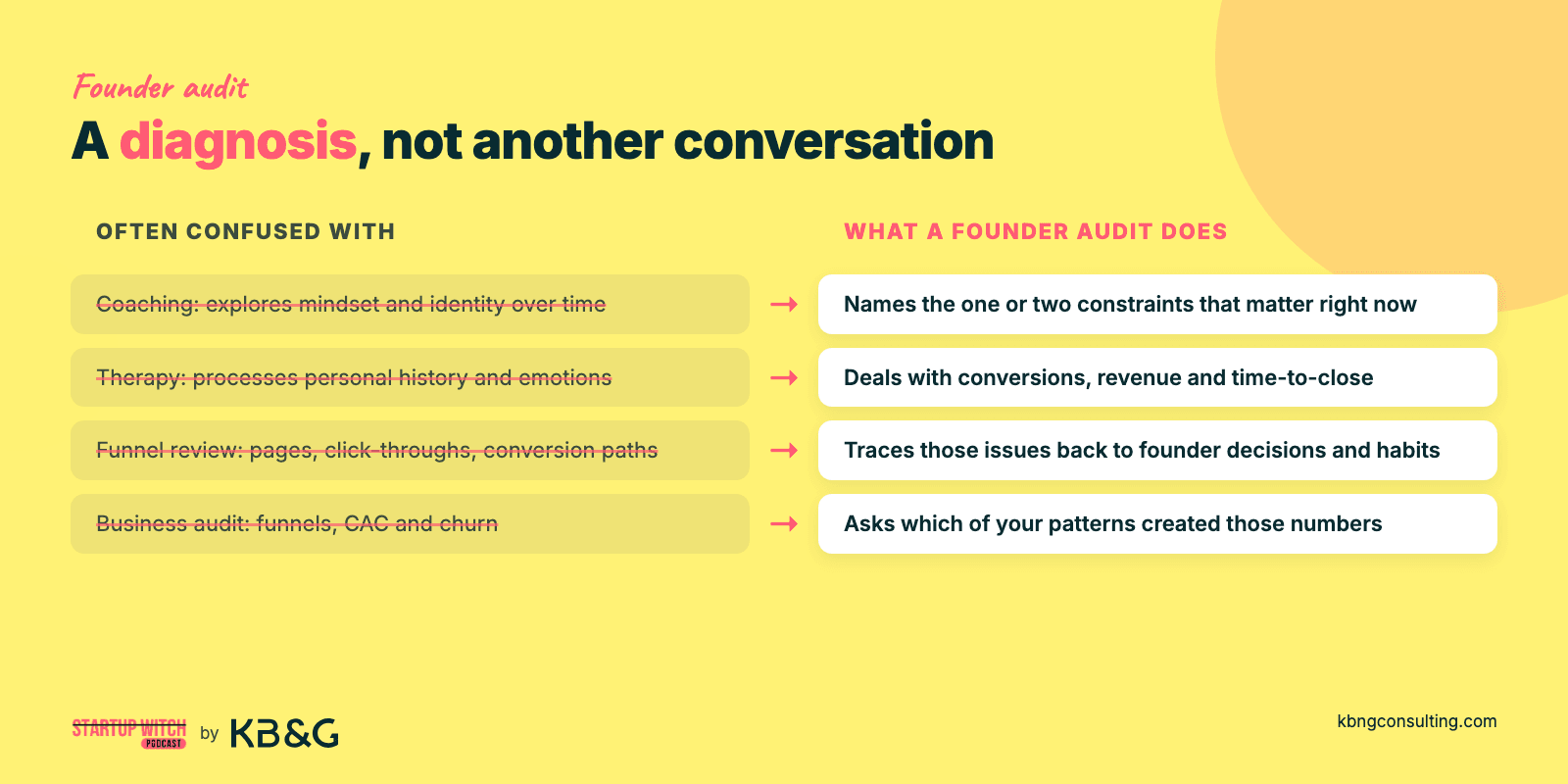
A generic business audit looks at funnels, CAC, and churn. A founder audit zooms in on the human at the centre of the system. It asks: which of your patterns created those numbers?
Core Business Dimensions of a Founder Audit
A proper founder audit covers six pillars. Each one examines a specific area where founders commonly get in their own way:
Positioning and narrative: How you talk about the problem, who it's for, and why you're credible. Investors and early clients care because unclear positioning kills conversion before a demo even starts.
Pricing and offer design: Whether your price reflects the value you deliver or is a guess copied from a competitor site. Buyers care because confused pricing signals unclear value.
Founder-led sales behaviour: How you run discovery calls, whether you listen or demo, whether you ask for the close. This is where revenue lives or dies at your stage.
Decision-making and prioritisation: How you choose what to work on each week. Investors assess whether you can execute with discipline or are reactive under pressure.
Team and delegation: Whether roles are clear, whether you're the bottleneck for every decision. A founder audit brings clarity to team structures and roles, and can prevent founder burnout by promoting better delegation.
Systems and metrics: Whether you have a pipeline view, clear targets, and clean data. Investors look for replicable systems in early-stage startups, not just promises, and they read efficient use of capital from clean systems and targets.
The audit looks for patterns, not isolated mistakes. It identifies recurring behaviours that show up across your pipeline, product roadmap, and team dynamics. Founder audits can identify single points of failure in operations that you'd otherwise miss.
How a Founder Audit Differs from Coaching, Therapy, or a Funnel Review
These get confused constantly. Here's the difference:
Coaching vs. audit: Coaching helps you explore mindset, potential, and identity over time. A founder audit diagnoses and names the one or two constraints that matter most right now. It's diagnostic and action-oriented, not ongoing exploration.
Therapy vs. audit: Therapy processes personal history, emotional patterns, and mental health. A founder audit deals with business outcomes: conversions, revenue, time-to-close. If you're in a serious burnout or mental health crisis, you need clinical support, not a business diagnostic.
Funnel review vs. audit: A standard funnel audit looks at pages, click-through rates, and conversion paths. A founder audit connects those visible issues back to specific founder decisions and habits: why your messaging is vague, why your pricing page confuses people, why leads go cold after the first call.
Understanding these distinctions matters because it determines whether a founder audit is the right tool for where you are today.
When You Need a Founder Audit (and When You Don't)
Now that you know what a founder audit is, the question is timing. Key reasons startups need audits include identifying risks and improving execution, but only when you're past the napkin-sketch stage and have something real in the market. The audit is most useful when things are "kind of working but not enough."
Clear Signals You Need a Founder Audit
These are concrete situations where a founder audit will surface the answer you're searching for:
Low close rate on founder-led calls. You're doing 15–20 demos but converting one or two. You've told yourself it's a lead quality problem, but you haven't asked whether your discovery process, pricing, or positioning is the real issue.
Investors keep saying "too early." You're getting meetings, but the answer is always vague: "come back with more traction." Operational chaos can disqualify startups from investor consideration, and you may not realise your lack of clean systems is the signal they're reading.
Feature bloat without paying users. Your product roadmap keeps growing based on edge-case requests, but the number of people who have actually paid you money stays flat. The roadmap is driven by curiosity or fear, not data.
Conflicting mentor advice. A handful of advisors are all telling you different things. One says go enterprise. Another says go PLG. You can't prioritise what to test next because you haven't named the core constraint.
Team confusion. Your team doesn't know whether the priority for the next 90 days is building, selling, or fundraising. Roles are fuzzy. People are guessing what matters.
Fragile, single-channel revenue. Your pipeline depends on one design partner or one LinkedIn content strategy. If that channel breaks, everything breaks.
Situations Where a Founder Audit Is Overkill
A founder audit is not always the right tool. Don't use one if:
You're pre-product and still validating whether the problem exists. You need customer discovery interviews, not an audit of your operating patterns.
You have a pure compliance or financial question. Tax, legal, or accounting issues require specialists, not a founder diagnostic.
You're in a serious personal crisis. If burnout or mental health is the primary issue, address that first with professional support.
You have a working growth engine at scale. Post-Series A with repeatable revenue? You likely need specialised growth or operations help, not a deep founder-level diagnostic.
Once you recognise that you need one, the next step is knowing exactly what it should cover.
What a Founder Audit Actually Covers
A thorough founder audit doesn't skim the surface. It systematically works through a defined set of areas where founders commonly get in their own way. A founder audit examines whether the founder's vision aligns with market realities, and whether daily behaviour matches stated priorities. Here's each dimension broken down with specific checks for AI and SaaS startups.
Positioning, Narrative, and Founder-Market Fit
This part of the audit looks at how you talk about the problem, who it's for, and why you're the right person to solve it.
Do you lead with the outcome or the technology? Many AI founders open with "we use large language models to..." when buyers want to hear "we cut unplanned equipment downtime." If your homepage, calls, and pitch deck lead with AI rather than the customer's expensive problem, your positioning needs work.
Is your ICP narrow enough? Saying "we serve industrial companies" is not a positioning statement. Saying "we serve maintenance managers in open-pit mining operations" is. A focused ICP changes everything downstream: messaging, pricing, channel, even product decisions.
Are you using your founder story? Your past, whether you're an ex-operator, ex-data scientist, or someone who lived this problem through your career, is your strongest signal. Investors and early clients listen for credibility. If you're hiding behind generic jargon, you're leaving your most powerful positioning tool unused. As CYCLE agency's work on founder-led positioning puts it, your "founder signal" is what only you can credibly claim.
Are different audiences hearing conflicting stories? If your site says "platform," your sales calls say "point solution," and your pitch deck says "infrastructure layer," you have a narrative consistency problem that confuses everyone in the rooms where decisions get made.
Pricing, Packaging, and Offer Design
The audit scrutinises how you've set price, packaging, and risk for your early buyers. A founder audit identifies revenue leaks in operations, and pricing is often the biggest one.
Is pricing anchored on value or guessed? Underpricing is one of the most common SaaS founder blind spots, and pricing is often the fastest revenue lever you have because it doesn't require a single new customer. If your price came from scanning competitor sites, it's almost certainly wrong.
Do packages map to real buyer realities? "Basic / Pro / Enterprise" tiers are lazy defaults. For industrial AI, buyers think in terms of site-based pricing, pilot contracts, and production licenses. Your packaging needs to match their procurement process, not your SaaS template.
Is the founder underpricing to avoid rejection? This is one of the most common patterns. You'd rather give a low price and get a "yes" than risk hearing "no." But underpricing erodes your margins, confuses your value proposition, and signals lack of confidence.
Are pilots structured to convert? In long-cycle industries like mining or manufacturing, "pilot purgatory" is real: endless tests that never become production contracts. The audit checks whether your proofs-of-concept have clear success criteria, timelines, and conversion terms defined upfront.
Founder-Led Sales, Clients, and Customer Discovery Habits
This is a deep review of how you personally run sales, discovery, and demos. At your stage, founder-led sales is necessary, but it becomes a ceiling when you're required in every deal.
Who are you actually talking to? Document the titles, industries, and company sizes of every person you've spoken with in the past month. If a prospect came through a webinar or podcast, record that source too. If there's no pattern ("whoever takes a call"), you don't have a sales strategy. You have a calendar.
Are calls demo-heavy or discovery-heavy? If you spend 80% of a call showing features and 20% asking questions about the buyer's problem, you're presenting, not selling. Great discovery means you listen more than you talk, quantify the buyer's pain in their language, and understand who else needs to say yes.
Do you ask for clear next steps? "Let's keep in touch" is not a next step. "Can we schedule a 30-minute pilot scoping call with your ops lead next Tuesday?" is. Vague follow-ups are where deals go to die.
For industrial AI: do you understand on-site realities? If you're selling to mining operations or manufacturing plants, you need to understand permits, unions, safety protocols, and operator workflows. Selling from a laptop without that context makes your product feel academic, not operational.
Decision-Making, Prioritisation, and Time Use
A founder audit assesses a founder's time allocation and leadership style because how you spend your hours determines your trajectory.
Run a two-week time audit. Track how many hours you actually spend building vs. selling vs. fundraising vs. admin. Most founders discover they spend far more time on product and admin than on the revenue-generating work that matters at this stage. AI tools can automate repetitive administrative tasks (scheduling, CRM updates, data entry), freeing you to focus on the things only a founder can do.
How are roadmap decisions made? Are you building features because users asked for them, because an investor mentioned them, because a competitor launched them, or because your instinct says so? Each of these has a different evidence base and a different risk profile. Note which pattern dominates your past decisions.
Do you have an operating rhythm? A simple weekly priorities session and monthly metrics review keeps you proactive. Without it, you're in constant reactive mode, responding to whatever's loudest rather than what's most important. Basic operational systems prevent founders from becoming bottlenecks in decisions.
Can you kill ideas? The ability to stop things, not just start them, is a critical founder skill. If your product backlog only grows and never shrinks, your prioritisation is broken.
Team, Delegation, and Communication
This section focuses on how you use your team as leverage, or don't. A founder audit helps align personal goals with business needs and can reduce dependency on the founder for decision-making.
Are you the bottleneck? If every decision and every customer conversation flows through you, you're not leading; you're clogging the system. A founder audit improves team empowerment and retention by identifying where authority can be distributed.
Are roles clear? Who owns product? Who owns sales? Who owns operations? If the answer to all three is "me, kind of," you have a delegation problem. Clear roles let people execute without waiting for you.
Are you delegating execution but hoarding decisions? This is subtler. You might hand off tasks but keep every meaningful choice to yourself. The result: your team does busy work while you become the chokepoint for anything strategic.
How do you communicate priorities? Especially with remote or hybrid teams, your people need to know what matters this week, this month, this quarter. If you haven't posted clear goals somewhere your team can reference, don't be surprised when they build the wrong things.
Systems, Metrics, and What Investors Actually Look At
Investors don't just look at MRR. They look at how you run the business. Clean systems enhance your credibility with investors, and operational systems matter even before product-market fit.
Pipeline visibility. Is there a simple, up-to-date view of your pipeline by stage and segment that you actually review weekly? If the answer is "it's in my head" or "somewhere in a spreadsheet I haven't opened," that's a problem.
Clear target metrics. Do you have specific targets for the next 6–12 months (number of design partners, active pilots, revenue milestones) or just "grow"? Your pitch deck is the script for investors, and it needs to reflect measurable progress against stated goals. According to CRV on how investors evaluate teams, decision rights, past failure, and ability to learn matter enormously at the earliest stages.
Experiment tracking. How are you recording what you've tested and learned? Pricing experiments, messaging tests, channel experiments: if there's no document tracking these, you're repeating mistakes.
Pilot-to-production conversion. For industrial AI: are your pilots structured to convert into production contracts, or are they left as endless "tests" with no clear end date or success criteria?
Data hygiene. How clean is your data on churn, usage, and engagement, even at small scale? Investors want evidence, not stories.
With these six dimensions mapped, the next section walks you through exactly how to run this audit yourself, step by step.
How to Run Your Own Founder Audit Step by Step
You can run a useful first founder audit in one to two weeks without hiring consultants, as long as you're brutally honest and structured. Here's the process.
Step 1: Collect Candid Input (Not Just Your Own)
You need raw, unfiltered data from clients, team, and investors before interpreting anything. Your own perspective is required but insufficient.
Identify 5–10 recent or current prospects (won, lost, and "stuck") and schedule 20-minute calls.
Ask 4–5 consistent questions: Why did you buy / not buy? What confused you? What almost made you say yes? What would need to be true for this to be a priority?
Ask 2–3 team members or advisors to give anonymous feedback on your strengths and on patterns they see slowing things down.
Gather all recent investor feedback emails and notes into one document. Look for repeated language: the same concern from multiple people is a signal, not noise.
Step 2: Map Decisions to Outcomes
The goal here is to tie specific founder decisions to real-world outcomes. This is where the analysis gets honest.
List 10–15 major decisions you've made in the past 12–18 months: pricing changes, ICP pivots, hires, go-to-market choices, feature bets.
Next to each, note the concrete outcome: what changed in revenue, pipeline, product usage, or team behaviour.
Highlight where your instinct was right vs. where you overrode data or advice and paid for it.
Pay extra attention to decisions you keep revisiting. If you've changed your ICP three times, that's not iteration; it's a positioning problem.
Look for the points where a single decision created cascading effects, positive or negative.
Step 3: Run the Six-Dimension Checklists
This is the heart of the founder audit. For each dimension, score yourself honestly (1–5) or mark true/false. Copy them into a working document; don't just read them.
Positioning: Can I explain my product's value in one sentence without saying "AI"? Is my ICP specific enough that I could name 50 companies? Is my founder story visible in my pitch?
Pricing: Is my price based on the value I deliver, or did I copy it? Have I tested raising prices in the past six months? Are pilots structured with conversion criteria?
Founder-led sales: Am I doing at least 5 discovery calls per week? Do I listen more than I present? Do I ask for a clear yes/no and next step on every call?
Decision-making: Do I have a weekly priority list I actually follow? Can I point to 3 features or initiatives I killed in the last quarter? Do I track where my time goes?
Team: Does everyone know their role and their key metric? Can my team make decisions without me for a day? A week?
Systems: Do I review pipeline weekly? Do I have a simple dashboard with 3–5 key metrics? Are experiments logged somewhere the team can access?
Step 4: Name One Primary Constraint
The goal is not a 40-issue list. It's one thing. A founder audit provides a roadmap to improve execution, but only if you can name the constraint clearly.
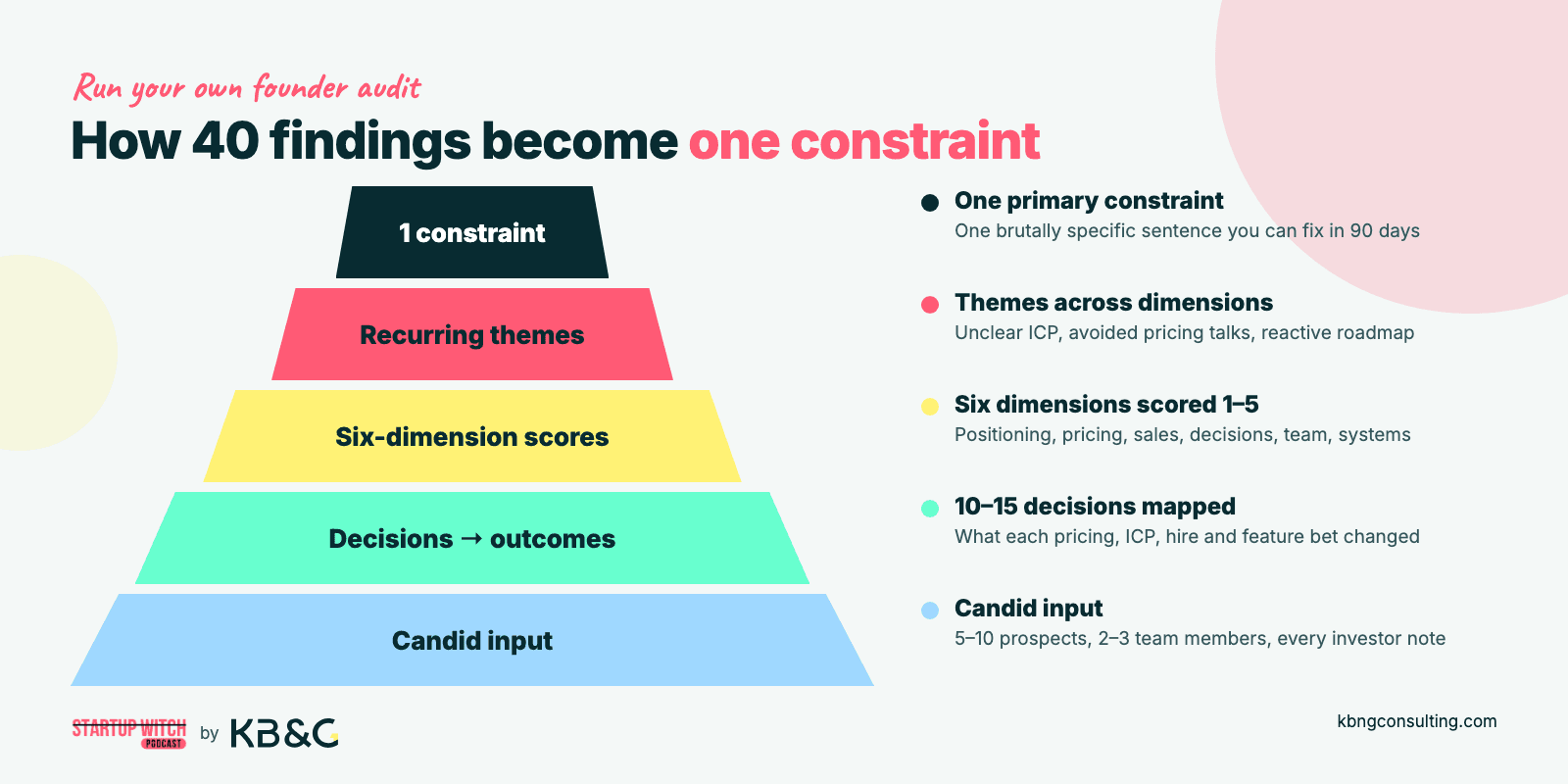
Group all your findings by theme: "unclear ICP," "avoidance of sales calls," "reactive roadmap," "no pricing discipline."
Ask: which theme shows up across the most dimensions and data sources?
Write a one-sentence problem statement that is brutally specific. Not "I need to sell more." Instead: "I avoid direct pricing conversations on discovery calls, so I never get real feedback on willingness to pay, and deals stall."
Check that this constraint is truly under your control, not purely external ("the market isn't ready" is almost never the real constraint).
Step 5: Turn the Audit into a 90-Day Plan
An audit without action is just a diary. A founder audit prepares the company for scalability, but only if you implement what you've learned.
Define 1–3 specific outcomes for the next 90 days tied directly to your main constraint (e.g. "Run 30 discovery calls with maintenance managers in mining," "Test two pricing tiers with 10 prospects each," "Close 2 pilot agreements with clear conversion criteria").
Choose 3–5 actions you will commit to weekly. Make these non-negotiable.
Decide what you will stop doing to make space. If you're building non-essential features, pause them. If you're sending content to a channel that isn't converting, stop.
Set a simple review cadence: weekly self-check, monthly mini-audit update. Regular founder audits help catch operational drift early.
With your plan in place, the next step is learning how to read patterns in your findings without overcorrecting or beating yourself up.
Interpreting Your Founder Audit: Patterns, Not Punishment
The point of a founder audit is not self-blame. It's to recognise patterns you can change and to double down on what's strong. Founder audits clarify decision-making; they don't exist to prove you're "the problem."
Recognising Product vs. Go-To-Market vs. Founder-Behaviour Problems
Many founders assume they have a product problem when the audit shows a sales or positioning problem. Here's how to tell the difference:
Product issues: Users actively try your tool and bounce quickly. You see clear complaints about missing must-have capabilities. Usage data shows people start workflows and abandon them at the same point.
Go-to-market issues: Strong interest on calls, but long delays and confusion about who the decision-maker is. Buyers don't understand the ROI narrative. Pricing conversations feel awkward or are avoided entirely. You may simply be targeting the wrong segment.
Founder behaviour issues: Inconsistent outreach: five calls one week, zero the next. Avoiding pricing conversations. Constant context-switching between building, selling, fundraising, and admin. Making decisions based on the last person who told you something, rather than accumulated evidence.
Making Changes Without Nuking What Works
A founder audit should produce focused adjustments, not a full reset.
Change one primary thing at a time. If your biggest constraint is unclear ICP, fix that before also changing pricing and product simultaneously. Stacking changes makes it impossible to know what worked.
Preserve assets that are clearly working. If one specific use case in one sector generates all your interest, that's your foundation. Don't abandon it to explore something shinier.
Communicate changes to your team and early customers. People who have invested time in your product or company deserve to know what's shifting and why. Trust is hard to rebuild.
Use simple experiments before rebuilding. Test new messaging on 10 calls before redesigning your site. Test a new price with the next 5 prospects before overhauling your packaging.
How Often to Repeat a Founder Audit
A full founder audit every 6–12 months. A lighter check-in (revisiting your primary constraint, reviewing your 90-day plan, and checking your six-dimension scores) every quarter.
Pre-seed to seed: More frequent small audits, roughly every 3 months. You're iterating fast and approaching product-market fit. Things shift quickly, and the opportunity cost of staying on the wrong path is high.
Post-Series A: Focus audits around big transitions: new market entry, new product line, major funding rounds. At this level, the audit is less about survival and more about scaling the right things.
Which brings us to the traps that sabotage this entire process.
Common Founder Audit Traps and How to Avoid Them
Founders often sabotage their own audit by filtering feedback, overcomplicating the process, or using results as proof that they're fundamentally flawed. Here are the most common traps and direct fixes.
Trap 1: Treating Feedback as a Personal Attack
When a customer tells you your pricing made no sense, or a team member says you change direction too often, it stings. The natural response is to defend, explain, or dismiss. A founder audit is not a character trial.
Fix: Treat every painful comment as a datapoint about behaviour, not identity. Write it down verbatim before you react. If three people independently mention the same thing, it's not an opinion; it's evidence. Founder audits highlight areas for upskilling, coaching, or hiring, not areas where you're broken.
Trap 2: Turning the Audit into a 60-Page Project
The risk of analysis paralysis is real. You start collecting data, making spreadsheets, interviewing people, and suddenly the audit itself becomes a project that delays the work it was supposed to accelerate.
Fix: Enforce hard limits. Two weeks maximum. One-page summary. One primary constraint named. Then return to shipping and selling. The audit is a tool, not an end.
Trap 3: Ignoring the "Uncomfortable but Obvious" Pattern
The real pattern often feels obvious in hindsight. "I haven't made time for sales in months." "I keep building features no one asked for." "I avoid the pricing conversation on every call." But founders look for complex, intellectually satisfying answers instead of the simple, uncomfortable one.
Fix: Specifically look for the pattern you keep rationalising away. The thing you've been told multiple times but dismissed. Commit 90 days to testing the opposite behaviour. If you've been avoiding founder-led sales, make 5 calls a day for a month and see what happens.
Trap 4: Doing It Completely Alone
Self-audits have a fundamental limit: you're inside your own story. You will miss things. You will rationalise things. You will unconsciously weight findings toward what you already believe.
Fix: Involve at least one trusted operator, investor, or external diagnostic to challenge your conclusions and sanity-check your priorities. Asking for outside perspective isn't weakness; it's strong leadership.
Conclusion and Next Steps
A founder audit is a focused, repeatable way to see how your own decisions drive traction or stall it. It identifies personal blind spots and operational bottlenecks, then names one constraint you can fix in the next 90 days. And it turns "I've tried everything" into "I'm testing the right things."
It's not about judgement. It's about moving from guessing to doing the work that actually matters in your AI or SaaS startup today.
Your immediate next steps:
Block 2–3 half-days in the next two weeks to run your first founder audit.
Use the six-dimension checklists above to score yourself honestly.
Write a one-sentence primary constraint and a 90-day plan to attack it.
Decide who else (co-founder, operator, advisor) will review your findings with you.
If you want a structured, external version of this, the Founder Blind Spot Diagnostic by Startup Witch is a 14-day diagnostic (EUR 750, fully refundable) that reads your startup and names the one thing blocking growth.