What Is a Founder Personal Brand Audit?
A founder personal brand audit is a structured review of how you actually show up when someone Googles you, checks your LinkedIn profile, or asks an AI tool who you are, and whether that picture matches the story your startup needs to tell. For AI/SaaS founders doing founder-led sales, hiring, and fundraising, this audit is the difference between closing deals and watching prospects ghost you after a quick search.
This article is a DIY, no-agency-required guide focused on three surfaces: Google search results, your LinkedIn presence, and AI-generated answers from ChatGPT, Perplexity, and Google AI Overviews. It also covers the critical alignment between your personal story and your company narrative. The scope does not include paid advertising, PR strategy, or broad marketing campaigns; those are different problems.
If you're a technical or operator founder of an AI or SaaS startup (pre-seed to Series A), this is for you. You've shipped something real. You're doing the sales calls, interviewing candidates, talking to investors. But people still don't "get" what you do. Investors Google you before they take your meeting seriously. Enterprise buyers check your LinkedIn before replying to your cold outreach. Senior candidates evaluate whether you're worth the risk. A personal brand audit helps founders see themselves through the eyes of investors, customers, and talent, and fix what's broken.
A founder personal brand audit maps how you appear across Google, LinkedIn, and AI tools, scores what you find against five concrete dimensions, and produces a short list of specific fixes. You can complete a first pass in under 90 minutes.
Here's what you'll walk away with:
A clear picture of exactly what an investor, candidate, or enterprise buyer sees in the first 5 minutes of searching you.
Identified gaps between your personal story and your AI/SaaS product positioning.
A step-by-step audit checklist you can run in one sitting.
3–5 prioritised fixes that move sales, hiring, or fundraising forward.
A repeatable process you can re-run quarterly as your brand evolves.
Understanding a Founder Personal Brand Audit
Your personal brand is not a logo or a tagline. It's the story people infer about you from search results, profiles, content, and what others say. It's what a prospect concludes about you in the 90 seconds between your email hitting their inbox and them deciding whether to reply. For most founders, that story is either invisible, incoherent, or someone else's to tell.
A founder personal brand audit is the repeatable process of inventorying those signals across Google, LinkedIn, and AI tools, diagnosing where you're invisible or misaligned, and fixing the weakest parts. It assesses your brand's effectiveness, not your ego. It's not about becoming a LinkedIn celebrity or building a content empire. It's about reducing friction in founder-led sales, recruiting, and fundraising for your specific AI/SaaS business.
Why Your Founder Brand Is a Revenue and Fundraising Asset
Your founder brand shapes investor confidence, hiring, and customer trust. Here's how founder visibility hits your bottom line across three critical channels:
Founder-led sales. Your prospects search you before or after that first call. If your Google results show a half-empty LinkedIn profile and an old university project, you've introduced doubt before you've even demo'd.
Hiring. Senior candidates check your story and signal before they respond to your recruiter. They want to know if you're a serious leader or a risky bet. A clear, complete LinkedIn profile can make the difference between attracting top talent and hearing crickets.
Fundraising. Investors Google you, skim your LinkedIn, and now also test AI tools to see how "legible" you are. If you're invisible online, you're starting every investor conversation from a deficit.
The pattern we see most often is the "invisible builder": a founder who has shipped real product but has zero public proof and no narrative. The result is longer sales cycles, skeptical investors, and candidates who pass. You can't fix what you haven't seen. The audit gives you a blunt baseline.
Core Components of a Founder Personal Brand Audit
The rest of this article unpacks four components, each with its own mini-audit:
Google surface: What appears on page 1 when you search your name + company, and whether it builds or erodes trust.
LinkedIn surface: Profile, content, engagement, and network from the perspective of buyers, hires, and investors.
AI surface: How ChatGPT, Perplexity, and Google AI Overviews describe you and your company, if at all.
Narrative alignment: Whether your personal story and your startup's positioning tell one coherent, compelling story.
Each component uses a simple 1–5 scoring system so you can identify and prioritise fixes instead of trying to overhaul everything at once.
Let's start with where your brand actually lives.
Where Your Founder Brand Actually Lives: Google, LinkedIn, and AI
In 2026, your founder brand lives on three discovery surfaces: search results, professional networks, and AI-generated answers. Each one shapes perception differently, and each one has specific things to check. Understanding all three is essential to conducting an honest audit.
Google Surface: What Page 1 Says About You
"Google yourself" is still the first sanity check for any personal brand audit. It's what every investor, enterprise buyer, and senior hire does before they engage with you.
Open an incognito browser and run these searches:
Your full name + "AI" or "SaaS"
Your full name + company name
Your full name + city or sector (e.g., "computer vision," "mining tech")
Now look at what comes back. Here's what matters:
Do your LinkedIn profile and company site appear in the top 3–5 results? If not, you have a discovery problem.
Are there confusing duplicates? People with the same name in unrelated fields can crowd you out.
Are old startups, side projects, or student blogs dominating? These dilute your current brand.
Is there any press, podcasts, or media features that establish credibility? Note which links strengthen your AI/SaaS founder story and which ones contradict it.
Note everything down. You'll use it to design fixes later, including how to push strong assets higher and bury noise.
LinkedIn Surface: The Fastest Legibility Check
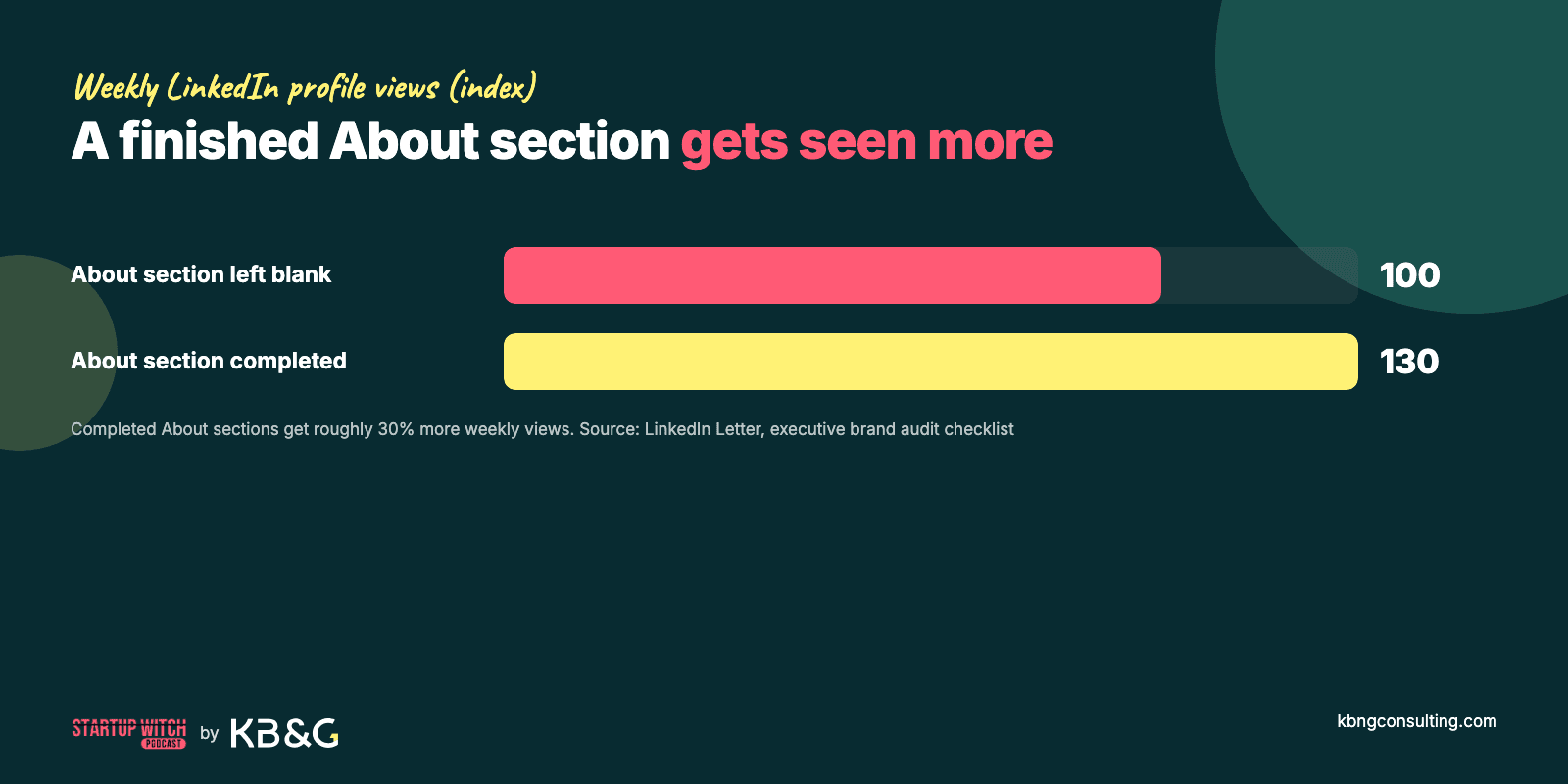
LinkedIn is usually the first click from Google for investors, candidates, and enterprise buyers. Your LinkedIn presence is your front door. Profiles with completed About sections get roughly 30% more weekly views than those left blank, and many founders leave theirs blank or generic.
Focus your audit on four sub-areas:
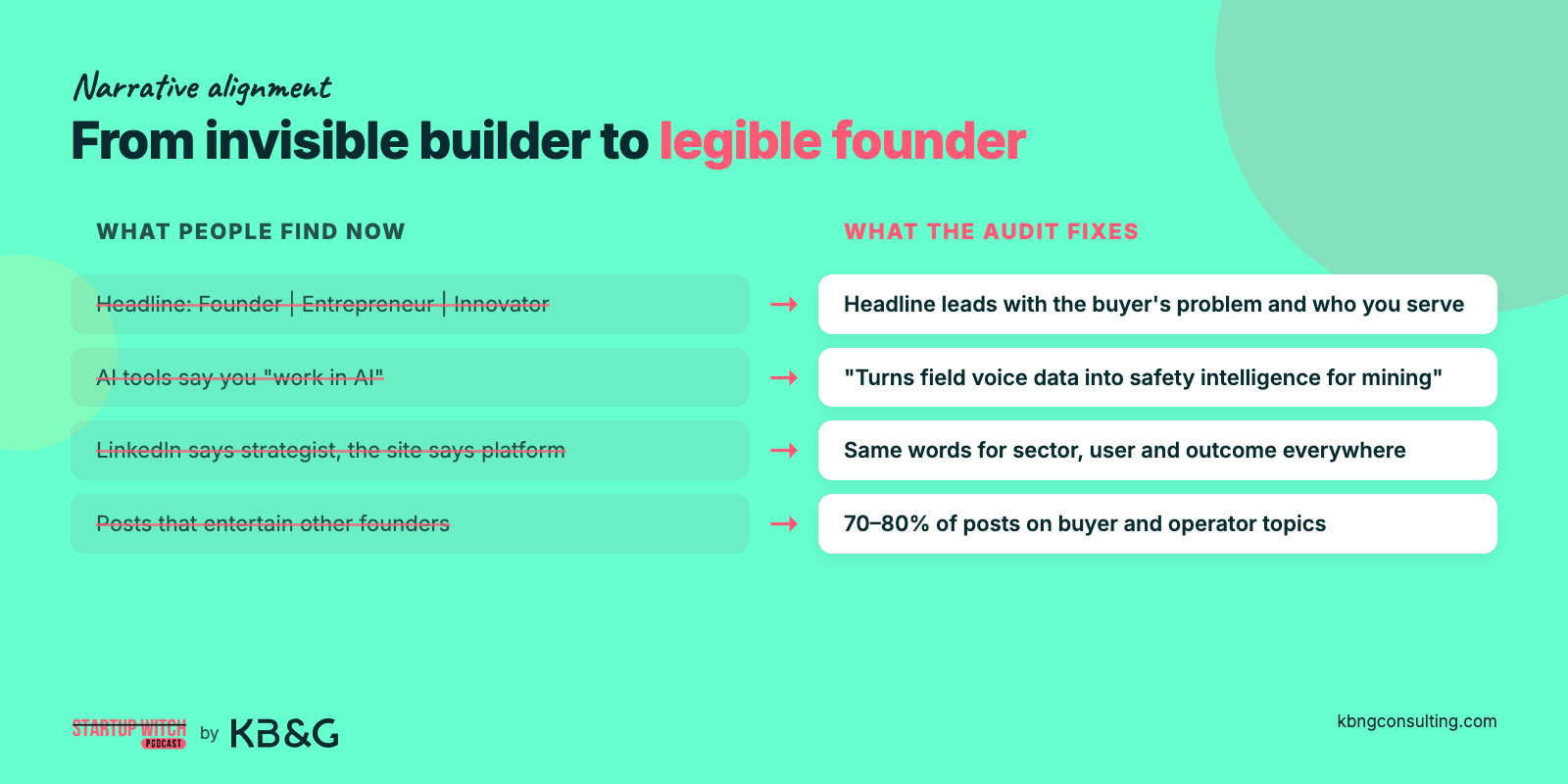
Profile basics. Headline, photo, banner, About section, Featured section. Does your headline communicate what you build and for whom, or does it just say "Founder | Entrepreneur | Innovator"? Leading with the customer's problem, not your title, is what makes a profile useful to a buyer or investor.
Recent activity. Look at your last 20 posts and comments. What topics do they cover? Are they speaking to your buyer profile with real insights, or are they generic startup motivation? The bar is lower than you think if you show up with quality.
Engagement quality. Who interacts with your posts? Buyers, senior operators, investors? Or mostly other founders and marketers? Engagement quality matters more than the number of likes on LinkedIn posts.
Network composition. Roughly split your connections: what percentage are ideal customer profiles vs. peers vs. investors and talent prospects? This affects both your credibility and your reach.
Run the "scroll test": in 5 seconds above the fold of your LinkedIn profile, can a stranger understand what product you build, whom for, and why you're credible? If the answer is no, that's your first fix.
AI Surface: How ChatGPT, Perplexity, and Google AI Overviews Describe You
AI answers have become a new discovery layer. Founders are now "looked up" via prompts, not only via search queries. Google has made Gemini 3 the default model for AI Overviews, producing summaries with links to web sources. Perplexity AI combines real-time web search with LLM generation, but reporting by Wired has raised concerns about accuracy.
Run these concrete tests:
Ask ChatGPT and Perplexity: "Who is [Full Name], founder of [Company]?"
Ask: "[Company] founder background" and "[Company] what does it do?"
Trigger Google AI Overview for "company name + founder" and "company name + sector."
Record what you find:
Do you show up at all? Does the model say it has no information? That's an invisibility problem.
Is anything factually wrong? Wrong roles, industry, stage, geography? AI hallucination risk is real: if your online footprint is messy, AI summaries can be damaging.
How are you described? Does it make you sound like a serious operator building an innovative product, or a vague "entrepreneur" or "business coach"? The difference between "works in AI" and "turns field voice data into safety intelligence for mining operations" is the difference between interest and a closed tab.
AI pulls from public sources (web pages, LinkedIn, press), so later fixes will focus on cleaning and feeding those sources.
Designing Your Founder Personal Brand Audit: A Practical Framework
Now you know where to look. This section gives you a structured way to score what you see so you can prioritise instead of trying to fix everything at once. The framework uses five dimensions, each scored 1–5.
This is designed for busy founders: you can run a first pass in 60–90 minutes and deepen it later.
Audit Dimension 1: Discovery & Legibility
What it measures: How easy it is to find you and understand, in under 30 seconds, what you build and why you're credible.
Checks to run:
Google page 1 contains at least one strong personal asset (LinkedIn, personal site, major interview).
Your name + company clearly associate you with a specific product category (e.g., "AI safety intelligence for mining," "B2B SaaS for pricing").
LinkedIn headline and banner pass the 5-second test for clarity.
AI tools can answer "who is [founder]" without hallucinating obvious nonsense.
Scoring:
1–2: You're hard to find or completely illegible. Search results are random or stale.
3: Findable but vague. An investor would still need a call to figure out what you do.
4–5: Instantly legible. Name and startup are tightly linked in search, LinkedIn, and AI.
Audit Dimension 2: Credibility & Proof
What it measures: Visible evidence that you can execute: past roles, shipped products, customers, or serious collaborators.
Signals to look for:
Past roles or projects that clearly relate to what you're building now (e.g., operations in mining, ML engineering at a B2B SaaS company).
Talks, podcasts, blog posts, or conference appearances on your domain. Even small, niche events count.
Case studies, pilot results, or quantified outcomes on your LinkedIn Featured section or company site.
Social proof: quotes from customers, advisors, or industry operators.
Scoring:
1–2: Nothing online suggests you can deliver. You look like a random LinkedIn profile with a half-built startup.
3: Some signals, but scattered. People must hunt to see proof.
4–5: Proof is front-loaded and obvious from your top links and profile.
Audit Dimension 3: Narrative Alignment (You vs. Company)
What it measures: How well your personal narrative and your company's positioning match, instead of feeling like two separate stories.
Items to assess:
Compare your LinkedIn About section with your company homepage copy. Do they describe the same problem and audience?
Check whether your "why I built this" story lines up with the product's stated value proposition.
Look for mismatched language: you talk "AI innovation studio" while your site says "generic consulting," or vice versa.
Ensure your personal content topics (posts, talks) support the category you want to own.
Scoring:
1–2: If someone reads both, they might assume you're running two unrelated careers.
3: Broadly aligned but messy. Jargon and focus differ.
4–5: Your personal story and the company story feel like two chapters of the same book.
Audit Dimension 4: Relevance to Buyers, Hires, and Investors
What it measures: Whether your public presence speaks to the people who move your startup forward, not just peers.
Items to review:
Scan your last 20 LinkedIn posts: how many would be obviously useful or interesting to your ideal buyer or candidate?
Check whether your headline and About section name the specific buyer persona (e.g., "mining operations leads," "CFOs at mid-market manufacturers").
Assess if your content addresses real decisions they face: pilots, procurement, pricing, safety, regulation.
Look at your followers and commenters: are there investors, senior operators, or domain experts in your orbit?
Scoring:
1–2: Your content mostly entertains peers or talks to yourself. Buyers and candidates are invisible.
3: Mixed. Some posts aim at buyers or hires, others are generic or self-indulgent.
4–5: A strong share of content and profile copy speaks directly to buyers', hires', and investors' questions.
Audit Dimension 5: Consistency & Momentum
What it measures: How reliably you show up with a coherent story over time, not just during a "posting sprint." Your audience notices when you disappear.
Checks to include:
Count LinkedIn posts over the last 90 days. Note average weekly frequency.
Check whether your message (problem, audience, product) stayed mostly stable, or jumped topic every week.
Look for signs of momentum: repeat themes, series content, people referencing your past posts in comments or DMs.
Note any long gaps that coincide with key fundraising or sales windows.
Scoring:
1–2: You show up only when you remember or during accelerators. Story resets every time.
3: Some rhythm but inconsistent. Good three-week bursts followed by silence.
4–5: Steady, predictable cadence that compounds recognition.
Step-by-Step Founder Personal Brand Audit Process
This section turns the five dimensions into a chronological checklist you can follow in one sitting. No fancy tools required: a browser, a text document, and maybe a spreadsheet are all you need.
Step 1: Run the Raw Discovery Sweep
This is a "no filters" snapshot before you start editing anything. Collect raw data first.
Search Google in incognito: Type your name + company + sector. Screenshot page 1 of results.
Open your LinkedIn logged out (or in a private browser window). Capture the top fold: headline, photo, banner, first lines of About.
Run AI queries: Ask ChatGPT, Perplexity, and Google AI Overviews the prompts listed earlier. Copy their full answers into a document.
Gut check: Write quick gut reactions. "Would I trust this person to handle a six-figure pilot?" "Would I join this team?" "Would I take this meeting?" Be honest.
Step 2: Score Each Audit Dimension (1–5)
This step translates subjective impressions into scores so you can prioritise.
Create a simple scoring grid with rows for each dimension: Discovery & Legibility, Credibility & Proof, Narrative Alignment, Relevance, Consistency & Momentum.
Based on the criteria above, assign a score for each. Add one line of justification per score.
Highlight your two lowest-scoring dimensions. These become your focus for the next 60–90 days.
Step 3: Diagnose Root Causes, Not Symptoms
Avoid "shiny object" fixes, like posting more or redesigning your banner, before understanding what's actually broken.
For each low-scoring dimension, write down 3–5 concrete reasons it's low (e.g., "no Featured case studies," "headline says 'Founder' but not what we do," "About section lists credentials instead of buyer problem").
Separate issues into three categories:
Information gaps: Missing proof, missing story, no case studies or media features.
Positioning gaps: Wrong or vague language, wrong audience, mismatched message.
Distribution gaps: Not enough visibility, no content strategy, no presence in the right channels.
Note constraints: time, writing ability, internal approvals, stealth mode considerations.
Then get an outside view. Ask 2–3 trusted contacts (a customer, a team member, a mentor) what they'd say you do if someone asked.
Step 4: Design a 30-Day Fix Plan
Focus on small, high-leverage changes that shift perception fast.
Choose 3–5 specific changes tied to your lowest dimensions. Examples:
Rewrite LinkedIn headline and About to lead with buyer problem.
Add 2 short case snapshots to Featured section.
Publish 4 founder posts aimed at buyers, not peers.
Update company website copy to match LinkedIn language.
Set weekly micro-targets:
Week 1: Profile rewrite (headline, About, Featured).
Week 2: Post first customer story or pilot outcome.
Week 3: Appear on one small podcast, meetup, or write a guest post.
Week 4: Iterate based on responses and analytics.
Block 2 recurring calendar slots per week dedicated to execution (e.g., Tuesdays and Thursdays, 07:30–08:00).
Decide what to delegate (design, copy-polishing) vs. what you must write yourself. Your voice matters: posts only work if they sound like a real person, not a consultant's template.
Step 5: Re-Test the Surfaces After 30 Days
Close the loop by running a lighter version of Step 1 to see real changes.
Repeat the incognito Google search. Screenshot and compare old vs. new results.
Re-run the same AI prompts. Check if descriptions updated or became more accurate.
Review LinkedIn analytics: profile views, connection requests from target roles, engagement from buyers over the last 30 days.
Re-score the five dimensions. Note where you've moved by at least one point.
Expect effects to compound over the following months, especially on AI tools that refresh slowly. This isn't a one-time job: re-run the audit every quarter.
Common Founder Personal Brand Failure Patterns (and How to Fix Them)
Across AI/SaaS founders, the same patterns emerge when the audit reveals problems. Naming them makes them fixable. Specific positioning makes a founder memorable and credible; vague positioning does the opposite.
Pattern 1: The Invisible Builder
Symptoms: Low scores on Discovery & Legibility and Consistency & Momentum. Google shows your GitHub, an old employer, or nothing relevant. AI tools know nothing about you. You rely entirely on private intros and DMs for sales and fundraising. Many founders start here.
Fixes:
Rewrite your LinkedIn headline and About to explicitly connect you to your product and market. Lead with the problem you solve, not your title.
Add at least one public proof asset: a blog post, talk recording, or detailed LinkedIn post explaining what you're building and for whom.
Commit to 2–3 short LinkedIn posts per week for 8 weeks on real problems in your customers' world. Consistent content is one of the most direct ways to become findable.
Pattern 2: The Misaligned Story
Symptoms: Low Narrative Alignment despite decent Discovery and Credibility scores. Your LinkedIn says "product/AI strategist," your site says "industrial safety AI platform," and your content is about generic startup life. Buyers and investors repeatedly ask, "So what exactly do you do?"
Fixes:
Rewrite your LinkedIn About to mirror the problem, audience, and language from your best-performing sales call or pitch deck.
Align keywords across surfaces: same phrasing for sector, user, and outcome on LinkedIn, website, and any personal site.
Publish 3–4 posts in which you plainly narrate the problem you saw, the specific operators you serve, and how your product fits into their workflow.
Effective personal branding combines clarity, credibility, and meaningful engagement, not volume. Your content strategy should reinforce your company narrative, not compete with it.
Pattern 3: The Peer-Only Influencer
Symptoms: High Consistency but low Relevance to Buyers and low Credibility for your actual category. Posts get nice engagement from other founders and marketers, but almost no serious buyers or hires interact. Investors appreciate your "content" but still don't see proof that clients care.
Fixes:
Shift 70–80% of your content to buyer and operator topics: pilots, integration, ROI, risk, long sales cycles, internal politics of procurement.
Start referencing the actual environments you sell into (e.g., quarries, manufacturing plants, call centres) to anchor your expertise and authority.
Use case-heavy posts: anonymised customer journeys, pilot outcomes, specific before/after stories. Your audience wants proof, not inspiration.
Your current brand might be a solid foundation for peer relationships, but if it doesn't create connections with the people who write checks (buyers, investors, senior hires), it's not doing its job.
What Not to Do After Running Your Founder Personal Brand Audit
Overreacting after an audit can create more chaos than progress. Here's what to avoid:
Don't nuke your history. Avoid deleting all old posts or profiles. Instead, rewrite key surfaces and add stronger, newer assets on top. Your brand evolves; it doesn't need to be rebuilt from scratch.
Don't try to fix every dimension at once. Focus on your two lowest scores for at least 30–60 days. Trying to scale everything simultaneously leads to burnout and inconsistency.
Don't outsource your voice completely. Even if you work with a ghostwriter or consultants, you must set the narrative, angles, and non-negotiable truths. Others can give you feedback, but the voice must be yours.
Don't copy generic "LinkedIn guru" templates. Your buyers in AI/SaaS care about specifics, not viral hooks. Smart founders post substance, not formulas.
Don't wait for "after the fundraise" to start. Investors already searched you before the meeting. Your professional presence is either working for you right now or it isn't.
Conclusion and Next Steps
A founder personal brand audit is a simple, repeatable way to see what the market actually sees about you across Google, LinkedIn, and AI, and to close the gap between your internal story and your external proof. It's not vanity. It's about reducing friction in sales, building trust with investors, and bringing clarity to hiring. Your personal brand is an asset that compounds over months, but strong fixes to headlines, proof assets, and consistency can start moving perception within weeks.
Here's what to do next:
Run the raw discovery sweep today: Google, LinkedIn logged-out, AI prompts. Store screenshots.
Score yourself across the five dimensions and pick your lowest two.
Commit to a 30-day fix plan focused on small, high-leverage changes.
Re-test and re-score after 30 days. Schedule a quarterly audit in your calendar.
The brand is the foundation; the business strategy is what you build on it.
If you want a blunt outside read on what is actually holding growth back, beyond messaging, you can book the Founder Blind Spot Diagnostic from Startup Witch. It reads your startup in 14 days and names the one thing blocking growth. It costs EUR 750 and is fully refundable.
Founder Personal Brand Audit Checklist and Tools
Quick Founder Personal Brand Audit Checklist
Copy this into a doc or notes app and work through it:
Google: Search "[Full Name] + [Company]" in incognito and screenshot page 1.
Google: Confirm your LinkedIn and company site appear in the top 3–5 results.
LinkedIn: 5-second test: can a stranger understand what you build, for whom, and why it matters?
LinkedIn: Featured section includes at least 2 proof assets (case snapshots, press, talks, detailed posts).
Content: Last 20 posts: mark which ones directly speak to buyers, hires, or investors.
AI: Ask ChatGPT, Perplexity, and Google AI Overviews "Who is [Full Name]?" and save the answers.
Scoring: Rate the five dimensions 1–5 and circle your two weakest.
Plan: Write 3–5 specific actions for the next 30 days to improve only those two dimensions.
Lightweight Tools and Prompts to Support Your Audit
You don't need expensive tools. Here's what works:
Spreadsheets or Notion for scoring and tracking changes over time.
LinkedIn's built-in analytics for profile views and engagement from specific roles (look at who's viewing, not just how many).
Screen capture tools or browser extensions to log search and AI outputs so you can compare month over month.
A few ready-to-use prompt ideas you can reuse in AI tools to sanity-check your narrative:
"Rewrite this LinkedIn About section to make my role as an [your domain] founder obvious to [your buyer persona]."
"Based on this About section, what would a [role] assume I do? What's unclear?"
"Compare these two descriptions [LinkedIn About vs. company homepage] and list the inconsistencies."
The goal is not perfection. It's to make it impossible for serious people to misunderstand who you are and what you build.