
How Do You Get Your First 10 Customers?
The fastest way to get your first 10 customers is to narrow your ideal customer profile until you can name specific buyers and their exact problem, build a list of 50–200 target accounts, and run founder-led outbound with an offer concrete enough that people will commit money. There is no hack, no viral loop, no Product Hunt launch that replaces this work.
This is a practical playbook for B2B AI or SaaS founders who have shipped something real (or at least a strong prototype) but have few or no paying customers. If you're still in the early stages of building, bookmark this and come back when you have something to sell.
The scope here is narrow on purpose: getting the first 10 paying B2B customers, including industrial buyers in asset-heavy sectors like mining, construction, and manufacturing. This is not about scaling to hundreds, optimizing a landing page, running paid ads, or hiring salespeople. It's about founder-led, high-touch selling before any of that matters.
If you've spent months building with no revenue, if your messaging feels vague, if you're confused about free trials versus paid pilots, or if long enterprise sales cycles are draining your runway, this article is for you.
Here's what you'll walk away with:
A defined ICP so narrow it feels uncomfortable
A named list of 50–200 target accounts with real human contacts
A concrete outbound plan combining warm intros and cold outreach
A framework for running discovery calls that lead to paid pilots, not just demos
A learning loop for each of your first 10 deals to shape product, pricing, and go-to-market
Understanding What "First 10 Customers" Actually Means
"First 10 customers" means ten paying accounts. Not beta users who signed up for free. Not email subscribers. Not people who said "this is cool" on Hacker News. Payment, or a binding contract for a paid pilot, is the threshold that matters.
These early customers are about proof of value and repeatability, not just cash. They shape your product roadmap, your positioning, and your messaging. They reveal whether your sales process actually works or whether you've been talking to the wrong people. In B2B AI and SaaS, selling to companies is high friction: decisions involve multiple stakeholders, procurement layers, and often months of evaluation. So your first deals aren't about scale. They're about learning through founder-led, high-touch sales efforts.
Consider the difference between a generic "AI writing assistant" and a mining-safety AI tool that converts radio communications from an active mine site into structured safety reports. The latter is a real customer when someone buys it, deploys it in operations, and risks budget on it. That's the bar.
To get the right first 10 customers, you must start by narrowing who you're building for.
The Difference Between Users, Design Partners, and Customers
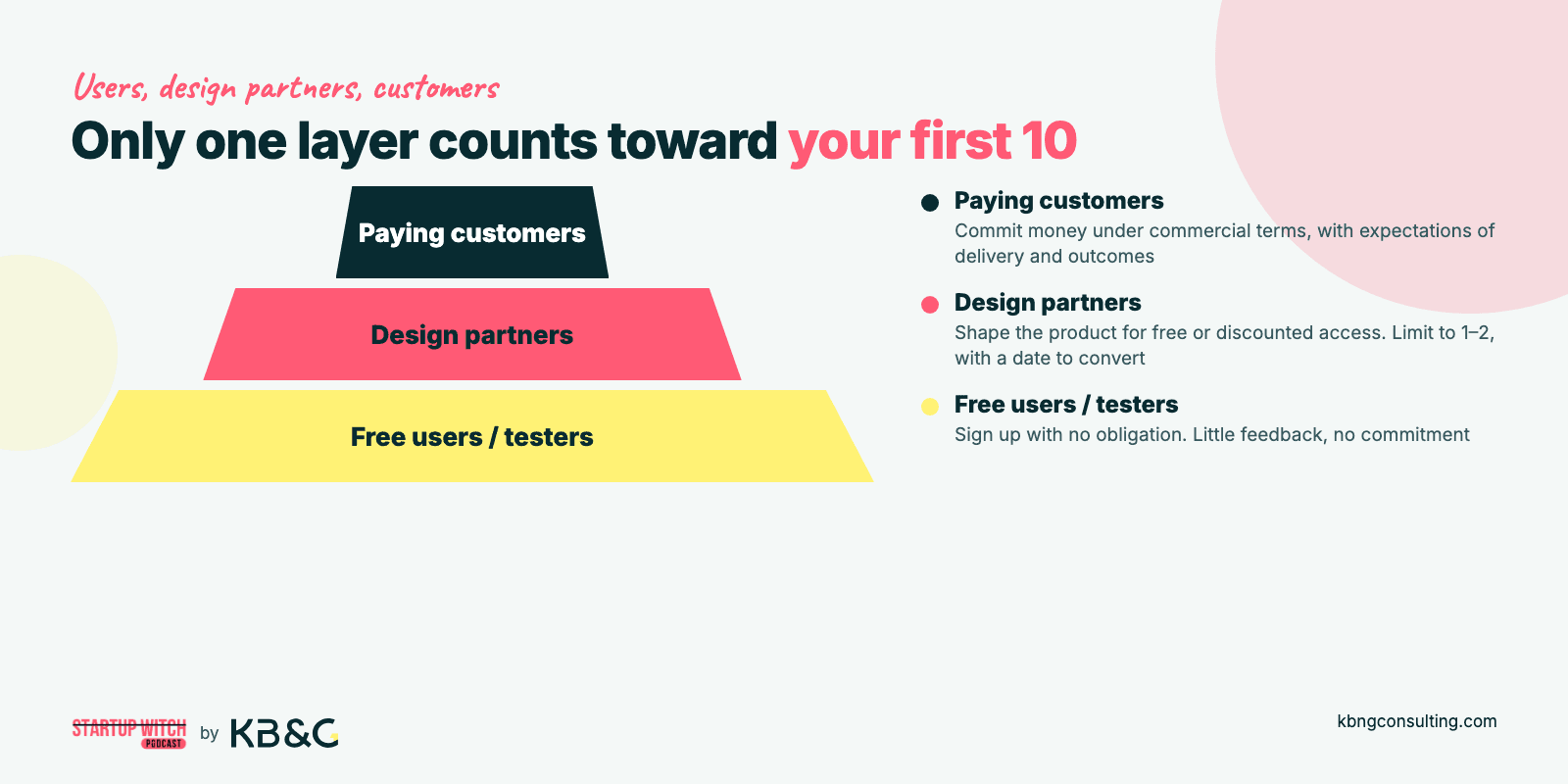
Three categories matter in your early days, and most founders blur them:
Free users / testers: People who sign up without obligation. They may poke around your product, but they give little feedback and no commitment. These are your first users, not your first customers.
Design partners / co-builders: Users who explicitly help shape the product by participating in regular calls, giving honest feedback, and exposing real workflows. They often get free or discounted access in exchange. Think of them as alpha customers.
Paying customers: People who commit money under commercial terms, with expectations of delivery, support, and outcomes. This is what "first 10 customers" means in this article.
Design partners are useful. A safety supervisor letting you record and analyze radio traffic at their mine site is invaluable for building the right product. But that's a design partner until they sign a paid pilot with price, scope, and deliverables. Some of your first 10 may start as design partners, but define upfront: what's the timeline for converting to paid, and what triggers that conversation?
Why These 10 Customers Are Your Real MVP Test
Pre-product surveys and demo applause are cheap signals. Paid commitments force you to confront real constraints: onboarding friction, time-to-value, trust, budget politics, and whether your product actually solves the exact problem you think it does.
Pricing, packaging, and messaging all get pressure-tested in these deals. You'll learn what people are actually willing to pay for, which features matter versus which are noise, and which job titles need to say yes before money moves. These are things no amount of content marketing or customer discovery surveys can tell you.
From day one, track these metrics for every deal: time-to-first-value (how fast you deliver something usable), renewal intent or pilot conversion signals, the strength and role of your internal champion, and your cost of acquisition in founder hours. These numbers will matter more than vanity metrics for months.
To get meaningful validation from these deals, you need a tight initial ideal customer profile.
Define and Narrow Your ICP Before You Sell
Most founders fail to land their first customers because their ICP is too broad. "Any company with data" is not an ICP. "Any operations manager" is not an ICP. A vague target market means unfocused outreach, weak messaging, and low conversion.
An ideal customer profile is a concrete description of the company, buyer, problem, and buying context where your product delivers the most value right now. For the first 10 customers, the ICP should be uncomfortably narrow: specific industry, specific role, specific problem. You can always broaden later. You cannot fix scattered positioning later.
Start From a Single Painful Problem
Pick one critical business problem your AI or SaaS product actually solves today. Not aspirationally. Not "we could build toward this." What does it solve right now, with the product you have?
The problem definition should include what happens if it isn't solved:
Near-miss reporting lag at mine sites: Safety incidents go unreported for days or weeks → compliance audit failures, regulatory fines, preventable injuries
SDR research bottleneck in SaaS sales: Reps spend hours researching accounts instead of selling → lost pipeline, missed quota, wasted headcount
Manual quote generation for industrial parts: Quote backlog delays orders by days → lost revenue, frustrated buyers switching to competitors
Unstructured frontline communication data: Radio and voice traffic at construction or mining sites goes unrecorded → no data for safety investigations, no pattern detection
If you can't articulate the cost of inaction in a single sentence, your problem definition isn't sharp enough.
Translate That Problem Into a Concrete ICP
Map the problem to a real buyer. Define the industry, company size, geography, job titles, and tech maturity.
Industrial example: "EHS managers at open-pit mines in Europe with ≥200 workers on site, using paper or radio-based near-miss reporting, no existing voice-data or digital safety platform."
SaaS example: "Heads of RevOps at Series A–B software companies with 20–100 revenue or customer success reps, using Salesforce but generating reports manually."
You want one primary ICP (your highest-conviction bet) and one backup hypothesis if the first doesn't yield interest. Not seven personas. Not a slide deck of segments. One sharp profile that you can use to filter every opportunity that comes your way.
Use LinkedIn to search for job titles matching your ideal customer. This alone will tell you whether your ICP has enough real people in it to build a pipeline.
Write an ICP One-Pager You Can Share Internally
Your one-page ICP document should include:
Who they are: Industry, company size, geography, role titles
What they care about: Their top 2–3 pains, stated in their language
How they currently solve it: Workarounds, tools, manual processes
Trigger events: What makes the problem urgent (new regulation, safety incident, budget cycle, leadership change)
Why they might say no: Budget constraints, internal politics, misunderstanding of AI, competing priorities
How they buy: Pilot first, subscription, outcome-based, procurement-driven
Keep the language blunt and operational. "Site visits delayed monthly because near-miss reports arrive weeks late → compliance auditor pressure" beats "we create safer mines." This document becomes your filter for building the prospect list, evaluating inbound interest, and briefing co-founders, angel investors, and advisors who can make introductions.
Once your ICP is nailed, you move to building a named account list.
Build a Named List of 50–200 Target Accounts
Your first 10 customers will almost certainly come from a small, hand-built list of specific companies. Not from inbound. Not from ads. From a spreadsheet where you can see every target by name and remember their story.
At this stage, a simple spreadsheet beats a CRM. You need visibility over each account (context, human nuance, relationship history), not dashboards or automation.
Set Up a Simple Prospecting Spreadsheet
Open Google Sheets or Airtable and create columns for:
Company name and URL
Industry and size (employees, sites, revenue)
Geography
Key contacts: name, title, email, LinkedIn URL
Role category: buyer, champion, or economic decision-maker
Status: not contacted / contacted / call booked / pilot proposed / closed-won / closed-lost
Last touch date
Notes: what you know about their pain, any trigger events, what they said
Use color-coding for stages: green for closed-won, red for disqualified, yellow for active conversations. This isn't about perfect data. It's about having enough context to write a personalized message to a real person about a real problem.
Source Accounts for SaaS and AI Products
For target customers in industrial verticals, use mining conference sponsor and attendee lists, national mining council membership directories, regulatory filings listing accredited sites, and industry association pages. Local industry events give you direct conversations with buyers and lists of companies that are already investing in their sector.
For SaaS and tech verticals, pull companies from LinkedIn Sales Navigator, YC alumni lists, remote job boards (which reveal company stage and team size), and startup directories filtered by funding stage and revenue.
Prioritize accounts where decision-makers are reachable: companies with recent funding (which signals innovation budget), management already buying similar tools, and organizational transparency that lets you identify the right contacts. Check your personal network for connections at any of these companies.
Identify Real Human Contacts Inside Each Account
For each account, identify 1–3 specific people:
Primary buyer: The role that feels the pain daily and has decision power (EHS Manager, Operations Superintendent, Head of RevOps)
Economic buyer: The role that signs off on budget (VP Operations, CFO, Regional Director)
Internal champion: A mid-level or frontline person who will push for your tool inside the organization (Safety Lead, early employee in the ops team, Digital Transformation Lead)
For industrial buyers, relevant job titles include EHS Manager, Safety Lead, Operations Superintendent, and Digital Transformation Lead. For software companies, look for VP Sales, Head of Customer Success, or Head of Revenue Operations.
Also note warm connections: shared LinkedIn contacts, former colleagues, mutual communities, or shared investors. These warm spots will power your intro engine.
Use Warm Intros and Founder-Led Outbound
Your first 10 customers will almost always come from a mix of warm introductions and highly targeted cold outreach, not from inbound or ads.
You own sales at this stage. You cannot delegate this to a sales team or a sales leader you haven't hired yet. This is founder-led selling.
Turn Your Existing Network Into an Intro Engine
Email former colleagues, friends, early advisors, angel investors, and other founders with a specific ask tied to your ICP. A warm introduction gets you a meeting with far more goodwill than a cold pitch.
Here's a template:
"Hey [Name], I'm building [product] to help [specific ICP role] solve [specific problem]. We're looking for our first paying pilots. Do you know 2–3 people who are [title] at [type of company]? Specifically someone dealing with [pain]. Would you be willing to make an intro?"
The key is specificity. Don't ask for "anyone who might be interested." Ask for "the Head of Safety at a mid-sized mine" or "a VP of RevOps at a Series A SaaS company with 30+ reps." Named industries, company sizes, and job titles. Ask investors for specific introductions to potential customers; this is one of the most valuable things early investors can do for you.
Track intro performance in your spreadsheet and follow up weekly.
Craft Effective Founder-Led Cold Outreach
When warm intros run out, or while you're waiting for them, run cold outbound in parallel.
A good cold email is 3–5 sentences:
Open with the problem (specific to their context, not your product)
Show you understand their world (reference something about their company, role, or situation)
Clear ask: 15–20 minutes to explore whether your product can help
Honest framing works: "I'm a founder building X to solve Y for companies like yours. Would you be willing to spend 15 minutes explaining how you handle Y today?"
Personalization doesn't mean spending 30 minutes per prospect. One or two sentences tied to their site, a recent job posting, a public safety report, or a LinkedIn post they wrote is enough. Online communities, industry-specific forums, Slack groups, and LinkedIn groups can also surface prospects who are already discussing the problems you solve.
Use 2–3 channels: email, LinkedIn messages, and for industrial buyers, sometimes a direct phone call.
Follow-Up Rhythm and Volume Targets
Follow up with prospects once or twice a week. A simple sequence works: initial outreach, then a polite follow-up after 3 days, then another after 4–5 days. Two to three follow-ups over 7–10 days.
Silence is not rejection. Many first meetings come from the second or third message. Most people are busy, not hostile.
Volume targets: aim for 20–40 highly targeted outbound messages per week, adjusted to your founder capacity. For customers 1–10, keep it manual: founder-led outbound, no automation.
Track reply rate, calls booked, and show-up rate. These are better leading indicators than open rates or website visits.
Once conversations are booked, the next challenge is running discovery calls that lead to paid pilots.
Run Discovery Calls That Lead to Paid Pilots
The first call is not a demo. It's a diagnostic conversation where you understand the customer's world, qualify them against your ICP, and figure out whether there's a real fit. Good customer discovery makes the close feel like an obvious next step, not a hard sell.
Talk to 50 people before selling anything. Listen for patterns, not outliers: you're looking for recurring themes across multiple conversations that confirm your ICP and sharpen your offer.
Structure of a 30–45 Minute Discovery Call
A simple agenda:
Intro and context (2 min): Who you are, why you're calling, what you're trying to learn
Their current workflow and problem (15 min): "What does your day look like when X happens? Who's involved? What tools or processes do you use now?"
Impact and constraints (10 min): Cost, risk, time wasted, compliance exposure. "What have you tried that didn't work?"
Short tailored demo (10 min): Only if you've confirmed fit. Map your product to their specific scenario
Next steps (5 min): Propose a pilot or commitment, schedule a follow-up
Concrete questions to ask:
"What happens today when [problem] occurs?"
"Who owns solving this internally?"
"What would change if you could reduce [lag/cost/risk] by X?"
"What budget or timeline do you have for addressing this?"
"What concerns would stop you from trying a new tool like ours?"
"What did you try before that didn't work?"
"How do you evaluate whether something like this is worth buying?"
Take verbatim notes, especially the language potential customers use to describe the problem. These exact phrases become your messaging copy later. End every customer call with a soft sell question: "Based on what we discussed, would it make sense to run a small pilot?"
When to Show the Product and How
Don't lead with a generic product overview. Only show the product after you've confirmed that the prospect has the problem, cares about solving it, and their workflow matches your product's assumptions.
Prepare 2–3 tailored demo "paths" depending on role. A safety lead cares about incident data and compliance risk. A plant manager cares about downtime and audit exposure. A RevOps lead cares about pipeline visibility and rep productivity. Show real value in the first 5–10 minutes: a screenshot or scenario that mirrors their actual work, ideally with their data or a close proxy.
If you can't show how value is delivered within 10 minutes, your demo isn't tailored enough.
Transitioning From Discovery to a Paid Pilot
Summarize what you heard: "You said that near-miss reports arrive weeks after incidents, and your compliance team flags this every quarter. You've tried paper forms and they don't work." Then propose a concrete next step.
Pitch a small, time-bound paid pilot: 6–12 weeks, clear success metrics, limited scope (one site, one team, one shift), and a specific price. The founder should explicitly ask for money. Don't default to offering free trials or an open-ended beta access arrangement. Be prepared to negotiate scope, not zero price.
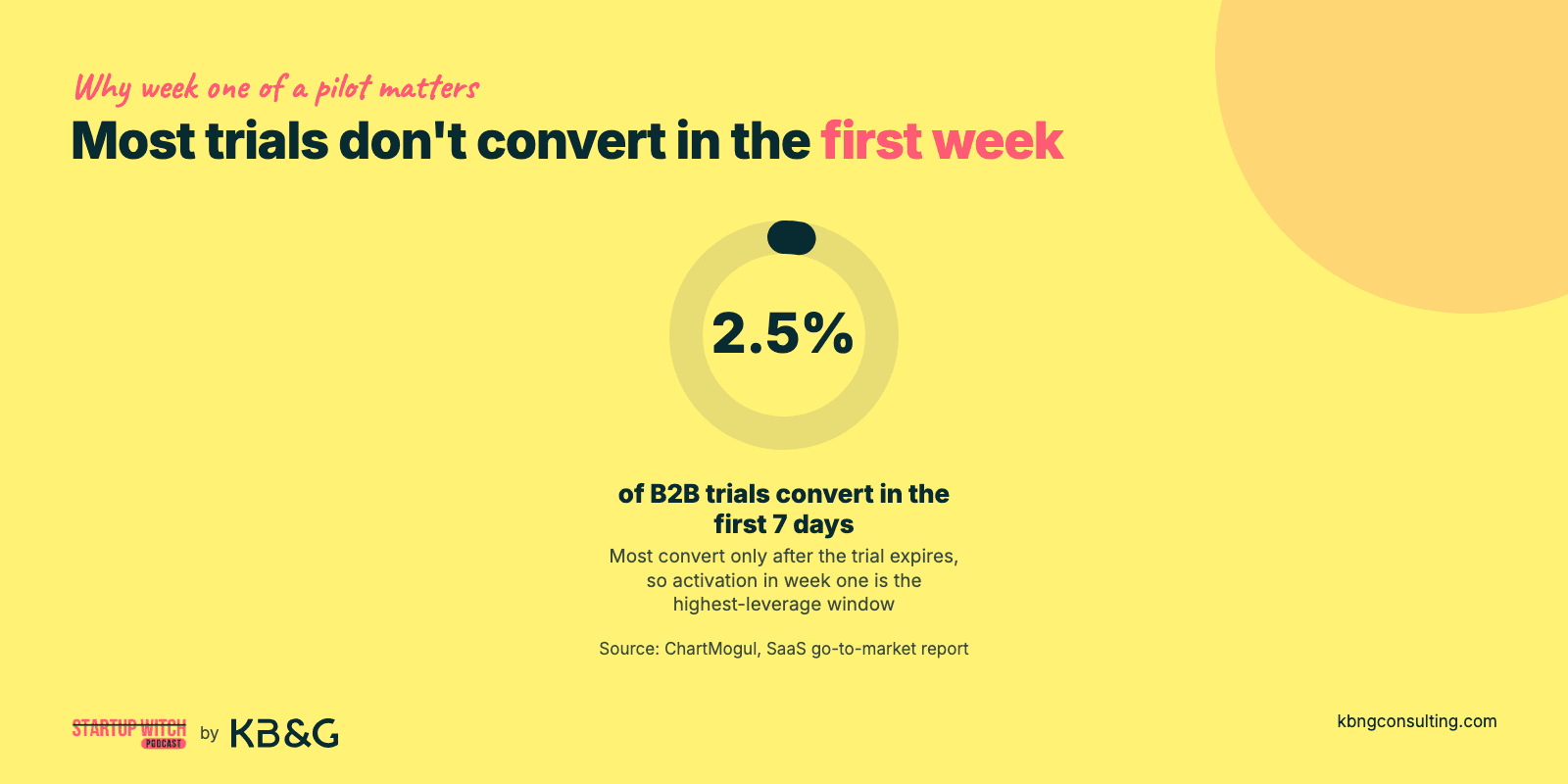
ChartMogul's SaaS go-to-market report found B2B trials convert at around 2.5% in the first 7 days, with most users converting only after the trial expires, and concluded that activation in week one is the highest-leverage window. Time-to-first-value must happen fast, or you lose the chance. Structure your pilot so the customer sees something useful within the first week.
Design Partners vs. Paying Pilots: Choosing the Right Early Deals
Here's the tension: you need product feedback and you need logos, but you also need people to pay. The trade-off between pure design partnerships and structured paid pilots is one of the most important decisions in your early growth phase.
When a Free or Discounted Design Partner Makes Sense
A free or discounted design partner makes sense when:
They match your ICP tightly and represent the exact problem you're solving
They will invest real time with your team: regular sessions, direct access to frontline end users, structured feedback
They agree to become a credible public reference or named case study later
You limit it to 1–2 partners, not five or ten
Formalize expectations upfront: how many sessions per month, who participates, what level of system access they provide, and a timeline for converting to paid or exiting.
Industrial example: a quarry operator gives you on-site access and radio recordings in exchange for co-building a voice-to-data safety tool. They're a design partner. If after 8 weeks you agree to a paid pilot with defined scope and price, they become a paying customer.
Structuring Paid Pilots So People Actually Pay
Frame a paid pilot as a low-risk experiment, not a big software commitment. You're not asking them to buy enterprise software. You're asking them to run a structured test with a clear outcome.
Price the pilot small enough to fit on a manager's discretionary budget or innovation line item, but high enough to signal seriousness. Think: enough that someone had to approve it, not so much that procurement gets involved. A discount can help get a first pilot signed, but zero price often means zero commitment.
Include a clear "convert to full deployment" path: pre-agree what scaled pricing looks like if the pilot succeeds. Set expectations for expansion before the pilot starts, not after.
Signals That a Prospect Will Never Become a Good Customer
Walk away early when you see these red flags:
Endless meetings, no commitment: Multiple calls with no decision or next step
No clear owner: Nobody inside the organization will champion this
No budget path: They can't articulate how they'd pay, even for a small pilot
Constant scope creep: Requirements keep expanding without any budget discussion
Misaligned use case: They want your product to do something it doesn't do
Founders should protect their time. A few people who will never buy can consume the same energy as ten who will. Better to focus on fewer high-potential future customers than chase every meeting.
Now that early deals are shaped, the focus shifts to charging from day one and extracting learning from each of the first 10 customers.
Charge From Day One and Learn From Every Deal
The point is not "10 logos." It's 10 paying customers who teach you how to sell this repeatedly. These deals validate product market fit, sharpen your positioning, and give you the data to build a repeatable sales process. Undercharging is fine in the early days. Charging zero is not, unless deliberately chosen for one or two design partners with formal agreements.
Setting an Initial Price and Offer
To set an initial price, work backward from the status quo. What does the buyer currently spend (in consultant fees, manual labor, lost revenue, safety incident costs, or wasted time) on the problem you solve? That's your anchor.
Simple early offers that work:
Monthly subscription (per seat, per team, or per site)
Flat pilot fee for a defined scope and timeline
"Per site / per team" pricing for industrial buyers
Outcome-based pricing if you can measure results clearly
Don't get hung up on "perfect" pricing. Pick something you can say out loud without stuttering, test it in a real conversation, and adjust after a few people say yes or no. Prioritize early adopters who have previously bought similar products: they are comfortable trying new tools before their peers and more likely to pay for something new if the problem is real.
Instrument Each of the First 10 Customers
Track these for every deal:
Why they bought: The specific pain and trigger event
Who championed it: Their title, influence, and bandwidth
What they actually use: Features adopted vs. features requested
Time-to-first-value: How long until you delivered something usable
Key objections: What almost killed the deal
Renewal / expansion potential: Will they grow with you?
Cost of acquisition: How many founder hours did this take?
This can live in the same prospecting spreadsheet: one row per customer, with qualitative notes alongside the numbers. After every closed-won and closed-lost deal, run a short retrospective: what worked, what didn't, what you need to adjust in your ICP, messaging, pricing, or product. A simple one-question survey helps separate enthusiastic users from passive ones.
Turn Early Customers Into Case Studies and References
Once a customer has seen real value, ask for a short quote or a 30-minute interview. Frame the ask: "We want to help more teams like yours. Can we share your story?"
Even anonymized case studies ("Tier-1 construction materials producer" or "mid-sized open-pit mine in Western Europe") build trust with buyers in the same sector.
Also use early customers for referrals. Ask them: "Do you know other folks at other sites or companies dealing with the same problem?" One warm introduction from a happy customer is worth more than fifty cold emails.
Industrial B2B Nuances: Selling AI Into Asset-Heavy Companies
Selling AI into mining, construction, manufacturing, or logistics looks fundamentally different from selling to SaaS teams. The buying process is slower, the stakeholders are more numerous, and the deployment constraints are physical, not just technical. This section is for founders targeting heavy industry and frontline workers.
Navigating Long Sales Cycles and Procurement
Typical decision paths in industrial companies run from site champion → regional lead → central innovation or EHS department → procurement. Each layer has its own concerns: cost, risk, regulatory compliance, safety certification, connectivity, data privacy.
Start at the level where pain is felt daily (the site EHS manager, the quarry supervisor, the operations superintendent) while mapping who else must sign off. Find small budgets: innovation funds, site-level safety budgets, or operations improvement line items that move faster than large CAPEX approval cycles.
Offer pilots as innovation or safety budget items to avoid frozen procurement cycles. Avoid contracts that require full vendor approval unless your pilot scope demands it. The goal is to get direct access to the problem and prove value before the bureaucracy gets involved.
Running Site Visits and Field Discovery
When possible, visit physical sites early. Observe actual work:
How people communicate: Radios, voice, paper forms, hand signals
Where bottlenecks occur: Shift handovers, incident reporting, data entry gaps
How safety incidents are logged: Paper? Software? Not at all?
Environmental constraints: Dust, noise, weather, intermittent connectivity, PPE requirements
These visits often reveal non-obvious adoption blockers that would kill a pilot later: workers can't carry phones underground, hub connectivity drops in certain zones, or adding hardware requires safety certification. You won't find these on a Zoom call.
Designing Pilots That Can Escape "Pilot Purgatory"
Pilot purgatory is when a pilot finishes, results are positive, and then… nothing. Stakeholder changes, procurement delays, no budget allocated for roll-out. Months pass. The champion moves on.
To avoid this, co-define success criteria with the customer before the pilot starts: fewer unreported near-misses, faster investigation turnaround, specific data quality metrics. Put dates and owners on "go/no-go" decisions for full deployment at the pilot's outset. Get alignment across site, regional, and budget authorities before you start, not after.
Line up vendor approval, security reviews, and IT compliance early. In AI applied to frontline operations, safety and data privacy questions always come up. Have your answers ready before they're asked.
Common Challenges and How to Avoid Them
A blunt list of mistakes most founders make while trying to get their first 10 customers, with direct remedies.
Problem: Talking to Everyone and Selling to No One
A vague ICP leads to scattered conversations with a few people from every industry, none of whom convert. You feel busy but close nothing.
Solution: Force-rank your potential segments. Pick one primary ICP for the next 60–90 days. Say no to off-ICP distractions, even if they feel like opportunities.
Problem: Hiding Behind Marketing Instead of Selling
Tweaking your landing page, posting on LinkedIn, doing content creation, reading about content marketing, or running small ads instead of picking up the phone or sending a cold email. These are lower-leverage activities before you know what resonates.
Solution: Set a weekly quota for new real conversations booked (say, 5–10 per week) and track it like a product metric. Outbound sales come from volume of quality conversations, not from perfecting your website.
Problem: Free Pilots That Never Convert
Indefinite free use with no success criteria undermines perceived value. The customer has no urgency to evaluate or commit. You become free labor.
Solution: Time-box every free engagement. Define success metrics. Attach a pre-agreed paid next step. Even a soft launch with limited scope forces both sides to treat the pilot as a real test, not a favor.
Problem: Over-Building Before You've Sold Anything
Adding features based on what you think is needed (or what one prospect mentioned once) instead of fixing positioning, pricing, or ICP. This is the most common form of procrastination for technical founders.
Solution: Make a rule that every major build decision comes from recurring themes across at least 3–5 real customer conversations. If only one person asked for it, it's not a pattern. It's an edge case.
Conclusion and Next Steps
The path is straightforward, even if it's not easy: narrow your ICP → build a named account list → do founder-led outreach and warm intros → run sharp discovery calls → structure paid pilots → close 10 paying customers.
Here's what you can do this week:
Write your ICP one-pager: one industry, one role, one problem, on one page
Build a 100-account target list: use LinkedIn, conference lists, and your personal network
Send 20 outreach messages tomorrow: warm intros and cold emails to real people at real companies
Book at least 5 discovery calls: aim to have them within the next 10 days
Define your first pilot offer: scope, timeline, success metrics, and a price you can say out loud
Engage 50 potential customers before selling anything. That's your real soft launch: not a blog post, not a launch day announcement, not a Product Hunt feature.
Once you have 10 paying customers, the game shifts: validating repeatable channels, refining pricing and packaging, and eventually building a sales team. That's beyond this article's scope.
If you're stuck (you've been building for months without traction and can't figure out what's blocking you), consider the Founder Blind Spot Diagnostic by Startup Witch. It reads your startup in 14 days and names the one thing blocking growth. Sometimes the advice you need most is the advice you can't give yourself.