What Is Radio Communication in Mining?
Radio communication in mining is the primary real-time coordination and safety lifeline for crews working in noisy, mobile and often underground environments. Safe mining operations live or die by how people use two-way radios under pressure: not by the hardware itself, but by the human protocols, discipline and tone that shape every transmission.
Getting radio communication right (consistent call signs, closed-loop confirmations, calm and clear language during emergencies) reduces the room for misunderstanding that sits behind many near misses and slows emergency response. When radio discipline breaks down, the consequences range from lost production to serious injury or worse.
This article focuses on the human side of radio communication in mining: the protocols, behaviours and culture that determine whether communication systems actually protect people or just create background noise. It covers open-pit, underground and plant environments, but does not dive into specific hardware brands or spectrum regulation details. The scope is practical: what mining teams should say, how they should say it, and what happens when they don't.
If you are a safety manager, operations leader, dispatch superintendent or innovation lead at a mining or quarrying operation, anywhere from North America or Australia to Africa, Europe or Latin America, this is written for you. It addresses problems you likely recognise: near misses that never make it into incident logs, inconsistent radio discipline between shifts, multilingual crews struggling to be understood, "radio chaos" during incidents, and difficulty proving that procedures are actually followed.
By the end of this article, you will have:
A clear mental model of how radio communication supports both safety and production on mining sites.
Concrete protocols for call signs, confirmations and closed-loop communication that miners can actually follow.
A checklist of common protocol breaches and how to correct them in the field.
Guidance on training and coaching radio tone, especially in multilingual and high-stress environments.
An overview of how voice-to-data tools can turn live radio traffic into usable safety intelligence.
Understanding Radio Communication in Mining Operations
Before changing behaviour, leaders need a shared vocabulary for how radio communication actually works on a modern mine: channels, roles, workflows and the boundary between the physical system and the human habits layered on top of it. This section establishes that vocabulary in clear, non-technical language with concrete mine-site examples.
The Role of Radios and Reliable Communication in Mine Safety and Production
Two-way radio communication in mining means push-to-talk voice coordination across surface and underground, used by operators, supervisors, maintenance crews, contractors and emergency response teams. Radios help maintain operational control by coordinating activities across large mining sites, from a busy haul road with haul trucks, shovels and dozers, to an underground decline shared by jumbos, loaders and personnel carriers.
Radios are preferred over phones in mining environments for good reason: they deliver instant communication to an entire group simultaneously, work in remote locations where cellular coverage fails, and are available in intrinsically safe versions certified for explosive atmospheres. They are built for noisy environments and for use with the PPE mine workers wear, and they have to cope with dust, moisture and extreme temperatures. Used well, they let equipment operators coordinate movements instantly and keep work flowing across the operation.
Regulatory bodies reinforce these expectations. MSHA's Program Policy Manual for underground coal mines expects an operative means of communication between each working section more than 100 feet from the portal and the surface, with a responsible person always on duty to hear and respond. Reliable communication is indispensable in an inherently hazardous industry.
But hardware is rarely the bottleneck. The radios work. Whether crews use them properly, with discipline, clarity and shared protocol, usually determines whether the system saves lives or just sits on a belt.
Core Elements of a Mining Radio System (Without the Jargon)
A few terms matter for understanding how mining radio communications are structured. Sites run conventional analogue or digital radio systems (VHF and UHF, often digital standards such as DMR or P25), and some are adding private LTE or 5G layers depending on operational requirements:
Talkgroups / channels: Distinct radio channels assigned to specific areas, functions or departments, for example "Pit 1", "Plant", "Emergency", "Maintenance".
Dispatch / control rooms: Centralised coordination points that manage traffic, monitor safety and direct emergency response. Separate from peer-to-peer calls between individual operators. Integrated mining communication may also connect with location tracking, text messaging and access control applications.
Repeater systems and leaky feeders: Repeater systems extend signal transmission across rugged terrain and large open pits. Leaky feeder systems act as continuous antennas along underground tunnels, overcoming the dense rock that blocks conventional radio waves. Heavy machinery also creates electromagnetic interference, and signals bouncing off tunnel walls can distort underground.
Channel discipline affects both safety and operational efficiency. Too many crews on one channel leads to overlapping transmissions and missed calls. Too many channels fragments situational awareness and makes it harder for dispatchers to track what is happening, especially when operations span large areas with patchy coverage.
It is also worth distinguishing between "formal" communication (written procedures for blasting clearances, pit entries, isolations) and the "informal" chatter that actually dominates air time. The informal calls are where many near misses and coordination failures originate.
Once the physical system is in place, the critical variable becomes how humans speak on it: protocols, clarity and tone.
Human-Centred Radio Protocols for Mining Crews
This section turns abstract safety expectations into specific, teachable radio behaviours that can be observed and coached on shift. The guidance applies equally to large open-pit mining operations with hundreds of mobile radios and smaller quarries with a dozen operators.
Call Signs, Identification and Standard Phrases
Consistent call signs reduce confusion, speed up emergency response and help new hires and contractors orient quickly. Without them, a call like "Hey, can you move?" is meaningless on a busy channel.
Simple, durable conventions work best:
Unit-based call signs for equipment: "Truck 231", "Loader 14", "LV 32". Every radio transmission should start with who is calling and who is being called.
Role-based call signs for key personnel: "Pit Supervisor North", "Underground Control", "EMT 1". These anchor calls to functions rather than individuals, so they survive shift changes.
A small library of standard phrases keeps everyone on the same page:
"Go ahead": ready to receive.
"Stand by": wait, channel busy or not ready.
"Copy": message received and understood.
"Negative": no, or not confirmed.
"Repeat last": message unclear, say again.
"Confirm route clear to [location]": requesting verification before movement.
Standardised phraseology is part of effective communication because it improves mutual intelligibility under stress. In fast-moving environments, that gives mine workers less room to mishear, guess, or delay.
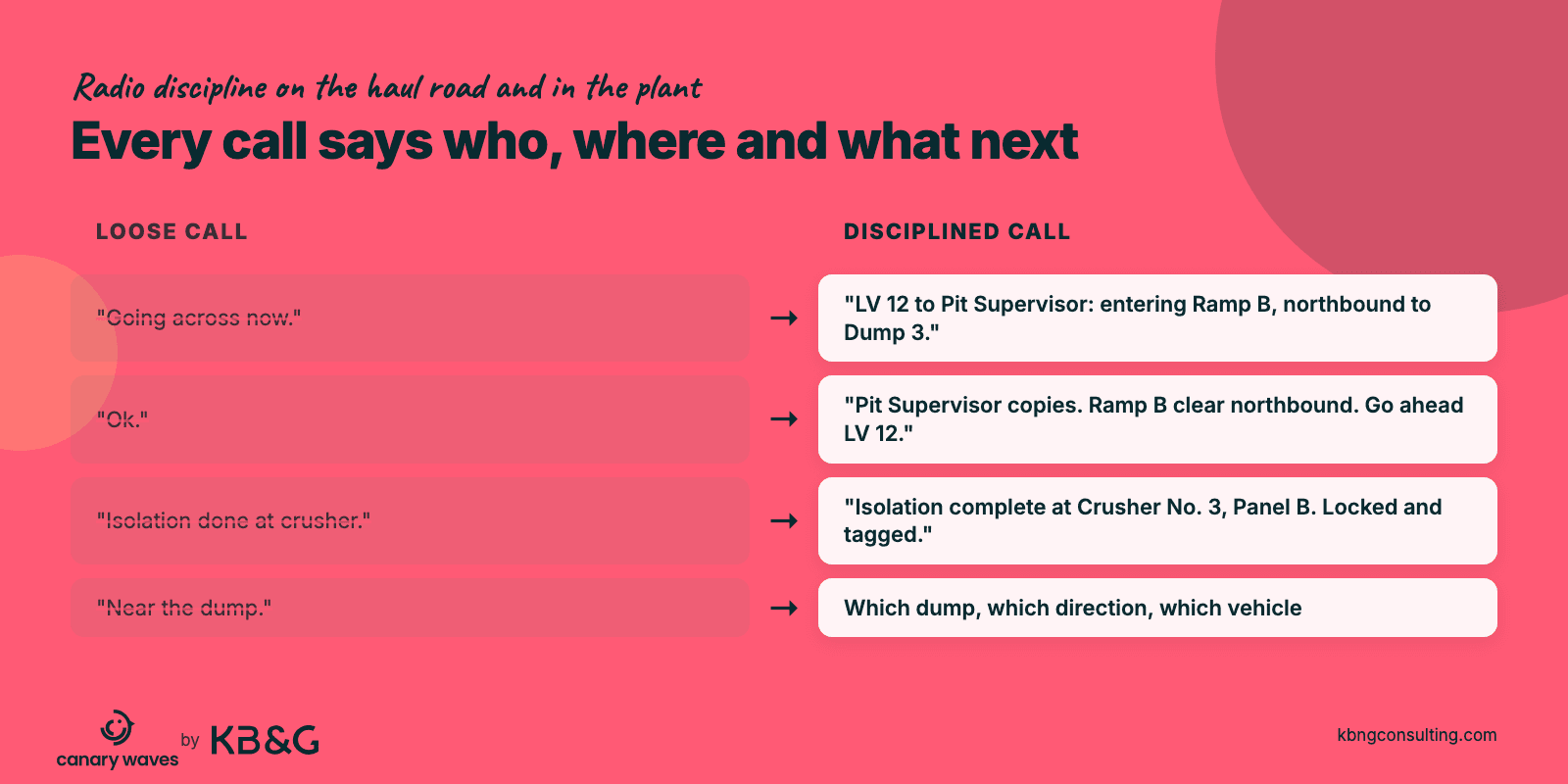
Bad example:
"Going across now." "Ok."
Good example:
"LV 12 to Pit Supervisor: Light vehicle LV 12 entering haul road Ramp B, northbound to Dump 3. Is haul road clear?" "Pit Supervisor copies. Haul road Ramp B clear northbound. Go ahead LV 12." "LV 12 copies, proceeding."
The difference is not pedantry. It is whether a loaded haul truck operator knows exactly who is on the road, where, and in which direction.
Closed-Loop Communication and Confirming Instructions
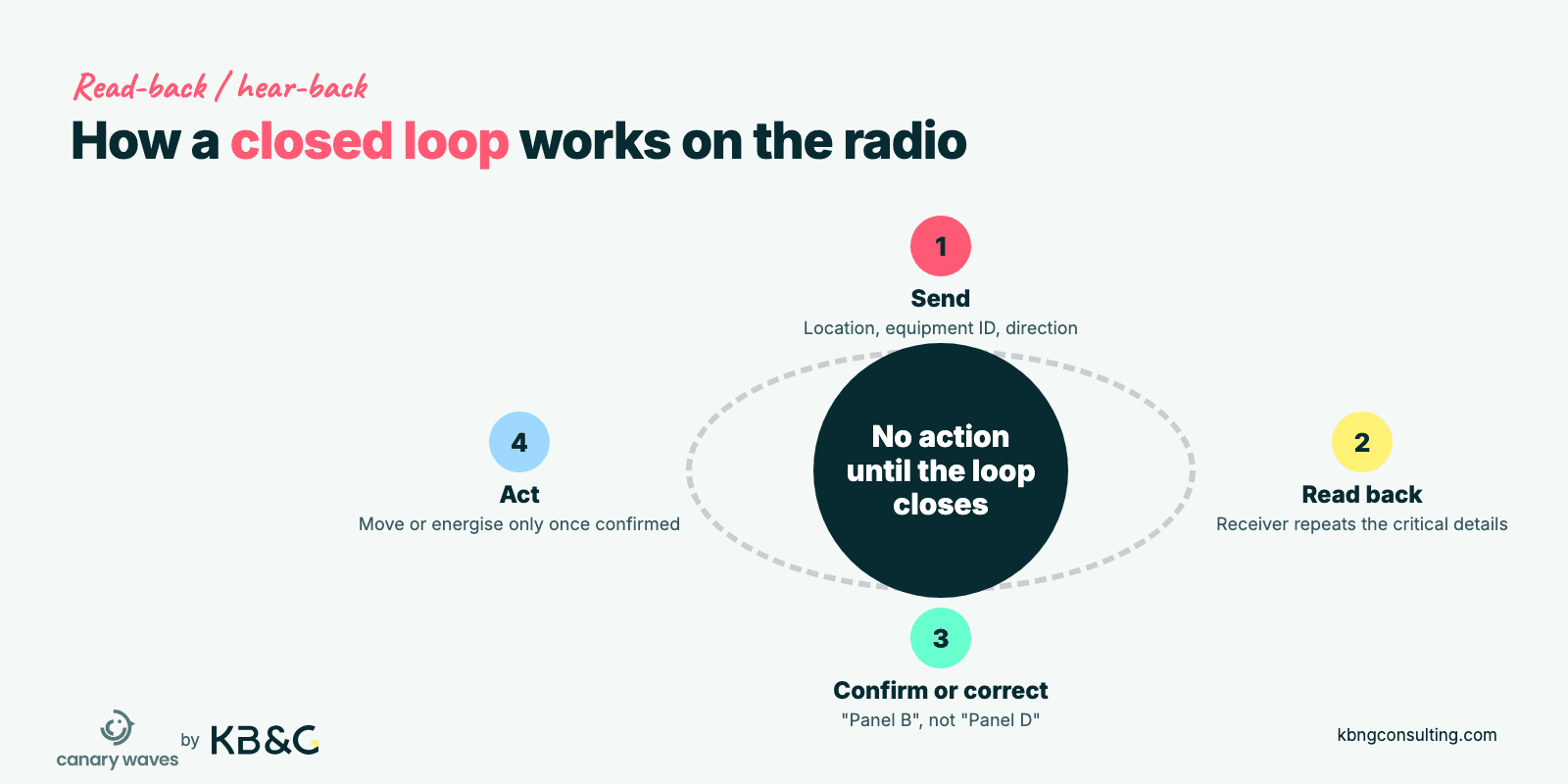
Closed-loop communication in mining means the sender gives an instruction, the receiver repeats back the critical details, and the sender confirms or corrects. This protocol is borrowed from aviation and medicine, where it is called "read-back/hear-back", and it is one of the most significant benefits a mine can gain from radio discipline alone.
Closed-loop confirmation matters most for:
Spotting and backing heavy equipment near personnel or other vehicles.
Passing points on single-lane haul roads or underground declines.
Isolations, lock-out/tag-out, and energisation/de-energisation calls at processing facilities.
The repeat-back should include: location, equipment ID, direction of travel, speed limitations, and any hazards (e.g., "water on road", "loose wall", "pedestrians near crusher").
Bad exchange (isolation):
Electrician: "Isolation done at crusher." Control: "Ok."
Good exchange (isolation):
Electrician: "Field to Control: Isolation complete at Crusher No. 3, Motor Panel B. De-energised, locked and tagged." Control: "Control copies Crusher No. 3, Panel B, de-energised, locked and tagged. Confirm field bypass removed." Electrician: "Confirm bypass removed."
Without repeat-back, a controller may mishear "Panel B" as "Panel D", or assume an isolation is complete when a bypass is still in place. Radios support safe coordination when crews share work areas, but only when the people on each end close the loop.
Priority, Escalation and Channel Use Rules
Crews should distinguish between three tiers of radio traffic:
Routine traffic: Waiting times, loading instructions, logistics teams coordinating movements.
Safety-critical traffic: Near miss reports, unstable wall conditions, brake failure, hazards like gas leaks or ground instability that need to be reported the moment they are seen.
Emergency traffic: Fall from height, fire, entrapment, or any major incident requiring immediate response.
Expected emergency radio protocol elements include:
Use of the phrase "Emergency, Emergency, Emergency" or site-specific code words at the start of the transmission.
The control room or on-site controller takes control of the channel and directs all other traffic to hold.
Crews know how their radio's emergency button or man-down function works, if it has one, and what happens when it is triggered.
Channel etiquette for daily operations:
No music, no personal conversations, no jokes that crowd safety traffic.
Keep transmissions short and purposeful.
Pause before pressing push-to-talk: someone with higher priority may need the channel.
One voice at a time; never talk over another transmission.
If unsure whether a message was received, ask for confirmation.
Instant communication is vital for safety teams during emergencies. When channels are disciplined, emergency calls are unambiguous, identified, repeat-backed and prioritised immediately.
Radio Communication in Practice: Typical Mining Scenarios
Protocols only matter if they survive contact with the real work. This section walks through how radio communication plays out in the scenarios where it matters most, and where it most commonly fails.
Open-Pit Haul Roads and Loading Operations
Picture a typical open-pit cycle: multiple haul trucks running between a shovel face and a dump point, water carts and graders on circuit, and light vehicles needing to enter, cross and exit haul roads. Radios help maintain operational control across these large sites, but the volume of traffic creates pressure to cut calls short.
Expected radio calls include:
Light vehicles announcing entry to haul roads, direction of travel and planned exit point.
Trucks calling blind corners, cresting ramps and queueing at the shovel.
Graders and water carts announcing their position and direction on shared roads.
Specific risks include light vehicles overtaking or passing trucks without calling, incomplete calls around intersections ("near the dump" without specifying which dump), and operators who stop announcing movements after a few uneventful hours.
A "good radio day" sounds like a steady, predictable rhythm: every vehicle on the road can be accounted for at any moment. Each call includes who, where, direction and intent. Heavy equipment operators acknowledge light vehicles. No one is surprised.
A "bad radio day" sounds like silence punctuated by sudden, unidentified calls, or worse, a near miss because a light vehicle crossed Ramp B without announcing and a loaded haul truck crested the ramp at the same moment.
Radios keep haul cycles moving, but only when road calls are made consistently and completely, for both safety and efficient operations across large sites.
Underground Declines, Intersections and Refuge Chambers
Underground mines compound the communication and safety challenges. Jumbos, LHDs, service vehicles and personnel carriers share narrow declines. Refuge chambers and crib rooms are critical waypoints during alarms.
Expected radio calls cover:
Decline entries and exits: announcing vehicle type, direction and expected destination.
Approaching sharp corners and narrow passing bays, where line-of-sight is zero.
Movement toward refuge chambers during drills or real events, confirming headcount and location.
Communication breakdowns underground are common: coverage drops out around corners, background noise from ventilation fans and equipment clips messages, and multi-language crews with different accents compound the problem. NIOSH's tutorial on underground wireless communication sets out how leaky feeder, node-based, medium-frequency and through-the-earth systems differ in coverage and in how well they survive an accident.
Emergency communication is crucial for keeping contact after an accident. Through-the-earth (TTE) communication systems, which send signals through the rock itself rather than along cables, are designed for post-accident scenarios when conventional infrastructure may be damaged.
The core principle underground is simple: speak slowly, speak clearly, repeat critical instructions, and never assume a clipped transmission was received.
Fixed Plant, Maintenance and Contractors
Radio communication ties together control room operators, field maintainers, electricians and contractor teams during shutdowns and major maintenance at processing facilities. Its role is central to:
Isolations and de-isolations of conveyors, crushers and mills.
Confined space entries and hot work where spotters are required.
Coordinating the interface between live plant and shutdown areas.
Common failure modes include missing "ready to start" confirmations before equipment is energised, unclear handovers at shift change, and contractors who are unaware of local radio protocol or assigned channels. At plant level, the human protocols are often the weakest link.
Short checklist for plant start-up and isolation confirmations:
Field confirms isolation location, tag numbers and bypass status.
Control repeats all details.
Field confirms repeat-back is correct.
"Ready to start" call given only after all confirmations complete.
Control confirms start-up is proceeding and broadcasts to all affected channels.
Effective radio communication streamlines coordination between teams, but only when every step in the sequence is spoken, confirmed and recorded.
Designing and Embedding Effective Radio Protocols
Knowing what good radio discipline looks like is necessary but not sufficient. This section covers how to move from "we know this is important" to "this is how our crews actually talk on the radio now." The process is iterative and must involve frontline operators, not just safety and engineering staff.
Step-by-Step: Building a Site-Specific Radio Standard
A written radio standard is needed for regulator expectations, onboarding new hires, managing contractors and achieving consistency across extended shifts and crew rotations. Here is how to build one:
Map critical workflows. Identify where radio calls directly affect worker safety: haul roads, underground declines, isolation procedures, emergency response, heavy equipment movements near personnel. For each workflow, document what the ideal radio interaction sounds like.
Observe current practice. Ride along in trucks, spend time in the control room, listen on multiple channels for a full shift. Note common breaches: who skips calls, where repeat-backs are missing, where tone degrades. MSHA's powered haulage safety guidance notes that the lack of effective communication with equipment operators has led to many preventable accidents, and calls for protocols that require verbal verification.
Co-design simple rules. Involve experienced operators, safety reps, dispatch controllers and contractors. Agree on call patterns, priority rules and standard phrases. Keep it to a handful of high-impact behaviours, not 30 rules no one will remember.
Document with examples. Create one-page, visual guides per area ("Haul Road Radio Rules", "Plant Isolation Call Script", "Underground Decline Calls"), including bad-versus-good dialogue examples and call-sign templates.
Test and refine. Run drills and short pilots in selected areas or shifts. Get feedback from night shift, contractors and multilingual crews. Adjust language and examples where ambiguity or difficulty arises.
Align the radio standard with existing traffic management plans, emergency response plans and isolation standards to avoid contradictions.
Training, Coaching and Reinforcing Radio Behaviour
A one-off toolbox talk does not change radio habits. Radio discipline is learned through repetition, modelling and feedback, the same way any other physical skill is developed on a mine site.
A layered approach works best:
Induction training for new hires and contractors includes live radio practice with realistic scenarios, not just slides. Simulate heavy equipment movements, emergency calls and closed-loop confirmations in noisy environments.
Supervisor coaching: Superintendents and foremen model good radio discipline every shift. Their calls set cultural norms. If supervisors skip confirmations or speak over others, crews mimic that. If supervisors demonstrate clear communication consistently, crews follow.
Scenario-based drills using realistic incidents: stuck truck on a ramp, fire on a conveyor, underground fall of ground. A study of a full-scale emergency exercise in an underground mine found that the ambulance incident commander's situational awareness was built largely through coordinated communication with other responders, and that handling information overload was a specific challenge.
Debrief using recorded or simulated radio audio. Play short clips and ask crews: what was clear? What was missing? What would you change?
Simple reinforcement mechanisms sustain discipline: quick "radio of the day" compliments for good closed-loop calls, calm correction when protocols are missed, and linking radio behaviour to existing safety observation programs. Ongoing support for radio discipline is what separates mines with strong safety culture from those where protocols exist on paper but not on the air.
Multilingual and Cross-Cultural Radio Teams
Many mining companies employ multinational crews where English is the lingua franca but speakers come from South America, Asia, Africa, Eastern Europe and elsewhere. Accents, varied English proficiency and local slang create real risks on the radio.
Practices that reduce misunderstanding:
Use short, simple sentence structures and agreed key phrases. Avoid idioms unlikely to translate ("give it a squirt", "she'll be right", "near enough"), which mean nothing to a non-native speaker.
Spell out numbers and letters when critical: equipment IDs, location codes, isolation panel references. Audio clarity matters more than speed.
Pair less experienced or lower-proficiency speakers with mentors for the first few weeks to practise radio calls in realistic conditions.
Set an explicit norm: slow pace, clear enunciation, no blame for asking someone to repeat. With people less confident in English, harsh or blaming tones lead to radio silence, and radio silence in hazardous areas is dangerous.
Tone and politeness matter even more in multicultural groups. Workers stay connected to the safety system only when they feel safe to speak up. Clear communication across languages is not about perfect grammar; it is about reliable, predictable patterns that everyone can follow.
Common Radio Communication Failures in Mining and How to Fix Them
These are not individual failings. They are predictable patterns in high-noise, high-pressure mining environments that can be anticipated, coached and corrected. Every safety manager will recognise at least one.
Skipped or Incomplete Calls on Haul Roads
The issue: Operators stop calling "in" and "out" of haul roads, or give partial location information ("near the dump") without specifying which dump, which direction, or which vehicle. This tends to creep in as shifts progress and familiarity breeds complacency.
The consequences: Near misses between haul trucks and light vehicles, confusion about right of way, reduced trust in the communication system. Two-way radios only make a site safer when they are used.
Corrective actions:
Reinforce a minimum call set (entry, key intersections, exit) and practise it in pre-start meetings.
Use spot checks or ride-alongs focused on coaching rather than punishment for first offences.
If overcrowded channels are driving shortcuts, adjust channel workload. Running too many crews on a single talkgroup creates the conditions for skipped calls.
Cut-Short Procedures and Missing Confirmations
The issue: Confirmations are skipped during plant start-up sequences, isolations where the field person assumes the controller heard them, or de-energisation calls where "Ok" replaces a proper repeat-back.
The fix:
Mandate closed-loop confirmation for specific high-risk steps in procedures. Include confirmation language directly in SOPs: "Field confirms isolation complete; Control repeats locations and tags."
Practise via short drills before major shutdowns. Radios provide instant communication in emergencies, but they also need to provide precise communication during routine high-risk tasks.
Make "missing confirmation" a specific category in safety observations, so the data is visible to leadership.
Tone Under Pressure: Shouting, Blame and Radio Silence
The issue: During incidents or near misses, tone degrades rapidly. Raised voices and overlapping transmissions flood the channel. Blame or sarcasm directed at operators over open channels shuts down reporting. Some crew members go quiet because they fear being yelled at, and critical details get lost.
Why this is dangerous: People hesitate to report bad news. Situational awareness collapses. Safety culture deteriorates shift by shift. Hazards like gas leaks or ground instability can be reported instantly by radio, but only if people feel safe to key up.
Solutions:
Train incident commanders and controllers in calm, structured radio language during drills. Practise under simulated stress, not just calm conditions.
Set explicit norms: "No blame on the radio", "One voice at a time", "Speak slowly in emergencies."
Debrief after significant events using anonymised radio transcripts or audio clips, focusing on learning rather than punishment. The goal is to improve safety, not to surveil individuals.
From Radio Traffic to Safety Intelligence
Radio channels are a live, unfiltered record of how work is actually done, and most mines do not systematically learn from them. Every shift, radio traffic carries information about protocol compliance, emerging hazards, crew fatigue and coordination quality. Then the shift ends and the information disappears.
This section is not about replacing radios. It is about augmenting them with analytics to support supervisors and safety teams.
What Your Radios Are Already Telling You
Patterns in radio traffic reveal information that no incident report or observation card captures:
Protocol breaches: Missing calls, absent closed-loop confirmations, call signs not used.
Emerging hazards: Repeated mentions of "water on road", "dust", "slippery", "smoke", "brake problem": hazard signals that may not reach a written report for hours or days.
Tone shifts: Irritation, fatigue, rushed instructions at the end of extended shifts, overlapping transmissions during high-pressure moments.
Safety culture is audible. Respectful, clear, proactive calls sound fundamentally different from chaotic or fearful channels. A mine where crews consistently use closed-loop communication and calm tone under pressure has a different safety profile from one where radio discipline varies by shift and supervisor.
Historically, this information disappears once spoken, unless someone happens to be listening and taking notes. The voice content itself has been treated as ephemeral.
Using AI and Voice-to-Data Tools in a Mining Context
Modern AI can change that equation. Voice-to-data tools can:
Transcribe live radio traffic into searchable text.
Detect keywords and patterns that indicate hazards or protocol breaches.
Summarise shifts by channel: what was discussed, which procedures were followed or skipped, where tone degraded.
Any such system must be passive: no extra buttons, no new radio devices, no new workflows for frontline crews. It must respect privacy, focusing on safety and operations rather than individual surveillance.
There is an important distinction between post-shift analysis (trend spotting, generating training content, identifying which shifts or areas show declining discipline) and near real-time alerts (e.g., repeated "brake problem" or "smoke" calls triggering immediate escalation to supervisors). Both have value. The first supports culture; the second supports response.
Conclusion and Next Steps
Radio communication in mining is the real-time nervous system of the operation. Tightening protocols and tone on the air is a practical way to improve safety culture and coordination with the equipment you already have: no new hardware, no new devices to deploy, no production interruption.
The most powerful levers are straightforward:
Clear, simple radio standards grounded in real workflows, co-designed with the people who use them.
Consistent modelling and coaching by supervisors, every shift, not just during audits.
Using the radio itself as a source of learning and measurement, not just a tool for talking.
Your next steps:
Listen to a full shift on a key channel this week and note common protocol breaches: skipped calls, missing repeat-backs, unclear identifications.
Pick one area (e.g., haul roads) and co-design a one-page radio rule sheet with frontline operators.
Run a short emergency radio drill at pre-start and debrief tone and clarity, not just timing.
Explore whether voice-to-data tools could turn live radio traffic into safety insights without adding work for crews.
If you want to learn from what your crews are already saying on the radio, that is what Canary Waves by KB&G is built for. It runs passively on your existing two-way radio, with no new hardware and no change for crews, transcribes radio traffic tuned to site slang, and flags near-miss and proximity language, hazards, protocol breaches and tone shifts that signal strain or fatigue. It has been proven in early MVP pilots on real mine sites.
Frequently Asked Questions about Radio Communication in Mining
These questions come up consistently when mining safety and operations leaders are tightening radio protocols or evaluating analytics.
What is the minimum radio protocol every mine should have in place?
At minimum, every mine should have:
Standard call signs and identification rules for all equipment and key roles, used on every transmission.
Mandatory call points on haul roads (entry, intersections, exit) and underground routes (decline entry/exit, corners, passing bays).
Closed-loop communication for all high-risk tasks: spotting heavy equipment, isolations, emergency response.
Emergency wording and channel priority rules: agreed emergency phrases ("Emergency, Emergency, Emergency"), a designated person who takes channel control, and a rule that all routine traffic holds until emergency traffic clears.
These four elements give crews a shared baseline and sit comfortably alongside regulator guidance on communication and verbal verification.
How do we improve radio discipline without slowing production?
Focus on a few high-impact behaviours rather than dozens of rules. Embed calls into existing workflow pauses: calling while waiting to load, not while steering through a pinch point. Use short, focused coaching at pre-starts rather than long classroom sessions. Radio protocols support efficiency when they are embedded in the rhythm of work rather than layered on top of it.
How can we manage radio communication with multilingual crews?
Agree on simple standard phrases and consistent number pronunciation. Provide audio examples during induction, not just written rules: hearing the correct call is more useful than reading it. Encourage repeat-backs and slow pace to confirm understanding. Pair lower-proficiency speakers with mentors for their first shifts. Never penalise someone for asking "repeat last". That request is the protocol working correctly.
Can AI really understand radio traffic in noisy environments?
Speech models can be tuned to mining-specific audio, accents, slang and background noise. The goal is not perfect transcripts; it is reliable detection of patterns: hazard words appearing more often, missing confirmations on specific channels, tone shifts at the end of long shifts. NIST research on mission-critical voice communication has used automated speech recognition to study how real-world impairments on public safety radio affect intelligibility, which is why noise and audio quality need to be part of any evaluation.
What should we look for when piloting radio analytics or voice-to-data tools?
Key evaluation points:
No change required for frontline crews: no new buttons, no new radio devices, no new workflows. The system must be passive.
Integration with existing radio infrastructure and IT policies, including your current radio system and repeaters.
Clear safety-oriented use cases: protocol breach alerts, hazard trend reports, shift-level summaries, not generic transcription.
Privacy and governance: support for consultation with workforce representatives, transparent policies on how data is used, and a focus on patterns and coaching rather than individual surveillance.
Pilots with clear use cases and workforce trust are far more likely to be adopted than analytics deployed as a surveillance tool, which invites resistance and worse data quality.