
What Is a Good SaaS Pricing Strategy?
A good SaaS pricing strategy for an early-stage product starts with value-based assumptions, keeps the pricing structure to two or three tiers, and gets tested in live sales conversations rather than perfected in a spreadsheet. If you treat pricing as a one-time decision instead of an ongoing experiment, you will leave revenue on the table or burn cash serving customers who cost more than they pay.
This article covers pricing strategy for early-stage SaaS and AI products, from pre-seed through Series A. It does not cover enterprise procurement law, tax treatment, or revenue recognition standards. If you are a founder trying to figure out what to charge, how to package it, and how to stop underpricing your product, this is for you.
Most founders underprice because they anchor on cost or fear pushback. Many build confusing pricing tiers that stall decisions. Others ignore the reality that AI compute costs can eat margins faster than revenue grows. These are the problems this article addresses directly.
By the end, you will know how to:
Pick a pricing model that matches your product and buyer
Design tiers and packages that guide prospects to the right plan
Account for AI inference and compute costs in your unit economics
Run pricing experiments with real prospects using structured conversations
Recognize whether you are underpricing or overpricing and when to change
Understanding SaaS Pricing Strategy Basics
A SaaS pricing strategy is the architecture behind how you charge, what you bundle into each offer, and how those decisions connect to your growth metrics. It is not "pick a number that feels right and put it on the website." The number matters, but the model, the packaging, and the iteration cadence behind it determine whether your SaaS business builds margin or bleeds cash.
Pricing connects directly to the startup concerns that keep you up at night. If your average revenue per customer is low, your CAC payback stretches out and runway shrinks even with traction. Pricing also reveals product-market fit: when customers pay without heavy discounting, you have evidence that your value proposition holds. When every deal requires a custom discount, you have evidence that it does not. Early-stage pricing strategy should favor clarity and speed of learning over building complex monetization models you will rebuild in six months anyway.
Revenue Model vs. Pricing Model vs. Packaging
These three concepts are distinct, and mixing them up leads to confused pricing plans.
Revenue model describes how money flows to you over time. For most SaaS companies, this means monthly or annual subscriptions. It can also include one-time setup fees, professional services for onboarding, or overage charges for usage above a cap.
Pricing model defines what customers pay "per." Per user pricing charges by headcount. Usage based pricing charges per API call, document processed, or minute of audio transcribed. Per-site pricing charges by physical location or asset. Choosing the right pricing model determines whether your revenue scales with the value your product delivers or gets capped by an arbitrary metric.
Packaging is how you group product features, usage limits, and support levels into offers. This is where pricing tiers live: Starter, Growth, Enterprise, or whatever you call them.
A few examples of how these combine in practice: a collaboration tool might use a monthly subscription (revenue model) with per user pricing (pricing model) across three tiers (packaging). An industrial AI platform might charge an annual fee per site (revenue model and pricing model) with tiered modules for safety analytics, maintenance, and reporting (packaging). An AI document processing tool might charge a flat fee plus consumption based pricing per document (hybrid model).
Mixing all three intentionally is the foundation of a real SaaS pricing strategy, not a random price list.
Core Principles for Early-Stage SaaS Pricing
Before choosing a specific approach, anchor on these rules of thumb:
Anchor on value, not costs. Start by estimating what your product saves or earns for the customer. Use cost-plus only to set a floor price so you never sell at a loss.
Limit your levers. Start with one or two pricing models and two or three tiers. Too many options create decision paralysis for potential customers and maintenance overhead for you.
Price high enough to feel mild discomfort. If no prospect ever pushes back on price, you are underpricing. That discomfort is a signal that you are capturing a real share of the perceived value.
Use pricing to qualify, not to win every deal. The right price attracts buyers who see ROI and can afford you. It repels tire-kickers who will churn and consume support resources.
Plan to iterate every 3 to 6 months. SaaS pricing strategy should be continually evaluated and adjusted. Expect several iterations before Series A based on customer feedback and margin data.
Understanding these basics sets up the choice of pricing approaches in the next section.
Core SaaS Pricing Approaches (Value, Cost, Competitor)
Now that you have the vocabulary, here are the three main ways founders set prices. In practice, most good strategies mix these, but one should lead. SaaS businesses commonly use tiered, usage-based, freemium, and flat-rate pricing models, but the strategic approach behind the numbers matters more than the model itself.
Value-Based Pricing
Value-based pricing means setting your price based on business outcomes your product enables: hours saved, revenue gained, incidents prevented, risk reduced. Instead of pricing your features or your servers, you price the result. As AI lets software do more of the work itself, more SaaS companies are moving towards value-based pricing.
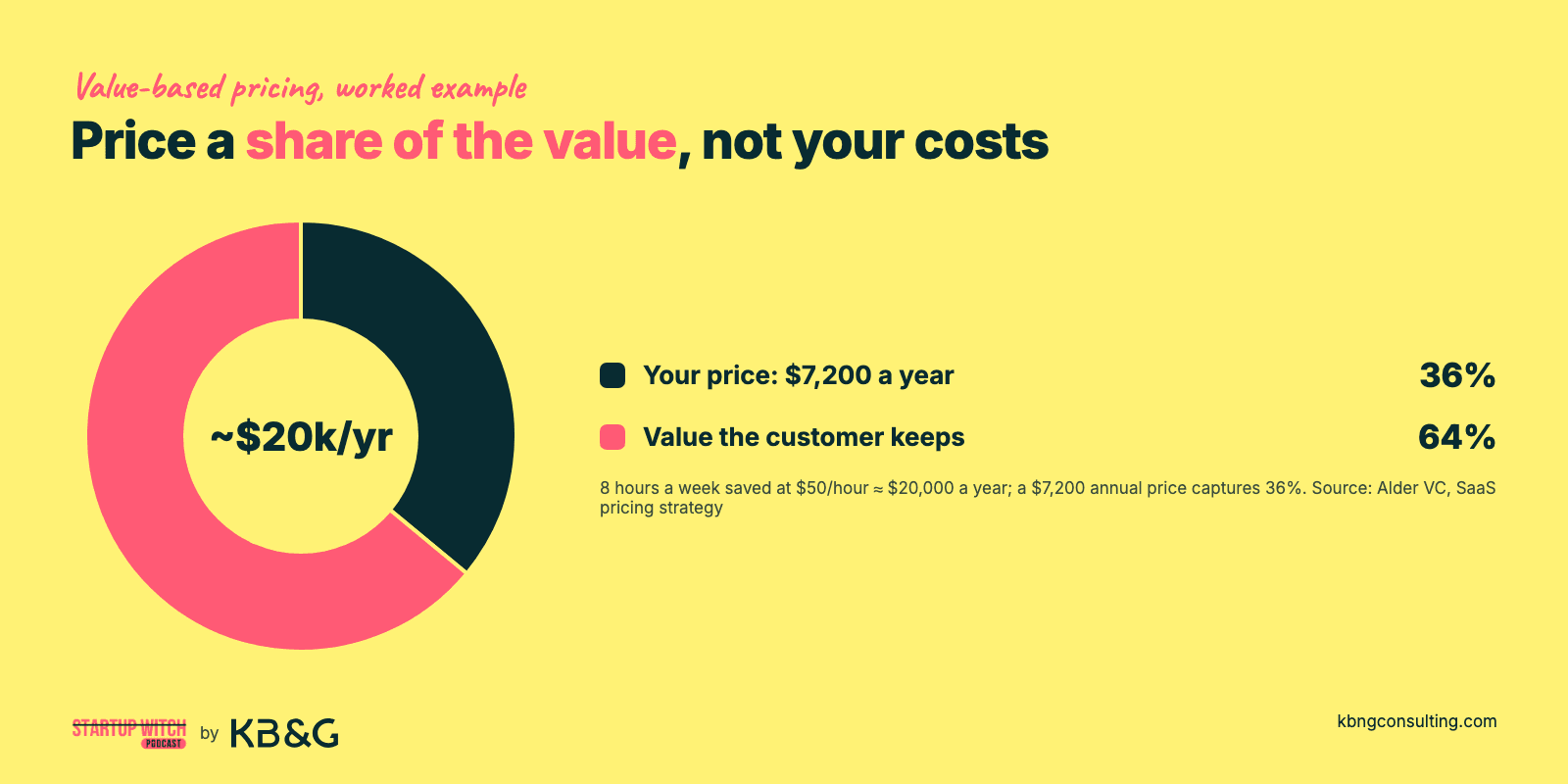
A simple way to estimate value: identify one or two outcomes and quantify them. If your AI tool eliminates 8 hours per week of manual reconciliation for a property manager earning $50/hour, that is roughly $20,000/year in savings. Charging $600/month (about $7,200/year) captures 36% of that value. Alder VC works through this example for vertical SaaS. Slack is a familiar illustration of the logic: its price is easier to justify against the communication overhead it replaces than against the cost of running chat servers.
For early-stage founders still validating product-market fit, value-based pricing is usually the right north star. It forces you to understand customer value metrics and align pricing with how customers derive value. You need evidence to do it well: real customer interviews, data on time or cost saved, and clarity on what your buyer would spend if your product did not exist. At zero customers, you estimate. After ten customers, you should have data to confirm.
Cost-Plus Pricing
Cost-plus pricing starts with your direct costs: cloud hosting, AI inference (per token, per minute of audio, per frame of video), third-party APIs, data labeling, support hours. You then add a margin on top.
This approach works as a safety net. It ensures you do not sell at a loss, which matters especially when AI compute costs are volatile. If your model inference costs spike because usage grows faster than per-token prices drop, cost-plus gives you a floor. But cost-plus as your primary method ignores what customers are willing to pay. It makes pricing reactive to your cost structure rather than proactive about your value proposition. Worse, as you optimize costs over time, pure cost-plus logic would force you to lower prices even though the value you deliver has not changed.
Competitor- and Market-Anchored Pricing
Competitor pricing means benchmarking against similar tools and positioning yourself relative to them. If every tool in your vertical charges between $40 and $80 per user per month, pricing at $200 without a clear differentiation story will confuse buyers. Pricing at $10 signals low quality.
This approach is useful early when you have little customer research and need reference ranges. A sensible pattern is to use competitor-anchored pricing as a launch anchor, then migrate to value-based pricing once you have enough customers to know what they were using or replacing. The danger is copying big-player models. Reproducing Salesforce's pricing page without matching their brand recognition, service infrastructure, and sales team makes no sense. Use competitor pricing as a sanity check for ranges, not as your blueprint.
Choosing a specific pricing model is where these approaches become real.
Choosing a SaaS Pricing Model That Matches Your Product
SaaS pricing strategy becomes concrete when you decide what you charge "per." The model you pick shapes buyer psychology, billing operations, and whether your revenue grows as customers get more value. Understanding customer segments helps tailor pricing models effectively, especially for AI and industrial buyers who think about value differently than a marketing team buying CRM software.
Per-Seat (Per-User) Pricing
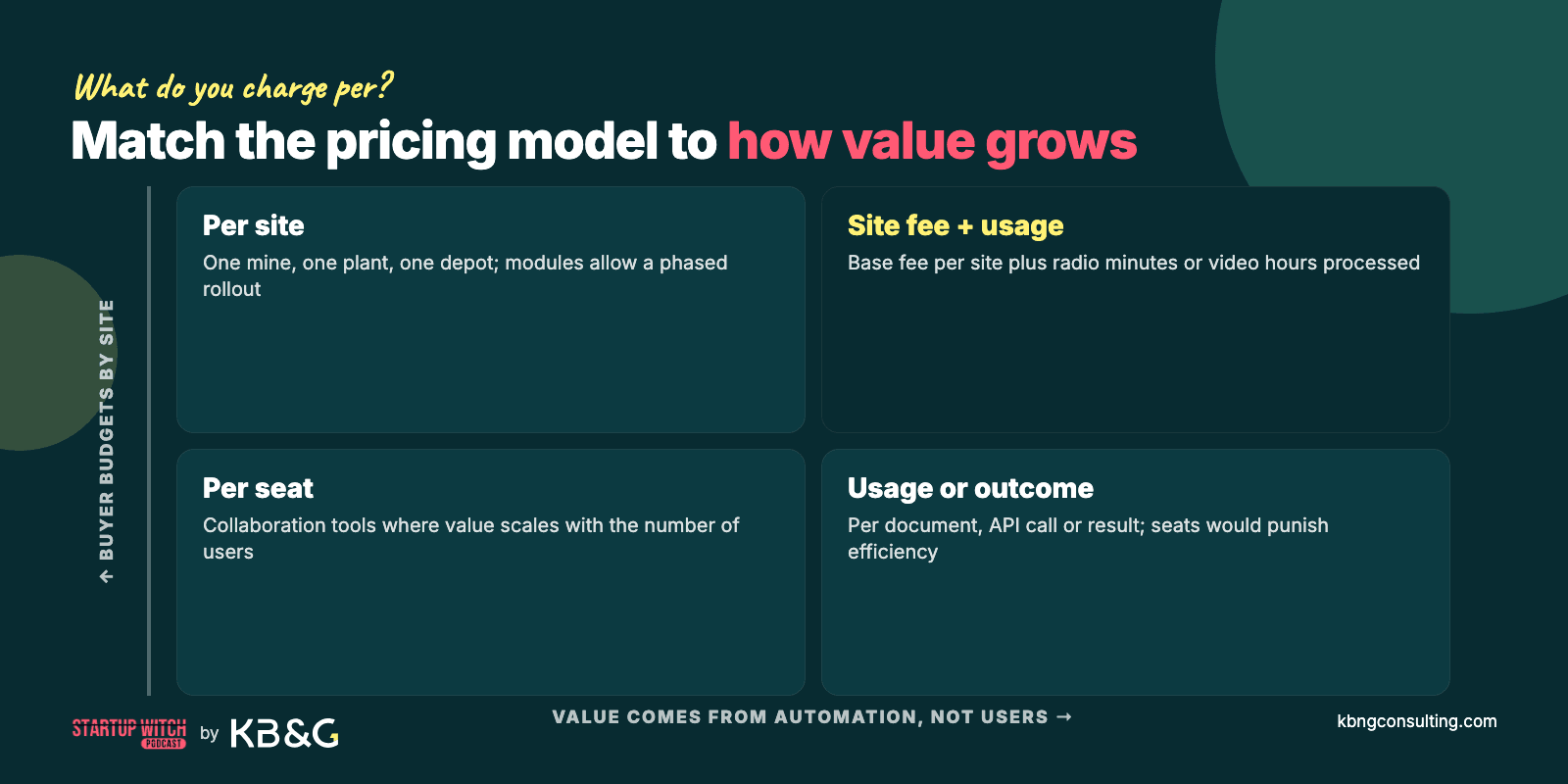
Per-seat pricing charges a flat fee per individual user account. It dominated SaaS for years because it is easy to understand, maps to headcount budgets, and makes revenue predictable. It still makes sense for collaboration tools and systems where value genuinely scales with the number of human users interacting with the product.
But seat-based pricing is losing ground across SaaS, and the reason is straightforward. As AI and automation let fewer people do more work, per-seat pricing punishes efficiency. If your AI tool replaces three analysts with one dashboard user, per-seat pricing caps your upside at one seat while delivering three seats' worth of value. For any product where automation is the core value proposition, per-seat is the wrong metric.
Usage-Based and Consumption Pricing
Usage based pricing charges per API call, document processed, GB of cloud storage, minute of audio, or similar usage metrics. AWS is the best-known example, charging for most of its cloud services by consumption, and usage-based billing has become much more common in SaaS. Usage-based pricing allows costs to scale with customer demand.
For early-stage SaaS, the benefits are real: usage based pricing aligns with value, reduces friction for initial sign-ups, and scales revenue as customers adopt more. But unpredictable bills scare CFOs. Usage-based pricing models can lead to unpredictable billing spikes, and customers need dashboards showing their usage in real time plus caps to prevent bill shock. Without those, you will face support tickets and churn from happy customers turned angry ones.
Tiered / Plan-Based Pricing
Tiered pricing offers structured packages tailored to different buyer personas. The standard pattern is two or three public pricing tiers: an entry plan with essential features and lower usage limits, a middle plan positioned as the obvious choice with core features and higher limits, and an enterprise or custom plan for larger buyers needing advanced features and dedicated support.
Some established companies publish five or more tiers, but for early-stage products, two or three tiers usually beat five or six. Fewer tiers mean less decision paralysis for your target audience, cleaner messaging, and simpler billing. Each tier should map to a stage of customer maturity: solo founder testing the product, small team standardizing a workflow, multi-site or multi-department organization rolling out at scale. Transparent pricing structures reduce friction and accelerate the sales cycle.
Per-Site, Per-Module, and Hybrid Models for Industrial Buyers
Industrial buyers in mining, construction, or manufacturing do not think in seats. They think in sites, plants, fleets, or regions. They budget by physical asset, not headcount. Charging per-seat for a mine safety platform makes as little sense as charging a quarry per Slack message.
Per-site pricing charges by location: one mine, one plant, one depot. Module-based pricing splits the platform into discrete capabilities (safety analytics, maintenance scheduling, operations reporting) so buyers purchase only what they need, enabling phased rollout. A hybrid model might combine a base fee per site with usage charges for variable components like radio minutes processed or hours of video analyzed. Governance of hybrid pricing models can be complex but allows flexibility in capturing value across diverse customer segments.
Outcome-Linked and "Digital Worker" Pricing for AI Products
Outcome-linked pricing means customers pay based on results: incidents prevented, hours saved, leads generated. SaaS companies are shifting to pricing based on outcomes and value delivered, and this model gives strong alignment between what you charge and what the buyer cares about. The challenge is measurement. You need clear KPIs, good instrumentation, and agreement on what counts as a "result."
"Digital worker" pricing applies when your AI system does a job a human used to do. You charge per agent or per "slot" of automation, framing the price against the cost of the person it replaces. This can work well in pilots and co-building deals where risk is shared. For broad rollout with many customers, simpler models often scale better because outcome measurement across different buyers introduces variance and disputes.
You have chosen how to charge. Now you need to package it into offers that guide buyers to a decision.
Designing Packages and Tiers That Actually Sell
A strong SaaS pricing strategy is as much about packaging and communication as it is about the raw numbers. You are designing a buying decision, not just a billing structure. Pricing structure complexity should be justified by the value it drives to customers.
Mapping Packages to Customer Segments and Jobs-to-Be-Done
Start by identifying two or three real customer segments based on your customer research. For a SaaS product, those might be: a solo founder with 0 to 5 users trying to prove ROI fast, a small team of 5 to 25 users standardizing one workflow, and a multi-site operator rolling the product out across locations. For an industrial AI tool, the segments might be: a single-site operations team running a pilot, a regional safety manager covering three to five sites, and a corporate buyer deploying across a fleet of dozens of locations.
Each segment has a primary job-to-be-done. The solo founder needs to validate that the product works before committing budget. The operations team needs to standardize a process and show results to leadership. The corporate buyer needs reliable deployment, support SLAs, and volume discounts. Your paid plans should map to these jobs, not to arbitrary bundles of product features.
What to Put in Each Tier: Features, Limits, and Support
Three levers control the content of each tier:
Features: What capabilities are enabled. Lower tiers include essential features. Middle tiers add advanced functionalities like integrations, analytics, or agent functionality. Top tiers unlock premium features and advanced capabilities like custom workflows, white-labeling, or dedicated infrastructure.
Limits: Usage caps, number of users, number of sites, or workflow volume. Set usage limits that feel generous for the target customer segment of each tier but create natural upgrade triggers. If a prospect outgrows the usage limits on Tier 1, moving to Tier 2 should feel like a logical step, not a punishment.
Support and services: Self-serve documentation for lower tiers. Onboarding calls and training for middle tiers. Dedicated account management, SLAs, and custom onboarding for enterprise customers.
The middle tier should feel like the obvious choice for most prospects: the best ratio of capability to price. The lower tier keeps the door open for budget-sensitive users without cannibalizing your average revenue per user. The top tier is flexible; for most early-stage products, "Contact us" covers it until you have repeatable enterprise deals.
Pricing and Packaging for Industrial and Heavy-Operations Buyers
Mining, construction, and manufacturing buyers care about reliability, safety outcomes, and vendor stability more than feature lists. They prefer per-site, per-fleet, or per-region pricing over per-seat because that is how their budgets are structured. Sales cycles in these industries are often long, which means your pricing needs to account for pilot phases.
Pilots typically carry different pricing structures: a fixed pilot fee covering limited sites and limited modules, with success metrics agreed upfront. The expansion plan then scales to full deployment with volume discounts per site or region. Annual billing discounts incentivize cash flow predictability and long-term loyalty, and multi-year pricing commitments are common. If your SaaS product serves operations teams in asset-heavy industries, do not try to force monthly per-seat billing. It will not match their procurement logic or budget cycles.
Accounting for AI Compute Costs and Unit Economics
AI inference, storage, and data labeling can quietly destroy margins if you ignore them. You do not need a perfect financial model at this stage, but you do need a back-of-the-envelope understanding of unit economics for each plan. Without it, you might build a pricing strategy that looks good on paper and loses money on every heavy user.
Identifying Your Real Cost Drivers
Common cost drivers for SaaS and AI products include:
Cloud hosting: compute, storage, bandwidth
Model inference costs: per token, per minute of audio, per frame of video; these scale with customer usage and model size
Third-party APIs and data sources
Data labeling and model retraining cycles
Support and onboarding time, especially for higher-touch tiers
Monitoring, compliance, and safety infrastructure (particularly in industrial settings)
Translate these into per-unit costs. What does it cost you to process one document, transcribe one minute of audio, or run one site for one month including infrastructure? These numbers let you check whether your pricing covers reality.
Setting Guardrails: Margins, Free Tiers, and Trials
Recurring-revenue software should run at healthy gross margins. AI-heavy usage plans may accept lower margins, but as a rule of thumb, if a plan consistently runs below 50% gross margin, the plan is mispriced or the usage limits are too generous.
A freemium model provides a free version with paid upgrades for advanced functionality. A freemium strategy can lower barriers to entry while building a user base. But free tiers are safe only when marginal cost per user is near zero, onboarding is self-serve, and the upgrade path is strong. Freemium models work best when the free product provides genuine value for potential upgrades. Free tiers become dangerous when variable compute costs are high, custom onboarding is expected, or users consume AI resources without converting to paid plans.
Design trials with clear limits tied to your cost drivers, for example 50 documents, 100 minutes, or 30 days. Require a credit card where appropriate to filter low-intent sign-ups. Make the overage or upgrade path simple so the trial converts rather than frustrating people.
Balancing Value-Based Pricing with Cost Reality
Start with a value-based target price. Then check: does this price cover projected average usage costs at a healthy margin? If heavy users break the economics, you need usage caps, overage charges, or a higher tier.
Model at least three or four customer archetypes: light user, moderate user, heavy user, and (if relevant) industrial site. Calculate the margin per plan for each archetype. If your value-based price for a "Growth" plan is $200/month but a heavy user consumes $180 in inference costs, you have a problem. The fix is either raising the price for that tier, adding usage limits, or introducing an overage charge for consumption beyond the baseline.
AI subscription models are under pressure because token usage is growing faster than the per-token cost is falling. Even the largest AI providers lose money on subscribers who use their plans heavily. A simple spreadsheet that models these scenarios will save you from discovering negative margins after launch.
Once guardrails are set, you are ready to test pricing with real prospects.
How to Test and Iterate Your SaaS Pricing in the Real World
Pricing is a live experiment, not a one-time decision. Test and iterate on pricing models as customer usage evolves. Early-stage founders should expect several pricing iterations before Series A, and the best data comes from conversations with real buyers, not from guessing in isolation.
Designing Simple Pricing Experiments
Frame two or three hypotheses before each round of testing. Examples: "per-site pricing increases close rates with industrial buyers," "annual contracts raise win rates by reducing monthly budget friction," "raising the mid-tier price from $99 to $149 filters out tire-kickers without reducing conversion among qualified leads."
Test on different surfaces depending on your stage:
Live sales conversations and proposals. Float different price points with different prospects and document reactions. This works at any volume.
A/B variants of pricing pages. Only useful when you have enough traffic for the results to mean something. If you get 50 visitors a month, skip this.
Private offers for specific segments. Industrial pilots, for example, can have bespoke pricing that tests willingness to pay in a controlled context.
Keep pricing changes isolated. Change one lever at a time so you know what drove results. If you simultaneously change the price, the tier structure, and the billing frequency, you learn nothing.
Running Pricing Conversations with Prospects
Discovery calls are your best pricing laboratory. Structure them to uncover willingness to pay without sounding apologetic about charging money:
Quantify current pain. "What is this problem costing you right now, in hours per week or dollars per month?" Let the prospect name a number.
Ask about budget and approval. "What budget range have you allocated to solve this? Who signs off on that?" This tells you the ceiling.
Float anchored options. "We have customers on plans at $150, $300, and $500 per month depending on usage and support. Which range feels right for your situation?" Watch the reaction.
Specific questions that surface price sensitivity: "If we could guarantee saving your team 15 hours per week, what would that be worth to your budget?" or "Compared to your current tool, what would make this feel like an easy yes at $X per month?" Research customer profiles before implementing pricing changes, and understand customer needs by listening more than pitching.
What to Track: Signals You're Underpricing or Overpricing
Underpricing signals:
Zero pushback on price from qualified leads
Prospects calling your product "cheap" or "a no-brainer"
Heavy customer usage that crushes margins, especially on AI workloads
New customers signing without negotiation
Overpricing or mis-packaging signals:
Strong interest during demos, but consistent "not now" at proposal stage
Constant discount requests from your target customer segment
Prospects confused by multiple pricing tiers, asking for bespoke combinations every time
Sales reps spending excessive time explaining the difference between plans
Use a three-to-six month window to collect enough data before making a major change. If you see extreme signals (negative margins, or most prospects dropping out at proposal stage), adjust sooner.
Common SaaS Pricing Mistakes Founders Make (and Fixes)
These mistakes show up repeatedly in founder conversations. Each one has a straightforward fix.
Problem 1: Underpricing Out of Fear
The pattern: founders discount heavily to "get logos" and end up with low-ARPU, high-demand existing customers who expect bargain pricing forever. The revenue potential of the product never materializes because the early customer base anchors on a price that does not support the business.
The fix: raise prices for new customers first. Raising prices for new customers only reduces churn risk because you are not surprising anyone who already signed. Stop publishing permanent coupon codes. If you need a discount to close a pilot, make it time-limited with a clear end date and a stated post-pilot price. Communicate product value to justify price increases effectively; adding new features provides a valid reason to raise prices.
Problem 2: Too Many Tiers and Options
Four to six plans, multiple add-on models, feature based pricing mixed with usage based pricing, and additional features bolted on everywhere. Buyers cannot decide. Sales cycles drag. Sales reps spend time explaining plan differences instead of selling outcomes.
The fix: simplify to two or three public plans with one clearly marked as "recommended." Move edge-case add-ons into custom or enterprise quotes only. Implement captive pricing for essential add-ons or features that unlock core value, rather than scattering them across every tier.
Problem 3: Copying Big-Company Pricing Models
An early-stage SaaS startup copies Salesforce or HubSpot pricing tables despite having a different buyer, a different average deal size, and a different sales motion. The result is a pricing structure that implies a level of brand, service, and feature depth the startup cannot deliver.
The fix: rebuild pricing from customer interviews and your own unit economics. Your deep understanding of your buyer should drive the design, not a screenshot of a Fortune 500 company's pricing page. Use competitor pricing only as a sanity check for whether your price points are in a reasonable range for the category.
Problem 4: Ignoring Industrial Buyer Realities
An AI or SaaS product built for mining, construction, or manufacturing tries to sell monthly per-seat subscriptions like a marketing automation tool. The procurement team does not know what to do with it. Budget owners think in OPEX per site, not per-seat SaaS licenses.
The fix: switch to per-site, per-fleet, or per-region pricing with annual or multi-year terms. Bundle pilots, training, and hardware integrations into clear packages. Offer flexible pricing that matches how industrial buyers actually allocate budget: by physical asset and operating region, with volume discounts for multi-site deployment.
Conclusion and Your Next Steps on SaaS Pricing Strategy
Start with value-based pricing as your north star. Choose a pricing model that matches how your customer extracts value from your product. Keep the pricing structure to two or three tiers. Protect your margins by modeling AI compute costs per plan. Treat pricing as an ongoing experiment, not a permanent decision.
Here are your next steps:
Write down your value hypothesis: what does your product save or earn for your main customer segment, and what target price range captures a fair share of that value?
Pick one primary pricing model (per seat, usage, per site) and design two or three tiers with clear feature, limit, and support differences.
Model rough unit economics for each tier using your real cost drivers, including AI inference costs. Check that each plan stays above 50% gross margin for a typical user.
Update your pricing page and sales deck with the new structure.
Run 10 to 15 pricing conversations with prospects using the structured approach described above. Record reactions and objections.
Schedule a review in 90 days. Adjust based on win rate, customer lifetime value trends, average deal size, and margin data.
If pricing is one of several blockers stalling your growth, the Founder Blind Spot Diagnostic by Startup Witch reads your startup in 14 days and names the one thing blocking growth, so you know what to fix first. It costs EUR 750 and is fully refundable. Start at kbngconsulting.com/founder-diagnostic.
Quick Reference
Pricing launch checklist: Discover (customer interviews, usage patterns) → Design (model, tiers, limits) → Model (unit economics per archetype) → Test (live conversations, page variants) → Announce (update pricing page, notify sales team).
Mini-glossary: ARPU (average revenue per user), ACV (annual contract value), gross margin (revenue minus direct costs divided by revenue), expansion revenue (upsell and usage growth from existing customers), pilot pricing (fixed-fee, time-limited offer to prove value before full deployment), customer lifetime value (total revenue expected from a customer over the full relationship).
Metrics to watch after a pricing change: conversion rate from trial or free tier to paid plans, win rate and close time by tier, average deal size (ACV) and variance, churn rate, gross margin by plan, usage growth over time per customer.
AI workload cost tracking: Monitor per-token, per-minute, or per-frame costs monthly. Compare actual customer usage against the baselines assumed in your pricing. Flag any customer archetype where usage growth is outpacing revenue growth.
Review pricing at key milestones: post-MVP when you have your first five paying customers, after your first 10 to 20 customers when usage patterns stabilize, and before raising your next round.