What Is a Startup Sales System?
A startup sales system is the documented, repeatable way your startup finds, qualifies, and closes B2B customers. If revenue drops every time you step away from selling, you don't have one yet. It's the bridge from founder-led one-off deals to a repeatable process any competent salesperson can run without your constant involvement.
This article is for founders of B2B AI and SaaS startups, pre-seed through Series A, who still close most deals themselves. You know the pain: constantly reinventing discovery questions, losing deals in the gaps between meetings, no shared view of your pipeline, and a gnawing fear that hiring a salesperson into this chaos will just burn cash. The focus here is practical: moving from founder hustle to a system someone else can actually execute.
We'll cover ICP definition, pipeline stages with exit criteria, a discovery framework, pricing and objection playbooks, CRM hygiene, weekly pipeline reviews, and how to document everything so your first sales hire can repeat what works. Here's what you'll walk away with:
A clear definition of what "good enough" looks like for a founder-run sales system.
A concrete pipeline model with stages and exit criteria tailored to B2B AI/SaaS.
A discovery, pricing, and objection framework you can plug into sales calls this week.
A simple CRM setup and weekly review rhythm so nothing falls through the cracks.
A checklist to know when the system is ready for a first sales hire.
Understanding a Startup Sales System
A startup sales system is a set of documented decisions, steps, and rules that turn leads into revenue in a consistent way. It's what allows you to hand your sales process to someone who isn't you, and have them close deals without calling you after every meeting.
Most AI and SaaS startup founders default to improvisation because it works at first. Your first customers come from relationships, not funnels. You know the product cold, you adapt the sales pitch on the fly, and your passion carries the conversation. But after your first handful of customers, that approach hits a ceiling. You can't clone yourself, your notes live in scattered docs and your head, and every sales conversation is a one-off performance. An effective sales system gives you a repeatable, scalable way to turn prospects into paying customers, and that's what you need to build before you try to grow.
The shift from "heroic founder selling" to "system selling" means moving decisions out of your memory and into shared, enforceable rules: a visible pipeline, written qualification criteria, and a process a new salesperson can follow on day one.
Core Components of a Startup Sales System
The essential building blocks are straightforward. Each one reduces variance and makes sales teachable:
Ideal Customer Profile (ICP) with hard criteria. Measurable traits that define who you sell to, and who you don't.
Pipeline stages with entry and exit criteria. The path from first contact to closed deal, with clear rules for when a deal moves forward.
Discovery framework. Structured questions, talk-time balance, and note discipline for every call.
Pricing guardrails and objection handling playbook. Standard packages, discount floors, and prepared responses to the objections you hear repeatedly.
CRM setup and hygiene rules. A minimum viable CRM that tracks every interaction with potential customers. Not a spreadsheet, not your inbox.
Review rhythm. Weekly pipeline reviews and monthly retrospectives that catch problems and codify learnings.
A system is not a pitch deck or a Notion page you wrote once. It's something you actually use on calls, in your CRM, every day. If a "qualified opportunity" doesn't have a defined problem, budget range, and timeline in the CRM, it's not qualified, regardless of how good the demo felt.
Why Founder-Led Deals Need a System
Founder-led sales typically looks like this: intros from friends, ad-hoc demos tailored to each prospect, custom pricing, chaotic notes scattered across email and Slack. All of it lives in the founder's head. Every sales conversation provides valuable product feedback, but if that feedback never gets structured, it disappears.
The ceiling arrives fast. Your calendar saturates. There's no pattern for new reps to follow. Investors push for a sales hire, but hiring sales before you have a system is how too many founders burn through their first AE. Close a meaningful number of similar customers yourself before hiring sales reps. Not because you need the revenue, but because you need the reps (repetitions) to discover what actually works.
Systemizing early compounds: faster learning loops on ICP and messaging, higher close rates from consistency, and a dramatically easier handover to your first sales hire. To build that system, you first need to be precise about who it's for: your ICP.
Designing Your Startup Sales System Around a Sharp ICP
Your ICP is the boundary of your entire sales system. It defines which opportunities enter the pipeline and which get politely turned away. Without it, your sales team (even if that team is just you) wastes time on prospects who were never going to buy.
For AI and SaaS startups, your ICP is a hypothesis that needs testing. It's based on actual customers and pilots, not persona slides created during a branding exercise. Document your ideal customer profile and their top business pain points, then revise it as you learn. A validated ICP concentrates your limited time and keeps your pipeline honest.
Turning Your ICP from Guess into Operating Rule
Define your ICP with measurable traits that anyone can evaluate in under a minute:
Firmographics: Industry, company size, geography, regulatory context. For safety AI sold to mining companies, a regulatory trigger (new inspection requirements, compliance deadlines) is often the real buying signal.
Buyer role: Specific titles (VP Operations, Head of Data, CIO), not vague "decision-maker" labels. Sales motions differ with product complexity and target market, so knowing the exact buyer matters.
Problem signals: Current workarounds, missed KPIs, compliance pressure, recent incidents. These are the pain points that make someone pick up the phone.
Start with your 3 best existing customers. Reverse-engineer the shared traits. Write them as "must-have" (non-negotiable) and "nice-to-have" (improves odds but not required). This becomes a checklist, not a paragraph someone has to interpret.
Qualifying In and Qualifying Out
Qualification is the gatekeeper of your sales system: it decides who enters the pipeline and who does not. At early stage, heavy enterprise frameworks like full MEDDIC are overkill.
Use something lightweight: Problem–Owner–Urgency–Fit. Does the prospect have a real problem your product solves? Is the person you're talking to the budget owner or connected to one? Is there urgency (regulatory deadline, board pressure, budget cycle)? Does the deal fit your current product without heavy customization?
Concrete disqualifiers save you enormous time: no budget influence, a problem that is "interesting" but not tied to a KPI, heavy customization that breaks your roadmap. Saying "no" early keeps the system focused and improves your conversion rates and sanity.
Documenting ICP So Others Can Use It
Create a 1–2 page ICP document with:
One-paragraph description of who you sell to and why.
A checklist of must-have traits (binary: yes or no).
3 real, anonymized customer examples showing what a great fit looks like.
Red flags and "do not sell" criteria (your anti-ICP).
This doc must live where sales works daily: pinned in CRM, linked in outreach templates, inside onboarding materials for your first hire. It's not a strategy artifact. It's an operating rule.
Once you know who you sell to, you design the path from first contact to signed deal: your pipeline.
Building Your Pipeline: Stages, Exit Criteria, and Signals
Pipeline stages are the skeleton of your startup sales system. Exit criteria are the rules that keep the bones in the right place. Without them, every deal is "50% likely" forever and forecasts mean nothing.
A defined sales process is a step-by-step roadmap aligned with the customer's buying process. The goal isn't more stages; it's stages that mean something a new rep can understand in five minutes.
Designing a Simple, Effective Pipeline for B2B AI/SaaS
Here's a recommended 6–7 stage pipeline for early-stage startups:
Target Account / Lead. Identified company matching ICP criteria. Could come from cold outreach, inbound interest, content marketing, or existing relationships.
First Conversation / Discovery. Live conversation where you explore the prospect's problem, workflow, and urgency.
Qualified Opportunity. Problem confirmed, economic buyer identified, rough budget and timeline established.
Solution Fit / Demo or Pilot Proposal. Buyer agrees your approach maps to their requirements. Demo or pilot scope defined.
Commercial Negotiation. Pricing, terms, security review, procurement and legal loops engaged. This is especially critical for enterprise sales in AI, where data-sharing agreements and compliance reviews add time.
Verbal Commit. Buyer confirms intent to proceed. Contract in final review.
Closed Won / Closed Lost. Deal signed or explicitly lost with documented reasons.
For AI/SaaS selling into industrial verticals, you may need explicit sub-stages for security review, data privacy assessment, or pilot execution. Adjust to your reality, but keep the total under 7 stages.
Exit Criteria that Make Pipeline Data Trustworthy
Exit criteria are the observable facts that must be true before a deal moves to the next stage. They must be binary: checkable in CRM fields, not gut feel. The biggest improvement comes from shifting seller-centric stage labels ("sent proposal") to buyer-centric exit criteria ("buyer confirms budget and timeline"). A stage defined by what the buyer has done tells you far more about the deal than one defined by what you did.
Examples for key transitions:
Discovery → Qualified: Clear business problem captured in CRM, named economic buyer, rough budget range discussed, agreed next step on calendar.
Qualified → Solution Fit: Problem tied to a measurable metric, buying committee mapped, timeline understood.
Solution Fit → Negotiation: Buyer has confirmed your approach vs alternatives, initial pricing shared, procurement or legal discussions initiated.
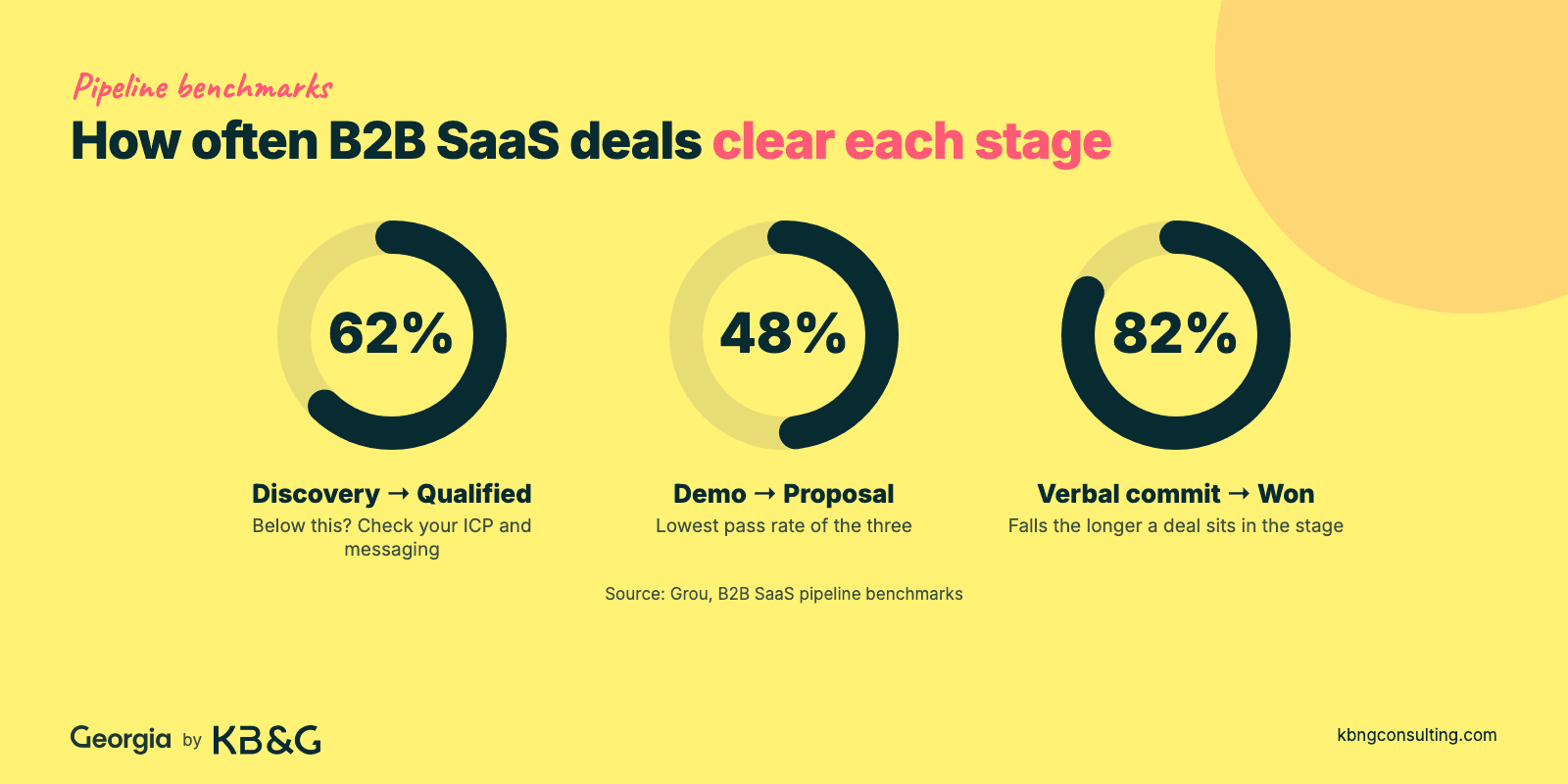
Verbal Commit → Closed Won: Signed contract received. According to Grou's B2B SaaS pipeline benchmarks, verbal commit converts to closed-won around 82% of the time, but that rate drops the longer a deal sits in the stage.
Signals, Probabilities, and Forecasting at Early Stage
Assign simple win probabilities tied to stages and exit criteria, not to founder optimism. Key metrics to track for pipeline management:
Conversion rates between stages. In the same benchmark set, Discovery → Qualified runs about 62% and Demo → Proposal about 48%. If your numbers are far off, it signals upstream ICP or messaging issues.
Average days in each stage. The median B2B SaaS sales cycle runs about 84 days from first contact to signed deal. Deals sitting in a stage far longer than your average are at risk.
Pipeline coverage vs targets. Are you generating enough opportunities to hit your revenue goal, given your stage-by-stage conversion rates?
The goal is directional accuracy, not perfect forecasting. But investors and your first sales hire will judge you on how "real" your pipeline is. A clean, criteria-gated pipeline with honest data beats an inflated spreadsheet every time.
Once the path is defined, you need a conversation framework that turns that path into real progress on calls.
Discovery, Pricing, and Objection Handling: The Conversational Engine
The quality of your sales system depends on the quality of the conversations you and your reps have. Discovery, price anchoring, and objection handling need structure: not scripts, but a repeatable skeleton. For complex AI and SaaS, discovery doubles as product research, and it's where you validate your messaging before scaling a sales team. But without a framework, every call is context switching between exploration and selling with no consistent output.
A Repeatable Discovery Framework for Founder-Led Sales
Structure your discovery call simply:
1–2 minutes: Context and agenda. Confirm time, state the purpose, set expectations.
10–15 minutes: Problem exploration. Current workflow, what's broken, what it costs them.
5–10 minutes: Fit check. Who else is involved in the buying process, timelines, constraints, success criteria.
5 minutes: Next steps and commitment. Agree on a concrete action with a date.
Use question themes instead of rigid scripts:
Trigger questions: "What changed this year that made you start looking at this now?"
Impact questions: "What happens if this stays as-is for another 12 months?"
Stakeholder questions: "Who else cares about this metric, and who else must say yes?"
Note-taking discipline is non-negotiable: every discovery call must end with 3–5 bullet notes saved to CRM in a consistent format, same day. Conversation intelligence tools can automate note-taking and summarize insights, but even manual bullets are better than nothing. This customer data feeds everything downstream: your pipeline accuracy, your playbook, your ability to train someone else.
Pricing Guardrails for Early-Stage AI and SaaS
Uncontrolled discounting and bespoke deals quietly destroy your sales system and future pricing power. When every deal has a different price, your new customers compare notes with existing customers, your referenceability suffers, and your sales team can't quote without calling you.
Define a simple pricing framework:
Anchor price and 1–2 standard packages (e.g., pilot scope at a fixed fee, production deployment at annual contract value). Free trials or free plan options can work for lead capture but need clear conversion criteria.
Written rules for maximum discounts and who can approve exceptions. A clear floor prevents the "just this once" spiral.
Non-monetary levers: Start date, contract length, scope, reference requirements. These give reps room to negotiate without cutting price.
Anchor every price conversation in the outcome and ROI for the buyer, not a list of product features. Keep a one-page pricing cheat sheet with default pricing, floors, and standard trade-offs. Anyone doing sales calls should have it open.
Objection Handling as a Playbook, Not Freestyle
Build an objections library curated from real calls: security concerns, integration effort, price pushback, "we'll build it ourselves," "come back after budget cycle."
For each objection, document:
What it usually really means. "Security" often means "if I push this through, my legal team will block me." "Price is too high" sometimes means "I'm not convinced the value is there."
2–3 diagnostic questions to understand what's really going on before responding.
1–2 concise responses tied to value, not defensiveness.
Store this where it's accessible during calls: internal wiki, Notion, CRM snippets, or a shared messaging templates library. Objections shift as your market and product change, so update the library monthly.
Once you know what conversations and decisions must happen, you need a system of record (your CRM) to make it visible and repeatable.
CRMs and Hygiene: Making Your Sales System Visible
Your sales system lives where your deals live: in your CRM. Without consistent data entry and rules, even the best framework collapses. Early-stage founders don't need an enterprise stack. They need a simple, enforced workflow.
Choosing a Lightweight CRM and Setting It Up
Pick a basic CRM based on practical criteria, not feature lists:
Easy to change pipeline stages and fields as your system evolves.
Native email and calendar integration so logging isn't a separate chore.
Fast to update during or after calls; mobile-friendly helps.
Basic reporting: stage counts, conversion rates, expected revenue.
For AI/SaaS, add these custom fields:
Industry and segment.
Primary buyer role.
Key metric impacted (e.g., safety incidents, cost savings, compliance gaps).
Deal driver (compliance, cost reduction, revenue growth, safety, automation).
Overbuilding is the classic mistake. The Founder CRM Benchmark Report 2026 from Coherence found that 78% of founders abandoned their first CRM within 18 months, and that founders underestimated the upkeep, expecting about 1.5 hours a week and spending about 4.2. Start with a minimal setup and improve it monthly.
CRM Hygiene Rules Everyone Must Follow
Define 5–7 non-negotiable hygiene rules. These aren't aspirational. They're the operating standard:
Every opportunity has a next step with a specific date on the calendar.
Deals only change stage when exit criteria are verifiably met. No "deal teleportation."
All calls get notes same day, even if they're bullet points.
Mandatory fields (ICP match, buyer role, impacted metric, deal driver) must be filled before proposal stage.
Deals get closed-lost with a documented reason, not left to rot.
Unresponsive deals with no progress in 30–60 days are closed-lost.
These rules feed accurate weekly pipeline reviews, better coaching, and honest investor reporting. They also save time: less chasing, better focus, fewer surprises.
Basic Reports to Run Every Week
Three to four simple reports give you what you need for pipeline management:
Pipeline by stage and owner. Where are your deals? Are they distributed or clumped?
Deals without a next step. These are dying. Act immediately.
Conversion rate from Discovery to Closed Won. Track it stage by stage, alongside customer acquisition cost (CAC) and sales cycle length.
Average cycle length for Won vs Lost deals. Won deals that take much longer than average signal process friction.
Use each report to spot bottlenecks. Lots of stalled demos? Likely weak discovery or unclear next steps upstream. Low proposal-to-close conversion? Pricing or objection handling needs work.
These reports set the agenda for a weekly pipeline review, the heartbeat of your sales system.
Running Weekly Pipeline Reviews and Continuous Improvement
Without a weekly cadence, the system decays. Deals slip, learnings never get codified, and your sales process quietly drifts back to ad hoc. This applies even if "the team" is just you and a co-founder reviewing over coffee. The ritual matters.
How to Run a 30–45 Minute Weekly Pipeline Review
Keep the agenda tight and recurring:
5 minutes: Quick metrics overview: wins, losses, stage movements since last week.
15–25 minutes: Deal-by-deal review of your top 10–15 opportunities. Focus on next steps and risks, not storytelling. Challenge fuzzy deals that don't meet stage criteria.
5–10 minutes: System questions. Are exit criteria working? Any new objections showing up? Are follow-ups happening on schedule?
Capture patterns in a shared doc during the meeting. If three deals this week stalled because prospects couldn't get internal security approval, that's a system insight, not just a deal problem.
Capturing Learnings and Updating the System
Run a simple monthly retrospective:
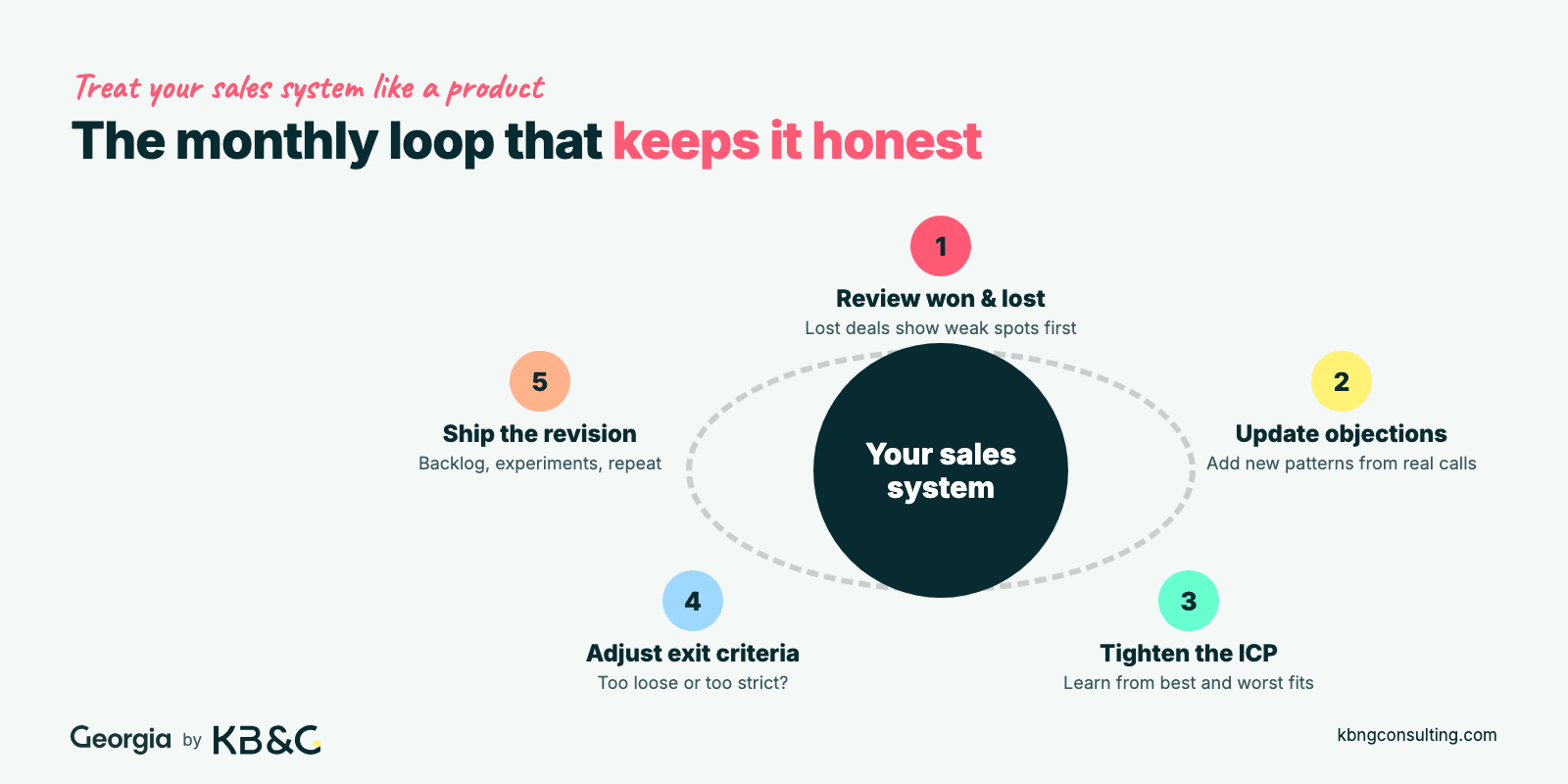
Review closed-won and closed-lost reasons. Lost deals are where your system's weak spots show up first.
Update the objection library with new patterns from real calls.
Tighten ICP criteria based on best and worst fits from the past month.
Adjust exit criteria if stages are too loose (deals jump ahead prematurely) or too strict (everything stalls).
Treat your sales system like a product: maintain a backlog of improvements, run small experiments, ship revisions. The system is never "done". It gets better every month.
Once the system exists and is being improved weekly, you need to document it as a playbook someone else can run.
Documenting Your Sales System as a Playbook
A sales playbook is the human-readable version of your system: not theory, but exactly how you sell today. It lets new hires replicate what already works rather than invent new processes from scratch. It's the single most important asset for your first sales hire: it shortens ramp time and reduces dependence on your memory.
The Minimum Viable Sales Playbook Structure
Every early-stage playbook should include these sections:
ICP and anti-ICP: who to pursue and who to ignore.
Pipeline stages and exit criteria: the path and the rules.
Discovery framework and example questions: the conversation structure.
Messaging: problem statement, value proposition, 2–3 case patterns, and how you differ from the alternatives.
Pricing and discount rules: packages, floors, approval workflows.
Objection handling: the library from real calls.
Daily and weekly habits: activity expectations, CRM hygiene rules, review cadence.
Each section should be short, practical, and live-linked to real examples: emails that converted, call recordings that demonstrate great discovery, proposal templates that won. That's what keeps messaging and process consistent across everyone who touches a deal.
From Founder Brain to Shared Asset
Here's how to extract the playbook from your head:
Record sales calls to create a training library for new hires. Start with 10–20 calls and tag the best ones.
Transcribe and highlight what you actually say when deals move forward: the questions, the framing, the responses to objections.
Turn those patterns into bullet-point steps instead of prose. A new salesperson needs actionable instructions, not essays.
Document your sales process in a way that someone could sit down, read in under an hour, and understand how to sell. Imperfect documentation is fine. What matters is that it's real, current, and usable, not polished and ignored.
A playbook is only real when someone else can practise and execute it. This is where practice and role-play come in.
Practice and Enablement: Making the System Real
A startup sales system only exists once real people have practised it enough that it comes out under pressure. Reading a playbook doesn't make someone effective at closing deals any more than reading about swimming makes you a swimmer. Sales reps need reps: practice repetitions, not just docs and one-off shadowing.
Role-Playing Discovery, Pricing, and Objections
Run low-friction practice sessions regularly:
10–15 minute weekly role-play between founder and rep (or co-founder, or ops lead: whoever is selling).
Each session focuses on one thing: discovery for a specific ICP segment, holding price in negotiation, or handling one tough objection.
Use real opportunities as scenarios instead of fictional ones. Pull a deal from the pipeline and practise the upcoming call.
Simple feedback rules keep sessions productive:
1 thing that worked well.
1 thing to fix next time.
Rerun the same scenario once after feedback.
This is how consistent messaging becomes muscle memory: not by reading about it, but by doing it.
Scaling Practice Beyond Your Calendar
You won't always be available to play the buyer, and your first hire shouldn't have to wait for a slot in your week to rehearse a tough call. Make practice something reps can do on their own: short sessions, one scenario at a time, built from the objections and pricing moments in your playbook. Then review a few together in the weekly pipeline meeting so the system and the practice stay in sync.
Common Startup Sales System Failures (and How to Fix Them)
Most early sales systems fail not because founders are bad at selling, but because they skip one or more core components. Here are the patterns that break things, and how to fix them.
Problem 1: Everything Depends on You
Symptom: Only the founder can close. When you travel, fundraise, or focus on product, pipeline stalls. Revenue growth is capped by your personal bandwidth.
Solution:
Immediately document ICP, stages, and basic frameworks for discovery and pricing. Even rough documentation is better than nothing.
Start weekly pipeline reviews with whoever helps (co-founder, ops lead, part-time advisor) to share context.
Record and share your best 5 sales calls as training assets. This is the fastest way to transfer what's in your head.
Problem 2: Pipeline Full of Ghosts
Symptom: Big pipeline numbers but low close rates and "stuck" deals everywhere. Leads that entered months ago sit at "qualified" with no next step.
Solution:
Tighten exit criteria for each stage and enforce them ruthlessly. Loose criteria let weak deals pile up in early stages and drag down conversion further along.
Clean CRM: close out deals with no next step in the last 30–60 days. Be honest: these aren't real opportunities.
Re-run discovery with a smaller set of serious target accounts to rebuild quality pipeline.
Problem 3: Inconsistent Messaging and Pricing
Symptom: Every deck is different, pricing changes by the day, potential customers compare notes and get confused. Your customer base hears different stories from different people.
Solution:
Create a canonical 1–2 slide problem and value story and standardize your demo flow. No more custom pitch decks for every prospect.
Lock in a simple pricing structure with clear floors. Tailoring the conversation to each buyer is good; tailoring the price list is not.
Train anyone doing calls to use the same narrative and price anchors. This is what consistent messaging actually means in practice.
Problem 4: Hiring Sales Before You Have a System
Symptom: First rep fails. Founder blames the rep. But no real process existed: no documented ICP, no exit criteria, no playbook. The rep was guessing from day one.
Solution:
Commit to closing a solid run of similar deals yourself first, so you know the problem and the buyer are real before you scale.
Build and test the playbook, ICP, and pipeline before hiring, and keep feeding what you hear on calls back into the product.
Use the readiness checklist below to confirm you're actually ready for a first sales hire, not just exhausted from doing it alone.
Once these failures are addressed, you're ready to run a lean, effective startup sales system and eventually hand it to someone else.
Conclusion and Next Steps
A startup sales system is the combination of a sharp ICP, stage-gated pipeline, structured conversations, pricing rules, enforced CRM habits, and regular practice that makes revenue predictable beyond the founder. The goal isn't a perfect enterprise process. It's a "good enough" system that a competent rep can follow, improve, and use to start closing deals independently. When your company scales, this system scales with it.
Here are your concrete next steps:
Write a one-page ICP with must-have traits, red flags, and 3 real customer examples.
Configure a simple 6–7 stage pipeline with exit criteria in your CRM.
Draft a basic discovery outline, pricing guardrails, and an objection list from your last 10 calls.
Schedule a weekly 45-minute pipeline review and stick to it for 4 weeks. No exceptions.
Turn your notes into a minimum viable playbook and run at least 5 role-plays. If you don't have a colleague to play the buyer, Georgia by KB&G is an AI role-play coach built with sector trainers: 3–8 minute self-paced sessions with real-time coaching on scenarios like holding price and handling price objections.
From here, two related topics are worth exploring: how this sales system plugs into your broader go-to-market strategy (positioning, pricing, and product strategy), and how to decide you're genuinely ready for your first sales hire after the system works, not before.
FAQ: Startup Sales Systems for B2B AI and SaaS Founders
These are the questions founders ask most often when building their first sales system.
What is a startup sales system in simple terms?
It's the documented, repeatable way your startup finds, qualifies, and closes new customers so revenue doesn't rely solely on you. Its core elements are an ICP, clear pipeline stages, discovery and objection frameworks, pricing rules, CRM hygiene, and a weekly review rhythm.
When should I start building a sales system?
Start once you've closed a handful of similar deals and see patterns emerging. Don't wait until after a sales hire. Documenting your sales process while you sell saves enormous time versus trying to retrofit later. In the early days, even rough documentation of what's working creates compounding value.
How do I know my sales system is ready for a first sales hire?
Look for these readiness signals:
You can describe your ICP in 3–4 sentences with real examples.
Your pipeline has defined stages with real exit criteria enforced in CRM.
You've documented discovery frameworks, pricing rules, and the most common objections.
Your own close rate and sales cycle length are relatively stable over 3–6 months.
You have at least one channel generating pipeline you didn't personally source, whether that's inbound interest from content marketing or targeted cold outreach.
A handful of KPIs that track activity and conversion health tell you whether the system is working before you ask someone else to run it.
What tools do I actually need to run a startup sales system?
A minimal tech stack:
A basic CRM with email and calendar integration. This is non-negotiable.
A call recording or meeting recording tool for building a training library.
A scheduling tool to cut the back-and-forth emails for meetings.
A way for reps to practise conversations on their own.
Sales enablement tools (email sequencing, data enrichment, video outreach), but only add these as the team grows.
Process over tooling: a simple tool used consistently beats a complex stack nobody follows. Start lean and add only what earns its place.
How often should I update my sales system?
Review and adjust monthly at first: ICP, messaging, objections, exit criteria. Once the system stabilizes, shift to quarterly reviews. Keep a short changelog so new reps can see how and why things evolved. Treat it like product development: small, frequent iterations beat big rewrites.