Will AI Replace Developers? The Short Answer
AI will not replace developers outright, but it will replace a lot of the work developers are paid for today, and it will need fewer developers to ship the same amount of software. The developers who stay in demand will be the ones who can direct AI tools, review what they produce, and turn real business problems into use cases, increasingly inside enterprise companies rather than software companies. In other words, AI will replace tasks long before it replaces the people who understand the software development process end to end.
That's my honest read after the RAISE Summit 2026 in Paris, one of the most impressive AI events I have attended. I listened to the CEOs building autonomous coding tools, I spoke to experienced developers who use them, and I compared all of it with what I see in my own startups. This post walks through what was shown on stage, what it really means for software developers and founders, what the research says, and what I would do now if I were a developer worried about my job.
You can also watch the full episode of Startup Witch on YouTube.
Why This Question Is Personal for Me
I am not a developer. I come from an analytical background: as a consultant I could run my own data analysis, but every startup I have built (four so far, two of them running today) has depended on developers. People who went to university, learned to code, and made it their craft and their lifestyle. So when a room full of AI leaders talks about "autonomous developers", I am not listening as a spectator.
And here is the irony I can't get past: the tools that threaten developer jobs were built by developers. The same people who made software development their passion built AI tools that can now produce code and remove a large part of the work. You can argue that one developer can now ship faster and deliver more. True. But that still means fewer developers for the same output, because demand for software does not magically grow at the same speed as our ability to produce it.
What Cognition Showed on Stage
Cognition, the company behind Devin, sponsored a large part of the summit, and its CEO gave one of the most engaging talks of the event. Devin is pitched as an autonomous software engineer. Keep one detail in mind: it still needs a developer to run it.
The headline promise was simple: one developer can now deliver around ten times more. One of the slides showed that the team had shipped roughly ten times more than before.
Shipping More Features Is Not the Same as Creating Value
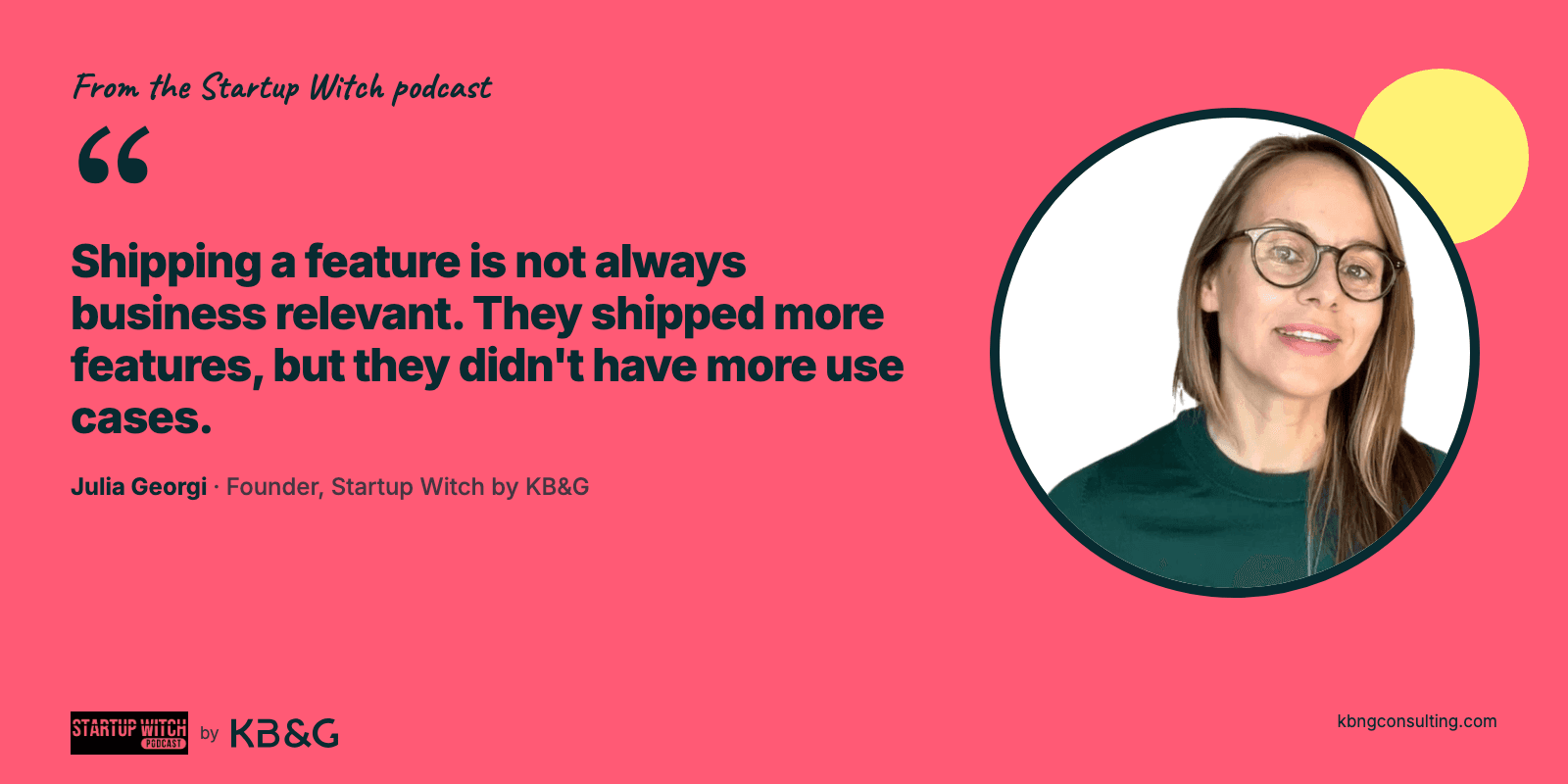
This is where my founder brain switched on. Shipping a feature is not always business relevant. I have no idea how they measured the value of what was shipped, and I'd love to know, because more code is not more value. They shipped more features, but they didn't have more use cases.
So the pitch leaves you with two options: either you need fewer developers, or you need to find ten times more use cases. And as I said in my post on startup decision making, use cases don't appear overnight, because people are still people. Customers adopt at human speed, not machine speed.
How Fast Are AI Tools and Code Generation Improving?
The point that impressed me most, and that affects everyone from developers to ordinary ChatGPT users, is how quickly AI's capacity for long tasks is growing. Research from METR found that the length of software tasks AI can complete has been doubling roughly every seven months.
On stage, the story was told like this: a few years ago AI could handle a task of around 30 seconds of "thinking". Today it is at about four hours, and the prediction we heard was fourteen hours. Imagine fourteen hours of non-stop thinking. Now add a few AI agents working in parallel.
It is phenomenal, and I already see it at my own founder scale. When I write a content plan, a marketing plan or a long social post that needs research and images, the gap between weaker AI tools and the best AI models is huge. I can only imagine what these tools will do with fourteen hours. But there is a catch that nobody on stage could remove: you need to know what you're doing, or it doesn't work.
The Benchmarks Behind the Hype
The data backs up how steep this curve is. In its original study, METR reported that the models it tested had an almost 100% success rate on tasks that take humans less than 4 minutes, but succeeded less than 10% of the time on tasks taking more than around 4 hours. That gap is exactly what the doubling is closing.
Stanford's AI Index 2025 tells the same story from a different angle: on SWE-bench, a benchmark built from real GitHub issues in real codebases, AI systems went from solving 4.4% of problems in 2023 to 71.7% in 2024. That is a 67.3 percentage point jump in a single year. Benchmarks are not production software development, and landing a fix in a test suite is not the same as solving complex problems inside a real product. But no one should pretend the tools are standing still.
How AI Takes Over Code Review, Automated Testing and Documentation
The other message for developers was that AI is transforming the whole development process, not just writing code. It is not as good as you would expect yet, and it will take time to get there. But because code generation is now so fast, the CEO's argument was that the rest of the software development lifecycle becomes realistic to automate too:
Code review: writing code doesn't guarantee the feature works, so the AI reviews its own output.
Automated testing: generating test cases and checking edge cases, which puts QA roles under pressure.
Documentation: writing technical documentation, depending on how much context you give it.
Honestly, I don't think many QA engineers love QA. Testing and documentation are exactly the repetitive tasks I would want AI to take over. When AI handles routine tasks, software developers get more time for the complex work. But put the list together and it touches almost every tech job. AI generates the code, checks whether the code works, writes the test cases and documents the result, which covers most of the development workflow that software development teams run today.
What Experienced Developers Told Me
I asked experienced developers who have used Devin. Their verdict: it's not there yet. It works for smaller use cases, like landing pages and rapid prototyping, where it can be genuinely good. For real system architecture, messy legacy code and solving complex problems, you still need human engineers and human review of the generated code. AI-generated code still needs human review for correctness and maintainability; without it, fast output quickly turns into technical debt. Still, it's worth keeping a close eye on, because the curve is steep.
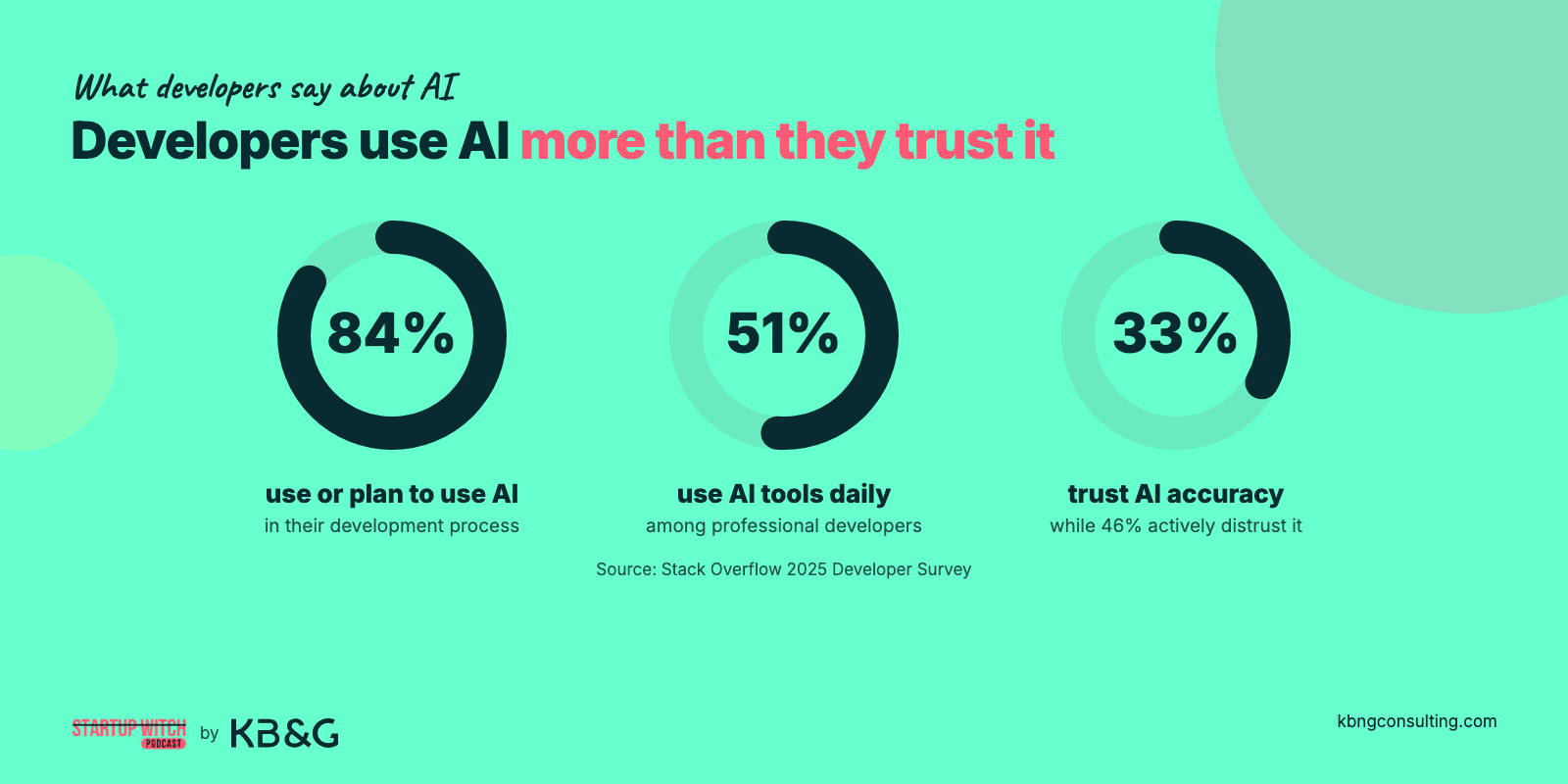
Developers at large seem to agree with them. In the Stack Overflow 2025 Developer Survey, more developers actively distrust the accuracy of AI tools (46%) than trust it (33%), and 66% say their biggest frustration is AI solutions that are "almost right, but not quite". That is the practical meaning of human review: someone who knows what they're doing has to find the gap between almost right and right.
What the Research Says: A Deep Dive Into AI and Developer Jobs
What I heard at the summit is one room in Paris. So I also looked at what neutral research says about adoption, trust and jobs in software development, with AI transforming how software gets built. Here is the picture, with the sources, so you can make up your own mind.
Developers Already Use AI Every Day
This is no longer an experiment. According to the Stack Overflow 2025 Developer Survey, 84% of respondents are using or planning to use AI tools in their development process, up from 76% the year before, and 51% of professional developers use AI tools daily. GitHub's Octoverse 2025 report found that nearly 80% of new developers on GitHub use Copilot within their first week. For the next generation of software developers, AI-assisted development is simply how writing code works.
The Number of Developers Is Still Growing
Here is the part that surprises people. GitHub counts more than 180 million developers on its platform, with over 36 million joining in the past year alone, according to the same Octoverse report. And the US Bureau of Labor Statistics projects employment of software developers to grow 10% from 2025 to 2035, with about 106,100 openings a year for developers, QA analysts and testers combined. Notably, the BLS projects slower growth for QA analysts and testers (6%) than for developers, and it links the strong demand to software development for AI, robotics and other automation. Routine tasks may shrink, but the official projection for developers still points up. That fits what I saw: the work is moving, not disappearing.
Entry-Level Developers Feel It First
The pressure is real at the bottom of the ladder. Researchers at the Stanford Digital Economy Lab found that employment of workers aged 22 to 25 in AI-exposed occupations, which include software development, now stands 19% below where it would be had it kept pace with their less-exposed peers, while experienced workers show no comparable gap. The gap sits exactly where routine, entry-level work used to be.
Why Enterprise Adoption of Artificial Intelligence Is Still So Low
This is the part everyone should watch, whether you're a developer, a founder or just curious: how will enterprises actually adopt this? At the summit, speakers put the share of enterprise AI projects that make it past the proof-of-concept stage at under 7%. That doesn't mean 7% of companies run autonomous departments. It means very few AI projects get past the pilot, even though those projects are well funded and have every resource they need.
Research from McKinsey points in the same direction. In its State of AI 2025 survey, 88 percent of respondents said their organizations use AI, but only 7 percent said AI had been fully scaled across their organizations. Almost everyone is trying it. Almost no one has made it part of how the whole company runs.
I see the same thing in my own startup in gold mining. The appetite for AI is there. The problem is that a large company simply doesn't run on the same cycles as a startup. For me, two weeks is a long time. For them, two weeks is nothing; they can reply to an email every ten days and be perfectly fine. Meanwhile I need to build the machine learning model, train it, and make sure the pilot turns into a signed contract. It is a very long process.
Low adoption does not mean there will be no adoption. It means there will be more demand for projects that actually succeed. Many companies want AI but don't know their use cases, and that is hard to figure out. They need experts and technical people to make it happen. If you are a subject matter expert inside a company, you can be that person, and I encourage you to be. And every subject matter expert who qualifies an AI use case will need data scientists and developers to build it.
Fewer Developers per Product: Where Developer Jobs Are Moving
So here is my prediction: a shift of developers from software companies to enterprise companies.
Smaller and mid-sized companies can now hire a couple of developers and use AI tools to build exactly the tools they need, without being experts in everything, because so many cheap tools help you define a use case and test it. Large, well-structured enterprises already have data science teams. With a handful of developers and AI-assisted development, they can rebuild something like their CRM exactly the way they want it. Think about it this way: an enterprise CRM contract can cost as much per year as two developers' salaries in Europe, and two developers with good AI tools can do a lot. Of course you then have to count maintenance and service, and it is never as easy as the demos suggest. But I think there is real truth in this direction.
That also means some software companies will struggle. And some AI companies will go bankrupt because they can't justify their growth and their spending. Even at the summit, people admitted nobody really knows the future. We probably can't expect clear results next year or the year after.
What Developers Should Do Now: Continuous Learning and Ownership
If you're a developer, or a technical founder, here is what I would take away:
Autonomous doesn't mean 100% autonomous. Even if AI does 90% of the work, you need someone really good to manage it, review the AI output and own the result. The role shifts from writing every line to orchestrating AI tools, integrating the code they produce and fitting it into the software development lifecycle. Be that person.
Commit to continuous learning. Study how these new AI tools work, how to direct agents, and where they fail. Staying on top of this is how you stay relevant as the tools and new technologies keep changing.
If you get laid off, retrain and come back. There is work, and there will be more. It is a difficult transition period, but it is difficult for everyone.
Look at the enterprise sector. Watch for companies hiring AI engineers or building internal AI teams. That's where a lot of the demand is heading.
Move up the stack. System architecture, trade-offs, understanding user behavior and creative problem solving are the skills AI is worst at and businesses need most. This is higher level thinking: understanding complex business requirements, systems thinking about how systems interact, and making sure you are not solving the wrong problem very efficiently.
A Quick Checklist Before You Trust AI-Generated Code
"You need to know what you're doing, or it doesn't work" is the line I keep coming back to. In practice, owning the AI output means you can answer yes to these questions before anything ships:
Do I understand what the code does? If you can't explain it, you can't own it, and you can't find the root cause when it breaks.
Is this a small, contained use case or real system architecture? Landing pages and prototypes are where the tools shine today; core systems and legacy code still need human engineers.
Has a human reviewed it? Treat generated code the way you would treat a new colleague's first pull request: read it, test it and check the edge cases. Review is what reduces risk; speed alone does not give you better code.
Does it meet the acceptance criteria and solve the right problem? Fast code that answers the wrong problem is still the wrong problem, just delivered sooner.
Who maintains it next year? Every line you ship is a line someone has to service. Count that before you celebrate the speed.
What This Means for Founders
I am one of those founders who deliberately decided not to learn to code. I chose to learn how to sell, how to grow, and how to help other founders succeed. Apparently Devin can do the coding for me now. We'll see.
But the lesson for founders is the same as for developers: faster code generation doesn't fix a missing use case. If AI lets your team ship ten times more, the bottleneck moves to decision making: deciding what is worth shipping and who will pay for it. That is a founder problem, not a developer problem.
Questions to Ask Before Your Team Ships Ten Times More
If you are tempted by the "one developer, ten times the output" promise, run through these before you celebrate the velocity chart:
Which use case does this feature serve? If you can't name the customer problem, the feature is output, not value.
Who will pay for it? More features do not create more buyers. Customers still adopt at human speed.
How will we measure whether it mattered? Decide what business result you expect before you ship, not after, and keep tracking progress against it.
Would fewer developers plus AI tools do the same job? Be honest about whether you need more output or more use cases.
Do we have someone who can own the AI output? Autonomous tools still need a person who knows what they're doing.
FAQ: Will AI Replace Developers?
Is AI replacing developer jobs?
AI will not replace programmers or replace engineers as a profession any time soon. It is replacing tasks, not whole developers, but the effect on jobs is real: teams can deliver more with fewer developers, and roles built on repetitive tasks such as basic testing, documentation and boilerplate code are under the most pressure. Demand is shifting towards developers who can direct and review AI and build real use cases, especially inside enterprises.
Which jobs will survive AI?
Nobody at the summit could give a reliable list, and I won't pretend to. From what I saw, the roles that last are the ones AI can't own on its own: people who manage AI output and take responsibility for it, people who understand system architecture and trade-offs, and subject matter experts who can turn a business problem into a real AI use case. Creative problem solving and human creativity stay valuable because someone still has to decide what is worth building. AI can produce code; it can't decide which software your customers need.
Is it pointless to learn coding in 2026?
No. You need to understand code to judge AI-generated code, catch its mistakes and design systems that work. What is changing is what you learn it for: less writing every line yourself, more architecture, review and turning business problems into working software.
Will AI replace junior developers first?
Entry-level work is the most exposed, because it is exactly the routine work AI does well, so entry-level roles are becoming more competitive while experienced developers are needed for architecture and strategic technical decisions. Junior developers who learn to work with AI tools from day one, and who build judgment through real projects, will still find a way in. Companies that stop hiring juniors entirely will struggle to grow senior engineers later.
Will AI replace software engineers in the next five years?
Even at the summit, people admitted nobody really knows the future, and I don't think clear results will show up next year or the year after. What I would bet on is fewer developers per unit of software, more developers inside enterprises, and a premium on people who can review and own what AI produces. The official outlook is not one of collapse either: the US Bureau of Labor Statistics still projects software developer employment to grow over the next decade.
Stuck With Something You Built?
If you have built something real and it isn't growing the way it should, the Founder Blind Spot Diagnostic by Startup Witch reads your startup in 14 days and names the one thing blocking growth. It costs EUR 750 and is fully refundable.
Watch Now: Will AI Replace Developers? Nobody Needs That Much Code