
What Causes Developer Stress in Startups?
The strongest driver of developer stress in startups is not code complexity or workload: it is misalignment with leadership. In KB&G Innovation Studio's 2025 developer survey, leadership misalignment showed a stronger relationship with stress than workload, technical difficulty or tooling.
Founders need to hear this uncomfortable fact: startups are slowly destroying software developers, and most founders don't even realize they're doing it. At KB&G Innovation Studio we researched hundreds of developers across multiple surveys, and the patterns were painfully consistent across startups, roles and strategies. If you're an early-stage founder thinking "this doesn't apply to me, we're too small": no way. Scale does not protect you or your team. Being small often makes things worse.
You can also watch the full episode of Startup Witch on YouTube.
Key Findings From KB&G's 2025 Developer Survey
Here are the numbers from our research that every founder should know:
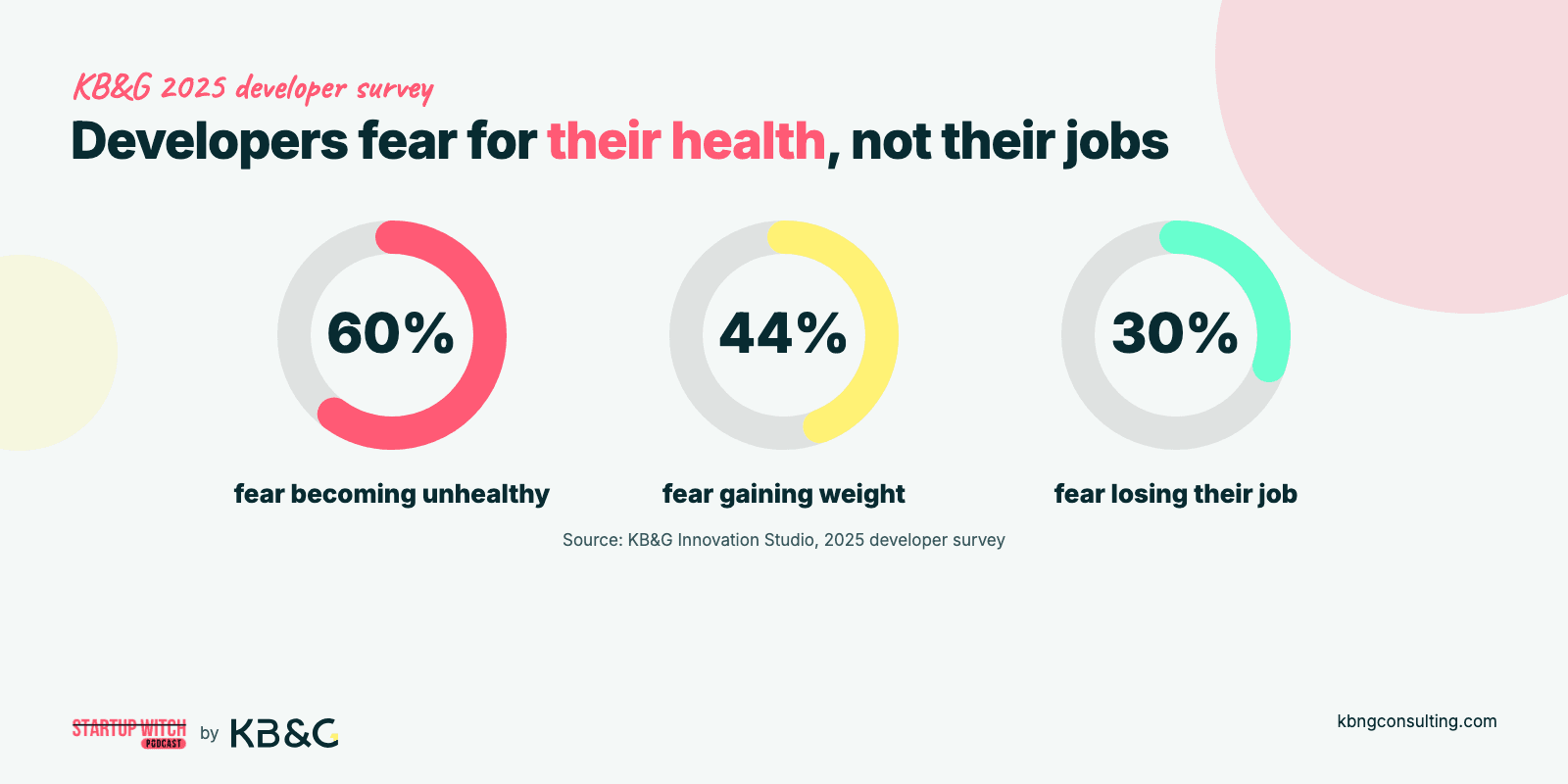
60% of developers fear becoming unhealthy, 44% fear gaining weight, and only 30% fear losing their job.
50% of developers reported moderate or high stress; only 19% reported low stress. No one reported overwhelming stress.
Leadership misalignment had the strongest relationship with developer stress, stronger than workload, technical difficulty or tooling.
Top causes of misalignment: 62% unclear expectations, nearly 60% limited access to background and context, over 37% delays or dropped balls.
More than 30% of developers report frequent misalignment with product managers and with leadership.
How developers cope: 44% rely on physical activity, 41% on boundary setting, and only 38% talk it out with a teammate or manager.
One in five developers report a "push through, then collapse later" pattern.
What the Research Says About Developer Burnout and Software Engineer Burnout
Our survey is not the only one pointing at this problem. Independent industry research gives useful context for the KB&G numbers above. These figures come from other organisations, not from our survey:
Burnout is the norm, not the exception. In JetBrains' State of Developer Ecosystem 2023, 73% of developers said they have experienced burnout at some point in their career. JetBrains defined burnout as emotional exhaustion and decreased motivation due to intense or difficult work.
It's happening right now, not just "at some point". In the Jellyfish 2024 State of Engineering Management report, 65% of respondents (engineers and engineering leaders) said they had experienced burnout in the past year.
Small teams are not protected. The same Jellyfish report found that 85% of engineers on teams of fewer than 10 engineers reported burnout.
Leaders and engineers see different realities. Jellyfish also found that 43% of engineers feel leadership at their company is out of the loop regarding engineering challenges.
Unclear goals show up as a burnout cause. A Haystack Analytics study conducted by Survation in 2021 found that 83% of software developers suffer from workplace burnout. The top reasons were high workload (47%), inefficient process (31%) and unclear goals and targets (29%).
Managers shape the team's experience. Gallup's research found that managers account for 70% of the variance in employee engagement. For founders and engineering leaders alike, that's the point: in an early-stage startup, that manager is very often you, the founder.
Different studies, different years, different definitions, so the numbers aren't directly comparable. But the direction is the same as in our survey: burnout among software engineers is widespread, small teams are not a safe zone, and the gap between what leadership thinks is happening and what engineers experience is where much of the damage starts.
What Do Software Developers Fear Most? (Hint: It's Not AI)
This is the most touchy part. It would be natural to assume developers today fear losing their job because of AI. That's the common narrative, and I've written about it myself in Will AI Replace Developers?. But our 2025 developer survey showed something different:
60% of developers fear becoming unhealthy
44% fear gaining weight
only 30% fear losing their job
More developers worry about their health than about being replaced. And when someone fears becoming unhealthy, it usually means they already feel the impact.
Startup life and software development come with a lifestyle: long hours, deep work and high focus, a lot of context switching, cognitive intensity. That's part of the job. But when health concern becomes the dominant fear, bigger than job loss, it tells us something about the system: sustained pressure, operational chaos, lack of control over workload and tasks. Intensity may come with the territory. Chronic stress and health anxiety don't have to.
The wider research fits this picture. JetBrains found that developers who have experienced burnout show stronger interest in their mental health and are more likely to use self-monitoring apps or devices to track their physical activity and sleep quality. In other words, people who have been burned out start watching their bodies. When your team's biggest fear is their own health, that concern doesn't stay in their personal life. It shows up in focus, energy and product quality.
How Stressed Are Software Developers Right Now?
The baseline is simple: stress is already there. In our research, 50% of developers reported moderate or high stress. Not overwhelming burnout, but sustained, ongoing stress: the kind that turns into burnout if nobody fixes the cause. Only 19% reported low stress.
Luckily, no one reported overwhelming stress. That is the danger zone we observed when we researched customer success managers back in 2025 (you can read about it in our post on customer success burnout).
Why Leadership Misalignment Beats Workload as a Stress Driver
When we looked at what correlates with developer stress, leadership misalignment showed the strongest relationship, stronger than workload, technical difficulty or tooling. Software engineers aren't stressed because they can't do the job. They're stressed because they're trying to execute inside unclear, shifting or conflicting leadership signals.
This isn't unique to our research. Major industry-wide surveys of software engineers and engineering leaders over the last few years have consistently found elevated stress and burnout, with communication quality and leadership alignment among the top drivers.
And early-stage founders are not immune. In small teams, leadership misalignment has nowhere to hide. It goes straight into execution, and it depends directly on you, the founder.
Why Are Unclear Expectations Worse Than Bad Code or Technical Debt?
Bad code can be refactored. Technical debt can be paid down. Ambiguity keeps multiplying.
In our data, these were the top causes of internal misalignment reported by developers:
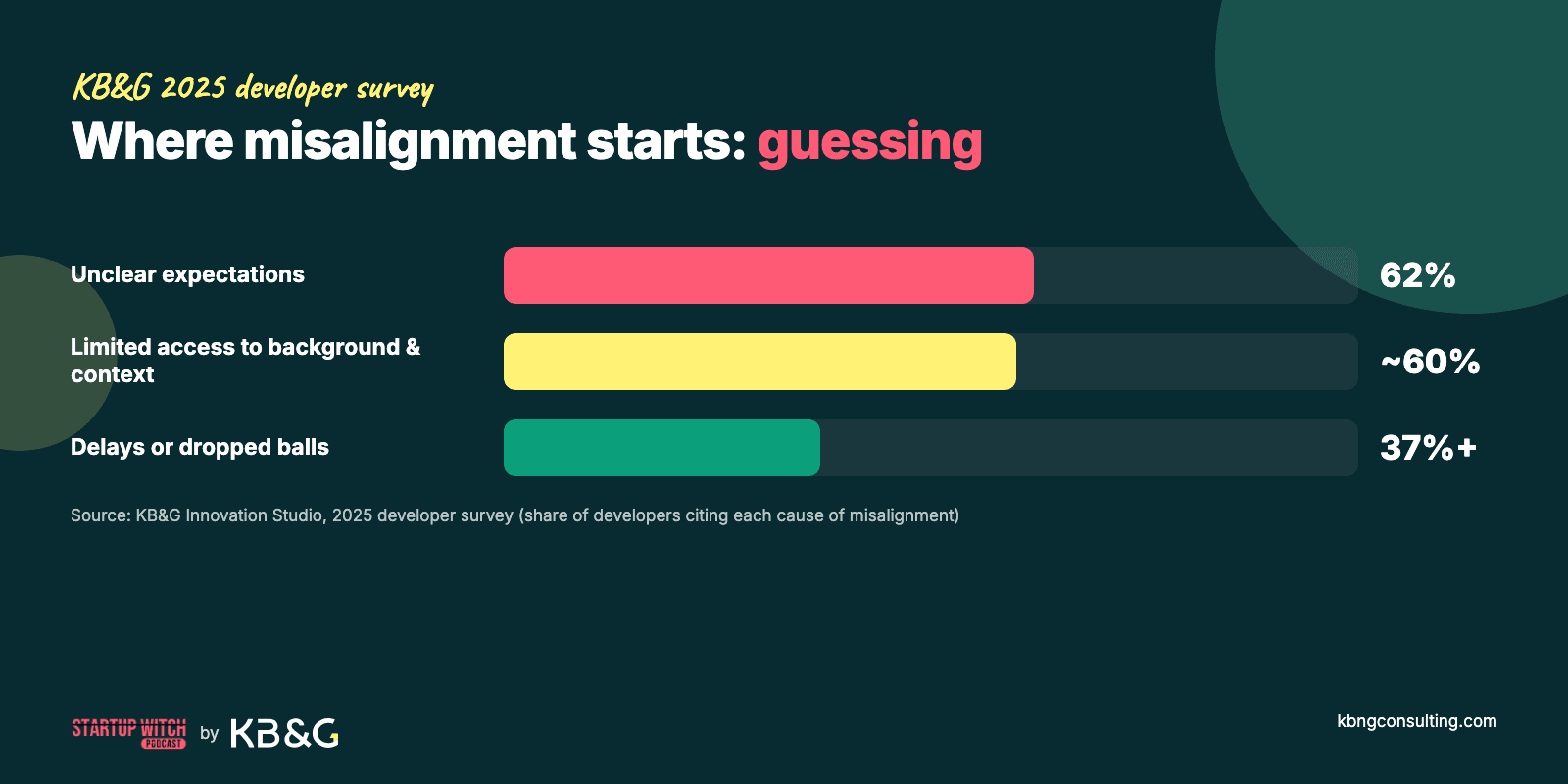
62% unclear expectations
nearly 60% limited access to background and context
over 37% delays or dropped balls
competing priorities, misaligned tools and communication style differences followed closely
So developer stress isn't caused by complexity. It's caused by guessing: guessing what matters, what success looks like, and which signals to follow when messages conflict. Ambiguous expectations and shifting deadlines keep engineering teams guessing on every project. And unlike technical debt, ambiguity never shows up in a code review.
Think about what guessing looks like in a normal week. A developer juggling multiple projects gets one priority in the stand ups, a different one in a Slack message from the founder, and a third one from a customer call nobody wrote down. Code reviews turn into debates about what the feature was supposed to do, not how well it was built. Work gets redone. Every conflicting priority means more context switching, which ruins focus and deep work. That's how too high expectations get created without anyone ever saying them out loud: the expectation is "read my mind", and nobody can meet it.
How Can Founders Reduce Developer Stress?
This is where you as a founder can step in, especially if you're non-technical. Your job is not to write code. Your job is to make sure clarity survives the transition from your head to your team.
Double-check with your team. Ask them to reformulate decisions in their own words.
Validate the day after. Check that things are still clear the next day, not just in the moment everyone nods.
Define what done means and explain the why behind it.
Confirm decisions when priorities change.
Grooming and "Regrooming" Before a Single Line of Code
As a non-technical founder myself, I found grooming sessions incredibly powerful. Sometimes I do what I call "regrooming": we groom, we decide, we record the decision, we draw the flows, and then we stop. We sleep on it. The next day, or the week after, we look at it again, before a single line of code is written.
This works extremely well for products with low technical complexity but many user flows and feature interactions. That's where misalignment hides: not in the code, but in the assumptions. For very technical products, you rely more on your tech lead for grooming, abstraction and architecture decisions. But the principle is the same: clarity first, execution second. And it applies to all startups, not just software.
The fix isn't more hustle or more hard work. It's clarity. If two people on your team describe the goal differently, the problem isn't execution, it's leadership alignment. And founders can fix that.
A Founder's Checklist to Avoid Burnout Before Work Starts
Here is the advice above turned into a checklist you can run before any sprint, feature or deadline, to prevent burnout before it has a chance to start:
Can every engineer explain the goal in their own words, and do the explanations match?
Is "done" written down, including the why behind it?
Does the team have the background and context you have, or only the task?
Has the decision been recorded, slept on and reviewed again before coding starts?
If priorities changed this week, did you confirm the new decision with everyone affected?
Did you check capacity with the team before committing to the deadline?
If you can't tick all six, your team is guessing. And guessing is where developer stress starts.
How Does Misalignment Spread Through a Startup?
More than 30% of developers report frequent misalignment with product managers and with leadership. Customer success, and even other engineers, follow closely.
Misalignment flows. Confusion at the top travels through product development and reaches customers sooner than you think. We've seen the same pattern in our earlier research with customer-facing teams: different roles, same mechanics. It's a chain reaction.
Early-stage startups have no buffers. When leadership isn't clear, the whole system absorbs it immediately. That's why founders feel sudden breakdowns (burnout, missed deadlines, quiet frustration) that actually started weeks earlier as communication drift. Small teams are only an advantage if clarity travels faster than confusion.
The data backs this up: in the Jellyfish report, 85% of engineers on teams of fewer than 10 reported burnout. A small team is not automatically a healthy one; the risk can be higher, because nobody absorbs the confusion.
How Do Software Engineers Cope With Stress, and Why Is It Dangerous?
In our survey, 44% of developers rely on physical activity, 41% on boundary setting (saying "no" or "not now"), and only 38% talk it out with a teammate or manager. Exercise and setting boundaries around work hours help, but they are private coping, not a fix for the business problem underneath.
One in five developers report a "push through, then collapse later" pattern. That is a textbook burnout signal, and a vicious cycle: engineers push through at full speed, then crash. The World Health Organization defines burnout as a syndrome resulting from chronic workplace stress that has not been successfully managed, marked by exhaustion, mental distance from the job and reduced professional efficacy.
Engineers suffer quietly and manage stress privately. Founders must not mistake this silence for resilience, or treat it as a personality issue. Silence usually means people don't feel safe or effective pushing back against the system. Without that psychological safety, software teams won't push back on impossible deadlines; they'll just absorb them. That's how company culture really gets built: by whether someone can say "this deadline is unrealistic" and be heard.
Research from Jellyfish shows how easy this is to miss from the top: 46% of engineers said their teams were experiencing burnout, compared to 34% of executives. Quiet coping is exactly what makes that gap possible.
How to Spot Burnout Before It Becomes a Resignation
Burned out engineers rarely announce it. Based on what we saw in our survey and the World Health Organization definition, these are the signals worth watching:
The "push through, then collapse" rhythm: bursts at full speed followed by crashes, an endless cycle rather than a steady pace.
Silence where there used to be pushback: a senior dev or top performer who stops questioning deadlines and just absorbs them.
Mental distance: less curiosity, less ownership, more "just tell me what to build".
Exhaustion: people who are always tired and never fully productive, even after a quieter week.
Withdrawal: fewer questions in stand ups, less involvement in team discussions, and code quality that slips before anyone says a word.
Physical signs: constant fatigue, trouble sleeping and the kind of health worries our survey picked up.
Blame everywhere: engineers who constantly blame everything around them. Listen carefully; it often points to the process.
None of these is a reason to call someone weak. Each one is a reason to look at the system first.
How to Prevent Burnout in Software Teams (Without Micromanaging)
You can keep stress at a healthy level. This doesn't mean treating engineers like kids. It means aligning, aligning, aligning, and holding people accountable as mature adults.
If engineers constantly blame everything around them, listen carefully. Then fix the process first:
Clarify expectations. Define what done means and explain the why.
Reduce mixed signals. One set of priorities, confirmed when they change.
Share context earlier. Background is not a luxury; it's how people make good decisions without you.
Regroom before coding. Decide, record, sleep on it, review again.
Align capacity before committing to deadlines.
If, after fixing the system, things still don't work, then yes, you may have the wrong person. A healthy environment still requires mature, responsible engineers. If you run a software startup, especially as a non-technical founder, you need strong development resources. Alignment doesn't replace competence or skills; it unlocks them.
Early-stage founders have leverage: small teams, direct access, fast feedback loops. If you don't use it from the start, you pay later, in the long term, with developer burnout, churn and lost momentum. Replacing a burned out engineer with a new job posting doesn't fix anything if the next person walks into the same chaos. Clarity is how small teams build momentum without burning out the people who create it.
Developer Stress Is an Alignment Problem, Not a People Problem
Across all our research, one message repeats: developer stress is not a people problem, it's an alignment problem. It's not that software engineers aren't capable, or don't care, or that talent is missing.
Software is still built by people. Your best engineers are brilliant people with extraordinary minds who solve complex problems every day and build things that change companies, and sometimes industries. But brilliance doesn't thrive in chaos. The only way to identify truly exceptional people is to remove the noise around them: unclear priorities, shifting goals, broken communication loops.
When you design clarity intentionally, you operate better, you communicate better, and your team has the space and the responsibility to perform at the highest level. It's a win-win: less pressure for everyone, less control for you, no micromanagement, just alignment. You either design this on purpose or learn it the hard way, through burnout, missed deadlines, quiet frustration and potentially bankruptcy.
If you take one thing from this post: don't try to fix your developers. Fix the system they operate in, and watch what happens.
FAQ: Developer Stress
Is developer a stressful job?
It can be. Software development comes with long hours, high focus and cognitive intensity. In KB&G Innovation Studio's 2025 developer survey, 50% of developers reported moderate or high stress and only 19% reported low stress. But the intensity of the work is not the main problem: unclear, shifting leadership signals are. For balance, the 2024 Stack Overflow Developer Survey found that 68% of professional developers report being happy or complacent at work, so stress is common, but it isn't the whole story.
What is the biggest cause of developer burnout and software engineer burnout in startups?
In our research, leadership misalignment had the strongest relationship with developer stress, stronger than workload, technical difficulty or tooling. The top causes of misalignment were unclear expectations (62%), limited access to background and context (nearly 60%) and delays or dropped balls (over 37%).
What are the top causes of stress at work for software developers?
From our survey: unclear expectations, missing background and context, delays or dropped balls, competing priorities, misaligned tools and communication style differences. Notice that almost all of them are about how work is organised and communicated, not about the code itself. Unrealistic deadlines and scope creep usually sit downstream of the same problem: expectations nobody made explicit.
What are the symptoms of job burnout?
The WHO describes three: feelings of energy depletion or exhaustion, increased mental distance from your job (or negativity and cynicism about it), and reduced professional efficacy. In software development teams, watch for the "push through, then collapse later" pattern and for developers who go quiet instead of pushing back. Silence is not resilience. The WHO treats burnout as an occupational phenomenon, not a medical condition; if someone is dealing with mental health issues, point them to professional support too.
How do you fix developer burnout fast?
There is no hustle shortcut, and more effort from the team is not the solution. For founders, the fastest lever is removing the noise: clarify expectations, stop sending mixed signals, share context earlier and align capacity before committing to deadlines. Fix the system your engineers operate in first; don't try to fix the engineers.
Are software developers losing their jobs to AI?
Developers fear it less than you'd think. In our 2025 survey, only 30% of developers feared losing their job, while 60% feared becoming unhealthy and 44% feared gaining weight. More developers worry about their health than about being replaced. For my view on where AI is actually taking software development, read Will AI Replace Developers?
Does remote work cause developer burnout?
Our survey didn't compare remote work with office teams, so I won't pretend it answers that. What it does show is that the strongest driver of stress was leadership misalignment, and misalignment travels just as well over video calls as across an office. Remote work doesn't create that misalignment and doesn't remove it either. Wherever your team sits, the fix is the same: clear expectations, shared context and confirmed decisions.
Not Sure Where the Misalignment Starts?
If your team is busy but your startup isn't growing the way it should, the Founder Blind Spot Diagnostic by Startup Witch reads your startup in 14 days and names the one thing blocking growth. It costs EUR 750 and is fully refundable.
Watch Now: What Developers Fear and Founders Ignore (inside our 2025 survey)