
Why Is Enterprise AI Adoption So Slow?
Enterprise AI adoption is slow because the technology is moving much faster than the use cases. The money invested in AI is real and it isn't going anywhere, but inside large companies AI still runs into siloed data, missing context, security rules and one very human question nobody has answered yet: if the AI fails, who is responsible?
That was my biggest takeaway from RAISE Summit 2026 in Paris, one of the most impressive AI summits I have ever attended. It is built for enterprise, a bit less for early-stage or non-funded startups, but for people like me who contribute to this ecosystem it was a rare chance to understand where everything is heading. When you are outside the bubble, you don't see the core topics that worry the people inside it. And this AI bubble was a bubble within the bubble: everyone was so absorbed in what was happening that they were probably losing a bit of contact with the outside world.
We, on the other hand, are feet on the ground. We are founders who want AI solutions that solve real-life problems, and a lot of founders will be building in the AI space. So this post is my honest read of what I heard on stage, combined with what I know from working in enterprise and building my own startups.
You can also watch the full episode of Startup Witch on YouTube.
Where Is the AI Money Actually Going?
I am not a hardware person. I used to work in enterprise, so I understand how processes in large companies work. I expected to see a lot of "AI everything" startups at RAISE Summit, and I did. But equally important, maybe even more important, were the companies working on infrastructure: storage, cabling, processors, chips, semiconductors.
I honestly didn't realize how much hardware needs to change for this AI revolution. Huge companies that have been around for 30 or 40 years have invested heavily in this infrastructure. The second surprise was the cloud: the whole cloud infrastructure also needs to be changed or adapted for AI systems.
Why AI Investments Depend on Enterprise
That is when I understood why this event is for enterprise. All these AI investments in hardware and cloud can only be justified if enterprises actually adopt AI. With this much enterprise involvement, the money locked in AI is not going anywhere. The real question is where it can be implemented first, and where it will create business value.
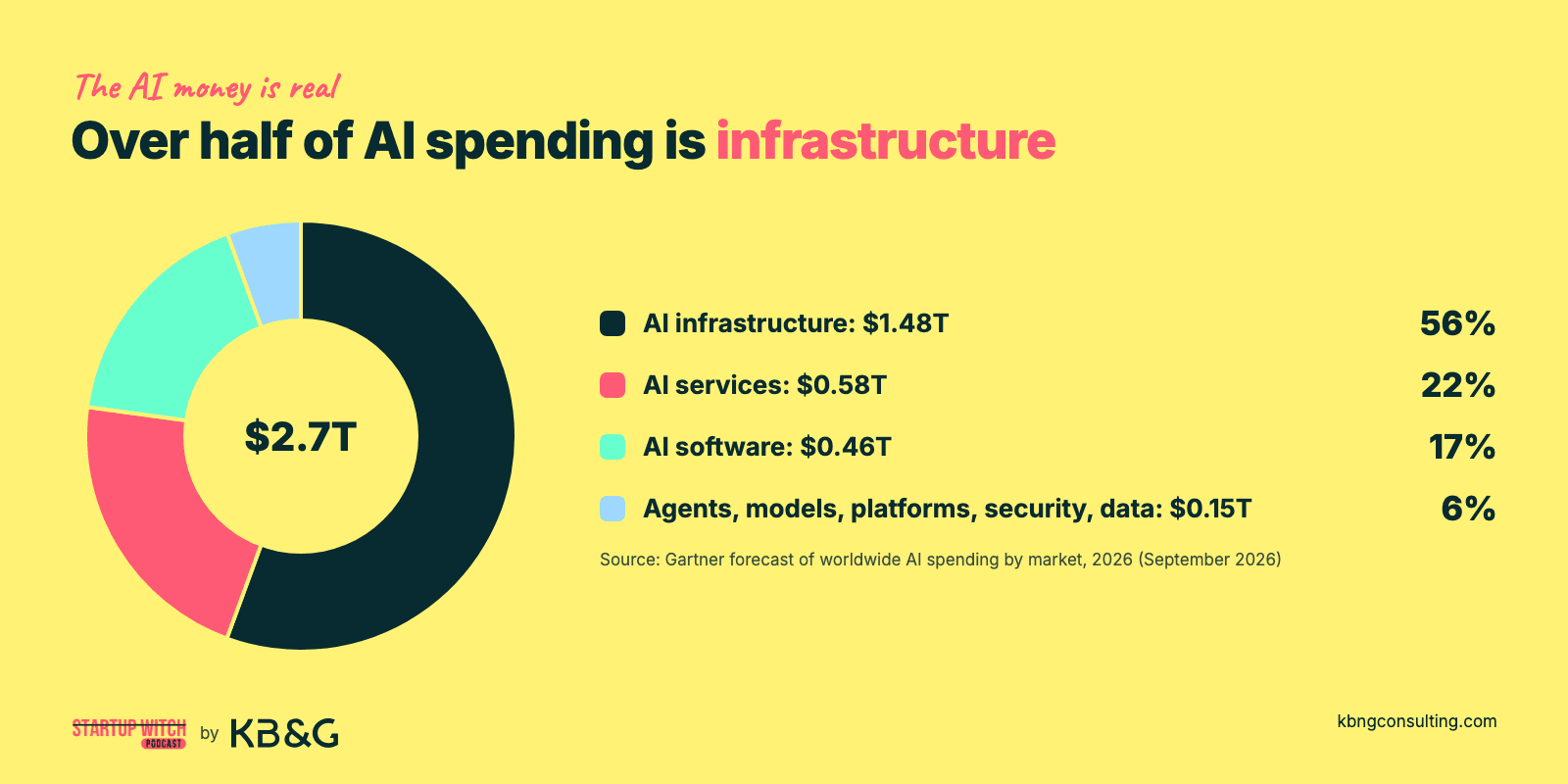
The data backs up what I saw on the show floor. Gartner forecasts that worldwide AI spending will reach $2.7 trillion in 2026, a 49.5% increase on 2025, and that AI infrastructure alone (servers, chips, network fabric and AI-optimized cloud) will account for nearly $1.5 trillion of it, more than half of all AI spending. Private money is following: the Stanford AI Index 2026 reports that U.S. private AI investment reached $285.9 billion in 2025.
What Does the State of AI Adoption at Enterprise Scale Look Like?
This is the problem: adoption is very slow. The core message from the stage was basically "you need to help us adopt". Speakers at the summit put real enterprise AI adoption at less than 7%, and they were not just saying it; they presented it as backed by data. It is in line with the key findings of McKinsey's State of AI research: 88 percent of respondents said their organizations use AI, but only 7 percent said AI had been fully scaled across their organizations. Reported generative AI use in the same survey series rose from 71% in 2024 to 79% in 2025.
In other words, most companies are using AI tools in at least one function, but very few have AI running across their business operations at enterprise scale. Using AI in one business function is not the same as scaling AI across the company. Early adopters experiment, but many AI initiatives stay stuck in the pilot. The human use cases of artificial intelligence simply don't develop as quickly as the technology. And that gap is where the whole industry is stuck right now.
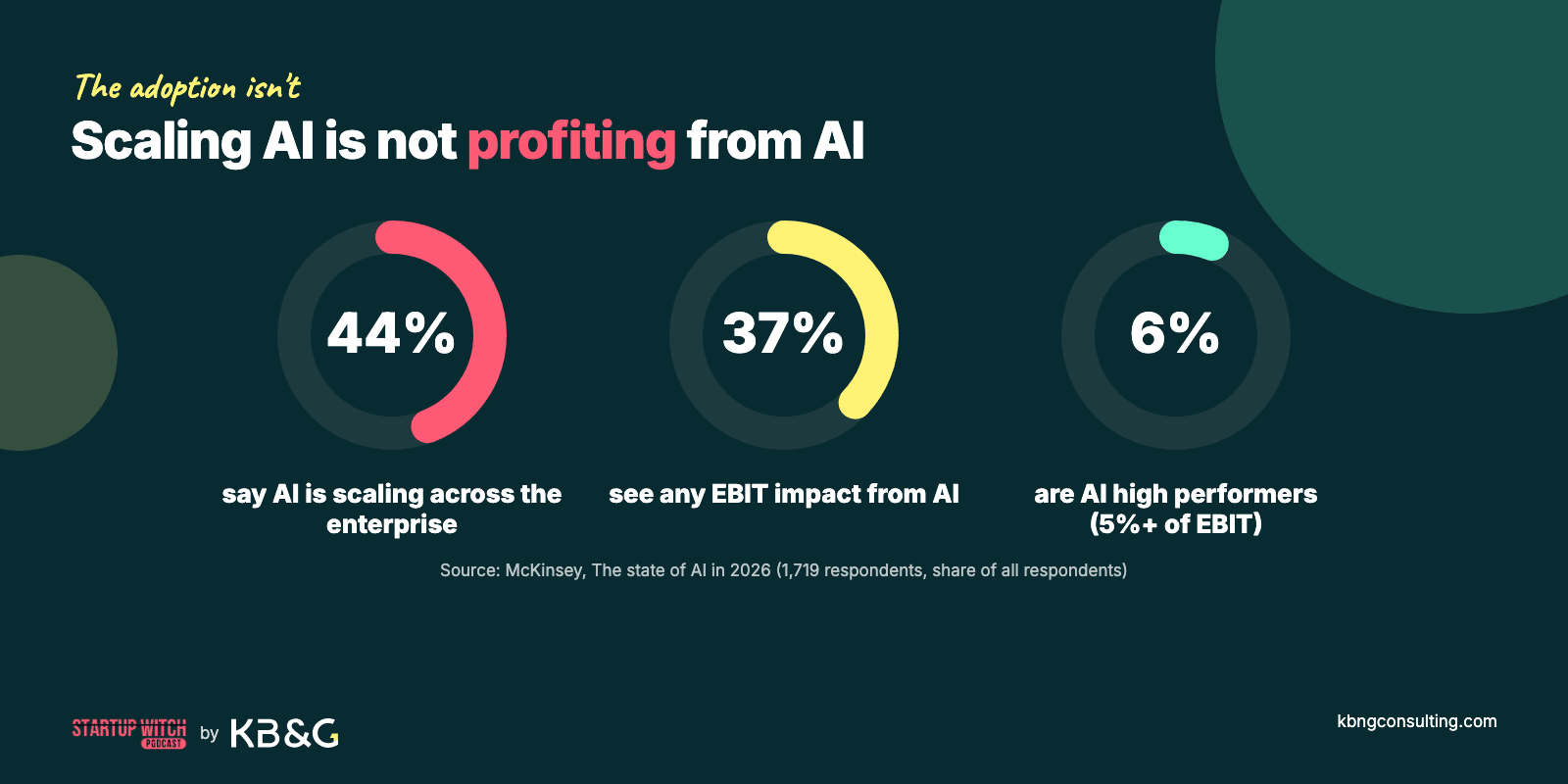
The newest numbers show the gap closing slowly. In McKinsey's State of AI in 2026 survey (1,719 participants, May to June 2026), 44% of respondents say AI is scaling across their enterprise, up from 38% a year earlier. But only 37% attribute any EBIT impact to AI, essentially unchanged from 2025, and the AI high performers who get at least 5% of EBIT from AI are still just 6% of respondents. McKinsey's authors conclude that "adoption tends to move more slowly than the technology does", because the limiting factor is the organization's ability to absorb change. That is exactly the gap I felt in Paris.
What the Research Says About AI Pilots
The numbers outside the summit tell the same story. Gartner predicted that at least 30% of generative AI projects would be abandoned after proof of concept by the end of 2025, because of poor data quality, inadequate risk controls, escalating costs or unclear business value. And S&P Global Market Intelligence found that 42% of companies abandoned most of their AI initiatives in 2025, up from 17% the year before, with cost, data privacy and security risks as the top obstacles. MIT's NANDA initiative, in its report The GenAI Divide, found that 95% of enterprise generative AI pilots are falling short: only about 5% achieve rapid revenue acceleration, while the rest stall with little to no measurable P&L impact. The report blames a "learning gap" and flawed enterprise integration, not the quality of the AI models. Small pilots are a good way to validate AI solutions, but moving from pilot to production needs clear business challenges, monitoring and controls, and a team that owns the result.
Why Enterprise AI Programs Fail: The Data Problem That Kills AI Pilots
We know AI can replace some of the work of knowledge workers and automate repetitive routines, from document processing to customer support tasks. But go deeper into enterprise processes and you find what every enterprise person already knows: data is structured in silos and systems don't communicate with each other. AI didn't miraculously erase those issues. Fragmented data is still fragmented data, with or without a large language model on top. AI models and machine learning models depend on clean, accurate data, and connecting new AI technologies to legacy systems creates exactly the friction nobody shows on stage.
The research says the same. In a Gartner survey of 1,203 data management leaders, 63% of organizations either did not have or were unsure whether they had the right data management practices for AI, and Gartner predicts that through 2026 organizations will abandon 60% of AI projects unsupported by AI-ready data. Gartner also notes that data is often collected in silos across repositories and systems, that organizations lack the practice to assess whether their data is ready for AI, and that the first step is to align data to specific AI use cases. Deloitte's State of AI in the Enterprise 2026 (3,235 leaders, 24 countries) found organizations feel less prepared than a year earlier on infrastructure, data, risk and talent.
AI Needs Context Before It Can Deliver Value
For an AI project to work in an enterprise, it needs context. It needs prompts, very clear use cases, and then it can learn and deliver value. It also needs access to data sets that even humans in the company don't have access to. Layering AI on top of a messy process doesn't fix the process. That is why enterprise AI adoption is not just an IT project or a digital transformation slide; it is a cross-functional transformation that touches every team that owns the data and the process, and it has to deal with very human resistance from employees whose work is changing.
Security, Access and Data Governance
One discussion on stage made me laugh. On one side, old enterprise people talking about security and protocols. On the other side, a new-generation AI startup leader saying that in his company he just gave everyone access to everything, and his AI assistant also became the HR person.
Yes, but that is a new company. It is not an old enterprise built on stability and security. Large organizations have data governance, data privacy rules and secure access for good reasons: handling sensitive corporate data is a real risk. Those reasons don't disappear because an AI model needs more data. Strong data governance and AI governance are what an enterprise needs before it can deploy AI safely, and they take time.
A Real Opportunity for Founders
Here is my reflection point for founders: what tools would we need to easily create context for AI for different use cases? And what tools would help enterprises restructure and capture their data so AI can actually use it? I think there is huge potential there for enterprise AI solutions that fix the foundations instead of adding another layer on top.
If AI Agents Fail, Who Is Responsible?
This is the question I kept coming back to. Today, if a tool fails, we call the IT department. Tomorrow, if the finance person is an AI, who is responsible? Can a person be responsible for a process that autonomous AI agents run? Who does the exception handling when something goes wrong? A technology failure inside a finance process is not the same as a broken laptop, and operations managers and senior leadership will want a name, not a system.
For developers, I can see the transition. A developer managing several AI agents, and checking their AI output with other agents, is still coding. It is a logical next step. But an accountant becoming an "accountant AI person" is a completely different job. I don't think that happens tomorrow. Until someone can answer who owns the result, and how human oversight works, that question stays a brake on enterprise AI adoption, no matter how good agentic AI gets. Replacing human agents in a process is an organizational readiness question and a change management question, not only a technology question.
The data shows governance lagging behind the agents. Deloitte found that only one in five companies has a mature governance model for autonomous AI agents. And Gartner predicts that over 40% of agentic AI projects will be canceled by the end of 2027, due to escalating costs, unclear business value or inadequate risk controls.
Can Use Cases Keep Up With AI Capabilities and Agentic AI?
Cognition, the company behind Devin, sponsored a big part of the event: the main stage was covered in their logos, they had a huge area, even a rally car. I have worked with many developers; many of them use Claude, and none of them used Devin. So they have clearly invested a lot in marketing, because they need to sell it.
The CEO was very engaging and clear, and his message was that AI makes production much faster. But use cases don't follow as fast. We can produce a lot more, but can we increase demand just as quickly, and who will pay for it? The whole industry is going in circles with this message: we can produce faster, so now we need real use cases. Faster production doesn't automatically improve efficiency, create cost savings or better business outcomes if nobody needs what you produce. I covered what this means for developers in a separate post, Will AI Replace Developers?, filmed at the same summit.
Are AI Investments a Bubble About to Shrink?
Not yet. Speakers also discussed token markets: token dollars, trading token futures, and tokens getting cheaper. If you are in finance, that is worth looking at.
The research points the same way. In McKinsey's 2026 survey, 60% of respondents expect their organizations to increase AI investments over the next year, even though one in five say their organization is already limiting AI use because of operating costs, including token costs. Deloitte found that 74% of organizations hope to grow revenue through AI initiatives, but only 20% are already doing so.
My overall takeaway is that the industry is big, the investment is big, and there will be money. The bubble is not ready to become smaller. There is momentum and energy, and enterprise AI use cases may well work in the future. Continued investment is coming; where it turns into real business impact and competitive advantage is still the open question. For most enterprise teams, AI maturity is still low, and an AI strategy that works on a slide is not yet an AI strategy that works in the business.
What Was Missing: Humans and Sustainability
I live in France, not in a big city anymore, and we talk a lot about sustainable consumption. These events are not about that. It was about more AI usage and more use cases, because the industry desperately needs to show revenue growth.
The numbers make the sustainability question hard to ignore. The International Energy Agency projects that electricity demand from data centres worldwide will more than double by 2030 to around 945 TWh, slightly more than Japan's entire electricity consumption today, with AI as the most significant driver.
Rarely did anyone speak about humans. Some startup CEOs did, generally from the Nordics, but overall the energy was "consume, sell".
Founders on a Leash
Something else struck me. Most of the heavily funded founders, the ones with tens of millions raised, always went on stage together with an investor. Why can't the founder speak alone? Is the investor afraid he'll say something that isn't political enough? It felt like they were on a leash.
One of them was asked what advice he would give early-stage founders. His answer: "Stay small for as long as you can." That summed up the energy for me: engineers who built something great, now carrying growth objectives and a lot of pressure. At some point I honestly didn't want to be in their place. But they are rich and famous, and it's their choice.
Is a Big AI Summit Worth It for Founders?
If you are as bad at networking as I am, here is the good news: this event was even better for networking than Slush, which is a phenomenal hype event where everyone is either a founder or an investor (I wrote about the reality of Slush for startup founders). RAISE was enterprise-focused: CEOs, VPs, vendors, smaller companies, data scientists and AI people who came to learn.
Because of that, the few founders I met at my stage and in my industry were much better contacts. It is a select few. For example, I have a startup in gold mining, and a guy I met there was very helpful. We're in touch and trying to collaborate. I also used the event app and scheduled a couple of investment meetings.
Most of all, it gave me a level of understanding of enterprise AI most people don't have. I even found marketing I am going to copy for a small event, because it matches the style of another company I work on.
How Founders Should Use Big AI Events
Here is how I would approach an event like this as a founder:
Go for ideas. Listen to what the AI leaders say on stage. It shows you where the market is heading and what worries the people inside the bubble.
Learn how enterprise people speak. If you want to sell to enterprise, understanding how they talk about security, data and business cases is half the work.
If you're B2B, work the stands. The people at the stands are there to present, so go and talk to them. You will see the gap between modern AI startups and older companies very quickly.
Meet the few founders like you. At enterprise events there are fewer founders, which makes the ones at your stage and in your industry much more valuable contacts.
Use the event app. Book meetings in advance, including investor meetings, instead of hoping to bump into the right people.
Steal marketing ideas. Big companies spend a lot on how they show up. Take what fits your brand.
Maybe you don't want to spend money going to Paris, and that's fine. There are other events. Go out, learn, and connect with as many people as you can for inspiration and ideas.
What the Research Says About Enterprise AI Adoption
The key findings behind what I heard at RAISE Summit:
Using AI is not scaling AI. Stanford AI Index 2026: organizational adoption reached 88%. McKinsey 2026: only 44% say AI is scaling across the enterprise.
Scaling is not profit. McKinsey 2026: 37% report any EBIT impact from AI; 6% are AI high performers.
People feel the gains first. McKinsey 2026: 80% of respondents say AI has improved their individual productivity and 50% say it helps them make better decisions. Deloitte 2026: 66% of organizations report productivity and efficiency gains.
What AI High Performers Do Differently
In McKinsey's 2026 survey, nearly three-quarters of AI high performers report fundamentally redesigning workflows because of AI, compared with one-quarter of other respondents. High performers are also twice as likely to say their senior leaders demonstrate commitment to AI initiatives and that they have defined processes to measure the impact of those initiatives, such as key performance indicators for AI. Deloitte found that only 34% of organizations are using AI to deeply transform their business, while 37% are using it at a surface level.
A Checklist for Founders Building Enterprise AI Solutions
If you are building AI tools for enterprise, turn the brakes I saw into questions you answer before the first pilot:
Use case: What real business problem does this solve, and who will pay for it?
Data: Which data does the AI need, where does it sit, and which silos have to talk to each other?
Context: How will the AI get the prompts, rules and context it needs to deliver value?
Security and access: Does it respect the company's data governance, data privacy and secure access rules?
Accountability: If the AI fails, who is responsible, and who does the exception handling?
Foundations: Are you fixing the foundations, or layering AI on top of a messy process?
FAQ: Enterprise AI Adoption
What does enterprise AI adoption mean?
Enterprise AI adoption means AI actually running inside a large company's business processes, with real data, clear use cases and someone accountable for the result, not just employees trying generative AI tools on the side. Using AI in one pilot is easy. Integrating AI into core operations and AI workflows across the organization is where most companies are still stuck.
Why do enterprise AI programs fail?
From what I saw, most don't fail because the AI model is bad. They stall because data sits in silos, the AI lacks the context it needs, security and access rules block it, nobody knows who is responsible when it fails, and the use cases simply don't keep up with the technology. Enterprise cycles are slow, and AI doesn't change that by itself.
Who are the AI leaders in enterprise AI?
At RAISE Summit, the companies with the most visible momentum were not only AI software startups but the infrastructure players behind them: hardware, chips, storage and cloud. They have invested the most, and they need enterprise adoption to justify it. On the software side, well-funded companies like Cognition were investing heavily in marketing, because they need to sell.
What companies are adopting AI the most?
From what I saw at the summit, the companies moving fastest are new, AI-native companies that don't carry old systems and old rules, like the startup leader who gave his AI assistant access to everything. Large, established enterprises are using AI too, but scaling AI across their business units is much slower, because of data silos, security and accountability.
What percentage of enterprises use AI?
Most organizations now use AI somewhere: the Stanford AI Index 2026 puts organizational adoption at 88%. But using AI is not the same as scaling it. In McKinsey's 2026 survey, 44% of respondents say AI is scaling across their enterprise and only 37% see any impact on EBIT. That matches what I heard on stage: the adoption that justifies the investment is still slow.
Building for Enterprise and Not Sure What Is Blocking You?
If you have built something real and it isn't growing the way it should, the Founder Blind Spot Diagnostic by Startup Witch reads your startup in 14 days and names the one thing blocking growth. It costs EUR 750 and is fully refundable.
Watch Now: The AI Money Is Real. The AI Adoption Isn't.