
What Is a Go-To-Market Strategy for AI Startups?
A go-to-market strategy for AI startups is a comprehensive plan that connects your product to revenue by defining who you sell to, what painful problem you solve, how you price and prove value, and how you close deals. It starts with founder-led sales, not with your model's architecture. If you're a B2B AI founder between pre-seed and Series A, your GTM strategy is the single highest-leverage thing you can get right, because startups far more often fail for lack of market need than for lack of technology.
This article is for technical founders building AI products sold to businesses, whether you're selling a generative AI tool to mid-market SaaS companies or a computer-vision safety system to mining operations. It covers problem-first GTM, beachhead selection, positioning, marketing channels, pilots, pricing strategy, trust and data concerns, and a concrete 90-day plan. This is not about growth hacking, consumer apps, or abstract marketing theory.
How do you build a go to market strategy for an AI startup? Pick a painful, measurable problem in a narrow segment, craft problem-led positioning, sell it yourself, run tight pilots that convert, price to value, and only then scale channels and headcount.
Here's what you'll walk away with:
How to choose a beachhead market and define an ideal customer profile that's actually useful
How to talk about your AI product without losing non-technical buyers
How to structure a pilot that converts into production revenue, not "pilot purgatory"
How to price and package an AI product buyers will approve
A 90-day GTM plan you can start executing this week
Understanding Go-To-Market Strategy for AI Startups
A go-to-market strategy is your plan for getting a product into the hands of target customers who will pay for it. For AI startups, distribution (not model quality) is almost always the binding constraint. You can have state-of-the-art accuracy and still lose because you can't explain what your product does, who it's for, or why anyone should trust it with their data.
AI-specific GTM is different because buyers are more skeptical than ever. They've been burned by overpromising, they fear black-box decisions, they worry about data misuse, and "AI" has become a buzzword that erodes rather than builds credibility. Your competitive advantage won't come from claiming you use AI. It comes from proving you solve a real problem better than the status quo.
The rest of this article shows you how to design a simple but hard-edged GTM motion built around a real problem and a narrow segment.
What a GTM Strategy Actually Is for an AI Startup
A GTM strategy is a focused, time-bound plan that connects five things: who you sell to (your ideal customer profile), what painful problem you solve, why you win over alternatives, how you reach and convert target customers, and how you retain and expand them. A go-to-market strategy connects products to revenue; that's the entire point.
GTM is not "marketing." Your marketing team runs campaigns and content. Your GTM strategy includes product, pricing, the sales team, channels, and customer success. Marketing is one moving part, not the whole machine. Successful GTM strategies require alignment across teams: your leadership team, product, sales, and marketing need to operate from the same plan.
Consider two examples. An AI safety analytics tool for quarry operations needs a GTM that accounts for long procurement cycles, deskless frontline workers, safety compliance, and multi-stakeholder buying committees. A sales email co-pilot for Series B SaaS companies needs fast onboarding, self-serve trials, and a pricing metric tied to SDR seats or emails sent. Same discipline, totally different motions.
In the current market, your GTM also has to work for AI answer engines. When a safety director asks ChatGPT "best AI tool for mine safety near-miss reporting," your product needs to show up. That means your content, positioning, and digital channels must be structured for both human buyers and AI tools doing retrieval.
Why AI Startups Can't Skip GTM Anymore
The "build a cool model and hope" era is over. Buyers are flooded with AI pitches, funding rounds require proof of traction, and enterprise companies are investing heavily in vendor evaluation (including performance benchmarks and security audits) before signing anything. A compelling value proposition is essential, but it's not enough without a plan to deliver it to the right people.
If you're a technical founder, you've probably felt this: stalled pilots, lots of demos with no closes, confused buyers asking "so what does it actually do?" These aren't product problems. They're GTM problems. The differentiating factor for AI products often lies in surrounding systems (sales execution, trust-building, pricing, customer onboarding) rather than the models themselves.
Here's a mini-example from heavy industry: imagine you built a computer-vision PPE detector. It works. It's accurate. You ran a free trial with a mining major. Six months later, the trial is still "in evaluation": no named sponsor, no success metrics, no budget owner, no exit criteria. That's pilot purgatory, and according to a 2026 SSRN paper, it's where the majority of enterprise AI initiatives stall. Not because the technology fails, but because governance, economics, and architecture are never resolved.
The first GTM decision isn't "which marketing channel?" It's "which beachhead and which problem?"
Choosing a Beachhead Market for Your AI Product
A beachhead market is the single, narrow customer segment you attack first. For early stage startups, going narrow is life-or-death: your runway doesn't support selling to "anyone with data." This section shows you how to choose that first segment, not build a five-year TAM slide.
Define a Sharp, Realistic Ideal Customer Profile (ICP)
Your ideal customer profile must include concrete, measurable attributes: company size, industry vertical, geography, buying role, tech stack, and urgency triggers. Vague ideal customer profiles waste marketing resources and lead to scattered sales execution. AI startups should develop a narrow ICP targeting early adopters with specific pain points.
SaaS example: "Revenue leaders at 50–300 person B2B SaaS companies on HubSpot, with outbound SDR teams doing more than 200 cold emails per week." Industrial example: "Health & Safety managers at open-pit mining sites in Australia with more than 150 field workers, existing radio communications infrastructure, and a history of under-reported near-misses."
"Any company that uses data" or "all manufacturers" is useless for GTM decisions. It tells you nothing about sales cycle length, buyer psychology, pricing tolerance, or how to write an email subject line. A narrow ideal customer profile helps avoid spreading resources too thinly across weak opportunities.
Your ICP should feel uncomfortably narrow. That's the starting point, not your lifetime constraint. You can expand later once you've proven the motion works.
Anchor on a Measurable Problem, Not Your Model
Stop leading with "we built a large language model for X." Start leading with "we cut Y pain by Z% for this role." Buyers do not purchase machine learning models; they buy time saved and risk reduced. Emphasize measurable results over technical specifications when communicating value.
Map the top three painful, measurable outcomes for your ICP. For a mining safety product: near-miss under-reporting (incidents that never get logged), slow incident response (hours between radio call and formal report), and compliance audit failures. For a SaaS email tool: SDR hours wasted on personalization, low response rates, and inconsistent outbound quality.
Test problem intensity with quick customer interviews. On your first call, ask for real numbers: "How many near-miss incidents per month? How long from radio call to written report? What does a compliance gap cost you?" These conversations will tell you whether you have a burning problem or a nice-to-have.
The "AI" is the how. The "job to be done" is the why, and that's what your market strategy must lead with.
Check Segment Economics Before You Commit
Before committing to a beachhead, run these economic checks:
Typical contract value (ACV): Can you build a sustainable business at this price point given your customer acquisition cost?
Sales cycle length: Weeks (mid-market SaaS) or months (industrial enterprise)? Your runway must survive the cycle.
Number of stakeholders: One budget holder vs. a committee of safety, operations, legal, and IT.
Willingness to run paid pilots: If prospects won't pay anything for a pilot, that's a signal.
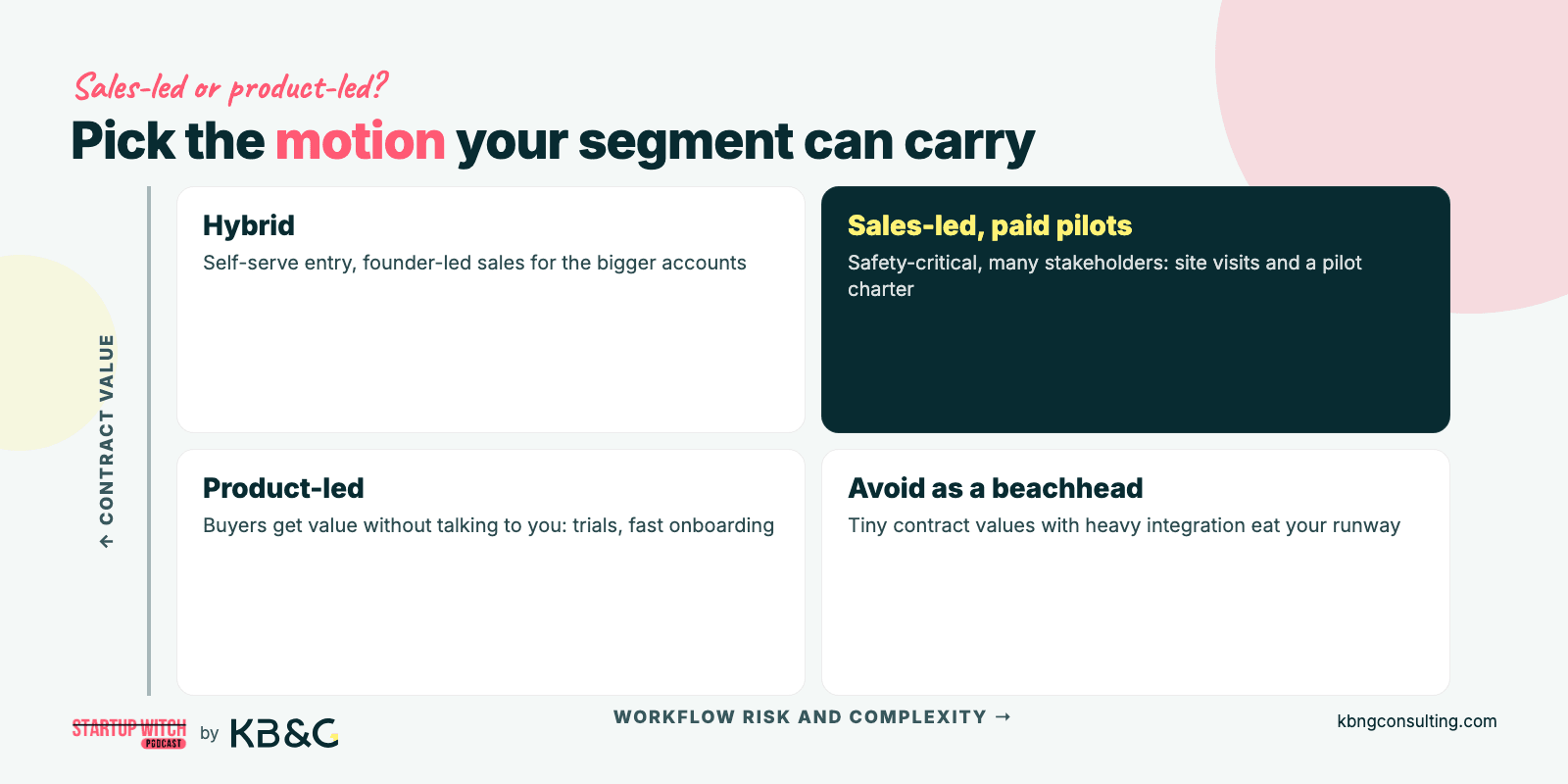
Contrast a fast-cycle SaaS use case (email personalization for sales teams, where the sales cycle might be two to four weeks with a single buyer) against a long-cycle industrial one like AI for haul-truck safety in mining, where you might face six months, five stakeholders, and a heavy proof burden. Sales-led motions fit complex, high-ACV deals with multiple decision-makers, while product-led growth can work for lower-friction segments.
Avoid starting where proof is impossible: tiny ACVs with heavy integration needs will eat your runway. Pick a narrow segment where you can prove ROI within a single budget cycle.
Positioning and Messaging for AI Products
Positioning and messaging are how you simplify your AI product into a story that a non-technical buyer can repeat inside their organisation. Effective positioning connects customer pain to product capabilities. Your job here is to talk about outcomes and risk, not algorithms.
Craft a Problem-First Positioning Statement
Use this template: "For [ICP] who struggle with [pain], [product] is an AI-powered [category] that delivers [outcome], unlike [status quo/alternative]."
Industrial example: "For safety managers at mines who struggle with under-reported near-misses from field voice communication, Canary Waves is voice-to-data safety intelligence that runs on existing two-way radio and flags near-miss language, hazards and protocol breaches, unlike paper logs or manual transcription subject to memory bias."
SaaS example: "For revenue leaders at mid-market B2B SaaS companies whose SDRs waste hours writing outreach emails, [Product] is an AI cold-email co-pilot that lifts response rates, unlike generic email templates."
Sanity-check your positioning: can a prospect repeat it to their CFO without you in the room? If not, simplify. Avoid jargon like "transformative AI platform" unless you can back it with a precise use case and proof.
Build a Messaging Ladder: From Executive to End User
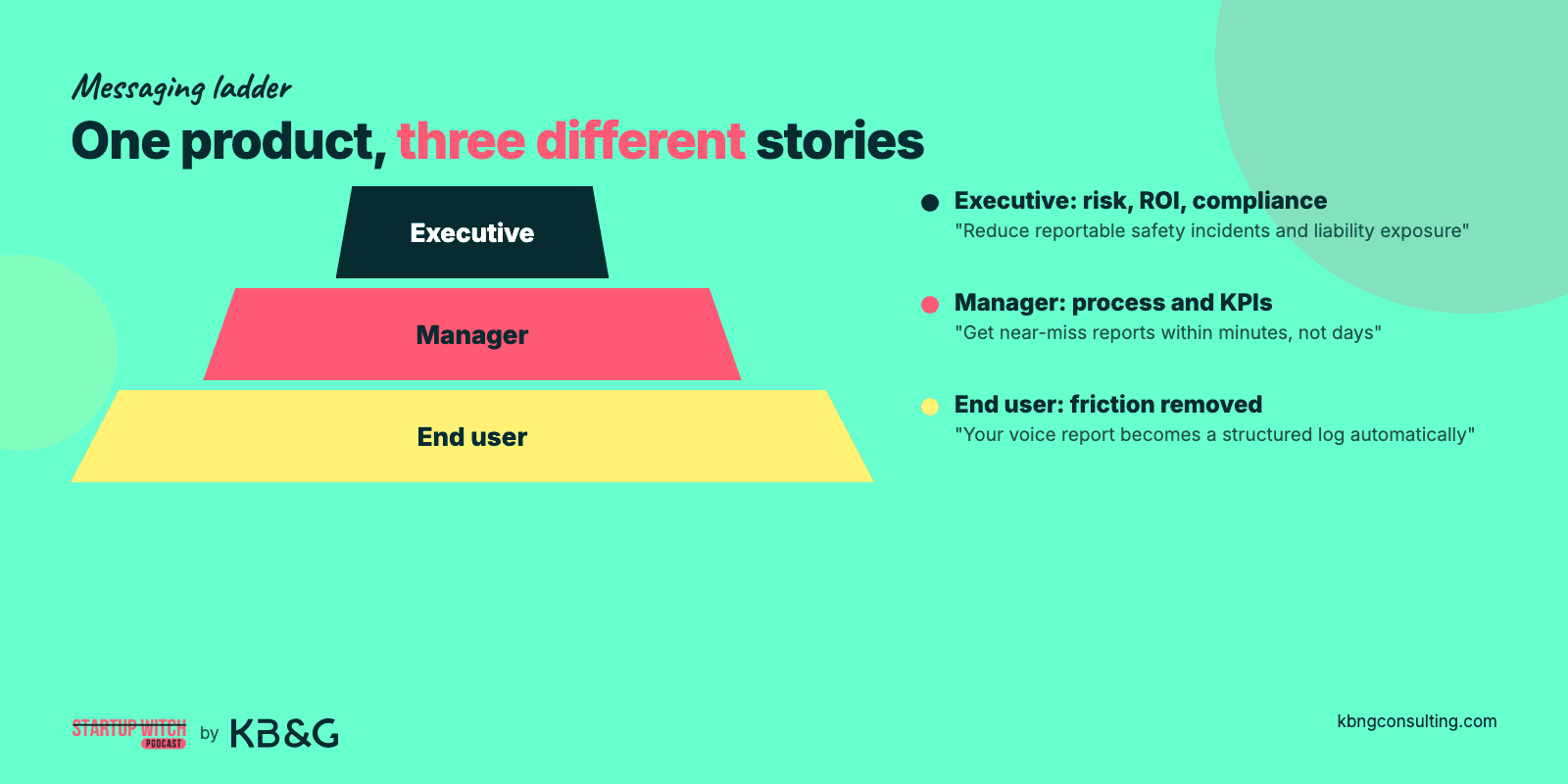
A messaging ladder matches your value proposition to each level of the buying organization:
Executive level (risk, ROI, compliance):
"Reduce reportable safety incidents and liability exposure"
"Cut manual reporting costs by X hours per week per site"
"Meet regulatory compliance with auditable, AI-structured event logs"
Manager level (process, KPIs, efficiency gains):
"Get near-miss reports within minutes of a radio call, not days"
"See trends across sites without waiting for quarterly audits"
"Reduce training overhead for incident documentation"
End-user level (day-to-day friction removed):
"No more paper forms after every radio event"
"Your voice report becomes a structured log automatically"
"Spend time on safety action, not admin"
Each rung leads with the problem and outcome, then briefly explains how AI enables it. Keep language direct and concrete; avoid fluffy claims or unprovable future benefits.
Prove You're Not Vaporware: Social Proof and Evidence
In AI GTM, proof matters more than polish. Here are the types of evidence that move deals:
Quantified pilot results: the number of sites, the pilot length, and the before/after count of the metric you agreed to move
Before/after workflows: Show the manual process vs. the AI-enabled process side by side
Anonymized case narratives: Walk through a real scenario, protecting customer identity
Product walkthroughs with realistic data: Demo on data that looks like the buyer's environment, not a clean lab dataset
Even with only two or three customers, you can show evidence. Highlight business outcomes such as cost savings and efficiency gains, and put numbers on them.
In heavy industry, operational leaders will also want to see how your system behaves on bad data and edge cases. Show false-positive rates, error handling, and human override workflows. Buyers often want to see how your system fails before they'll believe how it works.
Once your story and proof are solid, you can choose how to put them in front of your beachhead.
Channels and Motions: How AI Startups Should Reach Buyers
Channel choice comes after segment and positioning. At early stage, the founder is the channel. You don't need a marketing plan with eight digital channels; you need direct contact with potential customers who have the problem you solve.
Three primary motions matter for AI startups at this stage: founder-led sales, strategic partnerships, and content that works for both human buyers and AI answer engines.
Founder-Led Sales: Your First Dozen Customers
Founder-led sales is non-negotiable at pre-seed and seed. You need direct exposure to objections, buyer politics, real-world workflows, and the customer journey from first contact to close. No hired sales team can replicate that learning this early.
Core activities:
Outbound to hand-built lists: Build a list of 50–100 named prospects in your ICP. Personalized outreach, not spray-and-pray.
Warm intros via your network: Investors, advisors, former colleagues. Work every connection to your target audience.
Targeted industry events: Show up where your buyers gather: mining safety conferences, SaaS revenue summits.
Customer development calls that convert: Discovery calls that teach you the buyer's world and, when the fit is clear, lead into a pilot.
Record and transcribe everything: Use AI tools to mine call transcripts for repeated phrases, objections, and buying signals. This builds your feedback loop and sharpens messaging every week.
Industrial example: visiting a quarry or mine site to see the radios, PPE, safety workflows, and physical environment before promising anything. You'll learn things about edge cases (noise, connectivity, worker skepticism) that no market research deck will tell you. Hiring SDRs too early is a common GTM mistake. Build the motion yourself first.
Partnerships and Ecosystems (Especially in Heavy Industry)
Use channel partners when they have existing credibility and access to your target market that would take you years to build alone. In industrial settings, this means systems integrators and OEMs. In SaaS, cloud marketplaces or CRM ecosystems.
What partners actually care about: incremental revenue, low risk to their reputation, easy deployment, and a clear joint story. Partnerships can extend your distribution, but only after you've proven your own motion.
Example partner motions:
Bundling an AI safety intelligence layer into an existing fleet-management system used across mining sites
Listing a workflow AI tool in a CRM's marketplace to reach mid-market revenue teams
Don't outsource GTM to partners before you can sell it yourself. Partners amplify what already works; they don't define your direction. Scaling unproven motions leads to startup failures.
Content That Works for Humans and AI Answer Engines
Buyers now use tools like ChatGPT, Perplexity, and vertical AI portals to discover and evaluate AI products. When a safety director searches "AI for mine safety near-miss reporting," your content needs to surface, in traditional search and in AI answer engines.
Content formats that work:
"How we solved X problem for Y segment" posts: Detailed case studies with real metrics from real deployments.
Integration guides: Show exactly how your product fits into existing workflows and tech stacks.
Implementation checklists: Give potential customers a clear picture of what deployment looks like.
Transparent FAQs on data, safety, and oversight: Answer the exact questions buyers ask, directly, early on the page, with structured headings.
Structure content for retrieval: clear headings with buyer keywords, direct answers near the top of sections, and language that matches how your target audience actually searches. Let real product usage data and customer feedback shape what you write, not guesswork.
Designing Pilots That Actually Convert into Revenue
Most AI startups don't die because their model doesn't work. They die because their pilots never convert into production contracts. The fix isn't more features. It's how you set up the pilot, define success metrics, and negotiate the exit path.
Set Up the Pilot: Scope, Stakeholders, and Success Criteria
Define 1–2 target metrics: Time saved per report, incidents caught early, manual hours eliminated, accuracy improvement. Pick metrics your buyer already tracks.
Choose a limited environment: One mine site, one plant, one SDR team. Not a company-wide rollout.
Identify a single accountable sponsor: Someone with budget authority and a reason to care. If there's no named sponsor, don't start the pilot.
Pre-agree duration: 60–90 days. Longer than that and you're subsidizing indecision.
For a voice-to-data safety system, stakeholders would include the safety lead, IT/data lead, operations supervisor, and people on the radio network. Map all of them upfront. Frontline users, especially deskless workers in mining or manufacturing, must be included, not surprised.
Create a one-page pilot charter that both sides sign off before deployment. This sets expectations, prevents scope creep, and gives you a written reference when it's time to convert.
Avoiding Pilot Purgatory: Commercial Terms and Next Steps
Pilots should be low-friction but not free. Free pilots attract tyre-kickers and signal low value. Structure them as discounted paid engagements with a clear upgrade path to production.
Include "if/then" clauses:
"If we reduce near-miss report lag by 50% by day 60, we execute a 12-month production contract starting on [date] at pricing band A."
"If SDR response rates increase by 1.5× during the pilot, we move to annual billing at [price] per seat."
"If success criteria are not met, either party can exit with 15 days' notice."
For long procurement cycles in heavy industry, start with a limited-scope paid pilot through innovation budgets while running vendor approval in parallel.
Red flags that should make you walk away or renegotiate: no named sponsor, no committed internal resources, or "we'll see later" on conversion terms. These are signs of a pilot that will stall regardless of your product's performance.
Operationalizing Learnings from Pilots
Every pilot generates GTM data that's more valuable than any market analysis you can buy. Capture it systematically:
Data quality issues: What broke? What edge cases appeared?
Workflow friction: Where did the product collide with existing processes?
Persona insights: Which personas cared most? Who blocked adoption? Why?
Objections: What stalled the deal? What almost killed it?
Build a simple "pilot log" where each engagement records ICP attributes, outcomes, and lessons. Use call transcripts, support tickets, on-site observations, and first-party data from the product itself to refine both product and GTM narrative. Iterative GTM development focuses on learning, not just revenue.
The patterns from pilots should drive your pricing, packaging, and ROI story.
Pricing and Packaging an AI Product Buyers Will Actually Approve
Pricing is a GTM lever, not an afterthought. Your pricing strategy signals value, shapes who you sell to, and must align with the buyer's mental model of cost vs. risk. AI-specific issues include variable compute costs, fairness concerns with usage-based pricing, and buyers expecting "AI should be cheap because it's automated."
Choose a Pricing Metric That Tracks Value, Not Just Compute
Common pricing metrics for AI startups and their trade-offs:
Pricing Metric | Best For | Watch Out For |
|---|---|---|
Per seat | Clear user base (SDR teams) | Discourages adoption within org |
Per site/location | Industrial (mines, plants) | Large sites subsidize small ones |
Per asset monitored | Fleet, equipment, workers | Counting can be contested |
Usage events (API calls, reports) | High-volume, variable use | Cost unpredictability for buyer |
Outcome-based | High-trust, provable ROI | Hard to attribute; requires data |
Industrial example: charging per active site or per 100 field workers for a voice-to-data safety product, rather than per API call. Tying pricing to a clear business metric (number of trucks, number of SDRs, number of sites) makes procurement discussions easier than abstract usage units.
Value-based or usage-based pricing models align with customer value in AI products. Stripe's guide to AI pricing models describes hybrid pricing (a base subscription plus usage fees above included limits) as a way to give buyers predictability while protecting you when usage varies widely.
Test one or two pricing models in early deals rather than locking into one too early. Post-launch iteration tests GTM hypotheses against reality.
Structuring Tiers and Plans for Different Segments
A simple 2–3 tier structure works:
Entry tier: For early adopters. Limited features, lower commitment, gets them in the door.
Core tier: For your main ICP. Full product, standard support, the pricing you'll build your business on.
Enterprise tier: Higher support, compliance features, on-prem or VPC deployment, advanced audit logs, custom model fine-tuning, dedicated customer success manager.
Features that typically belong in higher tiers for AI products: on-premise deployment, SOC 2 or ISO compliance documentation, custom model training, SLA guarantees, and dedicated success managers. Bessemer's AI pricing and monetization playbook emphasizes that pricing for AI products should account for variable compute costs and usage, so heavier tiers should reflect the heavier resourcing they require.
If you claim mission-critical safety impact, don't price like a toy. Pricing must align with the product's positioning in the market.
Handling Common Pricing Objections for AI
"We already have internal data science." Counter: Your internal team has broad responsibilities. Our product delivers a specific outcome (near-miss detection, quote acceleration) in weeks, not quarters. Compare that with the total cost of building and maintaining this internally, before factoring in opportunity cost.
"Can't we do this with our existing tools?" Counter: You could duct-tape a workflow with existing tools. The question is speed to value and domain expertise: a generic speech-to-text API isn't tuned to mining radio traffic and site slang.
"AI should be cheaper because it's automated." Counter: AI products often involve higher infrastructure costs and probabilistic outputs that require human oversight and continuous improvement. The value isn't "cheap automation." It's outcomes you couldn't get before at any price.
"What if usage spikes and our bill explodes?" Counter: That's why we offer hybrid pricing with a base subscription and capped overages. We can also set alerts and caps so you're never surprised.
Equip yourself with a simple ROI calculator tied to pilot metrics (time saved × hourly cost, incidents caught earlier × cost per incident, incremental revenue) to ground every pricing conversation.
Trust, Data, and Risk: What B2B Buyers Worry About with AI
For AI startups, the sale is often "Do I trust you with my data and my brand?" more than "Is your model accurate?" AI buyers may assess products through standard procurement processes including performance benchmarks and security reviews. Addressing these concerns directly is part of your GTM, not a legal afterthought.
Data Security, Privacy, and Governance Basics
Buyers will ask these baseline questions, so have answers ready:
Data residency: Where is data stored? Which region/country?
Encryption: At rest and in transit?
Model training: Is customer data used to train your model? Who owns derivative data?
Access controls: Who at your company can see customer data? What's the principle of least privilege?
Incident response: What happens if there's a breach?
In industrial settings, these concerns get sharper. Transmitting radio audio off-site raises privacy questions. Camera feeds from operations have surveillance implications. Safety event logs can have legal consequences. Manage data privacy and compliance issues early in your GTM conversations, not when the deal is about to close.
Saying "we're small, we'll handle security later" kills deals. Even at pre-seed, prepare a short, honest security and data FAQ. Lean GTM includes minimum viable governance.
Transparency, Explainability, and Human Oversight
In safety-critical and high-stakes workflows (serious injury prevention, financial decisions, compliance reporting), buyers need to understand how your AI behaves and who is in the loop. They want to see the logic chain, not just the accuracy figure.
Show concrete examples: how your PPE detection model flags an image under harsh lighting conditions, how your voice model maps a noisy radio call to a structured safety event, where and when humans confirm or override a detection. Build transparency into the UI: logs, uncertainty indicators, human review queues.
Transparency and clear human oversight are part of your value proposition, not a grudging concession. Build trust into product development from day one.
Change Management for Frontline and Knowledge Workers
In both industrial and office settings, workers worry about being replaced or monitored. This concern can quietly sabotage AI adoption, even if management is enthusiastic. Customer satisfaction depends on the people actually using the tool.
Include change management in your GTM:
Clear messaging to end users: "This tool makes your shifts safer and eliminates paperwork," not "this tool monitors your compliance."
Supervisor buy-in: Train supervisors first; let them champion the rollout.
Feedback loops: Invite frontline users into pilot design. Show them sample events and how voice reports become action items. Allow bottom-up customer feedback.
Example: rolling out a radio-to-data system on a mine site. Operators need to see that when they report a near-miss on the radio, the AI structures it into a log that triggers a response. It should help them, not just generate reports for management.
A good GTM plan bakes all of this (segment, story, channels, pilots, pricing, trust) into a simple sequence you can execute.
A 90-Day Go-To-Market Plan for Your AI Startup
This is a realistic 90-day GTM plan for pre-seed and seed AI founders to move from "we built a model" to "we have a repeatable way to win customers." It's broken into three 30-day blocks, each with specific GTM outputs and experiments. Treat each block as a learning cycle, not just a checklist.
Days 1–30: Clarify Segment, Problem, and Narrative
Key outcomes: A beachhead ICP with 20–50 named accounts, validated top 1–2 problems, a draft positioning statement and messaging ladder.
Activities:
Run 10–20 discovery calls with named potential customers in your ICP. Don't pitch; ask questions. Record metrics around their pain, workflows, and job titles.
Visit at least one industrial site (if selling to industrial buyers) to see context, tools in use, and edge cases you'd never find in a Zoom call.
Audit the competitive landscape: what are competitors charging, how do they position, what proof do they show?
Write and test initial positioning statements and your messaging ladder. Test in calls, in small ad sets, in social posts.
Set up basic GTM infrastructure: simple CRM, call recording/transcription, one-page pilot charter template, and a lightweight website that leads with the problem and outcomes.
Success at day 30 is having a clear "who, what problem, what outcome" story, not polished marketing assets.
Days 31–60: Run Focused Outreach and 2–3 Pilots
Key outcomes: 2–3 signed pilot agreements, tested outbound messaging, early signals on pricing tolerance.
Activities:
Targeted founder-led outbound to your ICP list using the refined message. 50–100 personalized outreach attempts. Test different value propositions and email copy.
In-person or remote demos anchored in a specific use case, not a generic product walkthrough.
Negotiate pilot scopes with clear success metrics and next-step clauses. Use your pilot charter.
Track every conversation: segment, use case, objections, requested features. Update messaging weekly based on what lands, and use product usage data from early pilots.
Produce proof content: case study drafts, pilot results, before/after data. Start basic content optimized for human and AI answer engines.
For industrial products, start with one site or plant with clear constraints, not a multi-site rollout you can't support. Even if your "marketing team" is just you right now, make sure your sales execution and content tell the same story.
Days 61–90: Turn Lessons into a Repeatable GTM Motion
Key outcomes: At least one pilot hitting or approaching success criteria, a first version of your GTM playbook, and decisions on next hires or partners.
Activities:
Deep review of all pilot outcomes. Tighten your ROI narrative with real numbers. If one pilot nearly meets success criteria, move toward negotiating a production contract.
Decide whether your beachhead is working (double down), needs refinement (narrow further), or is wrong (pivot to a neighbouring segment) based on evidence, not hope. Watch for disengagement signals in your pilots.
Finalize pricing and packaging tiers (entry, core, enterprise) based on pilot feedback and real usage data.
Build your internal GTM playbook: sales stages, discovery questions, buyer personas, pilot template, success criteria chart, risk mitigation. This is the operating system for your new GTM strategy.
Map whether you need to hire (and whether you've earned the right to). Consider strategic partnerships if pilots reveal channel opportunities.
This is also the right moment to get an outside view if traction is unclear. If you want a blunt read on what's blocking your GTM, the Founder Blind Spot Diagnostic by Startup Witch reads your startup in 14 days and names the one thing blocking growth (EUR 750, fully refundable).
Conclusion and Next Steps
An effective go to market strategy for AI startups means choosing a narrow, painful problem, leading with outcomes not algorithms, closing a few well-designed pilots, and then scaling what works. A successful GTM strategy for an AI startup requires a focus on concrete business outcomes, not on how impressive your model is. Your job is to prove ROI before you try to scale.
Your next actions:
Define your beachhead ICP this week, with named companies, not just a persona slide
Schedule 5 discovery calls with potential customers who match that ICP
Draft a one-page pilot offer with clear success metrics and conversion terms
Write a blunt, problem-led homepage hero section that a non-technical buyer can understand
Set 1–2 core GTM metrics to watch: qualified conversations per week and pilot-to-production conversion rate
Frequently Asked Questions
What's the difference between GTM for AI startups and "normal" SaaS?
The core GTM discipline is the same: define ICP, position around a problem, sell, learn, iterate. But AI GTM has sharper constraints: data privacy and trust are front-and-center, buyers are more skeptical because of overpromising in the market, and the temptation to lead with technology instead of problem is stronger for technical founders. AI products also involve probabilistic outputs (not deterministic features), which changes how you demo, prove value, and set customer expectations. Effective GTM strategies for AI startups prioritize trust, specific high-value use cases, and quick feedback loops.
When should I hire SDRs or a dedicated salesperson?
Founders should usually close the first 10–20 deals themselves. Hiring sales teams only makes sense once you have a repeatable motion and more qualified leads than you can handle. If you haven't validated your messaging, ICP, and sales cycle yourself, an SDR will just burn through your list faster.
How do I know if my beachhead is too narrow?
"Too narrow" is rare for early stage startups. If you can name 100–500 prospects globally and see multiple painful use cases among them, it's probably fine. Adjust only if pilots consistently stall due to structural reasons: no budget owner, no measurable problem, regulatory barriers you can't clear. If your segments are too broad, you learn nothing useful from each interaction.
Can I run product-led growth (PLG) with an AI startup?
PLG can work for low-friction, low-risk workflows: a sales email co-pilot, a content generation tool, routine task automation. But complex or safety-critical AI (mining operations, compliance, financial decisions) usually requires sales-led or hybrid motions at initial launch. Many AI startups combine product-led and sales-led motions as they mature. The key question: can your buyer get value without talking to you? If yes, PLG. If no, sales-led first.
What should I measure to know my GTM is working?
Four core metrics:
Qualified conversations per week in your ICP: are you reaching the right people?
Pilot-to-production conversion rate: are pilots turning into revenue?
Customer acquisition cost and payback period: can you afford to acquire customers at this rate?
Why your last 5 customers bought: from call notes and customer conversations, not your assumptions.