What Is Product Market Fit Validation?
Product market fit validation is the process of proving (with behavioral evidence, not gut feeling) that a specific customer segment relies on your product enough to keep using it, pay for it, and tell others about it. You validate product market fit by tracking retention, willingness to pay, organic referrals, sales cycle compression, and by running structured tests like the Sean Ellis 40% survey against your ideal customers.
This article is for founders of AI or SaaS startups (pre-seed to Series A) who have shipped something real, have some users or pilots, but aren't sure whether what they're seeing is genuine product market fit or just noise. If you're still at the product idea stage with no users, start with problem validation first. If you're looking for a fundraising deck template, this isn't it.
Product-market fit (PMF) validation tests whether a product meets real market demand, and the stakes are high: building something nobody wants is one of the classic ways startups die. Validation moves a startup from guesswork to evidence-based growth, and it prevents wasted money by confirming market need before spending on ads and sales.
Here's what you'll walk away with:
How to translate "I think we have PMF" into a falsifiable hypothesis and a validation plan.
Which leading indicators to track (customer retention, pull, pricing power, referrals, sales cycle compression) and what "good" looks like at early stage.
How to run the Sean Ellis 40% test step by step and interpret messy results.
How to spot PMF mirages: pilots, friendly users, investor enthusiasm, and press that feel great but prove nothing.
A practical 30–60 day PMF validation roadmap tailored to AI/SaaS founders.
Understanding Product Market Fit Validation
Product market fit validation is an evidence-gathering process. You're proving, not assuming, that your product reliably solves a painful problem for a specific customer segment at a price and motion that can scale. It is the foundation on which everything else (hiring, fundraising, marketing strategies) gets built.
Most founders confuse belief with validation. A few warm pilot conversations, an investor who's excited about industrial AI, a corporate logo on your pitch deck: these feel like progress, but they're not evidence. PMF validation helps startups focus on the right customer segments rather than chasing vanity metrics that look impressive but mean nothing.
What Product Market Fit Actually Is (For AI & SaaS)
Product market fit means a specific segment repeatedly buys, uses, and sticks with your product because it's the best solution to an urgent problem they feel. It's not vague enthusiasm. It's behavioral.
Here's what PMF signals look like in practice for AI and SaaS:
Consistent usage and renewals without heroic effort from your team. Satisfied customers keep showing up in your product logs without you begging them.
Expansion within accounts: more seats, more use cases, more budget flowing your way because the product solves real customer needs.
Word-of-mouth leads from existing paying customers introducing you to peers. Evidence of PMF includes customers who actively seek the product without persuasion.
Product market fit is segment-specific. You can have PMF with "mid-market safety managers in EU quarries" without having it for "all industrial companies." Your target market might be narrow, and that's fine: what matters is depth, not breadth, at this stage.
Validation is about confirming these signals systematically rather than guessing. Reaching PMF often takes longer than founders expect, so you need a process, not a prayer.
What Product Market Fit Validation Is (And Is Not)
PMF validation is a series of tests across four dimensions:
Problem–solution fit: Does a significant problem exist that your product solves? Problem validation confirms that target customers face a problem worth solving.
Engagement and retention: Do they keep using it? High engagement indicates that users are integrating a product into their routines.
Willingness to pay: Do they pay list price and renew? Paid pilots are stronger validation than positive feedback alone.
Scalable acquisition: Can you repeatedly find and close similar new customers without burning through cash?
What PMF validation is not:
Not a one-off survey sent to friends. That's courtesy, not data.
Not "we raised a good round so investors must believe." Proof of market pull attracts investors, but investor interest alone isn't PMF.
Not "we got into a big accelerator or corporate pilot." These open doors; they don't prove market fit.
Now let's walk through the specific leading indicators you should be tracking before running more advanced tests.
Key Signals and Metrics for Product Market Fit Validation
You understand what PMF validation is. Now you need to know which PMF metrics actually matter: not total revenue, not sign ups, not LinkedIn impressions. These are the leading indicators useful at pre-seed and seed stage, before you have perfect dashboards or a data team.
Retention and Engagement: Do People Stick Around Without Being Forced?
Customer retention is the single most important indicator of product market fit. If people don't stick around, nothing else matters.
For SaaS and AI products, retention means the percentage of users or accounts that keep using your product over time. Track it at meaningful intervals: 4-week retention for self-serve products, 3-month and 6-month retention for B2B contracts, per-shift or per-site for industrial tools. High customer churn that never improves is a strong sign that product market fit isn't there yet.
What to look for:
Stable or improving cohort retention curves rather than steep drop-offs. Retention cohort analysis tracks users over time to verify ongoing engagement. For SaaS startups under $1M ARR, monthly churn of 5–10% is normal; what matters more is whether churn is concentrated in early cohorts and declining as the product matures. Churn that stays high or rises cohort after cohort is a serious warning.
Clear habit patterns: daily use for workflow tools, weekly for analytics dashboards, per-shift for industrial safety tools.
Qualitative signals: users complain loudly when you break things, ask for improvements, and resist churning. That's genuine satisfaction, not politeness.
Without retention, all other signals are noise and PMF is not validated.
Pull and Urgency: Do Customers Chase You, Or Do You Chase Them?
"Pull" is the market telling you it wants what you're building before you even ask. It's one of the clearest signs you're close to achieving product market fit.
Pull signals include:
Unprompted referrals from existing customers.
Potential customers emailing after hearing about you from peers or at industry events.
Decision-makers pushing to accelerate pilots or deployment rather than dragging their feet.
Track this simply at early stage: add a "how did you hear about us?" question to every form and sales call. Log referral chains (e.g., "safety manager at Site B heard from Site A"). Word-of-mouth demand is market validation you can't fake.
Pure outbound with zero pull can still be a valid business, but if it never transitions to any organic demand after months of usage, that's a warning sign that your value proposition isn't strong enough to create buzz.
Willingness to Pay and Pricing Power
Willingness to pay means customers hand over real money, on time, without heavy discounting or vague "we'll pay later" promises. This is where you separate interested potential customers from actual paying customers.
Evidence of pricing power looks like:
Limited discounts offered: customers arguing for scope, not price.
Renewals happening without re-bidding or procurement drama.
Upsells initiated by the customer ("Can we add three more sites?").
How to run simple price tests: quote at or above your target price to the next five qualified prospects and track close rates. If your target customers still close at full price, that's strong PMF validation. If everything requires 50% discounts or perpetual free pilots, you haven't validated willingness to pay.
AI founders are especially prone to underpricing, masking actual market fit by giving away too much value for free. "Paying" is the operative word in paying customers.
Referrals, Advocacy, and Word of Mouth
There's a meaningful difference between satisfied customers and evangelical ones:
Satisfied: they renew and use the product quietly.
Evangelical: they introduce you to peers, speak at webinars, and fight internal battles to keep your product. They're building your customer base for you.
Measure advocacy simply:
Count introductions requested vs. introductions actually made.
Track customers who proactively agree to be references or case studies.
Run a bare-bones "would you be very disappointed if we disappeared?" survey (more on this below).
In tight B2B niches (mining, manufacturing, industrial safety), even a small number of strong advocates can be a powerful PMF signal. One passionate safety director who gets you into three other sites is worth more than a thousand landing pages.
Sales Cycle Compression and Deal Quality
Track your sales patterns over time. If you're approaching product market fit, you'll see:
Deals in your core customer segment closing faster as you refine messaging and proof points.
Less need for founder hand-holding on every call. Prospects arrive with clearer problem understanding.
Higher win rates and fewer customization demands. Long, stalling sales cycles often signal poor product-market fit.
Compare your first five deals to your last five. If early deals took four months with custom demos, founder-led onboarding, and extensive discounting, but recent deals close in six weeks at closer to list price, that's real data showing you're validating demand in your target audience.
Beyond these ongoing signals, founders can run one specific test to get a quantitative read on PMF: the Sean Ellis 40% survey.
Using the Sean Ellis 40% Test to Validate Product Market Fit
The Sean Ellis test is one of the best-known survey methods for PMF validation. It gives you a clear benchmark (40% "very disappointed") and it's especially useful when you don't yet have solid revenue or retention data, but do have a user base you can survey. Use it alongside your behavioral metrics, not instead of them.
How the Sean Ellis Test Works
The core question is simple: "How would you feel if you could no longer use [product]?"
Answer options:
Very disappointed
Somewhat disappointed
Not disappointed (it really isn't that useful)
N/A: I no longer use the product
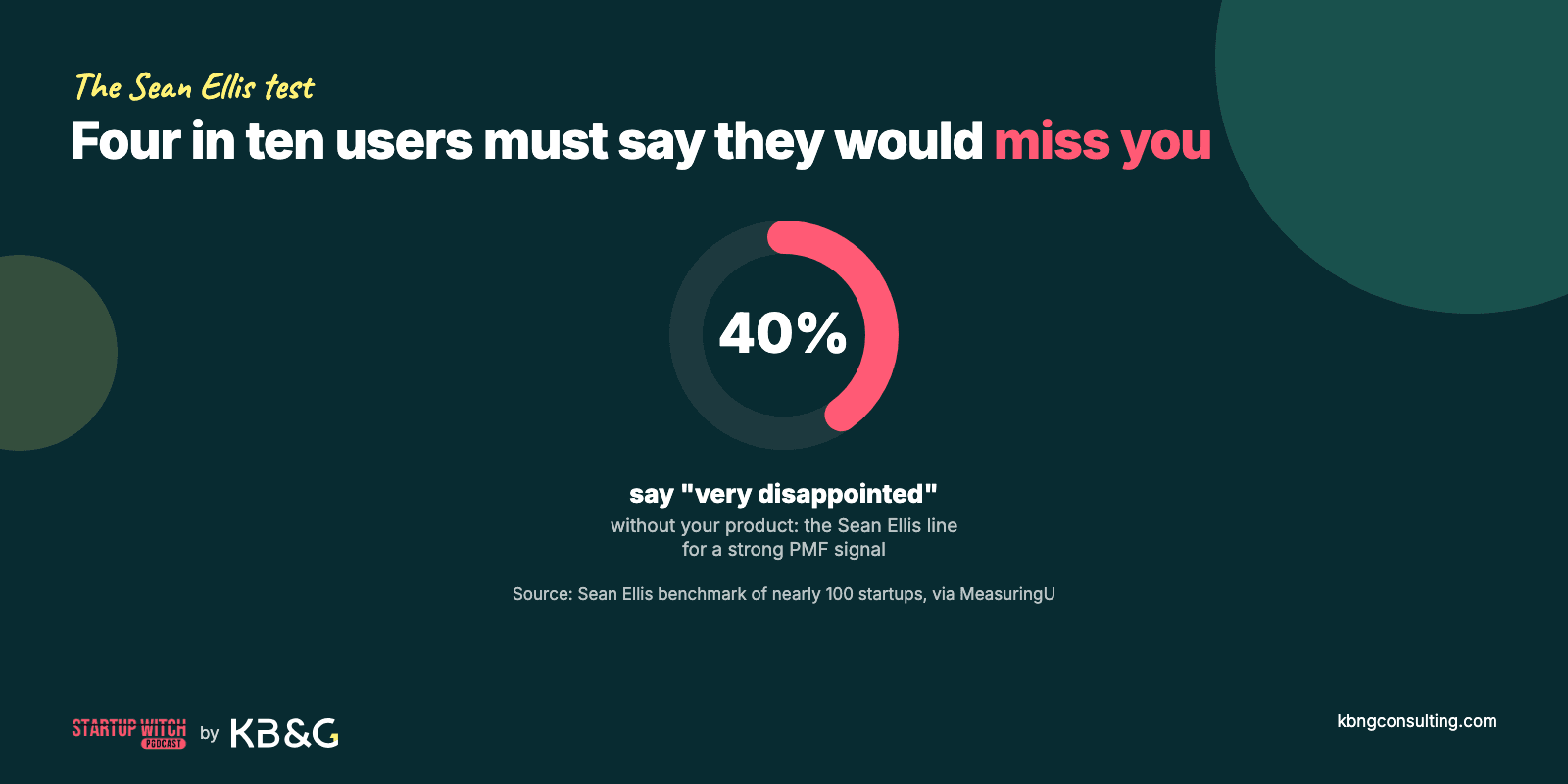
The benchmark: when 40% or more of users say they would be "very disappointed" without the product, that's a strong PMF signal. Sean Ellis set this threshold after benchmarking nearly a hundred startups: companies that struggled to find growth almost always scored below 40%, while companies with strong traction almost always exceeded it. Treat it as a rule of thumb, not a law: MeasuringU points out that the 40% line rests on its originator's experience across those startups, not on peer-reviewed research.
Critical rule: survey actual active users who have used the product meaningfully. Not friends. Not trialists who signed up and never logged in. Not people who only saw a demo. Measuring customer behavior rather than opinions leads to more reliable validation outcomes.
Setting Up and Running the Survey
Here's how to do it without overthinking:
Define the user cohort: Select people who used your product meaningfully in the last 30–60 days: logged in at least X times, ran Y workflows, or completed a core action. You want activated users who've reached the "aha moment," not everyone who ever created an account.
Choose survey tooling: Google Forms, Typeform, or an in-app prompt. Nothing fancy needed. Know what you're looking for before you send.
Keep the survey lean: 3–5 questions max. The core PMF question plus 1–2 open-ended questions: "What type of person would benefit most from this product?" and "What is the main benefit you get from [product]?" This helps you learn who your ideal customers actually are.
Send and close quickly: Email and/or in-app, with a 5–10 day response window. Don't let it drag.
Sample-size guidance: 30–50 responses give a directional signal for early-stage B2B products. For self-serve tools, aim for 100+. With 50 responses and a score around 40%, the margin of error is about ±13 percentage points at 95% confidence, so treat the number as directional, not gospel. Define success criteria before you look at results so you don't move goalposts.
Interpreting the Results (Especially in Messy Reality)
Calculate the "very disappointed" percentage by dividing "very disappointed" responses by total responses (excluding N/A). Then categorize:
≥40% "very disappointed": Strong PMF signal. Your core users would feel real loss. Now validate with retention and revenue data and prepare to scale. But check for the "high score, low retention" paradox: it's possible to score well on surveys but still see churn if switching costs, not value, are driving the responses.
25–39%: Promising but incomplete. You likely have PMF with a subsegment or specific use case, not your whole target audience. Narrow your ICP and double down on the segment that loves you most. This is where many early AI/SaaS founders live.
<25%: You have fans, but product market fit is not validated. This is optimization input, not a death sentence. Treat it as customer feedback that reshapes your product concept and positioning.
Mine the open-ended answers:
Language patterns you can reuse in positioning and marketing.
Profile patterns in who really loves you: role, company size, industry, specific jobs-to-be-done. This shapes which target customers you prioritize.
These surveys and signals are only useful if you don't fool yourself with false positives, which is exactly what the next section covers.
Common False Positives in Product Market Fit Validation
Founders, especially in AI and industrial verticals, regularly misread certain signals as PMF and then scale too early on false signals rather than validated demand. Here's a blunt checklist of things that feel good but don't prove anything on their own.
Corporate Pilots and POCs That Don't Convert
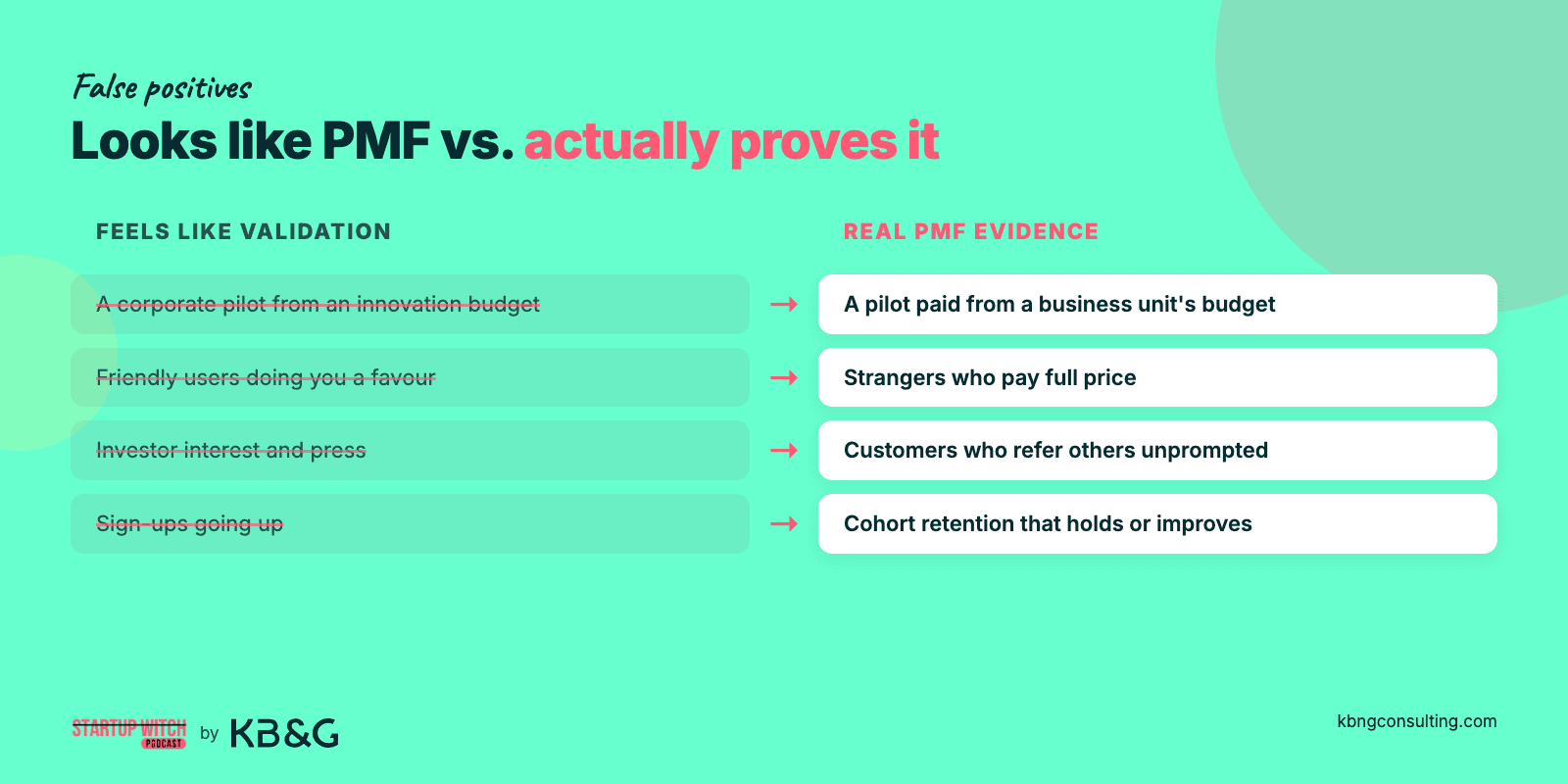
Corporate pilots are one of the most dangerous false positives in AI. Budgets labelled "innovation" or "AI experimentation" often don't tie to real operational owners. Pilots with unclear success criteria, no committed rollout plan, and no real pain owner are not validating demand. They're validating that someone in the organization is curious.
Make pilots valid PMF evidence by requiring:
Payment from a real business unit's budget, not an innovation slush fund.
Explicit success criteria and a pre-agreed decision date.
A named champion and economic buyer who owns the outcome.
Friendly Users, Favors, and "Innovation Theater"
Friends at other startups or corporates who "try" your tool but never integrate it into daily workflow. Teams who enjoy demos but never actually deploy. Hackathon-style experiments inside enterprises that never reach production. These are all forms of innovation theater.
How to distinguish real PMF validation from courtesy: real usage shows up in logs, renewals, and budget allocation. Real users complain loudly when you break things or change pricing. Courtesy users just stop responding. Interview potential customers for feedback, but watch what they do, not just what they say.
Investor Interest, Press, and Social Proof
Investor demand in 2024–2026, especially for anything labeled "AI," is not PMF evidence. Investors chase narratives, not always evidence. A hot category (industrial AI, LLM copilots) can get funded before PMF exists. Similarly, press coverage, awards, and accelerator acceptances feel validating but don't mean users are retained or paying.
Ask yourself: "If capital dried up tomorrow, do we still have a business?" Startups without product-market fit are running on a ticking clock.
Top-of-Funnel Growth Without Depth
Lots of free sign ups can mask poor activation and customer retention. Many pilots can hide the fact that almost none convert to production deals. This is the classic vanity metrics trap: impressive top-of-funnel numbers with no depth beneath them.
Track funnel depth instead:
Activation rates and time-to-first-value: how quickly do users reach the moment where your product solves their problem?
Weekly and monthly active users, not just total accounts created.
Pilot-to-production conversion rate and time to paid upgrade.
Fake door tests measure genuine intent through customer actions like clicking to buy a product that doesn't exist yet. Landing page tests gauge interest by measuring sign-ups or pre-orders for a product idea. These can supplement your funnel analysis, especially when validating a new idea or new features before full development.
After avoiding false positives, you need a concrete, time-boxed plan to validate PMF properly.
A Step-by-Step Product Market Fit Validation Plan
This is a practical 30–60 day process you can run without a growth team, focused on getting to evidence quickly. It's especially suited to AI/SaaS teams that already have some customers or pilots, not just a product concept. Reaching PMF can take a long time, but you can get clarity on where you stand in weeks.
Step 1: Define Your Sharpest Hypothesis and ICP
Write a single sharp PMF hypothesis. Example: "Shift supervisors at open-pit mines in Europe use our voice-to-data tool daily to reduce incident reporting time by 50%, and sites renew annually at full price."
Narrow your Ideal Customer Profile by:
Industry, company size, geography.
Specific roles (safety managers, ops leads, data leads in B2B; specific use-case owners in SaaS).
The specific customer pain points your product addresses.
Without a sharp ICP, PMF validation drowns in noise. You can't validate market fit for "everyone." Prioritize your hypotheses before testing them with users.
Step 2: Map and Clean Your Data
This is a 1–2 day exercise:
Export customer and user lists into a spreadsheet.
Tag by segment (ICP vs. non-ICP), cohort (month of first use), and plan type (pilot, paid, free).
Pull basic metrics per account: usage frequency, last activity, MRR, expansion or churn.
Look for patterns: which customer segment is quietly already showing PMF-like behavior? Which accounts have low churn and high engagement?
The goal is to see where product market fit might already exist before running any survey. Start with the behavior data you already have.
Step 3: Run the Sean Ellis Survey and Qualitative Interviews
Combine quantitative and qualitative validation:
Send the Sean Ellis survey to active users in your suspected ICP segment (follow the setup guidance above).
Schedule 10–20 short interviews with high-usage and low-usage accounts in that segment.
Ask about alternatives they'd use if your product vanished and what "job" they really hire your product for.
Script questions that focus on behavior (what they've done) rather than opinions (what they think they might do). Your interviews should probe whether the solution actually changed their workflow.
Step 4: Test Willingness to Pay and Contract Quality
Run practical experiments:
For the next 5 qualified ICP deals, quote at or above your target price and track win rate and pushback.
For existing customers, test small upsells (more seats, higher tier, extra module) and see who says yes. Median net revenue retention for private B2B SaaS is about 106%, and anything below 100% means your existing customer base is shrinking.
Convert or kill "forever pilots" by forcing a decision with clear success criteria and a deadline. Define the success criteria before the pilot ends, not after.
If ICP deals close at full price with realistic cycles, your PMF validation is stronger. If everything needs deep discounts or endless extensions, market fit is not validated. Customer acquisition cost trending down as you refine your ICP is another strong signal.
Step 5: Decide: Double Down, Narrow, or Pivot
Synthesize everything:
Combine retention data, Sean Ellis scores, willingness-to-pay outcomes, and qualitative interviews into a one-page narrative.
Label segments as: green (clear PMF signals), yellow (promising but weak), red (unlikely to convert).
Make the decision:
Double down: Focus product, marketing, and sales solely on the green segment for 6–12 months. This is where sustainable growth comes from.
Narrow: If PMF is only visible for a very specific slice (e.g., a certain country or workflow), formally niche down. You'll gain traction faster by owning a narrow real market than by spreading thin.
Pivot: If all segments look red after honest review, adjust the problem, product, or business model rather than chasing more pilots. This isn't failure; it's market research applied correctly.
Regularly monitor PMF metrics to adapt to market changes. Even with a clear decision, you'll hit execution challenges, so the next section addresses those.
Common Challenges in PMF Validation and How to Handle Them
PMF validation isn't a clean lab experiment. Data is messy, sample sizes are small, and internal politics can distort decisions. Even established industrial companies struggle here: in an MIT Sloan Management Review India study, only 11.1% of industrial respondents reported fully validated, digitally verified outcomes from their AI recommendations. You're not alone in struggling with messy data.
Too Little Data (Or Data That's All Over the Place)
You probably don't have thousands of users or years of retention data. That's normal at seed stage.
Focus on directionally strong signals rather than waiting for statistical significance. Even a few data points from your real market are better than assumptions.
Prioritize depth over breadth: fewer, deeper ICP accounts versus many random small ones. Usability tests and small groups of five to ten ideal customers can surface patterns that spreadsheets miss.
Use qualitative interviews to compensate for small N in metrics. They reveal motivations and behaviors that pure numbers can't capture.
Conflicting Signals Between Metrics and Gut Feel
Common tension: you "know" a segment is right, but retention and payment data say otherwise. Or your minimum viable product (MVP) gets great customer feedback in conversations but shows poor engagement in logs.
Decision rule: if data and gut disagree, time-box a specific experiment (e.g., 90 days to prove a new ICP) and predefine what will change your mind. Write down assumptions and thresholds before you start so you don't move goalposts later. This is the discipline of validating demand rather than confirming bias.
Internal Pressure to Scale Before PMF
Sources of pressure: investors pushing for growth, your team wanting to hire sales and marketing, fear of missing the AI wave, or simply the anxiety of a startup that needs to show progress.
Tactics to resist premature scaling:
Share a simple PMF validation scorecard with your board and team, updated monthly. Include retention, Sean Ellis score, NRR, and pipeline quality.
Define "gates" for hiring: e.g., no VP Sales until you hit your own predefined retention and "very disappointed" thresholds in your ICP. Gates like these stop you spending on ads and sales before market need is confirmed.
Remember: scaling before PMF is one of the most expensive mistakes a startup can make. You burn through cash, reputation, and team energy.
Enterprise and Industrial Context: Long Cycles and Procurement Hell
PMF validation is trickier in mining, heavy industry, manufacturing, and large enterprises:
Long procurement cycles, vendor approvals, and institutional risk aversion stretch every timeline.
Frontline users vs. central IT vs. HSE/safety leadership all have a say, creating fragmented customer expectations.
Data fragmentation and siloed systems mean that linking AI recommendations to operational outcomes is often manual and unreliable.
Specific guidance:
Focus on per-site behavior: are early sites expanding, standardizing, and fighting to keep you? Treat each site as a mini-market for PMF.
A cluster of strong sites can validate product market fit even if corporate procurement is slow. Track whether sites independently advocate for renewal: that's market demand expressed through action, not words.
Make sure the problem your product solves exists at the operational level, not just in executive slide decks.
Conclusion and Next Steps
PMF validation is about retention, pull, willingness to pay, advocacy, and coherent sales patterns, not about buzz, pilot counts, or investor excitement. You validate by defining a sharp ICP, running the Sean Ellis test, sanity-checking behavioral metrics, and refusing to be fooled by false positives. Find product market fit before you try to scale.
Here's what you can do this week:
Write down your one-sentence PMF hypothesis and ICP definition.
Export current customers, tag them by segment, and calculate basic retention and revenue patterns.
Set up and send a Sean Ellis survey to active users in your suspected ICP.
Schedule 10 customer interviews focused on behavior and alternatives, not opinions.
Decide in advance what evidence would make you double down, narrow, or pivot.
If you want an outside, blunt read on where you actually stand, the Founder Blind Spot Diagnostic by Startup Witch reads your startup in 14 days and names the one thing blocking your growth. It costs EUR 750 and is fully refundable.
PMF isn't a one-time achievement. Once validated for a segment, keep re-validating as you launch new features, enter new markets, or move upmarket. The market shifts. Customer needs evolve. Your validation process should be continuous, not a checkbox you tick once and forget.