
If you have ever hired a freelancer, you know the feeling. Good portfolio, good reviews, a smart call, and you think: "Okay, this should work."
Three weeks later you have a new landing page, deck or set of ads. The work is done. And somehow, the problem you hired this person to solve is still there.
You can also watch the full episode of Startup Witch on YouTube.
What Should You Do Before Hiring a Freelancer?
Before hiring a freelancer, decide what should actually be different in your business once the work is done, and be honest about how sure you are of the cause. Then give the person a small version of the real situation and watch how they approach it before committing to the full project.
When the work is done and nothing has changed, we usually say "I hired the wrong freelancer." Sometimes that's true. But sometimes the freelancer did exactly what we asked. We just didn't really know what we were asking for.
So the question is not only "How do I find a good freelancer?" The more useful one is: "How do I know what I actually need this person to change?"
Is the Freelancer Really the Problem?
A simple example. Your website is not converting, so you hire a copywriter. You send the landing page, explain the product, share a few competitor examples and ask for new copy. Three weeks later the headlines are cleaner, the structure makes more sense, the page looks more convincing. And conversions are still terrible.
Easy to blame the copywriter. But consider:
- Maybe the positioning is wrong.
- Maybe the offer isn't compelling.
- Maybe the company is talking to the wrong customer.
- Maybe there isn't enough traffic.
- Maybe the price is the problem.
- Maybe the product itself is difficult to understand.
- Or maybe people understand it perfectly well and simply don't want it.
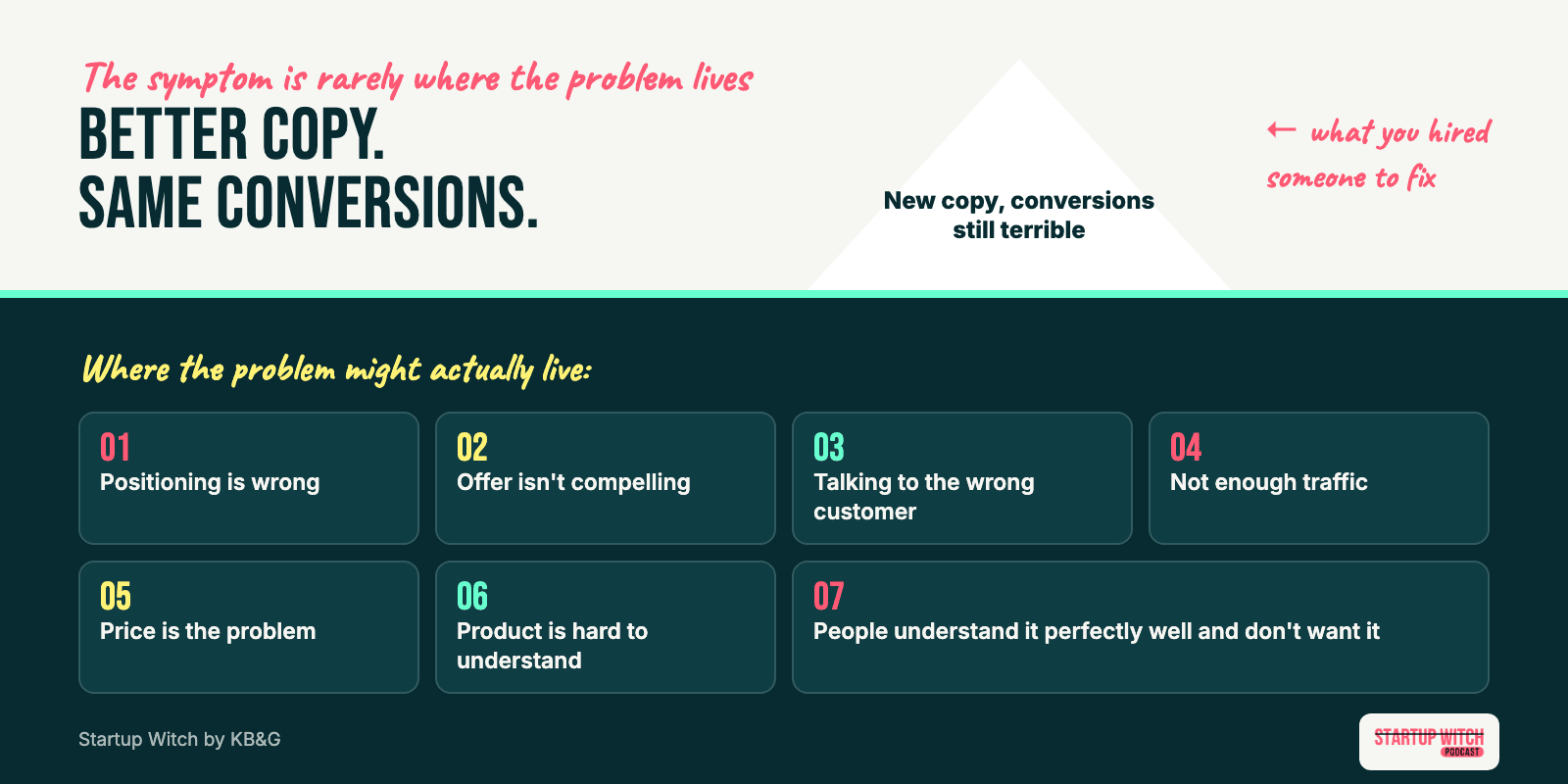
The copywriter can do a very good job and still not change the thing you actually care about.
We notice a symptom and immediately hire someone to fix it. But the symptom is rarely where the problem lives.
Why does hiring someone feel like progress?
Hiring creates a very satisfying feeling that something is happening: a kickoff call, documents, deadlines, a Slack channel. Someone is working. It feels like progress.
But progress is not the same thing as activity.
So before I hire anyone, I try to ask a slightly uncomfortable question: "What should be different in the business because this person did the work?" Not what should be delivered. What should actually be different?
How Do You Write a Freelancer Brief That Starts With the Outcome?
That question changes how you write the brief. Writing a freelancer brief usually starts with a job title. Start with the change instead. Not "I need a copywriter" but "I need more qualified people to understand the value of this product and book a call." Not "I need a designer" but "I need investors to understand the business in the first few minutes of the presentation." Or: "I need people who land on this page to understand what the product is for without someone from our team explaining it."
Then I ask myself:
- What exactly am I trying to change?
- Why do I believe this particular problem is causing the result I'm seeing?
- How confident am I that I'm right?
Why does your confidence matter so much?
When you hire a freelancer, you are often hiring based on a hypothesis: "I think this is the problem, and I think this person can solve it." But most founders treat it as a fact. Then six weeks later, when nothing has changed, they are surprised.
Research suggests this habit matters. In a randomized controlled trial with 116 Italian startups, Camuffo and colleagues (Management Science) trained one group of founders to formulate hypotheses and test them rigorously, while the control group followed its intuition. 19 of 59 treated startups pivoted at least once to a major new idea (about 32%), against 11 of 57 in the control group (about 19%). Founders who tested their beliefs changed direction more readily.
Can a Good Freelancer Still Be the Wrong Hire?
Yes, I've done it myself. Someone can be talented and experienced and still be completely wrong for your situation. Their expertise might solve a different problem. They might need much more direction than you expected. Or they excel at execution but not at figuring out what to execute. Those are very different skills, and an interview won't always show you the difference.
Why doesn't an interview show you how someone works?
We learned this clearly through Georgia. People are usually very good at explaining what they know. Ask "How do you handle a difficult customer?" and you can get a very impressive answer. That doesn't tell you what happens when a real customer says "This is too expensive." Or "I need to think about it." Or "Your competitor is cheaper."
Now there is pressure and incomplete information. You have to listen, decide what matters, respond, and sometimes change direction completely. That is a different skill from describing the right answer.
Research on hiring points the same way. In a reanalysis of selection research, Sackett, Zhang, Berry and Lievens found many common methods predict job performance less well than long believed. In their follow-up in Industrial and Organizational Psychology, estimates came out .21 lower for work sample tests and .19 lower for unstructured interviews than earlier figures, while structured interviews top the list with a mean validity of .42. My reading: no method is magic, and what holds up is built around the actual job and applied consistently. A friendly, open chat is not that.
Should You Interview the Situation or Put the Person in It?
There is a phrase I keep coming back to: we spend a lot of time preparing people for a room that doesn't exist.
The interview room is calm. Everyone has time to think. You ask a question, they answer, you move on. Real work doesn't. A customer gets annoyed, the brief changes, a deadline moves, the information turns out incomplete. And the thing you were very confident about five minutes ago becomes much less clear.
That is where you learn how a person actually works. Not because you caught them out, but because you finally gave yourself something to observe. The point of a freelancer test task isn't to make anyone uncomfortable or to create some ridiculous unpaid assignment. It is to get close enough to the real situation that you can see how they think.
What Does a Good Freelancer Test Task Look Like?
Back to the copywriter. I wouldn't give them a giant unpaid project. I'd give them a small version of the real problem, ideally as a paid trial project:
- Here is the current landing page.
- Here is the product.
- Here is the customer we are trying to reach.
- Here is what is happening right now.
And then I might ask: "What do you think is wrong here, and what would you change first?"
How do you evaluate a freelancer during the test?
I'm not only looking at the copy. I'm watching how they approach the problem:
- Do they immediately start rewriting headlines?
- Do they ask questions first?
- Do they separate what they know from what they assume?
- Do they notice that the problem might be somewhere else?
- Can they explain why they would change one thing before another?
- And, perhaps most importantly, can they say: "I don't know yet. I would need to understand this first."
That can be a very useful answer. I don't need someone confident about everything. I need someone who can tell what they know from what they are guessing. Same for a designer (a real problem, not a generic exercise) and for sales: don't only ask how they'd handle an objection. Give them the objection. See what happens.
How Does Georgia Use Simulation Instead of Advice?
This is what we explore with Georgia, our AI role-play coach built with sector trainers. We don't want another platform where people consume sales advice and feel like they learned something. So instead of reading about objections, you get an objection. Instead of watching someone explain how to sell, you have the conversation, the customer pushes back, and you decide what to do. Sessions are self-paced, 3 to 8 minutes, with coaching in real time. Then you look at what actually happened:
- Did you ask questions?
- Did you listen?
- Did you start defending the price?
- Did you offer a discount too quickly?
- Did you keep talking when the customer had already told you what the problem was?
- Did you change your approach when the first one didn't work?
That's the idea behind Georgia: simulate before real life. Simulation can't perfectly reproduce reality. But a realistic situation reveals things a conversation about it never will.
Is It the Wrong Freelancer, or Did You Skip the Diagnosis?
The uncomfortable part: sometimes when we say "I hired the wrong freelancer," what we actually mean is: "I didn't know how to evaluate the work before I hired them." Those are not the same problem.
Because delegating the work doesn't mean you can delegate the diagnosis. You still need to understand:
- What are we trying to change?
- What do we think is causing the problem?
- What would count as evidence that we were wrong?
- Can we test the person, or the approach, on a small enough scale before making a much bigger commitment?
Freelancers are a normal part of how work gets done: in the United States alone, the Bureau of Labor Statistics counted 11.9 million independent contractors in July 2023, 7.4 percent of total employment.
What is the real cost of the wrong freelancer?
The most expensive freelancer isn't necessarily the one with the highest hourly rate. It's often the person who spends six weeks doing exactly what you asked, only for you to discover it wasn't what the business needed. For a founder, six weeks moving in the wrong direction can cost much more than the invoice.
What Should You Do Before You Hire Your Next Freelancer?
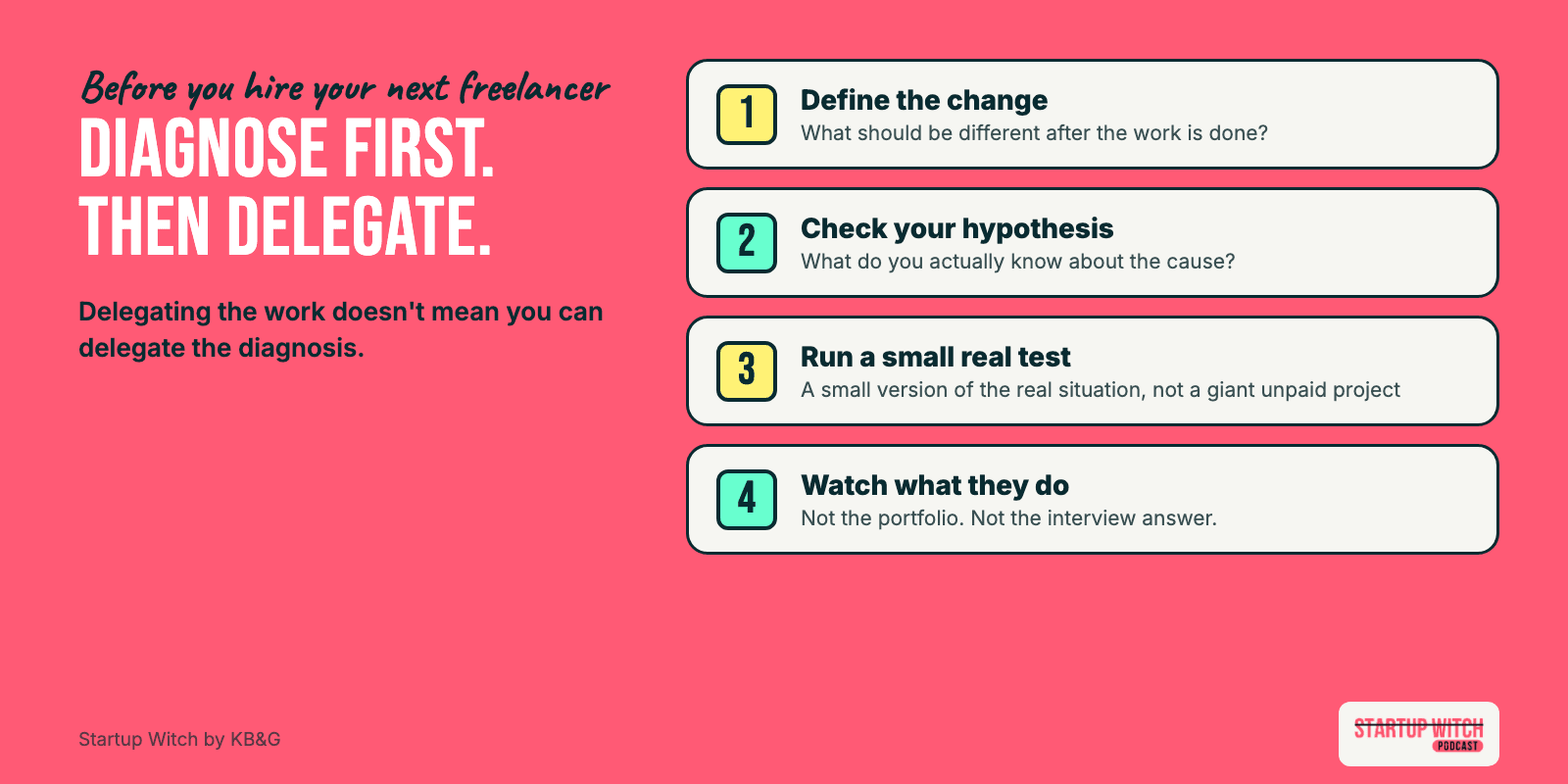
I would start with three things:
- Be very clear about what should be different after the work is done. Not the deliverable. The change.
- Be honest about what you actually know about the cause of the problem. Separate what you know from what you assume.
- Whenever possible, create a small version of the real situation and watch how the person approaches it. Not how well they describe it. Not how impressive their portfolio looks. Not how confidently they answer the interview question. Watch what they actually do.
Portfolio vs interview vs realistic test: what does each actually tell you?
| Method | What it tells you | What it can't tell you |
|---|---|---|
| Portfolio | What someone has done before | Whether that work changed anything, or how they would handle your situation |
| Interview | How they talk about what they have done | What they do under pressure, with incomplete information and a moving brief |
| Realistic test (small, ideally paid) | At least some evidence of how they might behave when the situation is yours | Not everything: a simulation is not reality, but it shows you things a conversation never will |
We hire based on what we can see easily, then spend money discovering what we couldn't see. Making the invisible a little more visible before the stakes get higher is exactly what we care about at Georgia.
So next time, don't only ask "Who is the right person for this job?" Ask "What am I actually trying to change?" and "Can I see how this person works before I commit to the full thing?" It can save you weeks solving the wrong problem. In my experience, that is usually the more expensive mistake.
Watch now: Why Great Freelancers Still Fail Founders?
If you can't say what should change, that is a diagnosis problem, not a hiring problem. The Founder Blind Spot Diagnostic by Startup Witch reads your startup in 14 days and names the one thing blocking growth, so you know what to change before you pay someone to change it. It costs EUR 750 and is fully refundable.
Frequently Asked Questions About Hiring a Freelancer
How do I hire a freelancer without wasting weeks?
Start with the outcome, not the job title. Write down what should be different once the work is done and why you think this problem is the cause. Then test the person on a small version of the real problem first.
Should a freelancer test task be paid?
Wherever you can, yes. A test isn't a way to get a giant project done for free. Keep it small and close to the real situation. You are buying evidence of how they think.
What should I look for when evaluating a freelancer?
How they approach the problem, not only the output. Do they ask questions first, separate knowing from assuming, notice the problem might live elsewhere, and say "I don't know yet" when that's true?