
What Is Sales Role Play Training?
Sales role play training is practising live customer conversations in a safe, simulated environment so reps perform under pressure, not just pass quizzes. It works because it closes the gap between what your reps know and what they actually do when a buyer pushes back, asks about price, or goes silent for three weeks.
This article is for founders and sales leaders at B2B startups and growing companies, including industrial suppliers, who need their sales teams to convert pipeline instead of fumbling through discovery calls. The focus is on conversational selling: discovery, pricing objections, incumbent-supplier pushback, and follow-ups. You won't find generic presentation tips or negotiation theory here.
To set up effective sales role play training: pick 2–3 realistic scenarios from your current pipeline, run short structured drills (5–10 minutes per call), and give specific feedback tied to observable behaviours and real deals.
By the end of this article, you will know how to:
Choose high-leverage scenarios that mirror actual buyer conversations
Structure a role-play session that fits inside a 20–30 minute block
Give feedback that changes rep behaviour instead of inflating egos
Understand where traditional peer role play breaks down and when AI role play fills the gap
Measure whether practice is translating into pipeline progress
Understanding Sales Role Play Training
Sales role play training means two people simulate a sales conversation: one plays the seller, the other plays the buyer. The seller practises specific skills (asking discovery questions, handling objections, setting next steps) and receives coaching on what to change. Role play creates a safe environment for reps to practise and make mistakes before those mistakes cost you a deal.
Knowing the right thing to say is not the same as saying it when a procurement director is pressing you on price or a plant manager tells you they already have a system. Pressure, cognitive load, and the speed of real calls expose every gap that slides and playbooks cannot reach. Reps who ace product quizzes still freeze when they need to adapt in a live conversation.
If your reps are freezing on discovery calls, mishandling "you're more expensive than the other vendor," or sending limp follow-ups, the problem is not knowledge. It is practice.
The Difference Between Knowledge and Performance
Most sales training starts and ends with enablement content: playbooks, slide decks, certification quizzes. These build knowledge. They do not build performance. A field experiment at Lindenwood University compared slide-and-lecture training with a format that added video modelling and role play. The group with role play showed stronger improvements in both skills and retention.
Consider a sales rep who scores 95% on your product quiz. That same rep sits across from a quarry operations manager who says, "We already have a system for that." The rep stumbles, defaults to listing features, and never asks what the manager actually dislikes about the current system. The quiz tested recall. The call tested performance under stress, with a real person pushing back.
Stress, multi-tasking (listening, taking notes, updating CRM), and the unpredictability of buyer reactions all degrade performance. These conditions cannot be replicated in a slide deck. They can be replicated in a role play. Frequent, spaced practice also works against the forgetting curve, and that repetition is what separates reps who sell from reps who present.
For founder-led and early non-founder sales teams, this gap is acute. You cannot afford to wait months for a new hire to "figure it out" on live calls. Repeated, realistic practice is not optional if you want reliable revenue.
Core Elements of Effective Sales Role Play
Every useful role play has five parts:
A clear scenario: a specific buyer persona with industry context, constraints, and realistic time pressure.
A specific learning objective: one skill per session. "Handle pricing pressure from procurement in construction projects" beats "improve objection handling."
A buyer: someone (peer, manager, or AI) who plays the customer and pushes back like a real buyer would.
A seller: the rep practising.
A feedback loop: specific, behaviour-oriented coaching on what worked and what to change.
Measure observable behaviours: how many layered questions did the rep ask? Did they set a clear next step? Did they hold the price line? These are concrete and coachable. "Felt confident" is neither.
Understanding these components is useful, but the real leverage is in which situations you choose to practise.
High-Impact Scenarios for Sales Role Play Training
The answer to "What should my reps actually role play?" is not "everything." It is the handful of conversation types that repeatedly decide whether a deal moves forward or dies. For B2B and industrial sales motions, four scenarios cover most high-stakes moments.
Discovery Calls That Actually Surface Value
A good discovery scenario looks like this: new prospect, 30-minute slot, limited context from an inbound form or a cold outbound reply. The rep has a company name, a job title, and maybe one sentence about the prospect's problem.
Skills to practise in this scenario:
Opening the call crisply and framing a two-sentence agenda
Asking layered questions (Why is this a priority now? How are you handling it today? What does it cost you when it fails?)
Tying answers to business impact: downtime hours, safety incidents, wasted engineering time, lost billable hours
Two concrete scenarios worth building: "First call with a seed-stage SaaS founder evaluating your tool against doing it manually" and "First call with a quarry operations manager evaluating safety tech after a compliance audit." The buyer personas, objections, and language differ. Both test the same underlying skill: surfacing value before talking product.
Ramp difficulty over time. Start scripted, with the buyer following a predictable path. Then remove prompts, add curveballs (the buyer says they only have 10 minutes, or introduces a second stakeholder mid-call), and watch how the rep adapts.
Handling Price and "You're More Expensive" Objections
Price pressure is the moment where most reps either cave or go silent. It is emotionally charged because it feels personal: the buyer is saying your thing is not worth what you are asking.
Set up the role play so the buyer is comparing your AI tool to a cheaper spreadsheet process, or so procurement is asking for "another 20% off to match the other bid." Use real price bands from your own pricing model. If your annual contract is £36,000 and the competitor quotes £22,000, use those numbers. Grounded scenarios produce grounded practice.
Skills to drill: staying calm (silence is fine), asking clarifying questions ("What is driving the comparison to that price point?"), reframing cost as risk reduction or ROI ("If one safety incident costs £50,000 in downtime and fines, what is prevention worth?"), and knowing when to walk away. Price comes up in most B2B deals, so it deserves the most reps.
Responding to "We're Already Working With Another Supplier"
This objection has several variants: "We use vendor X," "We built this in-house," "Our legacy system does the job." Each requires a different response, and the buyer's reasons for sticking with the incumbent differ depending on their role. An operator champion may like the workflow. A CFO may like the sunk cost. IT may like the API integration with existing systems.
Build scenarios that include different stakeholder types with distinct reasons for resisting change. The drill format that works best: the buyer starts neutral-to-negative, and the rep must earn permission to propose a pilot or side-by-side test. Reps practise probing for dissatisfaction ("What would you change about it if you could?"), understanding switching costs, and exploring wedge use-cases instead of going straight into a feature war.
Assigning varied roles in role plays builds empathy. When a rep plays the CFO defending a sunk-cost decision, they start to understand why "but our product is better" is not a persuasive argument.
Follow-Ups and Re-Engaging Stalled Deals
In enterprise and industrial sales, deals stall after demos all the time. The prospect liked what they saw, said "we'll discuss internally," and then went quiet for three weeks. Weak follow-up kills these deals.
Build a scenario: demo went well, the prospect has stopped responding to emails, and the rep has one more shot to re-engage before the quarter ends. Skills to practise: writing and speaking concise value reminders that reference specific discovery notes ("You mentioned the £200K annual cost of mis-dispatched field crews"), asking for a clear yes or no instead of "just checking in," and identifying where the internal process is stuck.
Every drill should close with an action commitment: the rep states what they will do differently on their next real follow-up call.
Key takeaways from scenario selection:
Choose scenarios from your current pipeline, not from a textbook
Repeat the same scenario type across multiple sessions; one pass does not build the skill
Realistic customer scenarios transfer to real conversations; generic ones don't
Once you know what to practise, the question becomes how to run sessions that reps don't dread.
Designing and Running Effective Sales Role Play Sessions
Many teams have done a role play "offsite" that felt awkward and got quietly dropped. The problem was not role play itself. It was sessions that ran too long, lacked structure, and gave vague feedback. Structure, brevity, and clear roles turn role play from a cringe exercise into a weekly habit.
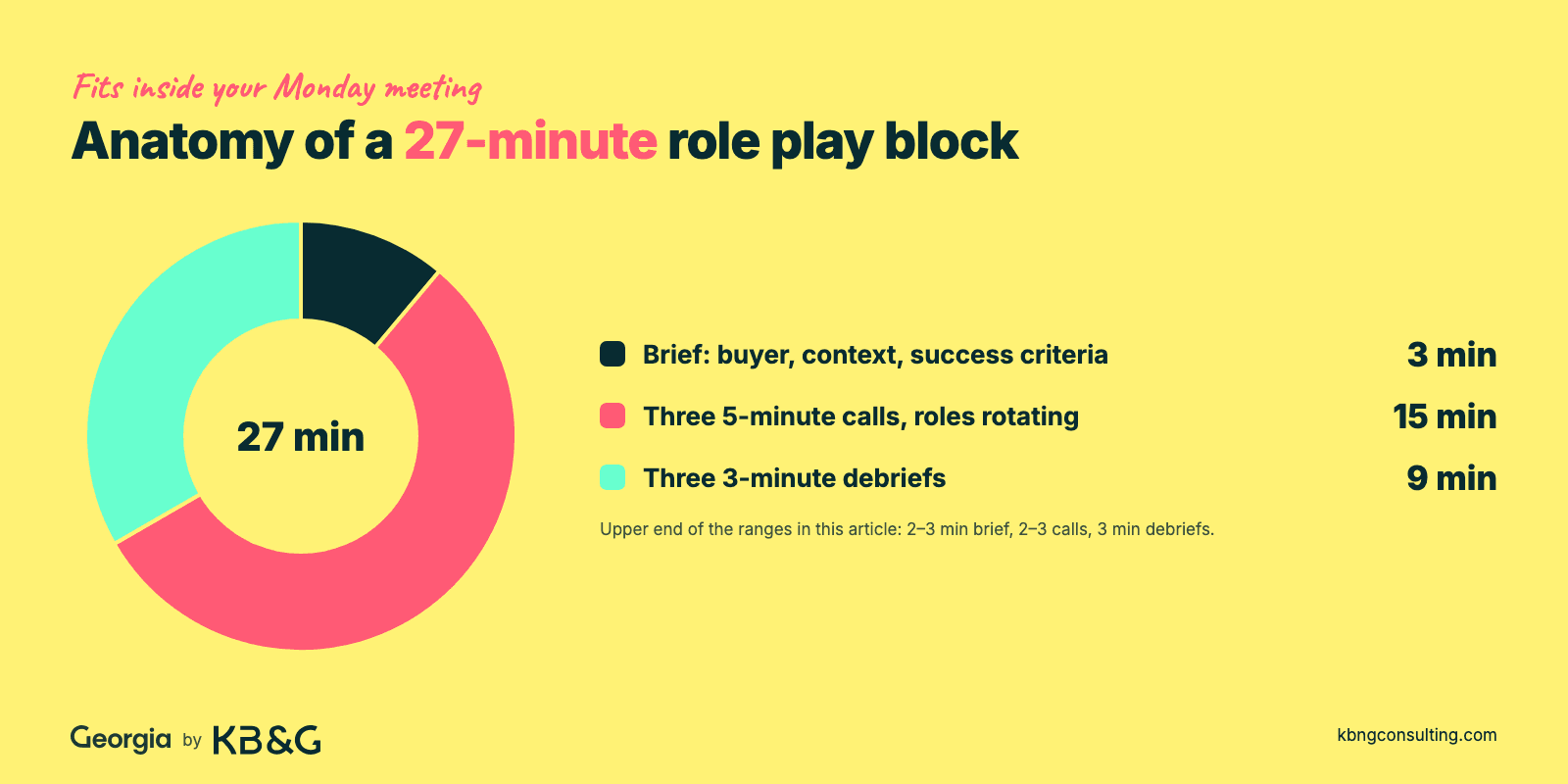
A Simple Structure for a 20–30 Minute Role Play Block
Use this structure inside an existing meeting: a weekly team standup, a Monday forecast call, or a pre-pipeline review. Do not add a new meeting.
Pick one scenario and one skill focus (e.g., "handle 'you're too expensive' without discounting"). One skill per session.
Brief the group in 2–3 minutes on context, buyer type, and success criteria. "The buyer is a procurement lead at a mid-size manufacturing company. They've received a cheaper quote from a competitor. Success means asking at least two clarifying questions before discussing price."
Run 2–3 short calls, 5 minutes each, with rotation of seller and buyer roles. Rotating roles matters: playing the buyer builds empathy for how buyers actually think.
Debrief each call for 3 minutes, focusing on 2–3 observable behaviours. Not everything. Not "general impressions." Specific actions.
The rhythm of weekly, short, focused practice builds the muscle memory and confidence that a quarterly half-day workshop can't.
Coaching and Feedback That Actually Changes Behaviour
Role play gives reps immediate feedback, but only if the feedback is specific. "That was great" is not feedback. "You asked two why-questions before mentioning price, which gave you the information to reframe the objection" is feedback.
A simple framework for the person giving coaching:
What worked: one concrete behaviour. ("You paused after the objection and asked what was driving their price sensitivity.")
What to try differently: one or two specific changes. ("Next time, tie the cost back to the safety incident they mentioned in discovery before offering any discount.")
What to keep on a live call: one thing worth repeating with a real customer.
Avoid turning the debrief into a manager monologue. Avoid letting peers soften everything into vague positivity. Use real talk tracks from existing deals so the coaching is immediately reusable on the rep's next call.
If reps consent, record drills so they can watch their own performance and self-correct.
Group, 1:1, and Self-Practice: When to Use Each
Three modes of practice serve different purposes.
Group role play builds shared norms and lets the team watch each other handle pressure. The downside: social pressure makes some reps hold back. The shared standards are worth the initial discomfort.
Manager-rep 1:1 practice allows deeper coaching tailored to individual gaps. The downside: it consumes manager time. A sales manager running 1:1 drills with eight reps every week may not have the hours.
Self-directed drills (including AI role play) give reps volume and privacy. A rep can practise the same objection five times in a row without anyone watching. The downside: without structure, self-practice can reinforce bad habits.
The best results come from blending all three: group sessions for team norms, 1:1 for individual development, and AI or self-practice for daily reps. Most teams that struggle with consistency are relying on only one mode.
Traditional Peer Role Play vs AI Role Play
In most sales teams, peer role play is occasional, awkward, and inconsistent. Plenty of sales leaders say role play matters; far fewer run it every week. The gap between belief and practice is not because role play is bad. It is because the traditional format is hard to sustain.
AI role play makes practice frequent, private, and realistically varied without consuming a manager's entire week.
Where Classic Peer Role Play Falls Short
Four problems recur in peer-led training sessions:
Peers do not behave like real buyers. They know the script, they are polite, and they default to easy objections. A colleague playing a procurement director does not push back the way an actual procurement director does. The scenario drifts, becomes unrealistic, and the rep practises handling a conversation that will never happen.
Feedback is inconsistent. One peer says "good job," another flags a missed question, a third comments on tone. Without a rubric, feedback becomes noise.
Social pressure reduces risk-taking. Reps feel silly. They hold back from trying new responses because they do not want to look bad in front of colleagues. The psychological safety that makes role play useful erodes when the audience is your team.
Time does not scale. A manager running 10 quality role plays for 10 reps every week needs hours that do not exist. Sessions get cancelled, rescheduled, or shortened to the point of being useless.
The impact: patchy practice, uneven standards across the team, and some reps opting out entirely.
What AI Sales Role Play Can Do Better
AI role play works like this: a conversational AI plays the buyer, follows a scenario you configure, pushes back on the rep's responses, and then gives instant feedback on specific behaviours.
Because the buyer is always available, reps can practise between meetings, before a big call, or at the end of the day. And because the scenario is configured once, every rep faces the same buyer and the same objections.
Peer vs AI Role Play at a Glance
Criterion | Peer Role Play | AI Role Play |
|---|---|---|
Availability | Limited to scheduled sessions | Available anytime; reps practise between meetings |
Consistency of buyer behaviour | Varies by who plays the buyer; drifts from the brief | Same buyer personas, same objection intensity each time |
Psychological safety | Social pressure from colleagues watching | Private; reps can fail without an audience |
Ability to scale | Constrained by manager and peer availability | Scales to any team size without adding headcount |
Data and analytics | Rarely tracked; feedback is verbal and forgotten | Tracked per rep; shows skill gaps across the team |
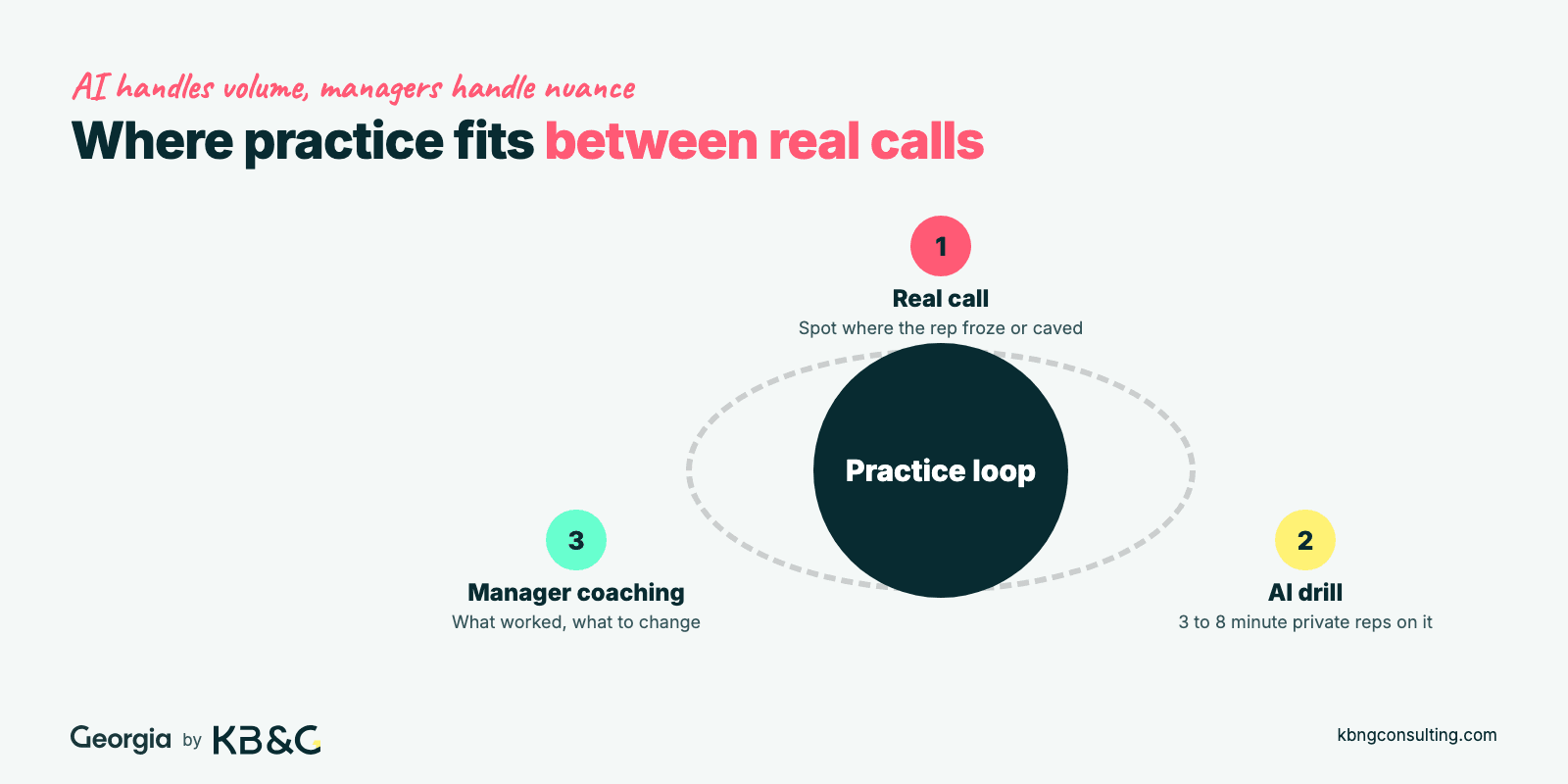
Lean on AI for daily drills, onboarding at scale, and deal-specific prep. Keep human-led sessions for complex enterprise deals with multi-stakeholder dynamics, for team rituals that build shared standards, and for coaching that requires reading the room. AI handles volume. Sales managers handle nuance.
Implementing Sales Role Play Training in Your Team
Many teams either over-engineer a full "sales academy" or run ad-hoc sessions that fizzle after two weeks. Neither works. What follows is a lean, staged rollout that a founder or sales leader can start next week.
Step-by-Step Plan to Roll Out Role Play in 30 Days
Week 1: Choose 3 core scenarios from your last quarter's pipeline. Pick one discovery call, one pricing objection, and one stalled deal. Pull from real lost deals, stalled opportunities, and objections from call transcripts.
Week 1: Define success criteria for each scenario. Write 3–5 observable behaviours per scenario (e.g., "Asked at least two why-oriented questions before discussing product," "Set a specific next step with a date and owner").
Week 2: Run a pilot with founders and 2–3 frontline reps. Collect feedback on whether the scenario felt realistic and whether the difficulty was right. Adjust the buyer persona based on what your reps and customer-facing employees report from real conversations.
Week 3: Add role play blocks to existing team rituals. Replace 15–20 minutes of a Monday forecast meeting or Friday retro with a focused drill. Do not add a new meeting.
Week 4: Introduce AI role play or self-recorded drills for daily practice between live sessions. This is where reps get volume without burning manager time.
Treat this as an experiment. Adjust based on rep engagement and whether you see progress on specific deal outcomes. Four weeks is enough time to see whether the format sticks.
Measuring Whether Role Play Is Actually Working
"Everyone liked the workshop" is not a success metric. Track behaviours and business outcomes.
Behavioural metrics:
Discovery questions per call (count them from recordings or transcripts)
Frequency of clear next steps set at the end of calls
Ability to hold price line without defaulting to discounts
Business metrics:
Conversion from first meeting to opportunity
Win rate for opportunities where pricing objections occurred
Ramp time for new hires to first closed deal
Link your role-play focus to current bottlenecks. If deals die after proposal, run scenarios around proposal review calls. If discovery-to-opportunity conversion is low, drill discovery. Correlation will take a few cycles. Keep basic logs of who practised what, and compare their call outcomes to the baseline.
Common Sales Role Play Challenges and How to Fix Them
Every team hits friction the first time they try to make role play a regular habit. These are the predictable problems and their fixes.
"My Reps Hate Role Play and Say It's Awkward"
Start with short, tightly framed scenarios: 3–5 minutes, not 20. Avoid public scoring in the first two weeks. Have the manager or founder go first to model vulnerability; if leadership is willing to stumble through a drill, reps follow.
Make every role play linked to an upcoming real call. "We're practising this because you have a call with a procurement lead at a construction company on Thursday" feels relevant. A generic "let's practise objection handling" feels theatrical. Role play prepares reps for high-pressure conversations only when those conversations map to their actual pipeline.
"We Don't Have Time for This"
Replace part of an existing meeting with focused drills. Fifteen minutes of a forecast call, repurposed for one role play and debrief, costs no extra time. If your team meetings already run over an hour, cutting status updates to make room for practice is a net improvement.
For volume beyond live sessions, async AI or self-recorded practice lets reps get reps in without adding to the manager's calendar.
"Our Scenarios Don't Feel Like Real Conversations"
Pull scenarios from real pipeline data. Lost deals, stalled opportunities, and objections lifted from call transcripts or emails are the raw material. Involve one or two frontline reps and, if possible, a customer success or operations person to co-design realistic buyer behaviour. They know what buyers actually say.
A scenario built from a textbook teaches textbook responses. A scenario built from your last lost deal teaches responses that matter.
"Managers Give Inconsistent or Vague Feedback"
Create a simple feedback rubric: 3–5 behaviours per scenario, each scored on a clear scale (did it / partially did it / did not do it). Train sales managers to stick to the rubric during the debrief.
Record some sessions (with consent) so managers can calibrate with each other. When two managers score the same drill differently, the recording makes the disagreement concrete and resolvable. AI tools can also help standardise scoring and surface patterns across reps.
How AI Role Play Fits Into a Modern Sales Training Stack
AI role play is an amplifier for human coaching, not a replacement. It solves for volume, consistency, and privacy of practice. The ideal workflow: reps alternate between real calls, AI drills, and manager coaching. Scenarios update as your messaging, buyer personas, and ICP evolve.
Daily Drills, Onboarding, and Deal-Specific Practice
Three core use cases for AI role play in a B2B or industrial sales team:
Daily micro-drills (3–8 minutes) on a single behaviour: asking layered discovery questions, responding to "you're too expensive," or re-engaging a stalled deal. Short sessions, done daily, build the muscle memory that weekly workshops cannot.
Onboarding paths where new hires must pass specific scenarios before owning certain types of calls. Instead of shadowing for weeks and then being thrown into live calls, a new rep practises discovery, price objections, and follow-ups until they demonstrate the target behaviours.
Deal prep before high-stakes calls. Before a procurement review or a safety committee meeting, a rep rehearses with a simulated buyer who mirrors the real person they are about to talk to. Think of it as a flight simulator: reps crash in practice, not with your biggest prospect.
A longitudinal field study at a large industrial firm with roughly 2,000 salespeople found AI role-play intervention increased overall job performance by about 2%. Effects were larger among reps with lower baseline performance and those with supervisors who had a narrow span of control. AI makes practice possible at scale; strong coaching makes it stick.
Georgia by KB&G is built for exactly this kind of practice. It's an AI role-play coach built with sector trainers, where reps practise real sales conversations (holding price, handling price objections, answering "the other supplier is cheaper") in self-paced 3 to 8 minute sessions with real-time coaching, so practice becomes a weekly habit rather than an occasional event.
Conclusion and Next Steps
Sales performance in real conversations is built through targeted, repeated, realistic practice. Slides build knowledge. Role play builds the ability to use that knowledge when a buyer pushes back, goes quiet, or tells you the other company is cheaper. The gap between knowing and doing closes only with deliberate, structured repetition.
Here is what to do this week:
Choose one scenario to pilot (e.g., "you're too expensive") from your current pipeline.
Draft 3–5 success behaviours and a simple feedback rubric for that scenario.
Schedule a 20-minute role play block in your next team meeting, replacing status updates.
Identify where AI role play could add daily practice without creating extra meetings.
Role play connects directly to the things that decide whether your company grows: founder-led sales that convert, shorter ramp time for new hires, and a repeatable sales motion that holds up when you are raising capital and need to prove your team can sell without you in the room.