
How Do You Train a Sales Team?
You train a sales team by writing down what you actually do in deals, turning it into a simple playbook, and then drilling it through practice (role-plays, call reviews, live coaching) and consistent measurement. If you're a founder or early leader of a B2B startup who can close deals yourself but can't get your reps to sell the same way, this article is your operating manual.
This guide focuses on early-stage B2B sales teams (0–20 reps), founder-led or founder-adjacent. It's not about enterprise-wide sales academies, generic corporate training programs, or large enablement departments. It's about the messy, high-stakes phase where your company needs to prove that revenue can happen without you on every call.
To train a sales team, you need a simple, written playbook and a training rhythm based on practice, real call coaching, and a few hard metrics like win rate and ramp time.
Here's what you'll walk away with:
How to capture your own sales moves and turn founder instincts into documented patterns
How to build a first version of a sales playbook in a week
How to design training sessions centered on practice over presentations
How to coach on live deals rather than abstract skills
How to track whether your sales training is actually working
Understanding What "Training a Sales Team" Really Means
Training a sales team in the early stages doesn't mean building a slide deck about your product and walking employees through it. It means installing a repeatable way of selling: one that scales beyond your personal involvement and helps the team reach its full potential. You're turning tacit deal behavior (what you actually do on calls, in follow-up emails, in negotiations) into teachable, repeatable skills that sales professionals can learn and apply.
This matters urgently for pre-seed to Series A SaaS and AI startups because founders need revenue generation to become repeatable rather than staying dependent on their direct involvement. Investors expect that founder-led revenue can become team-led revenue. That transition, from "the founder closes everything" to "the team closes consistently", is what reduces risk in the eyes of investors. Without it, you can't scale.
Skill Transfer vs. Headcount Growth
Skill transfer means capturing and teaching what you do: discovery, qualification, framing value, pricing, closing. It's the difference between hiring more sales reps and actually making them effective.
Without skill transfer, adding headcount just amplifies problems. Reps pitch product features rather than solving buyer problems. They over-discount because there's no negotiation framework. They chase low-probability pipeline because qualification is inconsistent. Deals stall because reps don't know how to influence decision makers or build internal champions.
The result? Your costs explode. You end up on every critical call. Customer acquisition costs rise because low-win deals pile up. Your calendar fills with "just hop on this one call with me" requests, and your ability to focus on anything else evaporates.
Enablement vs. Activity
Sales enablement means providing the minimum content, tools, and rituals your reps need to perform well: talk tracks, email templates, qualification frameworks, conversation guides.
Activity is volume: number of calls, outreach sequences, team meetings, demos booked. Early teams often mistake more activity for better training. But activity without enablement is dangerous. It burns leads, burns reps, and produces inconsistent outcomes. More calls from an untrained rep just amplifies weaknesses faster.
Effective sales training must start with mapping what works now. Only once you know what you actually do in deals can you build enablement that supports good behavior rather than bad. That's where we start.
Capture What You Actually Do in Deals
The first move in training a sales team is to externalize your own sales behavior. Turn the messy reality of your recent deals into a simple map others can follow. This isn't a glossy playbook PDF you'll never update. It's a working draft that captures how you actually sell, not how you think you sell.
Write Down a Simple Deal Narrative
Pick 5–10 recent closed-won deals and 5–10 painful near-wins from the last 12–18 months. Include pilots that stalled, prospects who went dark after a promising conversation, and deals where the buyer's expectations shifted mid-process. You want a mix that reflects your current market and product maturity.
For each deal, document:
Who was the buyer (persona, organization, seniority)
What problem they believed they had and the specific challenges they said they were facing
What messages made their eyes light up
Where the deal got stuck (objections, internal approvals, procurement, or outside factors such as competition)
How the deal resolved, and what the buyer's actual decision criteria turned out to be
Use plain language. Avoid sales jargon. Keep each narrative to one page so it's usable by reps, not just interesting to you. Ground these narratives in what actually happened, not what you wish had happened.
Extract the Key Conversations
Look across those narratives and identify the 3–5 critical conversations that show up in most of your deals. In B2B AI/SaaS, these typically include:
First discovery: scoping pain, goals, and whether there's a real business problem worth solving
Technical or pilot deep-dive: data, integration, safety, feasibility
Business case and pricing: ROI, scale, cost savings
Internal champion preparation: helping your buyer sell internally to stakeholders
Closing and next-step commitments: proposal, approval, procurement
For example, if you're selling an AI pilot to an industrial buyer, your key conversations might include discovery with an operations manager, a safety team review, a pilot design session covering site implementation constraints, and a pricing conversation that accounts for scale across multiple locations.
These conversations become the backbone of your training plan, and the specific scenarios you'll later role-play.
Clarify Who Your Real Buyer Is
Define 2–3 buyer personas based on your actual paying customers or near-wins. Not theoretical ideal customer profiles: real people who've bought from you or nearly did.
For each persona, capture:
Role and seniority (e.g., VP of Operations, Head of Data, Safety Director)
Goals (efficiency, cost reduction, regulatory compliance, competitive advantage)
Risks and objections they care about (data privacy, vendor stability, implementation complexity)
What "success" looks like to them (reduced downtime, better visibility, measurable ROI)
How they buy: procurement cycles, internal champions, multiple stakeholders, pilot-to-rollout transitions
Once you've captured these narratives and buyer types, you're ready to turn them into a lightweight, practical sales playbook your team can train on.
Turn Your Deals into a Simple Sales Playbook
Your playbook is a field manual, not an encyclopedia. A new AE should be able to read it in one sitting and apply it on their next 10 calls. It should live in your CRM or a shared doc your team actually opens, not buried in a Notion page nobody visits.
The playbook becomes the core asset around which all training sessions, coaching, and evaluation are built.
Outline Your Sales Stages and Exit Criteria
Define 5–7 clear stages that reflect how your deals actually move. A typical early-stage B2B/AI pipeline looks like:
Prospecting / Targeted
First Conversation
Qualified Opportunity
Pilot / POC Design
Commercial Proposal
Verbal Commit
Closed-Won / Closed-Lost
Each stage needs 2–3 concrete exit criteria tied to observable buyer behavior. "Economic buyer identified" is a good criterion. "Felt like a good call" is not. For industrial and AI pilots, include nuances like "site visit completed," "data access agreed in principle," or "internal risk review scheduled."
Clear stage definitions are also what let you tie training objectives to measurable business outcomes such as win rate, because you can see exactly where deals stop moving.
Create Conversation Guides, Not Scripts
For each key conversation (discovery, demo, pilot scoping, pricing, expansion), create a one-page guide that includes:
Objective of the call (e.g., uncover the business cost of the problem, align on pilot success metrics)
6–10 high-quality questions: open, problem-oriented, ROI-driven
3–5 red flags to listen for (signals the deal might be low priority, misaligned expectations, no budget)
A simple agenda to say out loud at the top of the call
These are prompts, not word-for-word scripts. Scripts feel unnatural and discourage adaptation. Guides help reps get into your voice while allowing personalization. Make sure your guides address the objections you've seen repeatedly in your deal narratives.
Document Your Pricing and Negotiation Rules
Write down:
Standard price points
Minimum acceptable pricing
When and how discounts are allowed
Who approves what (and at what thresholds)
3–5 preferred trade-offs (e.g., discount only in exchange for multi-site rollout, prepayment, longer contract term, or case study rights)
Clear pricing rules reduce panic discounting and build confidence for new reps, especially when selling to large industrial buyers with strong procurement teams who negotiate for a living. This is where many early sales teams lose money they didn't need to lose.
Once the playbook is drafted, the real training happens through practice, not presentations.
Train Through Practice, Not Slides
Most early-stage teams default to a half-day onboarding, a Notion link, and a hope that product knowledge alone will make reps productive. It won't. Sales training works through realistic practice, coaching, reinforcement, and measurement, not slide decks.
The core of effective training is repeated practice in safe environments: role-plays, call reviews, and shadowing, rolled into a weekly rhythm your team can sustain.
Design Weekly Role-Play Sessions
Run 30–45 minute sessions weekly. Keep groups small: 2–3 reps per session. Each rep picks a realistic scenario from their actual pipeline or from your deal narratives. Rotate roles: seller, buyer, observer. Debrief with specific behavioral feedback after each round.
Keep each individual round short so everyone gets several turns. Draw scenarios from your earlier deal narratives so practice matches the real market: an AI pilot objection from a skeptical operations director, a pricing pushback from procurement, a champion who needs help building an internal business case.
Focus each session on one or two skills. Trying to improve everything at once improves nothing. Research on role-play design suggests that starting with simpler scenarios and building complexity accelerates selling-skill development. Feedback during role-play must be specific and actionable: "you asked about budget before establishing the problem" is useful; "that was okay" is not.
Use Call Reviews as a Training Engine
Pick 1–2 recorded real calls each week. Listen to 10–15 minute excerpts as a team. Pause to discuss what worked and what didn't, using your playbook as the reference frame.
Evaluate discovery quality, qualification rigor, value framing, closing behavior, and how objections were handled. Start with the founder's own calls so reps see the baseline. Then gradually layer in team calls as skills improve.
Live examples give credibility. Reps see concrete application of the playbook principles. Deviations get surfaced and corrected in context, not in theory.
Shadowing and Reverse Shadowing
Standard shadowing: New reps spend their first 2–3 weeks watching you or a senior rep run live calls. Assign a focus for each call: how you open, how you handle a bad-fit prospect, how you navigate a multi-stakeholder conversation.
Reverse shadowing: After reps start running their own calls, you silently join and observe, then debrief immediately with targeted feedback. This prevents drift and accelerates improvement.
Time-box both. Shadowing belongs in the first 30–60 days of a new rep's ramp. The goal is to build competence and confidence, not to create a permanent dependency where you're on every call forever.
Sales Coaching on Real Deals, Not Abstract Skills
The fastest way to make training stick is to anchor it in live deals your team cares about right now: this month's pipeline, next quarter's targets. Once a basic playbook exists, coaching becomes the manager's or founder's main leverage point.
Turn Pipeline Reviews into Coaching Sessions
Your weekly pipeline review shouldn't just be "stage and amount." It should be "what's the next conversation, how will you run it, and what commitment are you aiming for?"
For each key deal, ask coaching questions: How will you open? What questions will you ask? What objections do you expect, and how will you respond? What's the specific next step you'll push for?
Document one or two commitments from each review ("rep will test the new pricing frame on Thursday's call," "rep will ask the economic buyer questions by next meeting") and follow up the following week. This keeps training connected to real outcomes rather than abstract techniques.
Give Feedback in the Right Format and Cadence
Feedback should be specific, behavior-based, and tied to outcomes. "You jumped to demo after just one qualifying question, so the buyer never voiced their budget constraints" is useful. "That was messy" is not.
Use a simple formula: what you saw, the impact on the deal, what to try differently on the next call. This kind of in-the-moment feedback also serves as a lightweight, ongoing assessment of whether the training is landing.
For early teams, the right cadence is: brief feedback after key calls, deeper coaching weekly, and a more structured skills review every 4–6 weeks. Ongoing coaching is what turns initial training into permanent behavior change.
Personalize Coaching by Rep Profile
Not every rep needs the same coaching:
Junior SDRs: Focus on discovery, listening, qualifying. Help them slow down and ask better questions before pushing for next steps.
Experienced hustlers: They might skip discovery entirely. Coach them on stakeholder alignment, internal selling, and negotiation strategies.
Mid-level AEs in industrial/AI domains: Multi-threading, risk management, procurement navigation, scale stories, and handling safety and regulatory objections.
Use each rep's strengths as starting points. Identify what they do well and build around that rather than trying to make everyone identical. To know whether all this coaching and practice is working, you need to measure a few key metrics and reinforce over time.
Reinforce Over Time: Knowledge Fades Without Practice
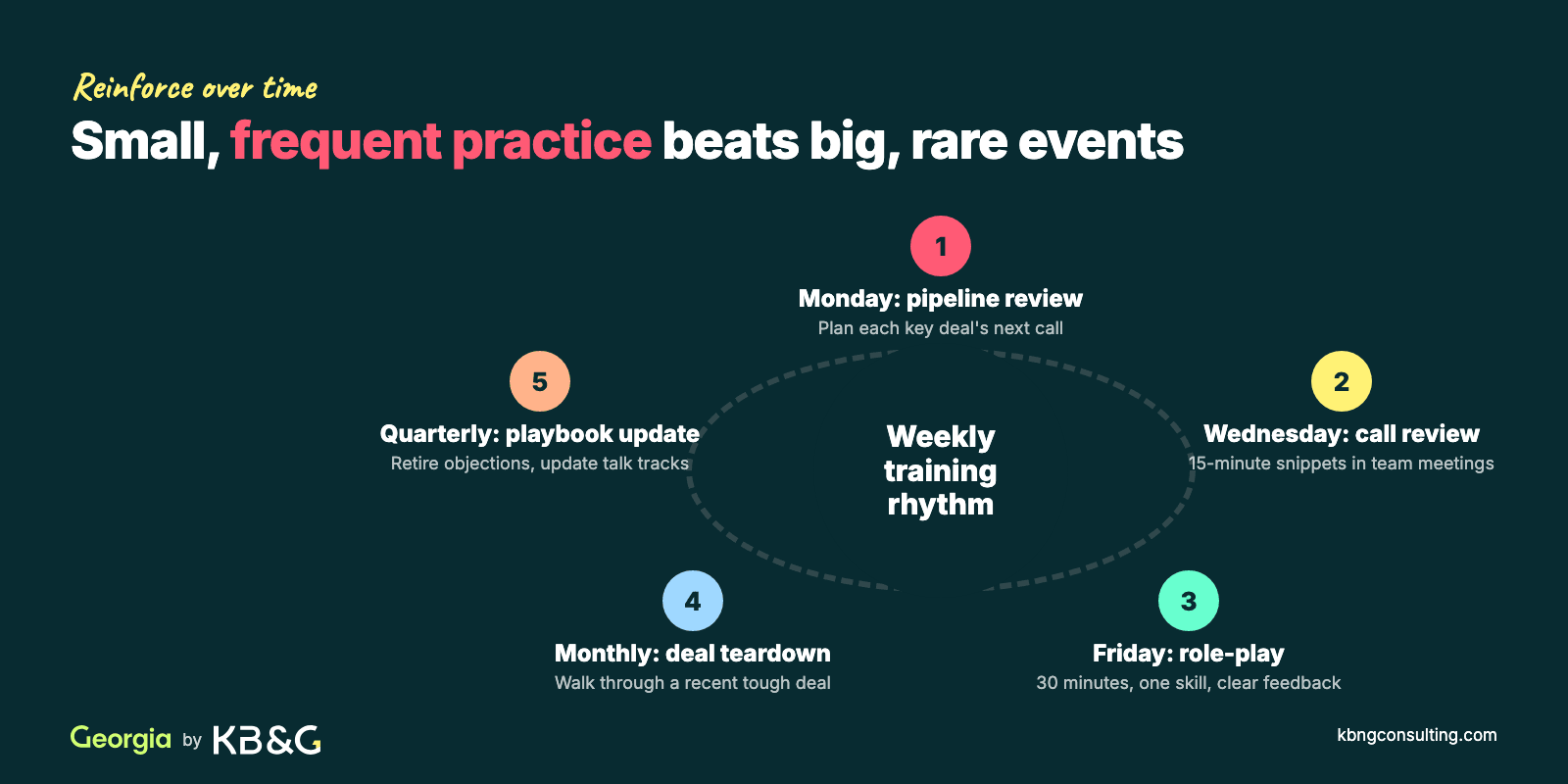
Without repeated use, even well-taught skills fade within weeks. This isn't speculation: the forgetting curve describes how recall drops steeply without review. The principle is simple: small, frequent practice beats big, rare events.
Effective sales training is a continuous rhythm rather than a one-time onboarding event. Training must be built into ongoing rituals, not treated as a quarterly workshop or annual kickoff.
Build Training into Weekly Rituals
Embed short practice blocks into rhythms your team already follows:
Monday: Pipeline review and planning
Wednesday: Call review snippets (15 minutes at the start of team meetings)
Friday: Role-play block (30 minutes, focused on one skill)
Monthly: Deal teardown lunch: walk through a recent tough deal as a team
Consistency matters more than intensity. These recurring sessions also create natural moments for reps to learn from each other. Complement live sessions with shared recordings and written guides reps can review on their own time.
Update the Playbook as the Market and Product Shift
In AI and industrial SaaS, messaging, pricing, and buyer objections evolve quickly. Regulatory changes, new competitors, shifting buyer expectations: your playbook needs to keep pace.
Set a quarterly cadence: review win–loss notes, update talk tracks, retire objections that no longer come up, and revise pricing rules. Involve 1–2 top-performing reps in these updates so the playbook reflects field reality, not just founder theory. When reps help build the playbook, they own it. When they own it, they use it.
Scaling Training as the Team Grows
You own training until headcount passes 5–10 reps. After that, consider bringing in a sales enablement or training lead to run the program. But the foundation you've built (the playbook, the weekly rhythms, the coaching cadence) is what makes that hire productive from day one.
Start documenting now: record training sessions, store role-play scenarios, create a simple onboarding path with milestones for days 30, 60, and 90. Build recognition for good deal behavior into your process early; it scales better than you'd expect.
This foundation also makes future investments in enablement tools and AI coaching far more effective, because you'll have clear scenarios, proven talk tracks, and established evaluation criteria to plug into any platform.
Measure Whether Your Sales Training Is Working
If you can't see training impact in numbers, it's just theater. Founders need a tight feedback loop between training effort and sales outcomes, built on business metrics such as win rates and pipeline velocity. The focus here is on a small set of metrics that are realistic for early-stage teams to track.
Core Metrics to Track
Track these monthly or quarterly:
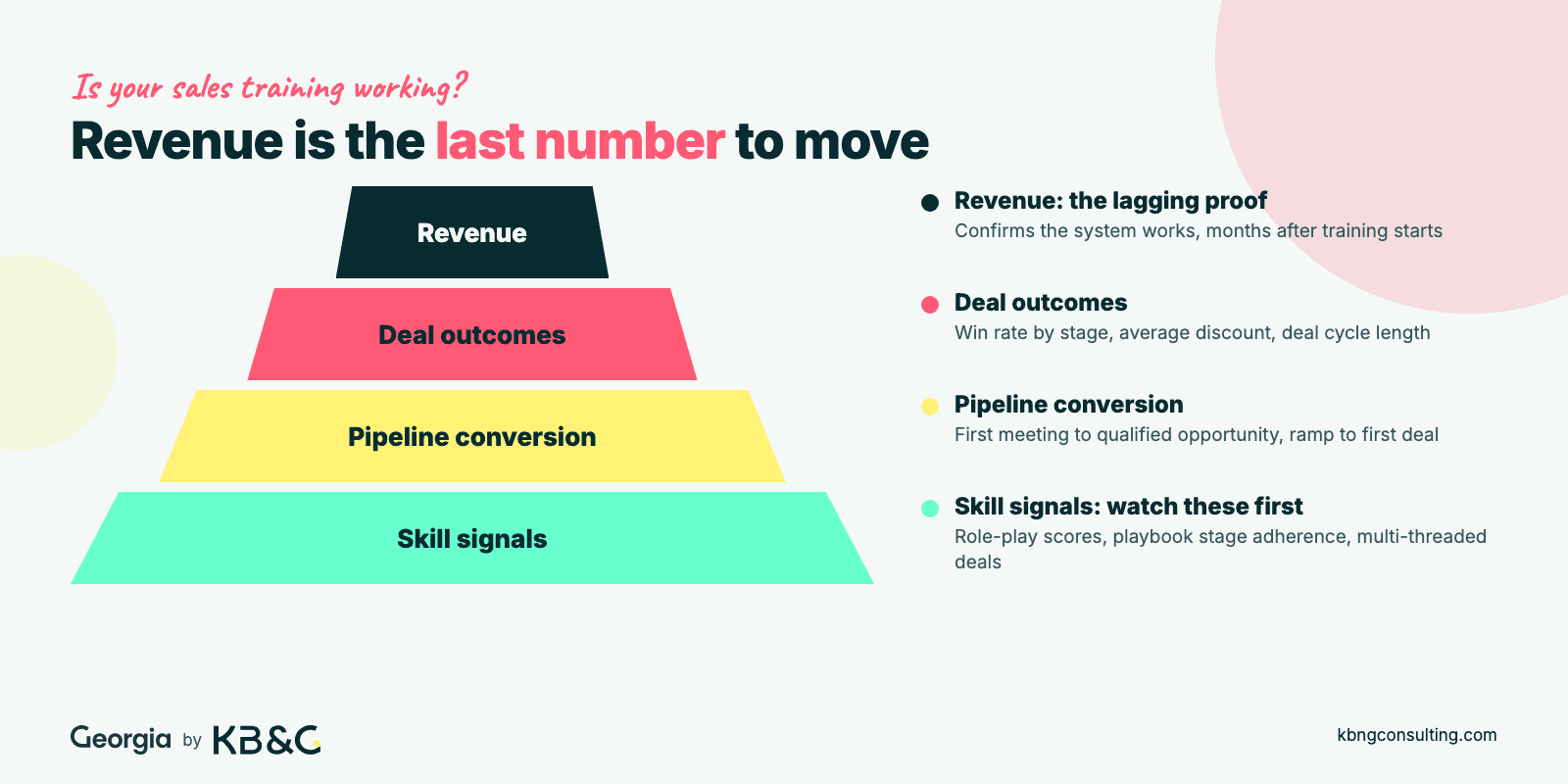
Win rate by stage: Track conversion at each stage (opportunity qualified → pilot → close) so you see exactly where deals drop off. Compare against your own baseline before training rather than against someone else's benchmark.
Average discount level: How much are reps discounting, under what circumstances, and how does that change after training?
Ramp time to first productive deal: For new reps in complex B2B/AI sales, expect this to take months, not weeks. A clear playbook plus intensive coaching is the main lever you control to shorten it.
Conversion from first meeting to qualified opportunity: This directly reflects how well discovery and qualification skills are working.
Deal cycle length: From first conversation to close. Monitor how training reduces unnecessary delay.
Each metric should be tied explicitly to elements of training. Better discovery shows up as higher first-meeting-to-opportunity conversion. Better negotiation training shows up as lower average discounts.
Leading Indicators of Skill Improvement
Revenue is a lagging indicator. You need faster signals:
Role-play scores on a simple 1–5 scale (discovery quality, value framing, asking for next step)
Adherence to playbook stages in CRM data
Frequency of multi-threaded deals (engaging multiple stakeholders)
Reduction in "no decision" outcomes
Clarity of documented next steps after each call
Use these scorecards in both role-plays and call reviews. They help you see if a new hire is on track within the first 30–60 days, before the revenue numbers arrive, and they tell you exactly where the performance gaps are.
Diagnosing When Training Isn't Working
When metrics stagnate or worsen, diagnose the root cause:
High outreach and meetings but low conversion to opportunities → messaging or qualification problem. Reps aren't connecting with buyers on the real problem.
Strong discovery meetings but low proposals or verbal commits → pricing, value framing, or internal champion-building issue. The deal isn't advancing because the business case isn't landing.
Pipeline builds but deals leak at late stages → competitive positioning, procurement navigation, or negotiation skills need work.
Common root causes include: a playbook that doesn't reflect reality (outdated or too theoretical), training that's inconsistent (practice gets dropped when things get busy), or the wrong rep profile for your buyer complexity. Once you have this system working, you can amplify it with tools that increase practice volume without burning manager time.
Using AI Role-Play to Scale Sales Training
AI can serve as a practice partner that gives reps more "at-bats" without requiring a manager on every session. It's not a replacement for the coaching and practice model described above. It's an extension that lets you scale what's already working.
What AI Role-Play Can Do for Your Team
AI role-play tools can simulate realistic buyer personas, objections, and deal contexts aligned with your actual playbook: safety managers raising integration concerns, procurement leads pushing for discounts, operations directors skeptical about AI reliability.
Reps can run short practice conversations focused on specific skills (discovery, objection handling, pricing) between live calls. The practice environment is where the biggest training benefits emerge, because reps can rehearse a hard conversation several times before they face it with a real buyer.
A longitudinal field study across nearly 2,000 salespeople found that AI role-play interventions improved job performance on average, with larger gains for reps with lower prior performance. The benefit is especially clear for distributed or fast-growing teams where manager time is severely constrained.
Common Training Mistakes Founders Make (and How to Avoid Them)
Most founder-led teams repeat the same few errors when trying to train a sales team for the first time. Use this as a quick diagnostic checklist against your current approach.
Dumping Information Instead of Building Skills
The pattern: long onboarding decks, product deep-dives, marketing collateral dumps, and zero practice. Reps can recite features but can't run a discovery call. Product knowledge without application is just trivia.
The fix: Cut slide time in half. Double role-play time. Attach every piece of product knowledge to a real conversation scenario: "when the buyer raises this concern about data integration, here's how that feature becomes relevant." This is the difference between information transfer and skill building.
Over-Relying on "Natural Sellers"
Early teams often lean on 1–2 charismatic reps without building a system. Revenue depends on individuals, not processes. If those reps leave or burn out, performance collapses. This makes your business fragile and nearly impossible to scale.
The fix: Codify what those top performers do differently. Study their calls. Extract their techniques. Bake their insights into the playbook and training so new hires don't have to be unicorns. Ultimately, organizations that prove their sales process works independent of any single person are the ones that scale.
Training Once and Expecting Permanent Change
Many startups run a big kickoff or bootcamp, often at the start of a funding round, and treat it as "job done." But forgetting curves and shifting markets mean that even excellent training decays without reinforcement.
The fix: Commit to the weekly rhythms described earlier. Decide in advance what will stop if time gets tight, so training doesn't get quietly dropped. Teams that keep a consistent practice rhythm keep improving. The ones that don't just repeat the same mistakes at higher headcount.
Conclusion and Next Steps
Training a sales team is about turning your real deals into a playbook, building a practice-based training rhythm, coaching on live pipeline, reinforcing over time, and watching the numbers. It's not a one-time event. It's a system that compounds. Every week you practice, review, and coach, your team gets closer to selling with the same quality and confidence you bring to your own deals.
Here are your immediate next steps:
This week: Pick 5 recent won deals and 5 near-wins. Write the narrative for each: one page, plain language.
Next: Draft v1 of your sales stages and exit criteria. Define what observable buyer actions move a deal forward.
Schedule your first weekly role-play session. Pick one scenario from your pipeline. Run it for 30 minutes. Debrief.
Choose 3 training metrics to track starting next month: win rate by stage, ramp time for new reps, and first-meeting-to-opportunity conversion.
Invest 15 minutes writing down your pricing and discount rules before your next deal negotiation.
Frequently Asked Questions about Training a Sales Team
These FAQs address specific, tactical questions founders often ask once they start building their training system.
How long does it take to train a new sales rep to full productivity?
In early-stage B2B/AI settings with complex products, ramp takes months, not weeks. A clear playbook combined with intensive early practice (shadowing, role-plays, and weekly call reviews) is how you shorten it. Don't expect full productivity in the first 60 days for enterprise or industrial sales; do expect visible improvement in discovery quality and pipeline accuracy by day 30.
How often should I run formal sales training sessions?
Weekly. Aim for one role-play or call review session per week, with additional ad hoc coaching around major deals, product launches, or messaging shifts. Consistency matters more than duration: 30 minutes every week beats a full-day session once a quarter.
Do I need a dedicated sales enablement hire to start training?
No. For the first 5–10 reps, the founder or sales leaders can own the process using the system outlined here. You need documentation, a feedback loop, and regular practice rituals. Once headcount passes 8–10, dedicated enablement ownership becomes valuable, but not before you have a working system to hand over.
What if my reps resist role-play and structured coaching?
Normalization helps. Leaders go first: run your own role-play in front of the team. Keep sessions short and behavior-specific. Focus on one skill at a time. Link practice directly to outcomes reps care about: their win rate, their commission, their ability to close faster. Create psychological safety by making it clear that practice is about improvement, not evaluation.
When should I introduce AI role-play into my training?
After you have a basic, tested playbook and 2–3 core scenarios that your team has practiced live. Then AI role-play can scale practice without overloading you or your managers. It's an amplifier for a system that already works, not a solution for a system that doesn't exist yet.
Georgia by KB&G is built for that stage. It's an AI role-play coach built with sector trainers, where reps practise real sales conversations (holding price, handling price objections, answering "the other supplier is cheaper") in self-paced 3 to 8 minute sessions with real-time coaching, so practice becomes a weekly habit rather than an occasional event.