
What Is an Investor Readiness Audit?
An investor readiness audit is a systematic evaluation of a startup's operational, financial, legal, and strategic maturity, designed to tell you whether your company, not just your pitch deck, is ready to raise capital now. It reviews your traction, unit economics, pricing, go-to-market strategy, founder-led sales pipeline, team, operations, and data room to expose what will break during diligence before investors discover it themselves.
This article is for founders of AI and SaaS startups at pre-seed, seed, and Series A who are preparing to talk to angels, VCs, or institutional investors. The scope is early-stage equity raises, not later-stage PE, debt, or IPO processes. If you're wondering whether you're actually fundable or just feel like you should be, this is where you start.
An investor readiness audit can reveal whether you're ready to raise capital now or if improvements are needed first. It identifies hidden vulnerabilities such as compliance issues, messy cap tables, and unassigned intellectual property: problems that silently kill rounds before term sheets ever materialize.
Here's what you'll walk away with:
A clear definition of what "investor-ready" means for an AI or SaaS startup in 2026.
A breakdown of the key dimensions a proper readiness audit must cover.
Specific fixes to make before you start your raise.
A step-by-step self-audit checklist you can run through in a weekend.
Understanding the Investor Readiness Audit
Investors read your systems, numbers, and decisions before they read your pitch deck story. The way you track metrics, price your product, manage your cap table, and run your pipeline tells them more about your company than any narrative slide ever will.
An investor readiness assessment is a structured diagnostic across traction, economics, go-to-market, team, operations, and legal that identifies gaps in investment readiness before investor conversations begin. It's fundamentally different from pitch coaching or deck design. Those polish the surface. An audit checks whether the foundation holds weight.
For AI and SaaS startups specifically, the audit is anchored in the realities of recurring revenue, long enterprise sales cycles, compute-heavy cost structures, and the constant tension between shipping fast and building a repeatable business model. It looks at your financial model, legal structure, and market opportunity through the lens of what investors actually check in due diligence at your stage.
Investor Readiness vs. "Having a Great Product"
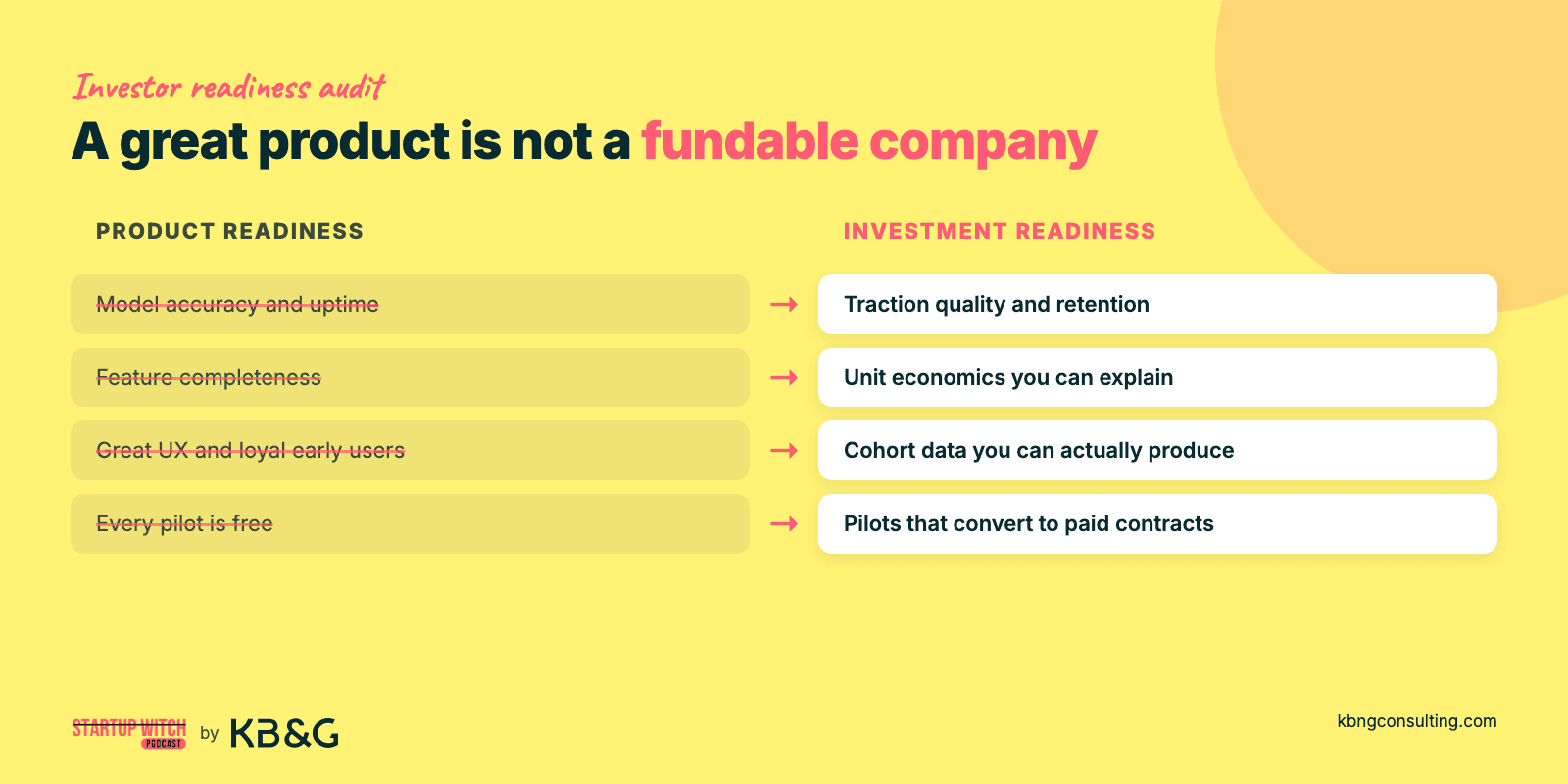
A strong product demo or a working AI model is necessary but insufficient. Most investors don't fund technology; they fund businesses. They care about repeatable revenue, capital efficiency, and whether the machine works without you personally closing every deal.
Here's the contrast:
Product readiness means model accuracy, uptime, UX quality, and feature completeness.
Investment readiness means traction quality, unit economics, decision speed, governance, and operational discipline.
Consider two scenarios. A founder ships an AI-powered safety module with excellent precision and recall. Impressive. But every pilot is free, and they have no idea what the compute and labeling cost per deployment actually is. Their unit economics fall apart at scale, so investors pass despite product strength. Another SaaS team has great UX and loyal early users, but when investors ask for cohort retention data, they can't produce it. The narrative breaks, and the second meeting never leads to a third.
Once you separate product excellence from investor readiness, you can audit the pieces that investors actually underwrite.
How Investors Quietly Assess "Readiness" in First Meetings
First impressions form fast. Much of a first call is an investor confirming or challenging an early read. They aren't just listening to your story; they're stress testing your clarity, coherence, and self-awareness.
Here are the unspoken questions most investors are answering during that first call:
Does this founder know exactly who buys and why?
Can this team sell beyond founder charisma?
Are the numbers coherent with the story?
Is there a clear path to product-market fit and scalable unit economics?
Will my capital go into experiments or into a machine that already works?
They assess these through how you answer other questions: about your pipeline, your pricing logic, your last lost deal. A structured investor readiness audit lets you run this evaluation yourself before they do, so you walk in knowing your blind spots instead of discovering them live.
The Core Dimensions of an Investor Readiness Audit
A serious audit doesn't just rate your deck. It runs across six systems: traction evidence, revenue model, go-to-market, team, operations, and data room completeness. These are the dimensions where most founders either build trust or lose it.
The following subsections mirror how early-stage investors think when they evaluate whether to write a check. Each dimension covers what evidence looks like and the red flags that get you a quiet pass.
1. Traction, Customers, and Proof of Demand
Traction metrics such as revenue growth and customer acquisition sit at the centre of investor readiness, but what counts as "real traction" shifts dramatically by stage.
Pre-seed: Signed pilots, letters of intent, paid experiments, or deep discovery with a meaningful number of ICP conversations. Letters of intent can demonstrate customer interest before revenue flows, and validated market demand reduces investment risk at every stage.
Seed: Early recurring revenue, a clear ICP, and early signs of repeatability. Customer interviews prove demand best when paired with actual conversion data.
Series A: Consistent MRR growth, cohort retention analysis, expansion signals, and net revenue retention above 100% become the standard.
Your audit should collect:
MRR/ARR broken down by customer, product, and segment.
Churn and retention metrics, even if the sample size is small.
Pilot outcomes with before/after metrics, customer quotes, and renewals.
For industrial buyers: proof-of-concept results, signed NDAs, waitlist depth.
For AI startups specifically, model performance (accuracy, latency, human-in-the-loop precision) must be tied to commercial outcomes. Time saved, errors prevented, cost reduced: these are what investors care about. "90% accuracy" means nothing without a dollar sign or a workflow improvement attached to it.
2. Revenue Model, Pricing, and Unit Economics
Investors will test whether your pricing is coherent with your buyer, your costs, and the value you create. They look for scalable business models with clear unit economics, not pricing that changes with every new deal.
The audit must review:
Pricing model (seat-based, usage-based, module-based, or hybrid) and why it matches your market. Your pricing maturity signals how well you understand your customer's willingness to pay.
Gross margin and cost drivers, including compute costs for AI, human labelers, cloud infrastructure, and integrations. If your margins sit well below typical SaaS levels, explain why and show the path to improving them.
Early CAC signals, even if acquisition is entirely founder-led outbound, and simple payback period estimates.
LTV logic based on realistic contract length and expansion assumptions, not fantasy. An LTV:CAC ratio of at least 3:1 is the benchmark many investors use.
Common AI and SaaS red flags: bespoke pricing for every deal, free "pilots" that never convert to paid contracts, no view on how margin shifts as model usage grows, and projections built on aspiration instead of documented assumptions.
3. Go-To-Market Strategy and Founder-Led Sales Pipeline
Investors expect a clear go-to-market strategy in your deck, and evidence that it's actually running, not just planned. At the early stage, most investors would rather see a working founder-led sales motion than a sales team burning cash without process.
Your audit should map:
Your ideal customer profile(s) for the next 18–24 months. For industrial AI founders, this might be EU mid-market manufacturers, North American ready-mix producers, or mining operators with specific safety and compliance needs.
Acquisition channels actually used (warm intros, outbound, content, partnerships) and which ones are working, with real data.
Sales stages with conversion rates: lead → meeting → pilot → contract → expansion. Investors want evidence of a repeatable sales process.
Average sales cycle length and where deals usually stall: security review, budget approval, procurement delays.
For industrial SaaS and industrial AI founders, additional specifics matter: pilot design and success metrics, procurement and vendor approval timelines, and how you avoid "pilot purgatory" with large companies. Startups that document past vendor approval timelines, safety compliance, and contract terms signal a maturity that separates them from competitors stuck in endless proof-of-concept loops.
Specificity increases investor confidence. Vague slides about a "$50B TAM" with no bottom-up funnel data get you nothing.
4. Team, Decision-Making, and Founder-Market Fit
Investors back execution capacity and judgment. A strong leadership team boosts investor confidence, but this isn't about impressive LinkedIn bios. It's about whether your team can make hard decisions fast and own the outcomes.
Items the audit must check:
Clarity of roles between co-founders: who owns product, sales, operations, AI/ML. Ambiguity here is a red flag.
Evidence of founder-market fit: years in the industry, past roles, lived experience with the problem you're solving. Domain expertise is a competitive advantage that's hard to replicate.
Decision-making cadence: how often you review metrics, make roadmap calls, and kill experiments that aren't working.
Advisors or operators covering critical gaps in GTM, regulation, or industry expertise you don't have in-house.
Red flags the audit must surface: dead equity on the cap table, co-founder misalignment on strategy or roles, and no one truly owning sales or GTM, which signals that the business runs on hope, not process. Formal vesting schedules prevent inactive-equity issues and show that you've thought about long-term alignment.
5. Operations, Data, and "Behind-the-Scenes" Systems
Investors infer operational maturity from details you might think are invisible: your reporting rhythm, data hygiene, and how you handle risk. They're looking for a minimum viable "operating system": not polished bureaucracy, but evidence that someone is watching the dashboard.
Operational elements to examine:
Core metrics dashboard: what you track weekly or monthly, and who sees it. If you don't know your numbers, investors assume you're not managing the business.
Experiment logs for product and GTM: hypothesis, test, result, decision. This signals that you iterate deliberately, not randomly.
Customer support and onboarding processes: even simple ones show that you think about retention, not just acquisition.
For industrial AI: field discovery notes, safety considerations, site deployment playbooks, and regulatory compliance documentation.
You don't need enterprise-grade systems. You need proof that decisions are data-informed and that your process has structure.
6. Data Room and Diligence Readiness
Even at pre-seed, a basic data room signals seriousness. At seed and Series A, it becomes non-negotiable. An organized data room speeds up due diligence, and a missing or chaotic one can stall a deal that was otherwise moving.
Documents investors typically expect:
Corporate: incorporation docs, cap table, key contracts, IP assignments and IP protection documentation.
Financial: P&L, balance sheet, cash flow, runway calculation, and a financial model with a documented assumptions sheet.
Commercial: key customer contracts, pilot agreements, case studies, pipeline summary.
Product/Tech: architecture overview, security/privacy summary, AI/ML model documentation where relevant.
The audit evaluates both completeness and coherence. Do these docs tell the same story as your deck? Misalignment between pitch deck and financial model is common, and it's one of the fastest ways to lose an investor quietly.
What to Fix Before You Raise: Applying the Audit Findings
The audit is only useful if it turns into a short, prioritized fix list before you start outreach. For every gap identified, decide: fix before raising, fix during the process, or acknowledge and explain. This section tells you what to repair first so you don't burn investor goodwill on a half-baked raise.
Fix 1: Align Story, Numbers, and GTM
Your narrative, financial model, and GTM slides must describe the same business in different languages. If your deck says "enterprise" but your model shows SMB economics, investors notice immediately.
Start from the traction and pipeline reality. Rewrite your "vision" to be an honest extension of what's already working.
Update the financial model to reflect the actual GTM plan: channel mix, hiring plan, and expected conversion rates.
Refactor your deck to show how capital turns into specific milestones (customers, revenue, gross margin) rather than generic "runway."
Financial transparency builds trust with investors; inconsistency destroys it.
Fix 2: Tighten Pricing and Basic Unit Economics
Avoid fundraising with "we're still figuring out pricing" unless you are genuinely pre-product. Pricing clarity is a baseline signal that you understand your market.
Pick one primary pricing model for the next 12 months and write down why it fits your best current customers.
Calculate simple unit economics for your main motion: gross margin per customer, CAC estimate, and payback period. CAC payback ideally sits under 12–18 months.
Run 2–3 concrete pricing experiments before fundraising and capture results for your deck and data room.
Bake AI workloads and cloud costs into margin assumptions instead of guessing. If compute cost per inference scales badly, your margins can collapse with growth, and investors will model that.
Unrealistic projections lead to investor distrust. Ground every number in something you've actually measured.
Fix 3: Make Your Pipeline Legible and Repeatable
Investors want to see a repeatable path from cold lead to closed deal, even if the sample size is still small. Most founders underestimate how much a clean, documented pipeline increases confidence.
Define a simple 5–6 stage pipeline in your CRM or spreadsheet and move all active deals into it.
Clean duplicates and standardize tags (sector, deal size, stage, ICP vs. non-ICP).
Calculate basic conversion rates and typical time-in-stage for the last 10–20 deals.
For industrial deals, note pilots, site visits, and procurement gates explicitly, and show which accounts are worth pursuing.
Even rough but coherent pipeline data builds more trust than vague claims of "strong interest." Your pipeline is where you make the market opportunity concrete.
Fix 4: Clean the Cap Table and Governance Basics
A clean cap table is essential for investor trust. Messy ownership structures and unclear governance scare off institutional investors early, sometimes before a second meeting happens.
Document all existing SAFEs, notes, and equity grants in a single cap table with a fully diluted view.
Resolve obvious dead equity or misaligned early grants where possible before you raise.
Define decision rules for big calls (product direction, hiring, fundraising) and document them briefly.
These changes often require legal input and should be planned before term sheets arrive, not after.
Fix 5: Build a Minimum Viable Data Room
Turn your audit gaps into a concrete checklist for a basic but professional data room.
Create a clear folder structure: Corporate, Financial, Product, Commercial, People, Legal/Risk.
Upload current, date-labeled versions of each document and remove obsolete drafts.
Write 1–2 page overviews where helpful (e.g., "AI architecture overview," "Pilot program methodology").
Create a simple index document listing what's in the data room and when each file was last updated.
This step alone can cut weeks off diligence for serious investors. Data room completeness signals that you respect investors' time and your own process.
How to Run Your Own Investor Readiness Audit
This is a founder-friendly, weekend-length process you can run yourself before involving outside advisors. It mirrors how a proper diagnostic works: scoring each dimension, identifying structural weaknesses, and turning findings into a sprint plan.
Step 1: Define the Round You're Aiming For
Clarify your target round (pre-seed, seed, or Series A), target raise amount, and intended runway, typically 18–24 months.
List 3–5 milestones you aim to hit with this capital. Examples: reach a specific MRR target, convert 5 industrial pilots to paid contracts, bring CAC payback under 12 months, or hire a first sales lead. Every later audit question should link back to these milestones. If you can't articulate what the money buys, you're not ready to raise.
Step 2: Gather Your Materials
Pull together everything an investor might ask for:
Current pitch deck and any one-pager.
Financial model and the last 12–18 months of actuals if available.
CRM export or pipeline spreadsheet.
Key customer documents (contracts, pilots, case studies).
Cap table, incorporation docs, major agreements.
The act of collecting these already shows you where the biggest holes are. Many founders discover that half the materials are outdated, incomplete, or contradictory. That's the point.
Step 3: Score Each Dimension on a Simple Scale
Use a 1–5 scale per dimension: traction, pricing/economics, GTM/pipeline, team/governance, operations, data room.
1 = Nothing documented, no data, no process.
3 = Basic systems exist, some data, clear gaps but direction is visible.
5 = Stage-appropriate evidence, coherent story, investor-ready documentation.
Err on the side of being harsh. Investors will be. Your self-assessment can be a single page with honest scores and brief notes.
Step 4: Prioritize 3–5 Highest-Impact Fixes
Not every weakness must be fixed before fundraising. Focus on the gaps most likely to kill the round; trade-offs are inevitable.
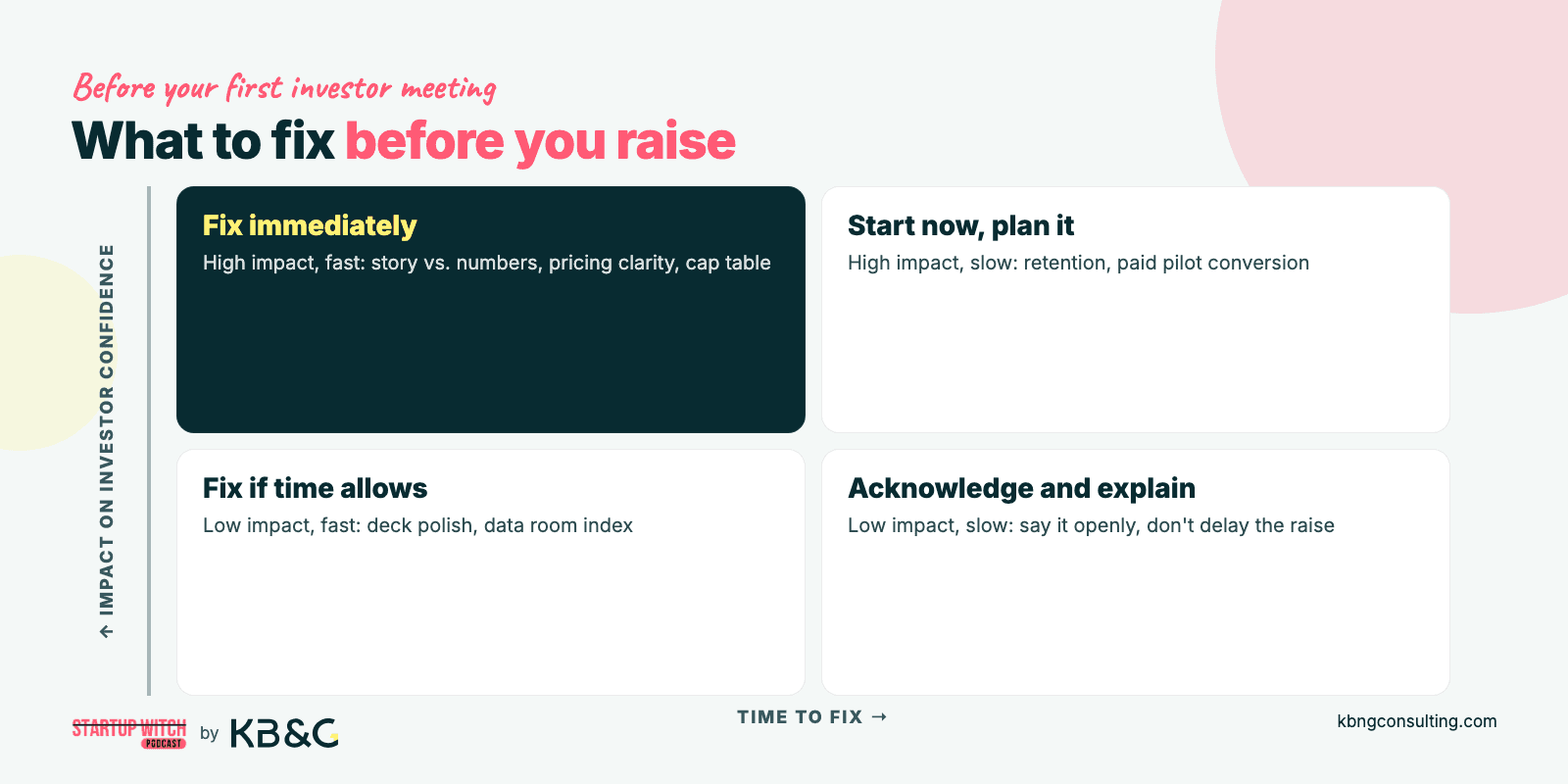
Use a simple 2×2 prioritization:
Fast to Fix | Slow to Fix | |
|---|---|---|
High Impact on Investor Confidence | Fix immediately | Start now, plan timeline |
Low Impact on Investor Confidence | Fix if time allows | Defer or acknowledge |
Commit to one sprint of two to four weeks to address the top 3–5 issues before any first investor meeting. This framework forces you to be specific about milestones.
Step 5: Rehearse the "Audit Story" Out Loud
Be ready to talk transparently about your current state and what you're fixing. Practice a short narrative:
What you're already doing well.
What you discovered in your own readiness audit.
What you're actively fixing and on what timeline.
This level of self-awareness often increases investor trust more than pretending to be perfect. Nothing builds trust faster than a founder who knows their own weaknesses and is already addressing them.
Common Investor Readiness Gaps (and How to Close Them)
Most AI and SaaS founders share a set of predictable weaknesses. These are the patterns that surface repeatedly in diagnostics and investor conversations, with the direct fix for each.
Gap 1: "We Have Users but No Coherent Revenue Story"
The pattern: lots of pilots, free users, or proofs-of-concept, but no clear path to MRR/ARR. Investors see activity without a business model.
Convert pilots to standard paid tiers with clear pricing and time-bound discounts.
Stop adding bespoke one-off features that don't roll into a product SKU.
Create 2–3 simple packages and test them with existing accounts.
Track which pilot customers would pay and at what price. This data is more valuable than another free deployment.
Gap 2: "Our GTM Slides Are Aspirational, Not Based on Reality"
The issue: top-down TAM slides with no bottom-up explanation of how customers actually find and buy.
Replace generic TAM with bottom-up targeting of 50–200 named accounts or specific segments.
Document the path of your last 5 closed deals and generalize that into a real GTM motion.
Cut slide content that you can't back with at least some data from your own funnel.
Gap 3: "Our AI Story Is Technical, Not Commercial"
The problem: founders over-index on model architecture, benchmarks, and patents while under-explaining why a buyer cares. A clear value proposition differentiates your solution, not a research paper.
Translate model performance into time saved, errors prevented, or revenue unlocked for a specific role.
Use 1–2 case studies showing before/after workflows (e.g., safety supervisors reducing incident response time, plant managers cutting manual inspection hours).
Cut jargon that doesn't affect cost, risk, or revenue from investor materials.
Gap 4: "We Treat the Raise as a Lifeline, Not a Milestone Engine"
Framing your raise as "we run out of cash in X months" weakens your negotiating position with any investor.
Reframe the raise as buying time for specific milestones that de-risk the business: validate pricing, standardize deployments, hit a set number of reference customers.
Adjust burn to show you can survive longer without new capital if necessary (for example, slower hiring). This demonstrates capital efficiency and improves your negotiating position.
Make sure your "use of funds" slide maps directly to value-inflecting milestones, not generic operational spend.
Gap 5: "Our Documentation Is a Mess"
Scattered docs, outdated files, and inconsistent numbers erode trust quickly in diligence. You can't be transparent if your own records don't agree with each other.
Assign one founder to own the data room and keep a single "source of truth" folder.
Audit for inconsistencies between deck, model, and actuals; fix or annotate discrepancies.
Keep an index document listing what's in the data room and when each file was last updated.
Conclusion and Immediate Next Steps
Investor readiness is about coherent systems and decisions, not a prettier deck. You should know your fundability (your structural weaknesses, your strengths, your blind spots) before investors do. A structured investor readiness audit lets you fix the handful of issues most likely to sink your raise and walk into investor meetings with confidence grounded in reality.
Here's what to do now:
Decide your exact target round and the 3–5 milestones it must fund.
Run the self-audit steps above and assign scores to each dimension.
Pick the top 3 gaps and schedule a 2–4 week sprint to fix them.
Build your minimum viable data room.
Only then, start investor conversations with a clear story and organized proof.
If you want an outside eye, the kind that catches what you can't see because you're too close to your own business, the Founder Blind Spot Diagnostic by Startup Witch reads your startup in 14 days and names the one thing blocking growth. It costs EUR 750 and is fully refundable.
Investor Readiness Self-Audit Checklist
Use this checklist to quickly assess where you stand. Answer each question honestly; "sort of" counts as "no."
Traction & Customers
Do you have clear, stage-appropriate proof of demand (pilots, paying customers, renewals, or case studies)?
Can you show your last 6–12 months of MRR/ARR and explain any jumps or drops?
Do you know exactly who your best customers are and why they bought?
Can you demonstrate validated demand through customer interviews, LOIs, or usage data?
Revenue Model & Unit Economics
Is your pricing model simple enough to explain in 2–3 sentences and grounded in customer value?
Have you calculated basic unit economics, including cloud/compute costs for AI workloads?
Can you roughly estimate CAC and payback from real data, not wishful thinking?
Are your projections grounded in data and documented assumptions?
GTM & Pipeline
Is your sales pipeline documented in a CRM or spreadsheet with clear stages?
Do you know the actual path your last 5 closed deals took from first touch to signature?
For enterprise or industrial deals, have you mapped procurement and vendor approval steps?
Does your go-to-market strategy name specific customer acquisition channels?
Team, Cap Table & Governance
Are co-founder roles and responsibilities clear, especially for sales/GTM ownership?
Is your cap table current, accurate, and free of obvious dead equity issues?
Do you have formal vesting schedules?
Do you have a simple decision-making cadence and documented major decisions?
Operations & Data Room
Do you track a small, sharp set of core metrics weekly or monthly and act on them?
Do you have a structured data room with up-to-date financial, corporate, and commercial documents?
Do your deck, financial model, and actuals all tell the same story?
Is there an index of your data room contents with last-updated dates?
FAQ: Investor Readiness Audits for AI & SaaS Founders
What is an investor readiness audit for a startup?
An investor readiness audit is a systematic evaluation of your traction, revenue model, go-to-market, team, operations, and data room against what pre-seed to Series A investors expect. Its goal is to reveal why investors would quietly pass before you talk to them, so you can fix those issues in advance. It goes deeper than deck feedback by looking at how your company actually runs.
When should I run an investor readiness audit?
Ideally 4–12 weeks before you start serious investor outreach, once you have a working product and at least some signs of traction. Too early (pre-product) and you'll only confirm that you need customer proof. Too late and you'll waste investor meetings fixing basics. Re-run a lighter version before each next round or major strategic shift.
How long does a self-run investor readiness audit take?
A focused founder can do an honest self-audit in a weekend, plus one to two weeks to gather materials and close obvious gaps. Deeper, advisor-led diagnostics typically take around two weeks once documents are assembled.
Can I raise if I'm not "perfectly" investor-ready?
Yes. No startup is ready across every dimension, and investors back direction and momentum as much as the current snapshot. What matters is that you've identified your main weaknesses, started fixing them, and can talk about them clearly. The audit moves you from "we hope we're ready" to "we know where we're strong, where we're weak, and what we're doing about it."