
What Is Pilot Purgatory?
Pilot purgatory is the state where an enterprise keeps testing your product in pilots or proofs of concept that never convert to signed production deals. You escape pilot purgatory by structuring paid, time-boxed pilots with clear success metrics tied to business outcomes, a budget owner, and pre-agreed conversion terms before the pilot starts.
This article is for you if you are a founder of an AI or industrial tech startup selling into large enterprises: mining, manufacturing, construction materials, infrastructure. It is not written for internal corporate innovation teams or enterprise executives running their own programs.
Why read this now: enterprise AI sales cycles in heavy industry are long, innovation budgets are under scrutiny, and boards want measurable outcomes from AI spend, not slide decks about "potential." If your pilots are not converting, your runway is burning.
Here is what you will get from this article:
A precise definition of pilot purgatory in industrial and enterprise AI sales.
The main reasons AI and industrial pilots stall: no budget owner, vague success criteria, free pilots, IT/procurement surprises, champion churn.
A template for designing pilots that convert to multi-site rollouts.
Concrete tactics to rescue a stalled pilot without burning your internal sponsor.
How pilot strategy fits into your go-to-market and what to fix before your next raise.
Understanding Pilot Purgatory in Enterprise Sales
Pilot purgatory is being stuck for months in a "trial" at one mine site or processing plant with no signed contract, no rollout plan, and no decision meeting on the calendar. You keep getting emails that say "we're still evaluating" while your team burns through engineering hours and travel budgets.
This is not bad luck. Pilot purgatory is structurally created by how enterprises buy (multiple approval layers, unclear ownership, long procurement cycles) and how startups accept pilots (open scope, no fees, vague deliverables).
The Anatomy of Pilot Purgatory
Here is what pilot purgatory typically looks like over many months:
An innovation lead or HSE director gets excited about your product. They select one site or department. You build a proof, run a trial, show early results. Everyone nods. Then usage drifts down. Supervisors stop logging in. Data pipelines break. IT intervenes. Your contact starts forwarding emails that say "we need to review more" or "let's extend for another quarter."
The tell-tale signs are consistent. There is no named budget line for a production contract. No sponsor above middle management has committed. No "go/no-go" meeting has been scheduled. The pilot lead keeps requesting "just one more extension."
The cost to you is real. Founder and CTO time consumed by custom integrations, site visits, and support for a non-paying customer. Opportunity cost: deals with higher conversion potential are delayed or ignored. The initial momentum around your engagement fades during lengthy delays. And indecision about a pilot can be more damaging than outright rejection, because at least rejection frees your team.
Where Pilot Purgatory Sits in the Enterprise Buying Journey
Enterprise buying follows a rough sequence: discovery, proof of concept, pilot, production rollout, expansion.
A proof of concept tests if the technology works in principle. It often runs on historical data or in a lab setup with the innovation team. A pilot runs the product in a live workflow with real users, real shifts, and clear business metrics. Production rollout means a contract is in place, support model defined, SLAs agreed, and live deployment is running in a repeatable way across multiple sites or teams.
Pilot purgatory sits in the gap between a "successful" pilot and a signed rollout contract. The technology proved it works. The frontline users liked it. But no one designed the decision path. No budget owner was identified. No conversion terms were agreed, and no shift in operating model from pilot to production was defined. Most enterprise buyers will not volunteer that decision path; you have to build it into the pilot from the start.
Understanding why pilots stall allows you to design around those failure modes.
Why Enterprise AI Pilots Fail and Industrial Tech Pilots Stall
Enterprise AI pilots fail because of execution, deal-design, and organizational capability gaps, not just technology failure. In asset-heavy industries like mining, cement, steel, and infrastructure, organizational structure and procurement rules create specific traps, especially when a pilot is not designed as a production-ready system from the start. Here are the five that account for most stalled pilots.
No Real Budget Owner Behind the Pilot
Picture a mining company's HSE team running a safety analytics pilot funded by an innovation budget. The HSE director likes the results. But operations owns the budget for radios, sensors, and site connectivity. The CFO has never heard of the project. Nobody in a P&L role has committed to spend. The pilot becomes a "science project" with no clear path into opex or capex budgets.
This is one of the most common reasons enterprise AI initiatives never reach production. If the person who can sign a six-figure contract is not identified before you scope the pilot, you are building on sand. Without clear ownership, you are stuck waiting for someone who does not know you exist to approve something they have never evaluated.
Vague or Politicized Success Criteria
"Improve safety culture." "Explore AI's potential on site." "See if this adds value." None of these can be measured, and none can trigger a buying decision.
Without baselines and target metrics, everyone can claim success or failure depending on their agenda. Imagine a predictive maintenance model that flags real maintenance issues, but operator teams were never trained on the workflow, so usage drops. The innovation lead calls it a success because the model worked. The operations manager calls it a failure because nobody acted on the alerts. Define success criteria before starting any AI pilot project, as a current value and a target, for example: time to close near-miss reports (current: 72 hours; target: under 24 hours), or unplanned downtime per month (current: 8 hours; target: under 5 hours). Without these numbers, you have no proof and no leverage.
Free or Underpriced Pilots
When you give your product away for free, the buyer has no financial stake. There is no urgency to allocate IT resources, schedule training, or push a decision meeting. Free signals "nice-to-have," and nice-to-have sits at the bottom of every enterprise priority list.
Pilots that run in a fixed window should still carry a fee, even if discounted against production pricing. The fee is not about revenue; it is about commitment. When the client pays, they assign resources. When they do not pay, they forget.
IT, Security, and Procurement Surprises
Late-arriving requirements kill timelines. Penetration tests, data residency reviews, vendor registration, cybersecurity assessments: any of these can add months if not surfaced early.
Industrial OT environments make this worse. Sites with limited network connectivity cannot support cloud-dependent analytics without edge infrastructure. Strict radio and OT segregation means adding voice data pipelines or computer vision may require bridging OT and IT networks, which is heavily controlled or outright blocked. Global procurement rules for vendor onboarding, master service agreements, liability insurance, and audit compliance stack on top.
Map these gates during pre-sales. If you learn about them after the pilot "succeeds," you lose months while your champion's attention wanders.
Your Champion Leaves or Changes Role
A site superintendent rotates to a new operation. A digital lead is reassigned. A sponsor's budget is cut mid-year. During pilot purgatory, your main contact may move on, and the single thread connecting your startup to the enterprise snaps. This churn is common in mining majors and multinational manufacturers, where leadership rotations are a normal part of careers.
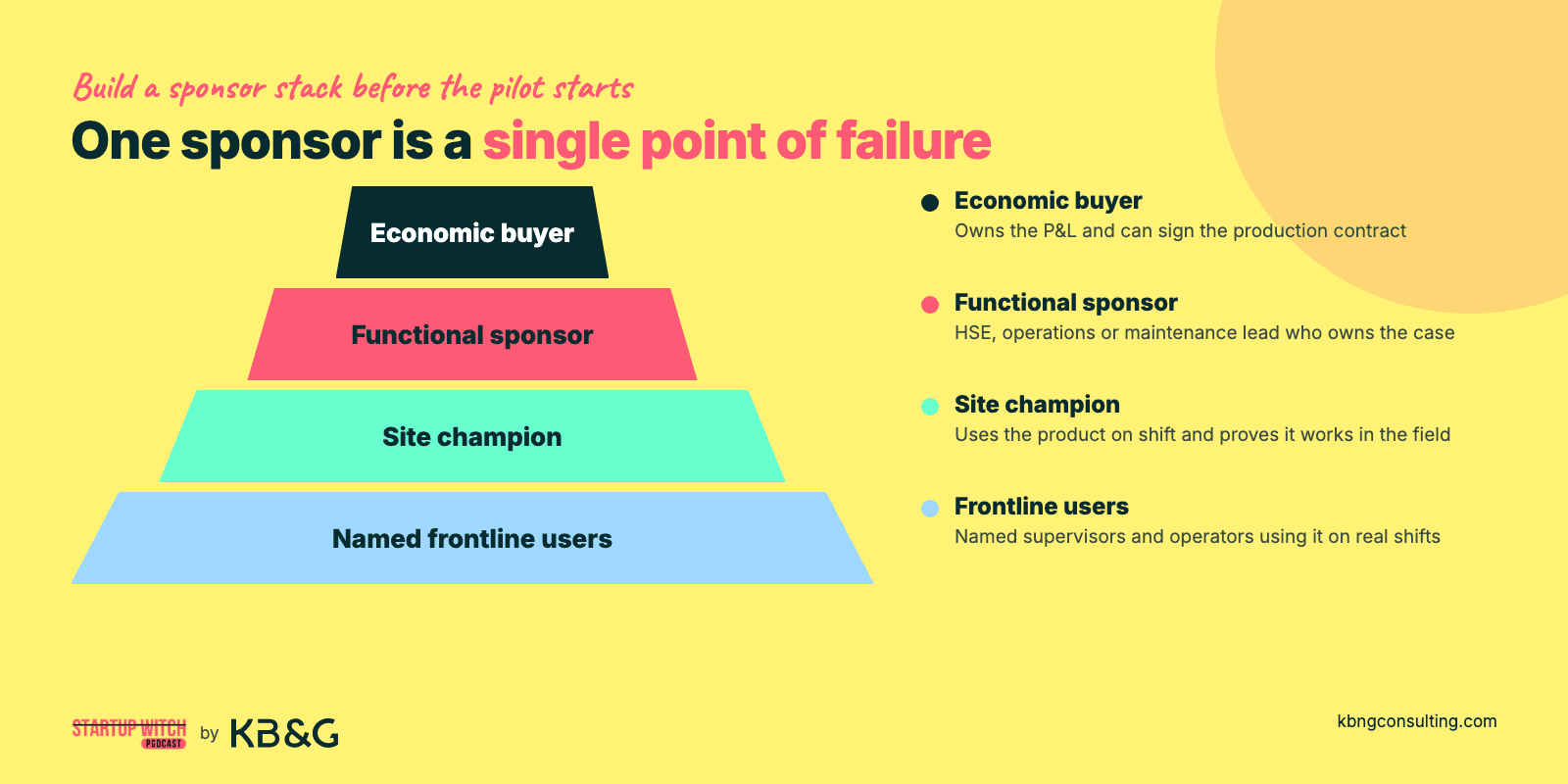
Single-threaded sponsorship is fragile. Build a "sponsor stack" from the start: a site champion who uses the product, a functional sponsor (HSE, operations, or maintenance lead) who owns the business case, and an economic buyer with P&L responsibility who can approve a contract. If any one leaves, the others keep the pilot alive.
Now that root causes are clear, the next section covers how to design pilots that are built to convert from day one.
Designing Pilots That Convert to Production
The only good pilot is one that ends with a clear outcome tied to operational reality: scale, kill, or redesign. Not "let's extend." You, as founder, control much of this through how you propose and structure the engagement.
Make Every Pilot Paid, Time-Boxed, and Scoped to One Outcome
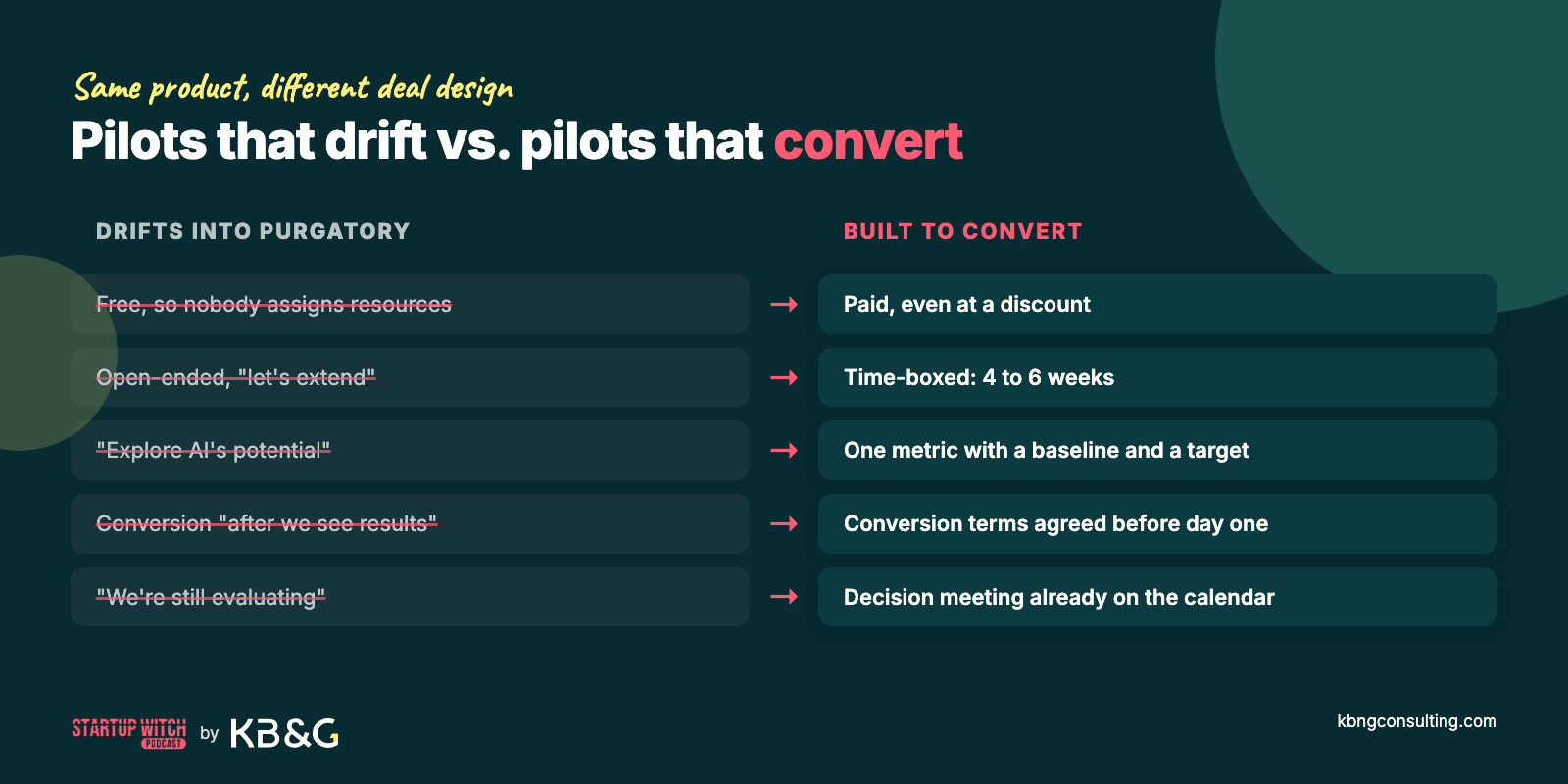
Three non-negotiable elements separate a pilot that converts from one that drifts:
Paid. Even a small fee separates internal experiments from external commitments. Payment unlocks internal attention: IT assigns resources, managers schedule training, procurement starts onboarding.
Time-boxed. Set a fixed evaluation timeline of 4 to 6 weeks. Extend to 12 weeks only when hardware installation or complex integration is involved. Open-ended timelines are open invitations to purgatory.
Single outcome. Choose one measurable business metric tied to one department and one budget owner. Do not try to prove five value propositions at once.
Concrete scoping examples: "Reduce time to log and classify safety incidents on radios at Pit A by 30% within 6 weeks." Or: "Cut weekly inspection report prep from 4 hours to 1 hour for the maintenance team at Plant 3."
Set Baseline, Targets, and a Fixed Decision Meeting
You need three things established before the pilot starts, not after.
A baseline measures how things work now in real numbers: hours per report, incidents per month, downtime per shift, cost per event. A target defines what "good enough to scale" looks like: an improvement threshold agreed upfront by both sides. A fixed decision forum is a calendar-blocked meeting at the end of the pilot with the sponsor and budget owner present.
The decision meeting agenda should cover:
Review baseline versus results with actual data.
Sponsor and budget owner confirm whether metrics meet the agreed threshold.
One of four outcomes: scale with a contract, iterate with revised scope, redesign the approach, or stop.
Agree Conversion Terms Before You Start
Your pilot proposal should include a post-pilot commercial path. If the buyer refuses to discuss conversion terms before the pilot begins, that is an early signal of low intent, full stop.
Typical structure: a clear trigger ("if minimum success criteria are met and signed off by Sponsor Y, we convert to a 12-month production contract for Sites A through C at price X"); defined expansion pricing per additional site or plant; and a credit mechanism where a portion of pilot fees applies against first-year production fees to reduce friction.
This is not aggressive. It is respectful of both sides' time and investment.
Map Procurement, Security, and IT Upfront
Run a mini-discovery on the buying process before you agree to start. Bolting governance and security reviews on after a successful pilot adds months to your timeline.
Ask these questions in your first scoping call:
What internal compliance or cybersecurity reviews are required before vendor software touches your network?
Who owns OT access, and what are their requirements for external tools?
Does the pilot require data residency, encryption, or edge device constraints?
What procurement or legal paperwork (MSA, NDA, liability, insurance) is non-negotiable before a contract?
How long does vendor registration normally take in this company: 30 days, 90, more?
What hardware or infrastructure (radios, sensors, cameras) must be installed, and who pays?
Is there a single point of contact across IT, OT, and procurement approvals?
For industrial buyers, IT and OT are often separate organizations with separate approval chains. Both need to be engaged.
Design for Frontline Adoption, Not Just Executive Demos
In mining, construction, and manufacturing, production value only appears when supervisors, dispatchers, and operators actually use the tool during real workflows. A dashboard that nobody opens during a shift is not a successful pilot.
Specify named users and roles in the pilot design: "5 supervisors on night shift at Processing Plant 1." Build simple, field-tested workflows. A radio phrase detection that triggers a one-click incident form works. A report that feeds an invisible dashboard does not. Include a training and enablement plan: one to two short sessions plus on-call support during the first weeks. Tools like safety radios, computer vision systems, and operational AI platforms must plug into real shifts and safety meetings. If frontline adoption does not happen, the pilot fails regardless of what the executive sponsor thinks of your demo.
Once good pilots are designed, you also need a clear internal process to run them.
A Practical Pilot Process You Can Reuse
A repeatable process beats heroic one-off efforts. It also means your next hire can run a pilot without reinventing the wheel each time.
Step-by-Step Pilot Playbook for Founders
Identify a high-pain, narrow use case at one site or plant with a clear operational cost or safety problem.
Qualify sponsor and budget owner. Confirm they can sign a rollout contract if the pilot meets targets. If they cannot, find the person who can before proceeding.
Co-write success metrics and define baseline with the operational team using their current data.
Draft a written pilot charter: scope, fees, timeline, metrics, decision date, conversion terms.
Run a pre-pilot workshop with IT, security, and procurement to map approvals, data flow, and network constraints.
Deploy, train frontline users, and track metrics weekly. Do not wait until the end to learn that usage dropped in week two.
Hold the decision meeting. Present results versus targets. Push for one of four outcomes: scale, iterate, redesign, or stop.
Capture learnings in writing (what worked, what did not) and update your standard pilot template.
Pilot to Production: PoC and What Changes at Each Stage
Mixing expectations between these three stages is a direct path into pilot purgatory. Here is what separates them:
Proof of Concept (PoC)
Main goal: prove feasibility; validate the technology works under controlled conditions.
Typical users: innovation team, engineers; no live frontline users.
Time horizon: days to a few weeks.
Technical expectations: historical data, lab environment, minimal integrations.
Pilot
Main goal: prove business impact in a live workflow with measurable outcomes.
Typical users: small group of frontline workers at one site (supervisors, operators, shift leads).
Time horizon: 4 to 8 weeks (12 weeks maximum with complex integration).
Technical expectations: light integration, focused metrics, training plan, weekly tracking.
Production Rollout
Main goal: deliver stable, ongoing operational value at organizational scale.
Typical users: multiple sites, regions, and functions under a P&L owner.
Time horizon: months to years.
Technical expectations: full integrations, performance and reliability SLAs, support contracts, maintenance plan.
Building production-grade features inside a pilot, or treating a pilot as a PoC, creates confusion and delay. Keep each stage clean.
Even with good design, pilots will still stall. Here is how to rescue them.
Escaping a Pilot That's Already Stuck
If you are already months into a drifting pilot, this section is for you. These are practical interventions you can deploy in the next 2 to 4 weeks.
Diagnose Which Type of Stall You're In
Four common stall patterns:
"Silent pilot." Usage metrics are low. Feedback is sparse. Users do not log in. You can spot this when support tickets dry up and your dashboard shows declining sessions. The product works; nobody is using it.
"Forever extension." Your sponsor keeps requesting more time but never commits to next steps. Calendar invites shift from "decision review" to "status update." Meeting notes never mention budget or contracts. Staying stuck in this loop for months means you are not evaluating; you are waiting.
"IT black hole." Security assessments, vendor onboarding, or OT access requests are pending with no clear owner. Emails get forwarded to generic inboxes. Nobody planned for governance while the pilot ran in isolation.
"Budget fog." Stakeholders celebrate outcomes verbally. They tell you how much they love the tool. But nobody knows which budget line or fiscal owner will cover costs.
Re-Set the Pilot With a Hard Decision Date
Approach your sponsor with a respectful but firm reset. Propose a short extension (4 weeks, not another quarter) with newly agreed metrics and a decision meeting locked on the calendar.
Offer to narrow the use case or focus on a single shift if scope was too broad. If the pilot has ballooned into three departments and two sites, pull it back to one measurable outcome.
Make clear that you are happy to stop if it is not a priority. Phrasing that works: "I want to make sure this pilot works for your team and also stops consuming your resources without measurable gains. If this is not the right time, let's pause cleanly." This often flushes out real intent. A sponsor who wants to continue will find the budget owner. A sponsor who does not will let you go; either outcome is better than limbo.
Escalate Carefully: Building a Broader Sponsor Stack
Widen support without going behind your champion's back. Ask your sponsor to bring in their manager or a BU lead to hear results. Offer to present at an existing operations, HSE, or digital steering committee. Share a concise one-pager: baseline, pilot results, proposed rollout plan.
In large enterprises, decisions above a certain spend threshold must go through formal governance. Your job is to help the sponsor navigate it, not to wait for it to happen on its own.
Know When to Walk Away
Exit when:
No visibility on budget after repeated attempts across multiple contacts.
No sponsor willing to own metrics or attend a decision meeting.
IT, legal, or procurement timelines stretch beyond a reasonable sales cycle for your stage.
Exit professionally. Send a summary of what you delivered and what blocked progress. Leave the door open for future work. Free up your team for prospects with a clear path to production. Many pilots that linger in purgatory are ultimately passed on; better to control that timing than to let it happen to you.
Structural fixes across your go-to-market can prevent these patterns from repeating.
Making Pilot Strategy Part of Your Go-To-Market
Pilots are not side experiments. For enterprise AI startups, they are your main sales instrument. Tightening this part of the funnel is often the fastest way to improve traction before your next funding round.
Align Pilots With Your Ideal Customer and Founder-Market Fit
Define which segment gives the cleanest pilot conditions. A mid-sized cement producer may have a single HSE director who controls budget and can approve a contract quickly. A Tier-1 global miner has deep legal review, strict OT rules, and a lengthy vendor onboarding process. Starting with the mid-sized producer lets you build a reference case and refine your pilot process before you tackle the multinational.
Identify which function (HSE, operations, maintenance) consistently finds budget for your category of tool. Geographies matter: vendor registration timelines, regulatory requirements, and procurement norms differ by country and by company.
Pricing and Packaging Specifically for Pilots
Keep pilot packaging simple. One or two options: "single-site 4-week pilot" and "single-site 8-week pilot with light integration." Too many options confuse the buyer and slow internal approvals.
Anchor pilot fees against expected value. If the expected saving is $100,000 per plant per year, a $10,000 to $20,000 pilot fee is easy to justify. Avoid per-user pricing during pilots; site-level or shift-level pricing is clearer for industrial buyers. Clear pilot packaging helps innovation leads justify spend internally, because they can attach a specific business case to a specific cost.
What to Fix Before Your Next Raise
Investors look less at "number of pilots" and more at:
Pilot-to-production conversion rate. Out of 10 pilots, how many became live contracts?
Time from first meeting to first paid pilot.
Average contract value after pilot and expansion path (land-and-expand across many sites).
Build a small, clean dataset of your own pilot metrics you can show in a deck. If you are stuck with dozens of non-converting pilots, you likely have a go-to-market and positioning blind spot, not a technology blind spot. That gap between promising demos and signed contracts is where startups lose the confidence of investors and board members.
Conclusion and Next Steps
Pilot purgatory is structural. You escape it by redesigning how you sell and run pilots, not by building better features.
Every pilot must be paid, time-boxed, and tied to a pre-agreed decision and budget owner.
Pilots should have a fixed evaluation timeline of four to six weeks. Anything beyond that without a decision meeting is drifting.
Stalled pilots can be rescued with a reset on scope, metrics, and decision dates, or deliberately closed.
Five things you can do this week:
Audit all current pilots and label them by stall pattern (silent, forever extension, IT black hole, budget fog).
Schedule decision meetings for any pilot that does not have one.
Draft a standard one-page pilot charter template to use with new prospects.
Refine pilot pricing and packaging to remove free, open-ended trials.
Track your pilot-to-production conversion rate and time-to-paid-pilot as core sales metrics.
If you want an external, blunt read on why your pilots are not converting, the Founder Blind Spot Diagnostic by Startup Witch reads your startup in 14 days and names the one thing blocking growth. It costs EUR 750 and is fully refundable.
Frequently Asked Questions About Pilot Purgatory
These are the questions founders ask most often when they realize their pilots are not converting.
What is pilot purgatory for an AI or industrial tech startup?
Pilot purgatory is being stuck in endless trials or proofs of concept with large enterprises that never convert to signed production deals. Many of these pilots demonstrate value at small scale but never reach production.
How long should an enterprise pilot last before it becomes purgatory?
Four to six weeks of active usage for most AI and industrial SaaS pilots. Twelve weeks maximum if integrations are complex or hardware must be installed. Any pilot running beyond its timeline without a scheduled decision meeting is drifting toward purgatory.
Should I ever agree to a free pilot?
Almost never. Free pilots strip out buyer accountability: no urgency to allocate IT resources, no pressure to schedule a decision meeting, no internal justification for change management. The only exception is a lighthouse customer where the buyer pre-agrees in writing to a rollout contract if targets are met. Even then, the risk of wasted investment and devalued pricing is high.
How many pilots do I need before I can prove product-market fit to investors?
Conversion rate matters more than count. Three pilots that convert to multi-site rollouts are more convincing than thirty stuck experiments. Track and share a simple funnel: pilots booked, pilots completed, rollouts signed, expansions. Investors want evidence that your value proposition drives consistent pilot to production conversion, not a long list of logos in "evaluation."
What if my product genuinely needs deep integration before any value shows up?
Split the work. Run a short, focused technical PoC to de-risk integration (data pipelines, OT connectivity, platform compatibility). Then run a tightly scoped pilot to prove business impact. Building integration inside a free, open-ended trial means you absorb all the cost and risk while the buyer absorbs none. Get post-pilot commercial terms agreed before you build.