What Is a Startup Growth Audit Checklist?
A startup growth audit checklist is a step-by-step list of questions and metrics you run through to diagnose exactly where your AI or SaaS startup is leaking growth and money (across positioning, funnel, pricing, retention, and decision-making) so you can prioritize what to fix next. If you've shipped something real but aren't converting, this audit tells you why.
This isn't a financial audit or a compliance exercise. It's designed for early-stage AI/SaaS founders, pre-seed through Series A, who have a live product, some traffic or users, but not enough traction, revenue, or momentum to show for it. You know the symptoms: MRR has plateaued for months, demos aren't closing, users ghost after sign-up, and fundraising conversations keep stalling because investors want proof of repeatable traction, not just a pitch about your tech.
This article gives you a practical breakdown of the entire audit process, section by section, so you can run it yourself in one to three days with tools you already have. By the end, you'll walk away with:
A complete audit checklist covering your growth engine from ICP to churn
Clarity on which metrics actually matter at your stage
A method for scoring issues and deciding what to fix this quarter
A way to turn audit findings into a focused 90-day action plan
A simple operating rhythm to keep the audit alive after day one
Understanding a Startup Growth Audit
A startup growth audit is a structured review of how you attract, convert, retain, and expand customers, plus how you price, position, and package what you sell. It connects your financial data, product usage, and customer behavior to specific decisions you've made (or avoided). A startup growth audit identifies bottlenecks in acquisition, conversion, retention, and unit economics, then forces you to prioritize fixes based on evidence, not gut feel.
This is different from a generic strategy review, which tends to focus on vision and market sizing. And it's not a financial audit in the compliance sense: you're not preparing financial statements or checking accounting compliance. You're holding your growth engine accountable. In 2026, this matters more than ever for AI/SaaS founders: markets are saturated, every product claims "AI-powered," and investor expectations have shifted hard toward efficient, proven traction. A startup growth audit helps align teams around high-impact priorities before scaling, rather than burning cash on things that don't move the needle.
The rest of this article walks you through a checklist broken into areas: foundation (ICP and positioning), pricing and packaging, funnel and conversion, founder-led sales, retention and churn, and focus and decision-making.
Startup Growth Audit vs. "Looking at Analytics"
A real growth audit goes far beyond checking a few dashboards. Analytics tell you what is happening: sessions are up, sign-ups are flat, churn is climbing. An audit checklist adds structured questions about why those numbers look the way they do and what you should do next. It forces you to connect metrics to specific business decisions and customer behaviors, not just stare at graphs.
The audit process requires you to pull data from multiple systems (your analytics platform, CRM, product logs, Stripe or Paddle) and interrogate it against a deliberate set of questions. You don't need expensive tools or external auditors. Most startups can run this in one to three days using what they already have, as long as someone on the team is willing to be honest about the answers.
A proper audit starts with grounding in who you actually serve and what problem you really solve: not what your pitch deck says, but what your data shows.
When to Run a Startup Growth Audit
Run a deep audit when you see concrete warning signs: MRR flat for three or more months, CAC rising while conversion drops, lots of demos but a low close rate, many sign-ups but poor activation, or right before raising a pre-seed, seed, or Series A round. These are the moments where due diligence on your own business pays off immediately, because investors will ask questions your audit should have already answered.
Set an audit frequency that fits your stage: a deep audit every quarter, with lighter monthly checkpoints on key metrics. Don't ramp ad spend or build major new features until you've audited. Otherwise you're scaling what's broken.
Who should be in the room: founder or CEO, product lead, growth or marketing lead, and whoever runs sales or customer success, even if that person is you. If your team is three people and you wear all those hats, that's fine. The point is that every critical function gets examined.
Startup Growth Audit Checklist Overview
Think of this as the table of contents for your audit. Each area takes roughly 30 to 60 minutes if you have your data accessible. Block one to two days total, and you'll have a complete picture of where your business is leaking.
Here are the core categories you'll inspect:
Foundation: Ideal Customer Profile (ICP) and positioning
Offer: Pricing, packaging, and value proposition
Demand: Traffic, channels, and lead quality
Conversion: Website, onboarding, and sales process
Revenue: MRR/ARR, expansion, and unit economics basics
Retention: Activation, engagement, churn, and feedback loops
Focus: Roadmap, experiments, and decision hygiene
How to use this checklist: Print it or duplicate it into a spreadsheet with one tab per area. Score each item red, amber, or green. For every score, note your evidence: a link to a dashboard, a screenshot, a customer quote, a number from Stripe. No evidence means you don't actually know the answer, which is itself a finding.
Metric definitions you'll need: Use the tools you already have for traffic, pipeline, and revenue. You can compute logo churn (customers lost ÷ customers at start of period), revenue churn (MRR lost from cancellations ÷ starting MRR), NRR (ending MRR including expansions ÷ starting MRR), and CAC payback (acquisition cost ÷ monthly gross margin per customer) without any custom tooling.
The sections below walk through each area with specific questions, simple metrics, and concrete outputs.
Foundation: Ideal Customer and Positioning Audit
Most AI/SaaS growth problems are actually misalignment problems: wrong customer, fuzzy problem definition, or vague positioning. If your ICP is off, everything downstream (your funnel, your pricing, your sales calls) leaks money. This section is about answering three questions honestly: who are you for, what problem do you own, and does that show up clearly across your site, deck, and sales calls?
Ideal Customer Profile (ICP) Checklist
Pull up your CRM or Stripe and look at your actual paying customers. Not your aspirational market. Your real ones.
Define your current paying customers by concrete attributes: company size (employees, revenue), industry vertical (e.g., mining, manufacturing, logistics, not just "operations"), buyer job title, budget range, geography, and any regulatory constraints (safety, data privacy, or compliance requirements such as SOC 2 or GDPR).
Identify which 5–10 customers you'd happily clone (the ones with highest LTV, lowest support cost, strongest usage) and write down what they have in common. This is your real ICP, whether you like it or not.
Highlight misalignment: Where does your website promise X but your best customers actually buy you for Y? If you're selling "AI-powered voice intelligence" but your best accounts buy you for reducing safety incident investigation time, that gap is costing you.
Call out "tourists": Users who sign up but never activate. Segment them away from your ICP. Are they coming from mis-targeted traffic? Are they expecting a different product? Use retention cohorts to separate signal from noise.
Output: A 3–5 line ICP summary that fits on a slide and can be read by a new hire in 30 seconds. If you can't write this, your foundation is cracked.
Positioning and Messaging Checklist
Read your homepage headline, pricing page, and LinkedIn tagline out loud. Then compare them to your ICP summary.
Check your above-the-fold headline: Does it state who you're for and what painful outcome you change, in one sentence? If it reads like "AI-powered synergy platform for modern teams," it says nothing. Better: "Help mine safety teams find near-miss incidents in radio chatter in under 5 minutes per shift."
Verify consistency: Your core message on homepage, pitch deck, and demo script should use the same problem language your best customers use. If your customers say "we need to cut investigation time" but your site says "unlock operational intelligence," you have a mismatch.
Audit claims: Strip any vague "revolutionize" or "transform" language. Every promise should be backed by a demo, a metric, or a concrete story.
Differentiate from the default option: Your positioning must clearly separate you from what your ICP does today (Excel spreadsheets, paper logs, manual rounds, generic LLM tools), not just from direct competitors.
Output: A short positioning snapshot: one-sentence value prop, three key benefits, two to three proof points. You'll reuse this in every section that follows.
Once your foundation is clear, you can safely inspect how you package and price the offer you're putting in front of this ICP.
Offer Audit: Pricing, Packaging, and Value Proposition
If your pricing and packaging don't match how your ICP actually buys, your funnel will always look "broken" even when traffic is fine. This is one of the most common pitfalls for AI/SaaS founders: building great tech, then wrapping it in a pricing model that confuses or repels the exact buyers you want.
Pricing Model and Levels Checklist
Identify your current pricing model: per seat, per usage (API calls, hours, documents), per site, tiered plans, or custom/enterprise only. Name it clearly.
Check alignment with how your best customers budget: Do they need opex vs. capex clarity? Annual vs. monthly? Fixed vs. variable pricing? Industrial buyers, for example, often need predictable annual contracts across multiple sites, not per-transcript or per-hour billing.
Review your starter price: Is it low enough to reduce friction but high enough to qualify serious buyers? In B2B, pricing too low can attract noise rather than real customers.
Look at discount habits: How often do you discount to close? Frequent discounting signals your tiers are mispriced or too inflexible, not that you're "good at closing."
Output: List two to three hypotheses for why your current pricing might block conversion (e.g., too complex, wrong value metric, trial too short for enterprise procurement cycles).
Packaging and Plans Checklist
Evaluate whether your plan names map to buyer stages (e.g., "Pilot," "Team," "Rollout") rather than vague labels like "Pro" and "Enterprise" that don't tell the buyer where they belong.
Check if each tier serves a distinct segment and use case, rather than arbitrary feature gating. If the difference between tiers is just "more API calls," you haven't designed for different buyers.
Review add-ons and modules: Too many optional AI modules, unclear overage fees, or "surprise" charges slow sign-off and erode trust. Simplicity improves conversion.
Assess if you have a clear entry offer that reduces risk for conservative buyers, e.g., a 90-day pilot for a single site or plant, at a real price, with a defined success metric.
Output: One to two changes you'd test first (e.g., rename plans, simplify feature matrix, introduce a structured pilot package).
Once the offer is sane, it's time to examine the path from first touch to paying customer.
Demand and Funnel Audit: From Traffic to Trial
If your foundation and pricing are solid but revenue is still weak, the problem is usually in traffic sources or the steps users take before they see value. A growth audit shows which marketing channels underperform and where to move budget, but only if you look at the right data.
Acquisition Channels and Lead Quality Checklist
Pull the last three to six months of data from your analytics, CRM, and ad platforms.
List your top three to five channels by volume: organic search, LinkedIn outbound, events, referrals, partner resellers, content marketing, paid ads.
For each channel, compare three metrics: sign-ups or leads generated, conversion to opportunity or demo, and conversion to paying customer. Track conversion at every stage from visitor to paid user per channel, not just in aggregate.
Flag vanity channels that drive sign-ups but no revenue: Product Hunt launches, generic AI newsletter mentions, social media traffic that never converts.
Identify over-dependence: If 70% of your leads come from one paid source, you're fragile. One algorithm change or budget cut, and your pipeline disappears.
Output: A prioritized list of one to two channels to lean into and one to two to de-emphasize or stop.
Website and Landing Page Checklist
Assess your homepage and key landing pages for one primary CTA (e.g., "Book a demo" or "Start trial") and minimal competing options. If your page has six buttons going six directions, nothing gets clicked.
Check if pages speak to your ICP's context: Show screenshots and examples from actual industries you serve (mining, manufacturing, field operations), not generic dashboards that could belong to any SaaS product.
Review loading speed and mobile usability: Slow pages kill conversion, especially for buyers visiting from remote job sites on mobile. A quick check with PageSpeed Insights is enough.
Evaluate social proof: Do you show credible logos, quotes, or numbers that match your target segment? Even anonymized case references beat no proof at all.
Output: Three to five landing page changes that could realistically improve conversion in under two weeks.
Top-of-Funnel Metrics Snapshot
Capture a simple, current snapshot of your key numbers for the last 30 to 90 days:
Total website sessions and unique visitors
Visitor-to-lead or visitor-to-sign-up conversion rate
Lead-to-demo or lead-to-trial conversion rate, by main channel
Average time from first touch to first live conversation or activation
Customer Acquisition Cost (CAC) is calculated by dividing total acquisition costs by new customers acquired; compute it per channel if you can. Use this snapshot as the baseline for future audits. For example, if you get 10,000 sessions per month but only 50 demo requests, that's a 0.5% visitor-to-lead rate, which usually points to misaligned traffic or a weak CTA.
Next, zoom into the core conversion flow and founder-led sales.
Conversion and Founder-Led Sales Audit
At early stages, your conversion problems are usually founder problems: unclear discovery calls, weak demos, or no consistent follow-up. The good news is these are fixable without hiring a sales team. The bad news is you have to look honestly at your own process.
Onboarding and Activation Checklist
Define "activation" for your product in one sentence: First dashboard set up? First model trained? First workflow automated? First radio channel connected? If you can't define it, you can't measure it.
Measure sign-up-to-activation rate and median time-to-activation over the past 90 days. Better activation lifts conversion and lowers effective CAC, which often makes it the highest-leverage metric at early stage.
Review onboarding screens and emails: Do they drive users to the activation event quickly, or distract with settings, configurations, and feature tours that nobody asked for?
Check for friction: Integrations that block progress, approvals needed from other teams, unclear empty states, hardware dependencies. For AI tools in industrial or field contexts, onboarding might involve site visits, radio integration, or safety certifications. These blockers need explicit handling, not hope.
Output: One to three changes that could reduce time-to-first-value (e.g., pre-configured templates, a guided setup call, default demo data). Shorten time-to-value as far as you can; where setup genuinely takes time, make its cost and timeline transparent.
Founder-Led Sales Process Checklist
Document your current sales steps: From inbound lead or outbound prospecting to booked meeting, discovery, demo, proposal, and close. Write them down. If they only exist in your head, they're not a process.
For the last 10–20 opportunities, note: How many reached each stage, where they stalled, and typical objections (price, timing, internal approval, trust in AI, security concerns, procurement cycles).
Check if you have a consistent discovery question set or if each call is improvised. If you're not doing structured discovery, you're presenting solutions to problems you haven't confirmed exist.
Assess your follow-up: How many touches after a demo, over what timeframe, and via which channels (email, LinkedIn, phone)? Do you send a written recap with clear next steps? Most founders don't, and that's why deals go silent.
Output: Specific gaps (e.g., weak discovery, no written recap, no mutual action plan) and a simple default sales script or checklist you'll standardize on.
Mid-Funnel Metrics Snapshot
Capture a clear view of your mid-funnel performance for the last 90 days:
Lead-to-opportunity rate (by channel, if possible)
Opportunity-to-customer conversion rate
Average days from first call to signed deal
Win/loss count and qualitative reasons for losses, from your actual notes and email trails, not guesses
Even small samples of 10 to 20 deals are useful. This data feeds directly into prioritizing fixes later.
Once someone converts, are you keeping them and expanding them, or bleeding them out quietly?
Revenue, Retention, and Churn Audit
Growth isn't just new logos. Leaky retention and weak expansion quietly kill momentum and make fundraising narratives fall apart. This section uses simple, founder-level financial and product metrics. You don't need complex cohort models; you need honest numbers.
Revenue and Unit Economics Basics Checklist
Capture current MRR/ARR, number of paying customers, and ARPA (average revenue per account = total MRR ÷ number of paying accounts).
Check revenue concentration: What percentage of revenue comes from your top three customers? If one churns, what part of revenue dies? This is a risk management question, not an academic one.
Estimate fully loaded CAC for your two biggest channels: Include ad spend, tools, and founder/BD time. Most founders undercount their own time. Don't. Your CAC payback period is only honest if it includes all sales hours.
Compare rough LTV to CAC: Lifetime Value (LTV) represents the expected gross profit generated by a customer over their lifetime. If LTV isn't comfortably above CAC, each new customer costs you more than they earn back.
Output: A short written statement describing whether your current revenue model is sustainable, fragile, or unknown.
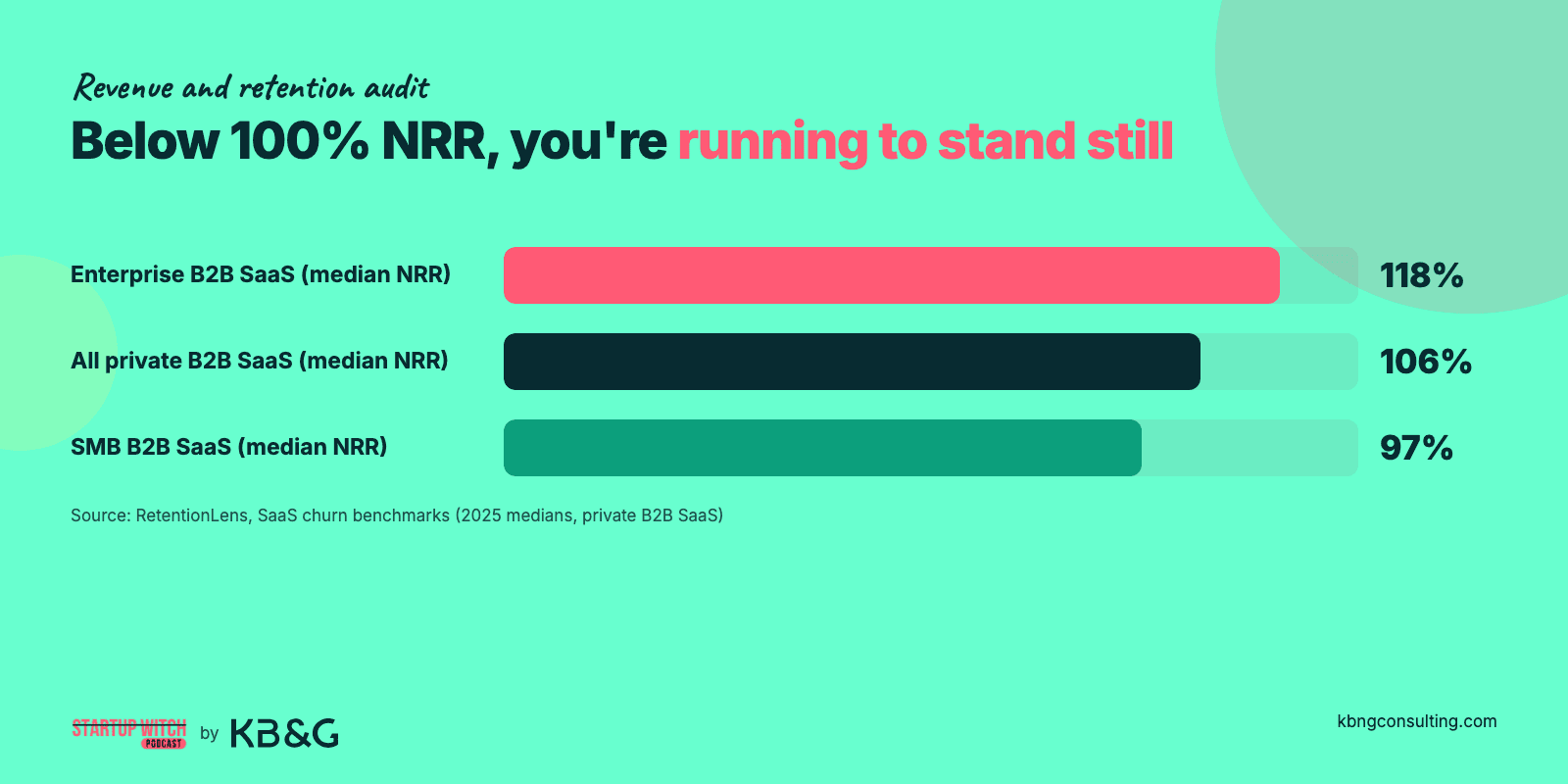
For reference, B2B SaaS retention benchmarks put 2025 median net revenue retention (NRR) for private B2B SaaS at about 106%, with enterprise segments around 118% and SMB segments around 97%. Anything below 100% NRR means your expansion revenue isn't offsetting churn: you're running to stand still.
Retention and Churn Checklist
Calculate logo churn and revenue churn for the past 6–12 months. Simple counts are fine if your data is messy. Healthy monthly customer churn for B2B SaaS is typically under 1%, while early-stage companies under $300K ARR commonly run around 6.5% a month.
Identify when churn tends to happen: After trial? At first renewal? After the champion leaves the company? Knowing when is as important as knowing how much.
Look at product usage patterns of healthy vs. at-risk accounts: logins per week, key feature usage, number of active users per account. Single-user accounts with declining usage are your highest churn risk.
Check whether you have a systematic way to collect feedback from churned customers: Exit calls, short surveys, email exchanges. If you don't ask, you're guessing.
Output: Two to three common churn reasons and one to two "save" or expansion opportunities you're currently missing.
Customer Feedback and Learning Loops Checklist
Assess how often you speak directly to users and buyers. Weekly? Monthly? Only during sales? Pair those conversations with NPS and churn data to see what actually drives satisfaction or dissatisfaction.
Check where customer insights live: Scattered in Slack threads and personal notes, or centralized in a simple doc or CRM field? Undocumented customer feedback is a silent growth killer.
Review whether you systematically turn feedback into product or copy changes, with a clear owner, timeline, and follow-up. How many product decisions in the past 90 days were backed by real user feedback versus founder intuition or investor pressure?
Output: Define a simple recurring habit: three customer conversations per week, a monthly "voice of customer" review, and a process for feeding insights back into roadmap decisions.
With this data laid out, you still need to decide what to do first. That's where focus and prioritization come in.
Focus and Decision-Making Audit
Most founders don't lack ideas. They lack ruthless prioritization. This section checks whether your roadmap, experiments, and daily operations match what the audit just revealed, or whether you're chasing shiny objects while your growth engine leaks.
Roadmap and Experiment Discipline Checklist
List your top three to five current initiatives (features, channels, partnerships) and classify each as acquisition, conversion, retention, or "shiny object." Be honest.
Check if each initiative has a clear success metric tied to growth (e.g., +5% trial-to-paid, +20% demo bookings) and a defined timeframe.
Audit your last 90 days of work: How many changes were driven by data versus founder anxiety or investor comments? If most were reactive, your roadmap isn't yours.
Verify whether you kill experiments that don't work or let them linger indefinitely, consuming limited resources and attention.
Output: A trimmed list of three things you'll actively pursue in the next 90 days, and three you'll deliberately pause or kill.
Operating Rhythm and Accountability Checklist
Assess whether you have a recurring growth review ritual (weekly or bi-weekly) with the team, even if it's just two people for 30 minutes.
Check if you have a single place where key metrics and audit outputs are visible. A simple dashboard or shared doc is fine. If your growth metrics live in someone's head, they effectively don't exist.
Review whether each critical metric has clear owners: sign-ups, demos, MRR, churn. Even if the owner is you for everything right now, make it explicit.
Output: Define a simple operating rhythm, e.g., a weekly 30-minute growth review with a standing agenda: metrics snapshot, blockers, decisions needed.
Now that the audit is complete, turn it into a focused, time-bound action plan.
Turning Your Growth Audit into a 90-Day Action Plan
The audit is useless unless it converts into a short, brutal list of actions with owners and dates. This is where most startups fail: they run the audit, feel informed, then change nothing. Don't be that founder.
From Findings to Priorities
Follow this four-step process:
List all issues and opportunities you uncovered, grouped by category (foundation, offer, funnel, retention, focus).
Score each by impact (on revenue or traction) and effort (time, complexity, dependencies). Use a simple high/medium/low grid.
Choose three to five high-impact, low-to-medium-effort items as your next 90-day priorities. Not ten. Not "everything." Three to five.
Translate each priority into a mini-project with an owner, a deadline, and a success metric.
Example: If your trial-to-paid conversion rate is 5% and most churn happens in month one, the highest-impact work is probably onboarding and activation, not opening a new acquisition channel. Fix the leaky bucket before pouring in more water.
Maintaining the Audit Loop
Schedule the next full audit in 90 days and monthly check-ins on key metrics. Consistency matters more than perfection.
Keep a living document of audit snapshots to show progress over time. This is useful for investor updates, board meetings, and internal morale: you can actually see what changed.
Adjust your ICP, positioning, and pricing as you learn, rather than treating them as permanent. As your startup grows, these should evolve with your data.
If you want a done-for-you external read instead of running this yourself, Startup Witch by KB&G offers the Founder Blind Spot Diagnostic. It reads your startup in 14 days and names the one thing blocking growth. It costs EUR 750 and is fully refundable.
Common Growth Audit Findings and How to Fix Them
Most early-stage audits reveal a handful of recurring patterns. Here are the ones you'll most likely recognize, and what to do about them.
Problem 1: Lots of Traffic, Few Trials or Demos
Symptoms: High site sessions, but a low visitor-to-lead rate.
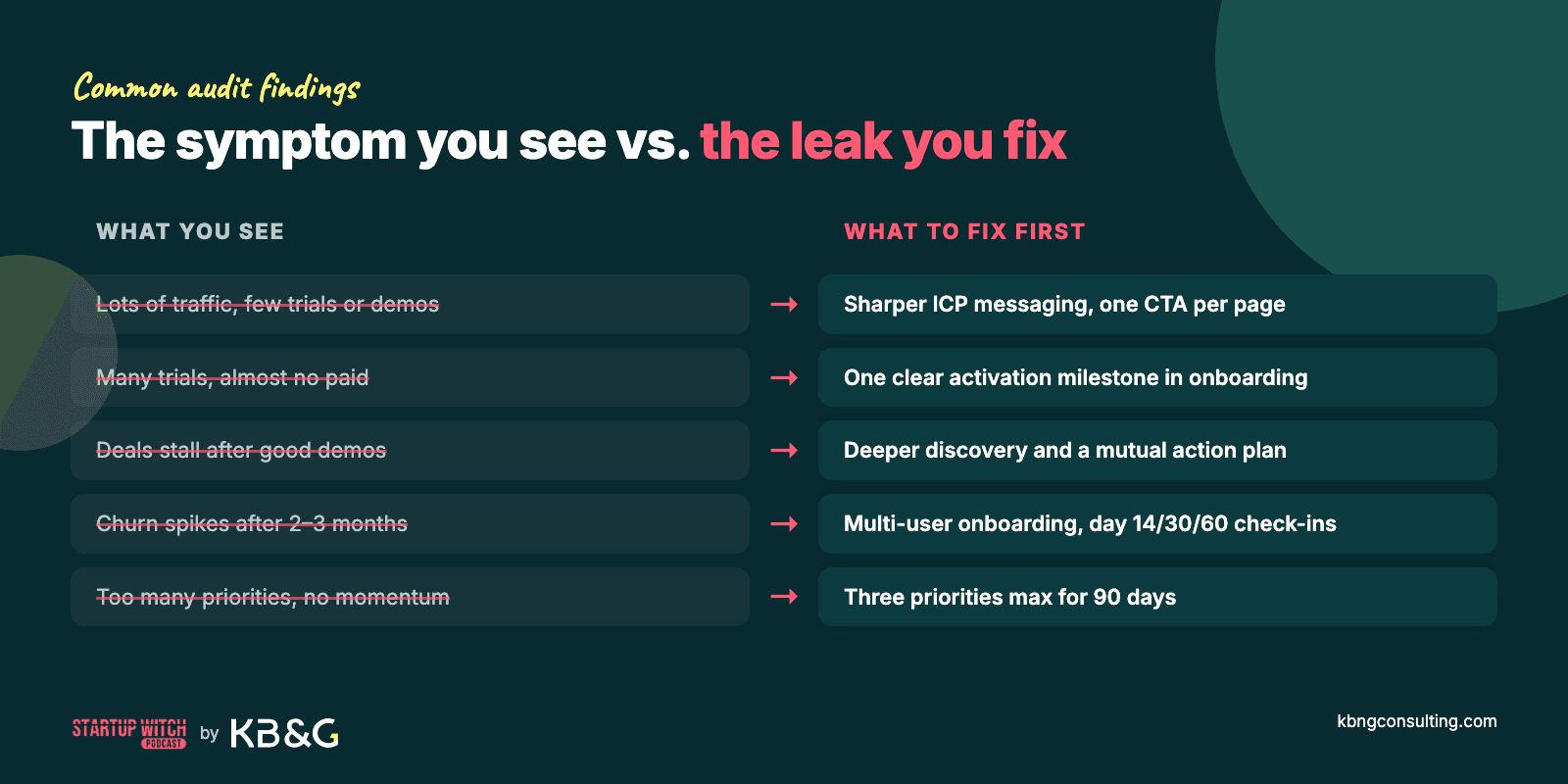
Fixes: Sharpen your ICP messaging so the headline speaks to a specific buyer and outcome. Use one primary CTA per page. Build focused landing pages per segment instead of one generic homepage. Remove fluffy jargon. Add concrete outcomes and social proof from customers in your target industry. Faster page loads help too.
Problem 2: Many Trials, Almost No Paid Conversions
Symptoms: Sign-ups look healthy, but activation rate is low and engagement in the first week is weak.
Fixes: Define activation clearly and redesign onboarding around that single milestone. Add in-product guidance that drives users to the first value event. Offer high-touch onboarding calls for qualified accounts. Extend or adjust trial length for enterprise buying cycles: a seven-day trial is meaningless for a company with a six-week procurement process.
Problem 3: Deals Stall After Good Demos
Symptoms: "They loved it," then silence for weeks.
Fixes: Do stronger discovery before the demo so you understand their internal metrics, procurement timeline, and blockers. Always end with a clear next step and a mutual action plan. Send a written recap email within 24 hours. Frame ROI in their specific KPIs. Pre-empt internal procurement, regulatory compliance, and security questions, especially in industrial AI, where these are the real reasons deals stall, not "they're busy."
Problem 4: Churn Spikes After 2–3 Months
Symptoms: Churn clustered in the first one to three months, poor adoption beyond the initial champion.
Fixes: Multi-user onboarding where possible: if only one person uses the tool, you lose the account when they leave or get reassigned. Provide internal enablement materials so your champion can train others. Proactive check-ins at day 14, 30, and 60. Set up usage alerts to flag at-risk accounts before they churn. Conduct structured feedback calls before cancellation; sometimes a 15-minute conversation saves the deal.
Problem 5: Too Many Priorities, No Momentum
Symptoms: Constantly starting new initiatives, but key metrics barely move quarter over quarter.
Fixes: Brutally cut your initiative list. Commit to a 90-day focus on three things maximum. Institute weekly metric reviews where someone is accountable. Tie every roadmap decision directly to what the audit revealed, not to what a prospect mentioned once or what a competitor launched.
The goal isn't a perfect audit. It's a clearer, more focused next 90 days.
Conclusion and Next Steps
A startup growth audit checklist is a practical way to see exactly where your growth and money are leaking, so you stop guessing and start making targeted fixes. It surfaces problems you've been ignoring or didn't know existed, and gives you evidence-based business decisions instead of hope-based ones.
You don't need complex tools or perfect data to do this. You need honesty, your existing data, and a willingness to choose a few priorities and commit to them.
Here's what to do now:
Block one to two days on your calendar to run the audit with your core team.
Fill out the checklist sections and capture current metrics snapshots for each area.
Choose three to five high-impact actions for the next 90 days and assign clear owners.
Schedule the next audit date before you close the document. Don't let it become a one-time exercise.