
What Is the Most Common Bad Startup Advice?
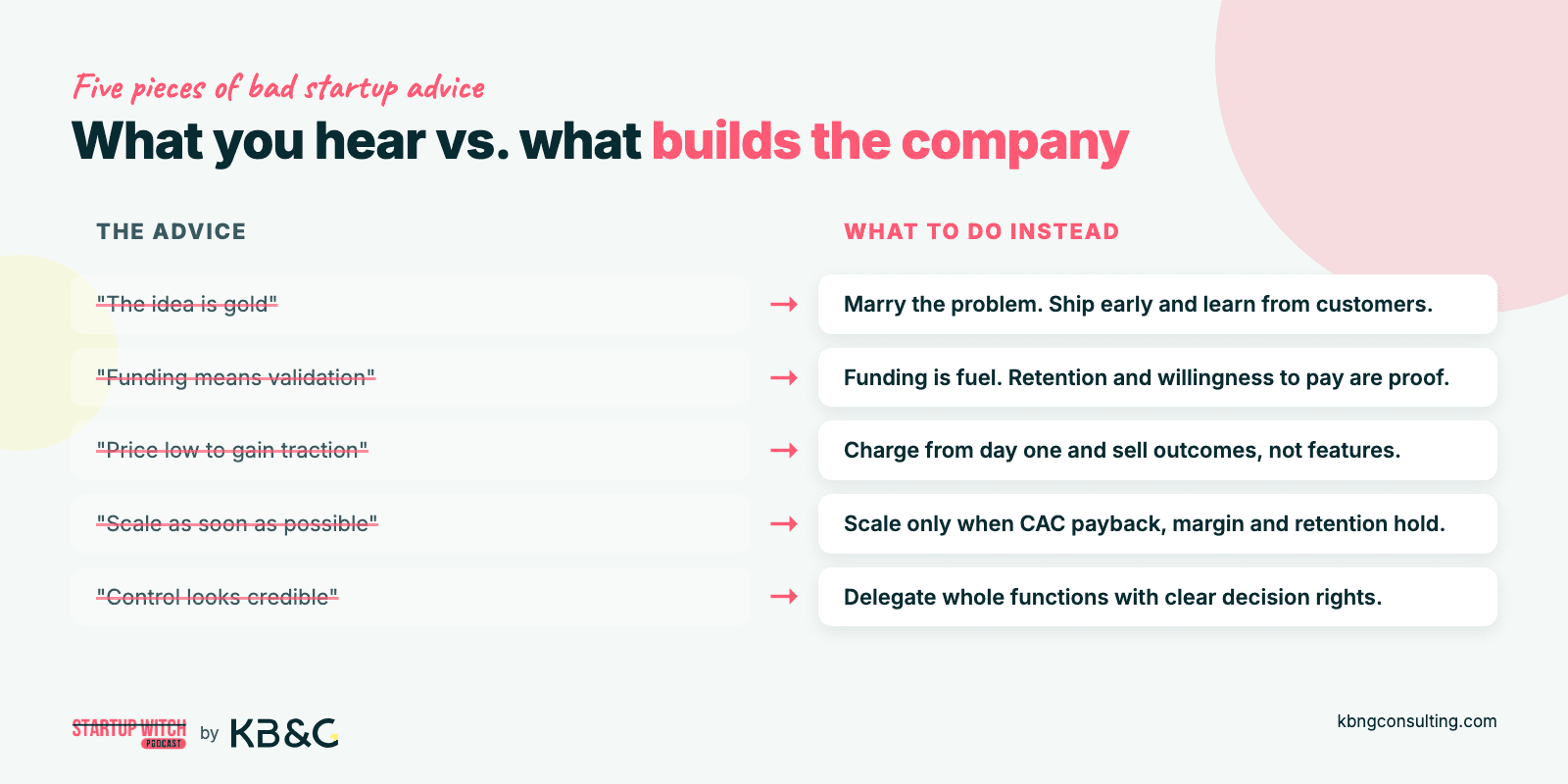
The most common bad startup advice is the kind that sounds intelligent but quietly drains your momentum: that the idea is gold, that funding proves your market, that VC is a must, that you should price low, scale fast and control everything yourself. The reality is less glamorous and far more useful: execution, retention, a real go-to-market plan, lean teams and clear ownership are what actually build a company.
Whether you're a first-time founder or a seasoned entrepreneur, you hear the same conventional wisdom everywhere: chase funding, move fast and ride the hype, or be left behind. The problem is that chasing the wrong advice, especially advice that sounds smart, is one of the fastest ways to lose momentum. So I put together 16 widely accepted startup beliefs that don't help, and what to do instead. Sixteen sounds like a lot, I know, but it's as short as I could make it. My goal is to shift the narrative and help you build with more clarity.
You can also watch the full episode of Startup Witch on YouTube.
1. "The Idea Is Gold." Reality: Execution Matters Most
The best founders flirt with an idea, but they fall in love with the problem and marry it. Ideas are cheap. ChatGPT can generate more creative ideas in one afternoon than most of us come up with in a year. What builds companies, and what leads to success, is solving a known problem well: learning quickly, iterating, and securing customers early. The brilliant idea rarely survives first contact with customers anyway, so adapt it to their feedback instead of clinging to the original version. Just an idea, however clever, is not a company.
What to do instead: ship earlier than feels comfortable and stay close to your users. Their behavior and customer feedback will teach you more than any amount of polishing the idea in your head. (If you're still defending how unique your idea is, read my post on entrepreneur myths that quietly kill momentum.)
2. "Funding Means Market Validation." Reality: Plenty of Well-Funded Startups Still Die
Raising money from investors feels like proof. It isn't. A closed fundraising round is not a verdict from the market, and a high valuation doesn't equal success. Investment gives you legitimacy, visibility and resources. What it doesn't do is solve retention, churn, product problems or bad unit economics.
The data backs this up. Research by Harvard Business School's Shikhar Ghosh, covering more than 2,000 venture-backed companies that raised at least $1 million between 2004 and 2010, found that about three out of four never return their investors' capital. A more recent CB Insights analysis of 431 VC-backed startups that shut down since 2023 found that the median company had raised $11 million before it died. More capital did not buy those companies a working business model.
What to do instead: see funding as fuel, not proof of product-market fit. Validate retention, willingness to pay and unit economics before you raise money to increase your burn rate.
3. "VC Is a Must." Reality: Not Every Great Business Is Aligned With Venture Capital
Venture capital is designed for hyper-growth markets with very big outcomes. If that's not your business, VC money and its pressure for hyper-growth can push you onto a roadmap that doesn't serve the company. And not every great founder is aligned with VC either.
There are alternatives. Grants give you non-dilutive capital, credibility, R&D partners and access to ecosystems. I've also been advised to try friends, family and fools. Personally, I prefer professional investors, because they bring structure and experience along with the money.
What to do instead: look at the grants and innovation programs in your region, and consider combining grants, an angel investor or two and early revenue. Plenty of good businesses start bootstrapped or funded by their first customers, and you don't need venture capital to build a successful business.
4. "The Founder Is the Best Head of Sales." Reality: Your Enthusiasm Sells Early, Then Becomes the Bottleneck
In the beginning, nobody sells your product like you do. But unless you're a natural sales magician, being the only closer slows the whole company down. Founder-led sales works in the early days; it doesn't scale. I wrote more about this in founder-led sales wins deals and hides your blind spots.
What to do instead: build a sales machine. Document your ideal customer profile (ICP), your message, and your discovery, qualification and closing flow. Look for sales talent earlier than feels logical. And learn the basics of scalable sales in your niche, so you can evaluate the workload and hire people with the right skill sets.
5. "Demos Should Only Be Done by Specially Trained People." Reality: Everyone Should Be Able to Demo the Basics
For planned, high-match demos, the founder or a trained team member should lead. But everyone in the company should be able to demo the basics confidently: what problem the product solves, for whom, and how well. I heard Max Junestrand, CEO of Legora, make this point on stage at Slush 2025, and I fully agree.
What to do instead: teach the whole team a basic demo. It speeds up the company, strengthens your culture and buy-in, and turns everyone into an internal advocate for the product.
6. "Price Low to Gain Traction." Reality: Discounts Hide Weak Value
Low pricing backfires. Discounts hide weak value differentiation, and the real issue is usually that customers don't yet understand the value. Teaching customers to pay from day one sets the tone, signals professionalism, and shows your team that their work has worth. Someone who refuses to pay often doesn't see the value, and they would probably churn anyway.
Here's what many founders miss: in a lot of companies, price is not the biggest hurdle. Internal approvals, compliance, security reviews and plain bureaucracy are. Cutting your price won't get you through any of those.
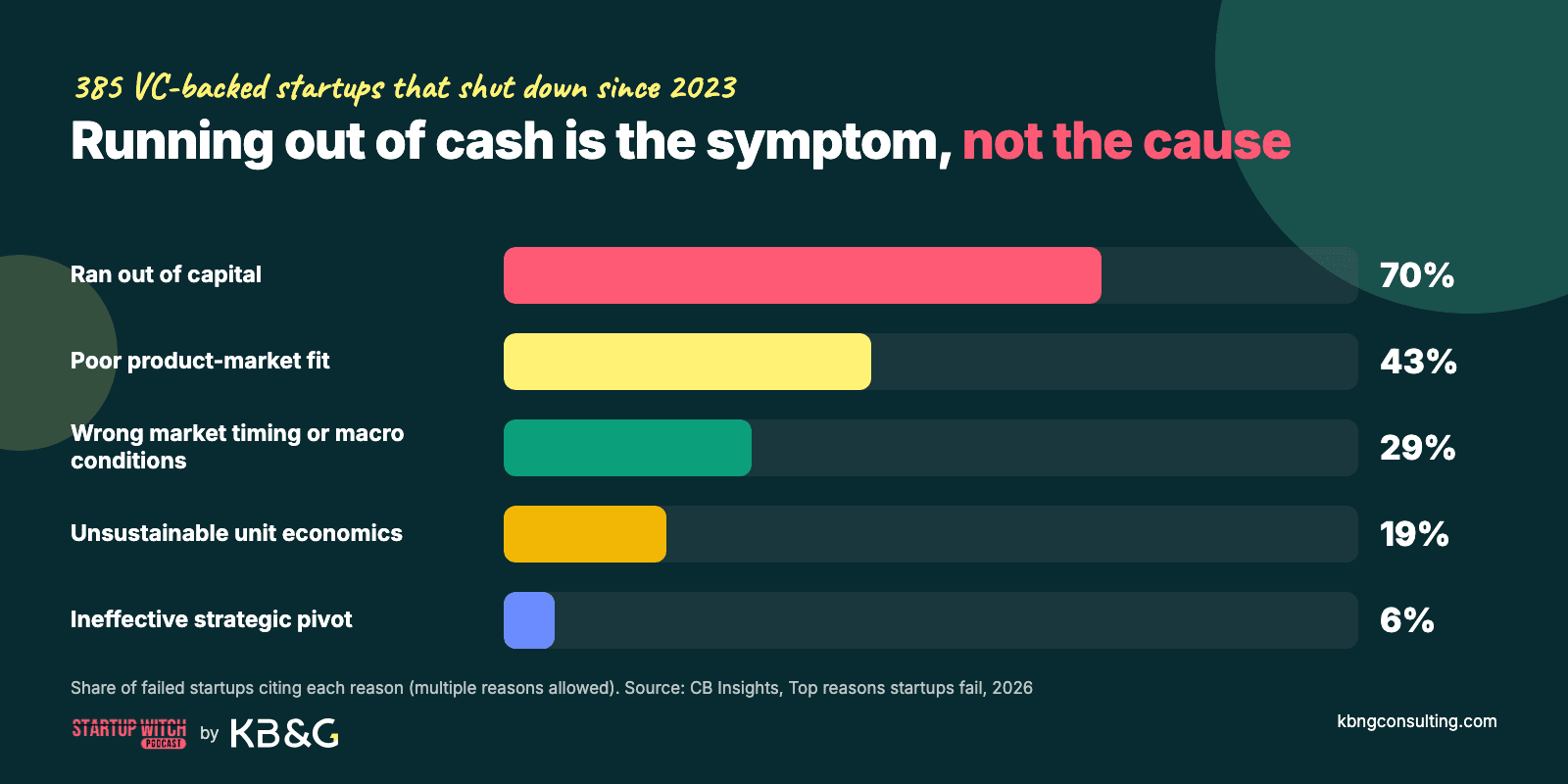
Research gives this a sharper edge: in the CB Insights shutdown analysis, 19% of failed startups cited unsustainable unit economics as a reason they died. A price that never covers your costs leads straight there.
What to do instead: price properly. Frame value around outcomes, not features, and show the ROI. Use case studies (borrow them if you must), before-and-after examples and impact stories. And use pricing to filter out who is really committed. For more, see my guide to SaaS pricing strategy.
7. "PMF Is Binary, and You Have It." Reality: Product-Market Fit Is a Spectrum
Almost every founder thinks they have product market fit. Most don't. Startups don't succeed overnight: I know brilliant businesses that took five years of iteration to reach real PMF. One enthusiastic customer is not fit.
In the real world, fit looks like this: customers renew, refer and advocate for you without being pushed. The signals are usage, retention, customer satisfaction, customer engagement and healthy growth, not a heavily promoted free trial with a 90% drop-off.
This is not a small risk. Poor product-market fit was the second most common failure reason in the CB Insights study, cited by 43% of the startups whose reasons could be identified. Only "ran out of capital" (70%) ranked higher, and the researchers describe running out of money as the final cause of death, not the root problem.
What to do instead: treat PMF as something you measure continuously, not a box you tick. My post on product-market fit validation goes deeper.
8. "Scale as Soon as Possible to Show Growth." Reality: Scaling Too Early Multiplies Waste
Premature scaling burns money on sales, marketing and operations before the product is ready, and recovering from it is painful, sometimes impossible. Scaling a broken model just makes it louder and more expensive. Sustainable growth means your cash flow and customer demand can carry the extra spend. Growth without product-market fit just produces poor retention.
The best-known research on this is the Startup Genome report on premature scaling, based on about 3,200 high-growth internet startups. It found that 74% of them failed because of premature scaling, 93% of those that scaled prematurely never passed $100,000 in monthly revenue, and startups that scaled properly grew about 20 times faster. The data is from 2011, but the pattern is familiar.
Which Metrics Should You Check Before You Scale?
Focus on a few gating metrics, not your gut. My rules of thumb:
CAC payback: under 12 to 18 months.
Gross margin: healthy. If you scale a business with a tiny margin, you may never break even.
Retention: stable and meaningful. Otherwise you're pouring customers into a leaking bucket.
What to do instead: scale the features you've validated, and launch new ones as a beta, the way many B2C products do.
9. "Move Fast." Reality: Move Fast, but Don't Break Trust
"Move fast and break things" was Facebook's famous early motto, and much of Silicon Valley adopted it. Moving fast is fine, as long as you don't break trust. Sloppy releases break customer confidence, and no amount of speed saves trust once it's damaged. Speed without quality is just a mess.
What to do instead: build solid development foundations. You need a strong, available tech lead or architect who structures the process, keeps your technology stable and respects the service levels you promised customers. One of the best early investments you can make is QA automation.
10. "Hiring Isn't an Issue Nowadays." Reality: One Wrong Hire in Your First Five Can Sink You
Early hires shape your culture, your speed and the emotional temperature of the team. One wrong person in your first five can sink the company. You need competent people with the right attitude, who take the project seriously.
What to do instead: work on your managerial skills and plan in a structured way. Give new hires several different projects during the trial period; capable people don't need 30 days to learn. Set clear 30/60/90-day expectations and spend around two to four hours a week supporting each new hire. That means reviewing their work and validating achievements, not micromanaging. (Related: if you're hiring juniors for your startup, it's too late.)
11. "Build a Great Product and Customers Will Come." Reality: Great Products Need an Even Greater Go-to-Market
There is no perfect product that sells itself. A great product with no go-to-market strategy stays invisible. Distribution and marketing are as critical as product development. And selling to the wrong persona can be the reason a startup fails.
What to do instead: define your persona and ICP early, and craft messaging around the problem you solve, not the product you built.
12. "Any Revenue Is Good Revenue." Reality: Bad Customers Cost More Than They Pay
Bad customers leave, complain, or both. In SaaS, churn isn't revenue. Unfit customers also distort your product: they pull your roadmap in random directions that serve nobody else, and your focus goes with it.
The right customers are the ones who stay, so choosing them well protects your retention.
What to do instead: define and enforce your ICP. Design qualification questions early. They can be technical, data-driven, perception-driven or related to the buying process.
13. "A Solid Process and a Big Team Make You Faster." Reality: Lean Beats Large
People who come from a big company or large companies in general often bring the belief that more people means more speed. But startups aren't mini corporations. They're closer to the wild west. What you need is clarity and ownership, not approval layers. Adding people too early often slows you down and adds cost and confusion.
I learned this the hard way. At one of my startups we cut 25% of our development capacity. It was emotionally tough. And our speed increased dramatically: fewer cooks, fewer steps, fewer dependencies.
The same Startup Genome research found that startups which scaled prematurely had teams about three times bigger than consistent startups at the same stage.
What to do instead: keep the team lean and the ownership clear. Lean beats large, and clarity beats complexity.
14. "A Founder Looks More Credible Controlling Everything." Reality: If Every Decision Needs You, You'll Never Scale
If every decision goes through you, you'll never scale, your team never grows up, or you never find out who the right team is. Delegating 20% of a function isn't delegating.
How Do You Delegate a Whole Function?
Delegate the whole function, not a slice of it.
Define ownership clearly.
Hold people accountable for results. It's the only reliable way to know who fits.
Give decision rights with clear guidelines and a few validation points, such as extra spending or changes to the plan.
Move from daily approvals to weekly or monthly alignment.
What you need as a founder is visibility, trust and accountability, not control of every detail.
15. "Documentation Is for Big Companies." Reality: A Verbal Operating System Collapses Fast
A purely verbal operating system collapses even between two people. Context gets lost and decisions get made again and again. With today's AI tools there's no excuse: record and summarise sales calls, product interviews, weekly updates and roadmaps. If your team is remote, give everyone a note-taker.
What to do instead: write lightweight SOPs for recurring tasks; a simple flow is enough, and it helps enormously with onboarding. Use a tool like ClickUp to centralise documents, tasks, meeting notes and roadmaps. Documentation gives you clarity and alignment, and it preserves your speed.
16. "Go-to-Market Means Direct Sales, Especially in B2B." Reality: The Fastest Route Can Be Someone Else's Audience
Direct sales is a slow and expensive path to market early on. Partnering with complementary SaaS products and platforms can bring you warm customers much faster, through relationships the partner already has. Many founders are afraid a partner will steal their idea. Your job is to find the right partners.
What to do instead: identify the tools your ICP already uses and look for overlaps. Start small: shared content, co-marketing, an integration or a referral agreement. A lightweight partnership can open more doors than weeks or months of cold outreach.
What Does the Research Say About Most Startups and Bad Advice?
The research on why startups fail keeps pointing at what this bad startup advice encourages:
Funding is not a safety net. About three in four venture-backed companies never return investors' capital (Harvard Business School, Shikhar Ghosh).
Scaling early is the classic trap. 74% of the high-growth startups in the Startup Genome dataset failed because of premature scaling (Startup Genome).
Survival is a long game. Of new US private-sector business establishments, 77.9% survive their first year, 51.4% survive five years and 34.7% are still operating after ten (latest cohorts, US Bureau of Labor Statistics).
How Do You Tell Good Startup Advice From Bad Advice?
Every piece of bad advice on this list has a grain of truth: funding does help, speed does matter, founders do sell well early on. The myth is in treating that grain of truth as the whole picture. Good advice fits your stage, your market and your business model; bad advice is generic, outdated or written for a big company. Even advice from famous founders may lack the context of your situation. Before you act on any startup advice, ask:
A Quick Checklist: Does This Startup Advice Fit Your Business Model?
Does it help you learn from real customers faster, or does it keep you polishing an idea?
Would it still make sense if you never raised another round?
Does it protect retention, gross margin and CAC payback, or does it only make growth look good?
Does it add people, layers or approvals, or does it add clarity and ownership?
Does it keep you selling to your ICP, or does it pull you toward the wrong things and the wrong customers?
Does the person giving it have experience relevant to your stage and industry, and a track record of building, not just talking? Do your due diligence.
Why Do Startup Founders Believe Bad Startup Advice?
Because it sounds intelligent, and startup founders and first-time entrepreneurs hear it from every direction. In an early stage startup, there is rarely time to check where a rule came from. The real challenges of entrepreneurship are messy, and a simple rule feels safer. If any of these beliefs felt uncomfortably familiar, that's a good sign. It means you're aware of it, and awareness is where real change begins. Stop building on beliefs that don't serve you, start building on reality and operate from it: your clarity improves, your decisions get faster and your progress becomes visible, wherever you are in your startup journey.
FAQ: Bad Startup Advice
What is the #1 mistake startups can make?
For me, it's believing the idea is what matters most and polishing it instead of shipping. Ideas are cheap; execution, learning quickly and securing customers early are what build a company. Fall in love with the problem, not the idea.
Is it true that 90% of startups fail?
It depends on how you define failure. According to the Bureau of Labor Statistics, about half of new business establishments survive five years and roughly a third are still operating after ten. For venture-backed startups the odds are worse (see the Harvard research above). Either way, most startups don't make it, which is exactly why following the wrong advice is so expensive.
What are the top 5 reasons for startup failure?
In the 2026 CB Insights analysis of 385 failed VC-backed startups, the top five reasons were running out of capital (70%), poor product-market fit (43%), wrong market timing or macro conditions (29%), unsustainable unit economics (19%) and an ineffective strategic pivot (6%, tied with being outcompeted by rivals).
Behind those labels, most startups don't die from one dramatic event. More often it's a slow drain: scaling before retention is stable, selling to the wrong persona, one wrong early hire, or a founder who has to approve every decision. Most of the bad advice in this list leads to one of those.
Do you need venture capital to succeed as a startup?
No. VC is designed for hyper-growth markets with very big outcomes, and it can push other businesses onto the wrong roadmap. Grants, angel investors and early revenue are real alternatives, and they can be combined.
Why do funded startups still fail?
Because funding doesn't fix retention, churn, product problems or bad unit economics. Fundraising buys time and resources, nothing more. If you increase your burn before you've validated willingness to pay and retention, the money just helps you scale the problem.
Not Sure Which Bad Advice Is Holding You Back?
If you have built something real and it isn't growing the way it should, the problem is often in your blind spots. The Founder Blind Spot Diagnostic by Startup Witch reads your startup in 14 days and names the one thing blocking growth. It costs EUR 750 and is fully refundable.
Watch Now: 16 Widely Accepted Startup Beliefs That Don't Help (And What Does!)