
Why Do Startups Get Stuck?
Most startups don't get stuck, or fail, because of one missing feature or one bad month. They get stuck because of a few invisible patterns that founders refuse to see and address: hesitation, cheap positioning, shallow relationships, emotional fragility around feedback, starting sales and marketing too late, and making decisions based on hype.
So no, I can't fix your startup in 10 minutes. Did you really think that was possible? I hope not, because startups are complex systems and they don't collapse for a single reason. But if you're not too detached from reality, you can spot these patterns in 10 minutes and start fixing the behavior that's holding you back. If your product is built, the roadmap is clear, the team is solid, and you're still not where you want to be, this is for you.
You can also watch the full episode of Startup Witch on YouTube.
Key Takeaways
Startups often get stuck due to a lack of product-market fit, premature scaling or poor cash flow management, but those are outcomes of founder behavior.
Poor product-market fit is the most-cited root cause of startup failure in CB Insights data (43%); running out of capital (70%) is usually the final cause, not the first.
Premature scaling is a common mistake: the Startup Genome Report links it to 74% of high-growth internet startup failures.
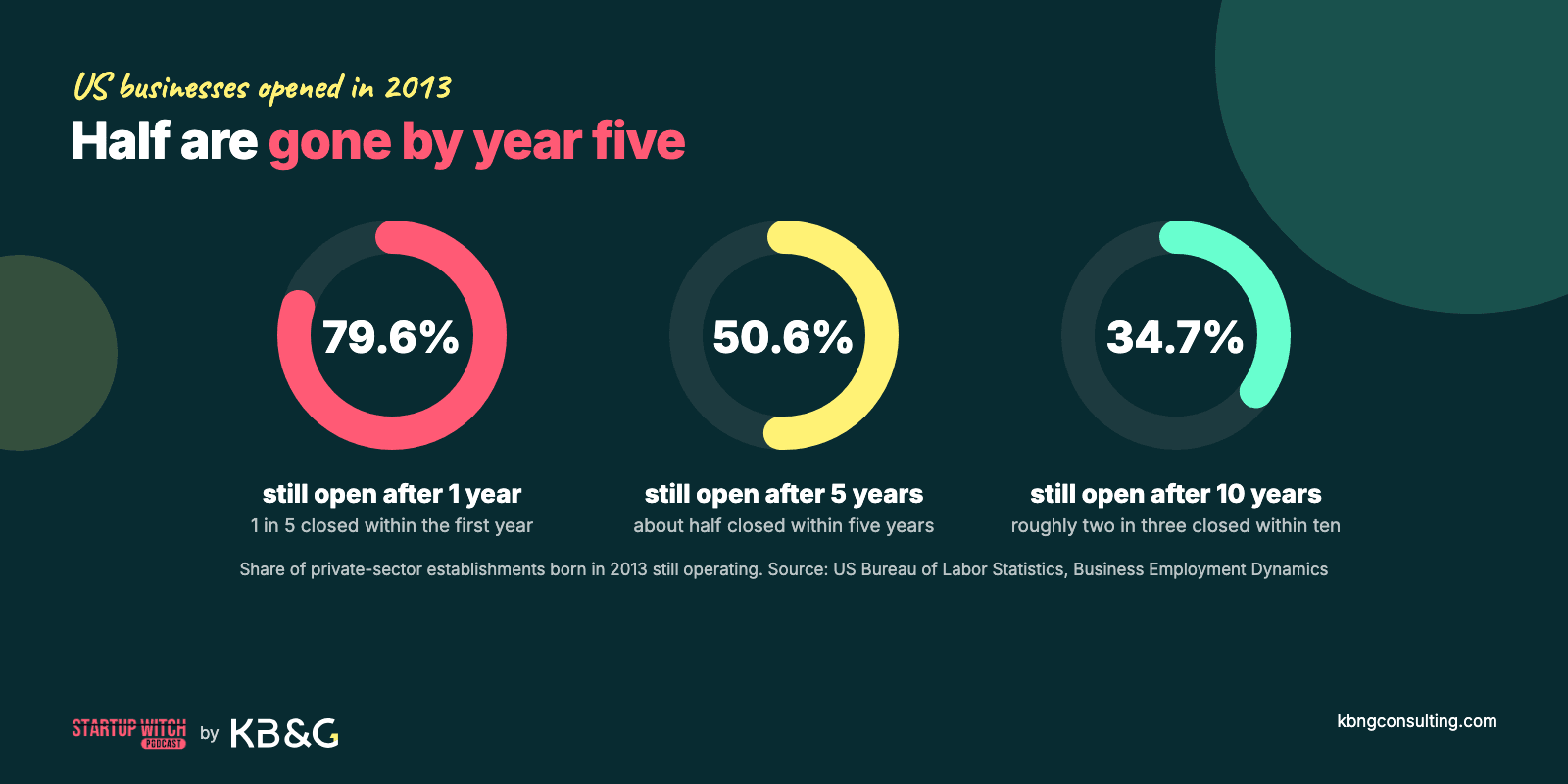
About one in five new US businesses closes within its first year and about half are gone within five years, according to the Bureau of Labor Statistics.
Operational bottlenecks, founder burnout and resistance to pivoting can halt startup growth, and all of them trace back to how the founder decides.
Why Do Startups Fail, and Why Do So Many Stay Stuck in the Startup Phase?
The usual answers to why startups fail are well known, and the numbers behind the major causes of startup failure are sobering. CB Insights analyzed 431 venture-backed companies that shut down since 2023: 70% ran out of capital, 43% cited poor product-market fit, 29% bad timing or macro conditions, and 19% unsustainable unit economics. The other explanations you'll hear again and again:
No validated demand: many startups fail to validate customer demand, building the product before checking that customers actually want it.
Weak customer understanding: not knowing users well enough prevents effective product development.
Poor cash flow management: spending ahead of revenue until the runway is gone, which leads to stagnation long before the company shuts down.
Premature scaling: trying to scale up before the business model works, a common challenge for startups.
Ineffective marketing and distribution: heavy reliance on one marketing channel, or on none, strains customer acquisition.
Not adapting when markets change: difficulty adapting results in stagnation, and resisting a pivot the numbers clearly call for can stall growth.
Team problems: misalignment within the founding team, operational and governance bottlenecks, scaling the wrong team culture, and founder and team burnout that hurts execution quality. The Startup Genome Report found that solo founders take 3.6x longer to reach the scale stage than a founding team of two.
Lack of focus: poor execution spread across too many priorities.
All of that is real, and any of it can make a startup fail. But notice that most of those reasons are outcomes. Even CB Insights calls running out of capital "almost always the final cause of death, not the root problem." Nobody wakes up and decides to build something without demand or to scale up too early. Those outcomes come from founder behavior that repeats every week: how you make decisions, how you price, who you spend time with, how you react to criticism and to competitors. That's the part most advice skips, and that's why so many entrepreneurs stay stuck in the startup phase long after the idea has been proven.
Being stuck is also far more common than the success stories suggest. According to US Bureau of Labor Statistics survival data, of the private-sector establishments opened in 2013, 79.6% were still operating after one year, 50.6% after five years and only 34.7% after ten. Venture funding doesn't change the picture much for entrepreneurs: research by Harvard Business School's Shikhar Ghosh on more than 2,000 venture-backed US companies found that about three-quarters never returned their investors' capital.
The 6 Patterns That Keep Many Startups Stuck
None of these patterns show up in your product analytics. They show up in how you, the founder, make decisions every day. That's why many startups stay stuck for an extended period even with a working product, early traction and a few loyal early adopters. Most founders look for the answer in new features, new technology or a new growth hack. The answer is usually in their own behavior, and it's something you can control.
Here are the six patterns in the order I'd look for them.
1. Are You Trying to Build a Startup, or Actually Building One?
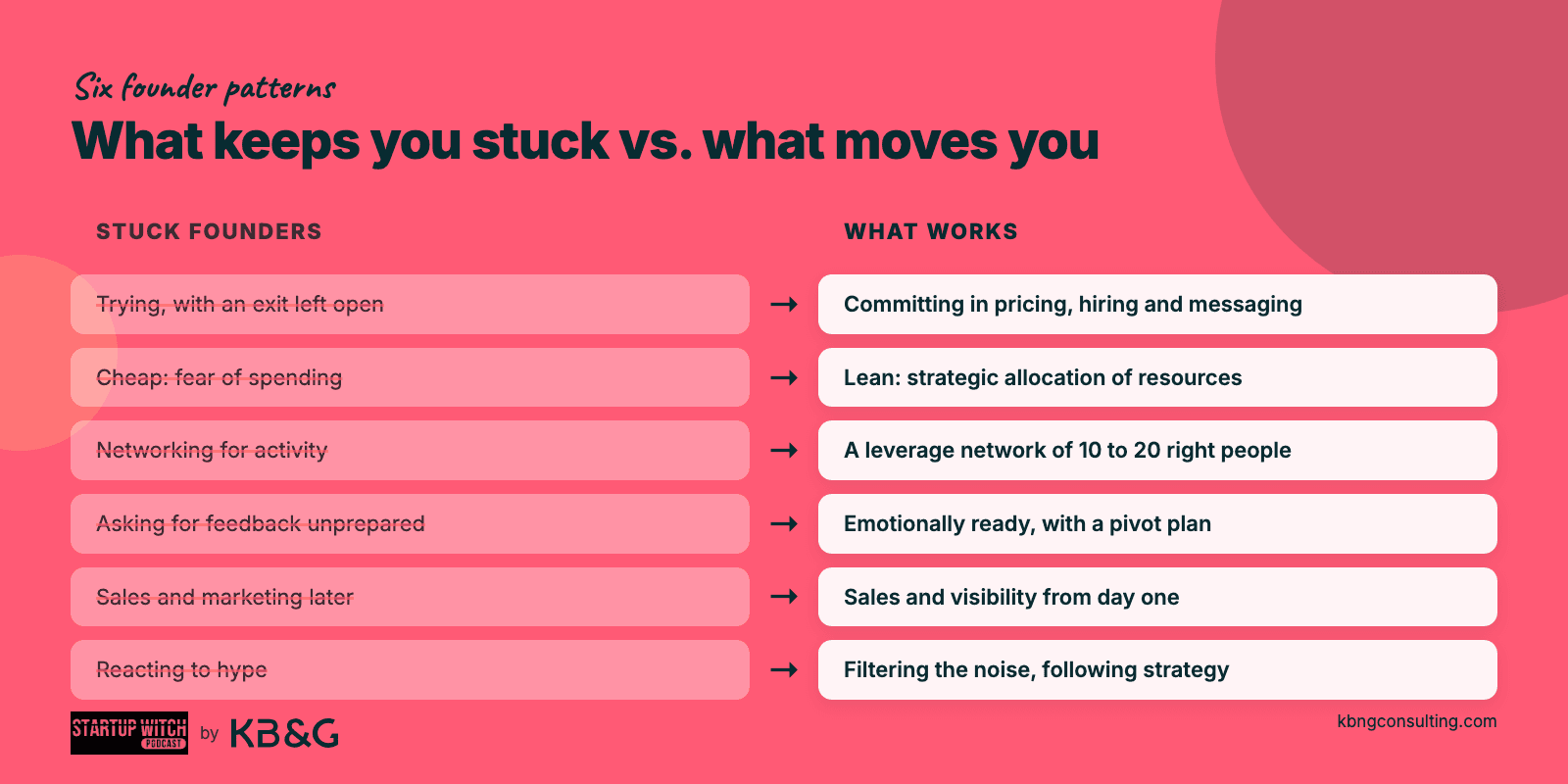
Many startup founders are trying. Trying to build, trying to raise, trying to see if it works. That word is the problem.
When you're trying, you leave an exit open. You negotiate with difficulty. You soften decisions. You avoid uncomfortable moves. A startup doesn't respond to hesitation; it responds to commitment.
When someone is fully committed, you see it everywhere:
In pricing: they don't undercharge out of fear.
In hiring: they don't tolerate mediocrity.
In messaging: they don't sound unsure or apologetic.
Trying is cautious energy. Building is decisive energy. Your customers, your team, your co-founder and your investors can feel the difference long before you say a word about your business model or your vision.
2. Is Your Startup Lean, or Just Cheap?
There is a difference between lean and cheap. Lean means strategic allocation of resources. Cheap means fear of spending. Both feel like good management of money in the moment, but only one of them helps you achieve growth.
You cannot expect premium clients with a discount presentation, unless you work in a purely technical environment where only the equations matter. For everyone else, perception drives trust and trust drives money.
I hear founders say it all the time: "I'll improve this later." "We'll invest in positioning after revenue." "We'll get better tools once we grow." That logic keeps you small, because serious clients assess signals instantly:
your visual standard,
the clarity of your communication,
the maturity of your process,
your tool stack.
Research shows how fast that first judgment happens. In a widely cited study, Lindgaard and colleagues found that people form an opinion of a web page's visual appeal within 50 milliseconds, long before they read a word about your product.
You cannot sell a 100k solution wrapped in $500 energy. Perception doesn't replace product, and it won't fix product-market fit. But it can remove a lot of doubts and move you up the list of potential vendors when a buyer is choosing who to take seriously.
3. Is Your Network Busy, or Is It Leverage?
Stop networking for activity and start building a leverage network. Building strong relationships early is one of the most underrated growth decisions a founder can make.
We spend enormous amounts of time in conversations that never flourish: random coffee meetings, endless intro calls, surface-level connections without meaningful advancement. It feels productive, but it's not. Meeting more people is not the same as making progress.
I'm not suggesting you drop your networking buddies and friends. Add more meaningful people to the mix. Build an environment where every relationship has some future activation potential:
subject matter experts,
early hires,
advisors,
strategic partners,
early customers.
If you surround yourself with people who are aligned with you long term, execution becomes much easier and it's far simpler to move the business forward when you hit a wall. You don't need a huge number of contacts. Sometimes 10 to 20 of the right people is more than enough.
The data backs up the value of the right people over more people. The Startup Genome Report on premature scaling, based on more than 3,200 high-growth tech startups, found that startups with helpful mentors, which also tracked their metrics and learned from startup thought leaders, raised 7x more money and had 3.5x better user growth.
4. Are You Emotionally Ready for Feedback?
This is the only one I'll make personal, because it hits differently. No one prepares founders for the emotional cost of feedback.
You build something, you invest time, and you attach your identity to it. Then you present it, and the response is most likely not excitement. It's criticism.
What Happened When My Brand Concept Got Rejected
Recently I worked for six months on a brand concept aligned with our long-term vision. The strategy was clear and the direction was intentional. The first reactions were not small adjustments: the entire direction was questioned. People suggested changing the name and the visuals, and they challenged the whole angle and the creative direction of the ads.
I was not prepared for that much resistance. I even considered changing everything, until I found a way to use different storytelling to solve it (but that's another story).
That's when I realized feedback is not just data you collect. When you're deeply passionate about what you do, its emotional impact can be really damaging.
Questions to Ask Yourself Before You Ask for Feedback
Before you ask anyone for feedback on your product, your brand or your pitch, ask yourself:
If they hate it, what will I do?
Do I have a pivot plan?
Do I have the emotional stability to hear it?
Can I separate my identity from the iteration?
If you can't, feedback will paralyze you instead of refining you. And a paralyzed founder kills momentum faster than a bad feature ever could.
5. Why Should Startups Start Sales and Marketing Early?
Building is no longer rare. Smart distribution is. AI builds, no-code builds, and developers build fast. Selling, positioning and channel maturity are where the competitive advantage is now. Innovation in the product alone won't carry you if nobody knows it exists.
If you wait until the product is perfect before you build visibility, you're already late. Start now:
Identify where your target audience lives.
Find out which events matter.
Test which channels convert.
Learn which messaging resonates.
Remember: your startup is not your product. Your startup is your ability to consistently sell your wonderful product. That's how you keep strategic focus on what actually moves revenue, instead of launching one more feature and hoping users find it.
Early traction on its own isn't proof either. CB Insights found that two-thirds of the product-market fit failures in its dataset were early-stage companies that never found a market, and that 20 Series B or later companies also cited poor product-market fit, having raised on early traction that never widened into a real market.
6. How Do You See Through the Hype?
Competition creates pressure and hype creates distortion. Both can be good for some markets. But you see huge funding rounds, press announcements and growth screenshots, and you assume everyone is ahead of you. Most of your competitors probably aren't. Many are scaling chaos and burning cash silently.
Respect your competitors. Study them and understand their timing. But don't react emotionally to noise. If you pivot every time someone announces something, you don't have a strategy; you have insecurity.
Applause and thousands of LinkedIn likes don't equal revenue and growth. Markets change, and competition will always be loud. Learning to filter out the noise can save you years.
Research supports deliberate pivots over reactive ones. The same Startup Genome analysis found that startups that pivoted once or twice raised 2.5x more money, had 3.6x better user growth and were 52% less likely to scale prematurely than startups that pivoted more than twice or not at all.
What Does the Research Say About Why Startups Get Stuck?
The research doesn't use my words, but the real-world data points in the same direction: the numbers describe outcomes, and behind most of them sit founder decisions.
Scaling before the model works is the big killer. The Startup Genome Report found that 74% of high-growth internet startups fail because of premature scaling, meaning they scale up the team, customer acquisition or product before the business model works, that no startup that scaled prematurely passed the 100,000-user mark, and that 93% of those that scaled prematurely never broke $100k in monthly revenue. Startups that scale properly grow about 20 times faster.
The founder is the variable in startup success. In Noam Wasserman's study of 212 American startups, published in Harvard Business Review, 50% of founders were no longer CEO by the time their ventures were three years old, only 40% were still in the role in year four, and fewer than 25% led their companies to an IPO.
That's why this article starts with founder behavior. You can't control the macro climate or what competitors announce, but you can control how you commit, price, network, take feedback, sell and react to competition.
How to Spot What's Keeping Your Startup Stuck in 10 Minutes
You can't fix a startup in 10 minutes, but you can run an honest check on yourself. Take one question per pattern and answer it without softening:
Commitment: Where am I still "trying" and leaving an exit open, in pricing, hiring or messaging?
Positioning: Does the way we look, communicate and work match the price we want to charge?
Relationships: Who are the 10 to 20 people who could actually move this company forward, and am I investing in them?
Feedback: If the next round of feedback is harsh, do I have a plan and can I separate my identity from the iteration?
Sales and hype: Am I building visibility and sales channels now, and am I making decisions based on strategy rather than on what competitors announce?
If one of those answers made you uncomfortable, that's the point. Growth is rarely comfortable.
Founder Checklist: What to Change This Week
Once you know which pattern is yours, begin with one concrete move instead of new growth tactics:
From trying to committing: close one exit you've been keeping open, and stop softening your price or your message.
From cheap to lean: fix the one signal serious clients see first for your product or service, whether that's your visual standard, your communication, your process or your tools.
From busy to leverage: write down your 10 to 20 people (experts, early hires, advisors, partners, early customers) and invest in them instead of another random coffee.
From fragile to ready: answer the four feedback questions before your next pitch, brand or product review.
From late to early sales: pick one channel and one message to test now, not after the next release.
From noise to strategy: before you react to a competitor, check whether anything changed for your customers or your numbers.
Founder-Level Shifts Change Companies
Put the six patterns together and you get a clear picture of why startups get stuck: hesitation, cheap positioning, shallow relationships, emotional fragility, a late focus on sales, and hype-driven decisions. None of them is a product problem. They are founder and leadership problems, which is good news, because founder-level shifts change companies faster than another feature release. You don't need to work harder at the same things; you need to change the behavior underneath them before you try to scale up.
FAQ: Why Startups Get Stuck
Is it true that 90% of startups fail?
It depends on how you count. The "90%" figure is repeated everywhere, but the official data looks different. BLS survival data shows about half of new US businesses are still operating after five years and about a third after ten. For venture-backed startups, Shikhar Ghosh's research found about three-quarters don't return investors' capital. Either way, the odds are tough for entrepreneurs, and the founder patterns above are the part you can actually control.
What are the top 5 reasons why startups fail?
In CB Insights' 2026 analysis of shut-down venture-backed startups, the leading reasons were running out of capital (70%), poor product-market fit (43%), bad timing or macro conditions (29%) and unsustainable unit economics (19%). Add premature scaling, which the Startup Genome Report links to 74% of high-growth internet startup failures. My view: those are the outcomes. The causes usually sit in the six founder patterns above.
What kills a startup?
Usually not the product. A hesitant or paralyzed founder kills momentum faster than a bad feature ever could, and momentum is what a startup lives on. Add cheap positioning, late sales and hype-driven pivots, and even a startup with product-market fit can run out of cash before it reaches the growth phase.
Why do founders often fail as CEOs?
Often because they stay in "trying" mode: they soften decisions, avoid uncomfortable moves, and take every piece of feedback or every competitor announcement personally. Being a CEO means committing, separating your identity from the iteration, and making decisions based on strategy rather than noise. The research shows how common the transition is: in Wasserman's study, half of founders were no longer CEO by year three.
How do you fix a startup that has stopped growing?
Start with the founder, not the roadmap. Identify which of the six patterns applies to you, pick the one that hurts most, and change that behavior first. Many founders learn the hard way that shipping another feature rarely fixes a problem that lives in positioning, relationships or sales.
Can a startup have product-market fit and still get stuck?
Yes. Product-market fit is essential, but it isn't the finish line. A proven idea with early traction can still stall when the founder stays in trying mode, prices cheap, starts sales late or pivots on hype. That's why many startups with a working product and a sound business model still don't reach the growth phase.
Should you pivot when a competitor raises a big round?
Not by reflex. Study the competitor, understand their timing, and check whether anything actually changed for your customers. Pivoting every time someone announces something is insecurity, not strategy. A pivot makes sense when your own customers and your own numbers tell you something is wrong, not when a competitor's press release does.
Not Sure Which Pattern Is Yours?
If your product is built and your startup still isn't growing the way it should, the Founder Blind Spot Diagnostic by Startup Witch reads your startup in 14 days and names the one thing blocking growth. It costs EUR 750 and is fully refundable.
Tell me in the comments on YouTube which pattern hit you hardest. Next time I'll go deeper into how I handle brutal feedback without losing strategic direction.
Watch Now: Give Me 10 Minutes and I'll Fix Your Startup… Or Will I?