
What Is Fear of Failure for Founders?
Fear of failure for founders is the anticipation of losing money, credibility, time or self-worth if the company does not work. It rarely stops founders outright. More often it quietly redirects their week: away from sales calls, pricing conversations and direct asks, and towards safer work like building one more feature.
This piece is for early-stage AI, SaaS and industrial-tech founders who are busy, whose product keeps improving, and whose uncomfortable conversations keep sliding to next week. If that sounds familiar, fear is probably steering.
Here is what you will get:
- What the research actually says about fear of failure among entrepreneurs, including how common it is and how fast it is rising.
- Why fear can push you forward in some moments and freeze you in others.
- How loss aversion, the ask gap and impostor feelings show up in a founder's ordinary week.
- A practical way to overcome fear of failure: name the fear, then act on the smallest next ask.
How Common Is Fear of Failure Among Entrepreneurs?
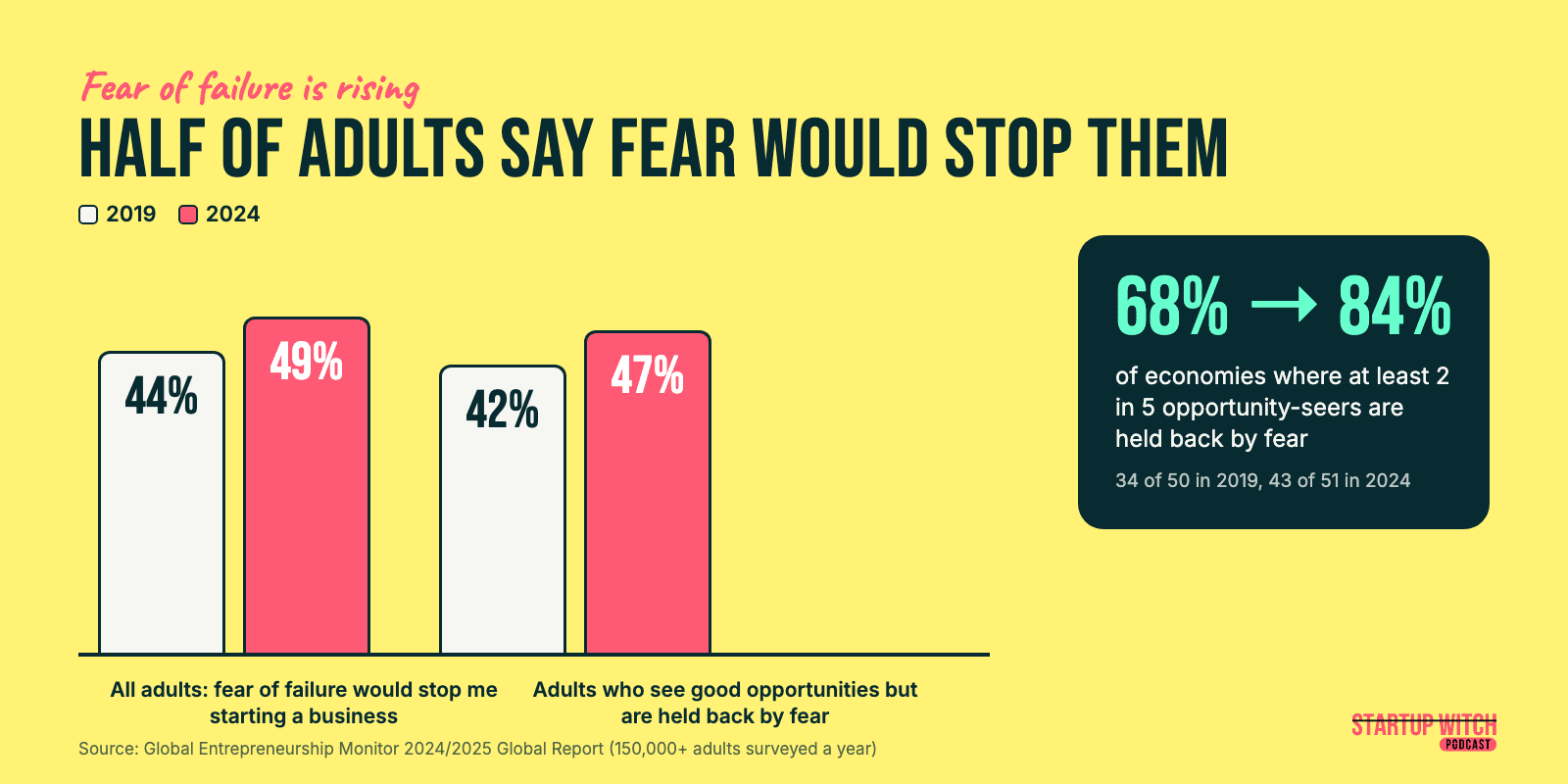
Very common, and growing. The Global Entrepreneurship Monitor (GEM), which interviews more than 150,000 adults a year, found that the share of people who say fear of failure would stop them starting a business rose from 44% in 2019 to 49% in 2024. Among people who saw good business opportunities around them, the share held back by fear rose from 42% to 47%.
The spread across countries is just as striking. In 2019, 34 of 50 economies (68%) had at least two in five opportunity-seers held back by fear. By 2024 that was 43 of 51 economies (84%), according to the GEM 2024/2025 Global Report. Note that 84% is the share of economies, not a rate of increase.
The newest edition, the GEM 2025/2026 Global Report, covering 53 economies and more than 160,000 interviews, puts it at about two in five adults deterred by fear of failure, even as early-stage activity sits at record highs. The wording of the measure differs between reports, so read that as "still very high", not as a sudden drop.
Context matters too. A study of 42 countries using GEM and cultural data found that fear of failure reduces entry into entrepreneurship, and that national culture changes how strongly it does so. Your fear is partly shaped by where you are. It is not a flaw unique to you.
Those numbers measure who never begins. Founders are the people who began anyway, so fear of failure for founders rarely looks like paralysis. It looks like a slightly different set of priorities.
The Two Faces of Fear: It Inhibits and It Motivates
For years, research treated fear of failure as a fixed personality trait. A systematic review by Cacciotti and Hayton argued that this was a mistake, and that fear is better understood as a temporary state that depends on the situation. That is good news: a state is something you can work with.
The follow-up study interviewed 65 entrepreneurs and would-be entrepreneurs in the UK and Canada and found seven distinct sources of fear:
- Financial security
- Ability to fund the venture
- Personal ability and self-worth
- Potential of the idea
- Social esteem
- Ability to execute the venture
- Opportunity costs
These fears do not behave the same way. In the published paper, worry about opportunity costs was linked to more persistence. Worries about the idea's potential or your own ability reduced proactivity. Fear also showed up as procrastination, "paralysis through analysis", distorted goal-setting and escalation of commitment: doubling down on a plan because stopping would feel like failing.
The founders coped in four ways: emotional self-monitoring, problem solving, learning and support seeking. A later scale-development study by the same team confirmed that the different dimensions of fear have different effects. Fear does motivate as well as inhibit. This research tells you how fear works, not how many founders feel each type, but it gives you a better question than "Am I scared?": "Which fear is active this week, and what is it making me avoid?"
Loss Aversion: Why the Downside Feels Heavier
Behavioural economists have a name for one reason fear steers so well: loss aversion. Kahneman and Tversky's prospect theory described people weighing losses more steeply than equivalent gains. The best modern estimate comes from a meta-analysis of 607 estimates from 150 articles, which found an average loss-aversion coefficient of 1.955 (95% interval 1.82 to 2.10).
Put simply: on average, losses tend to feel about twice as heavy as gains, though the size varies a lot by person and situation. Some researchers argue the effect is more context-dependent than often claimed, so treat it as a tendency, not a law.
For a founder, raising prices risks losing a customer you already have, which feels heavier than the revenue you would gain. Asking for a pilot risks a visible "no", which feels heavier than the deal you might win. None of this feels like fear in the moment. It feels like prudence.
The Ask Gap: You Are Probably Overestimating the No
Many founders know they should ask more: for the demo, the intro, the pilot, the price. What stops them is a forecast: "They will say no."
That forecast is often wrong. In a series of studies, Flynn and Lake found that people underestimated how often others would agree to a direct request by as much as 50%. In a fundraising field setting, participants expected to need about 50% more solicitations than they actually did. The reason: askers focus on what saying yes costs the other person and underweight how awkward it is for people to say no.
An honest caveat: these were studies of help requests, not B2B sales or venture fundraising. Treat it as an analogy, not proof that your next investor will say yes. But the direction is useful: your gut is probably too pessimistic, and the only way to find out is to ask. For more on the ask in early selling, see how to get your first 10 customers.
Impostor Syndrome in Founders: Why the Numbers Are All Over the Place
Be sceptical of any precise percentage of founders with impostor syndrome. A systematic review of 62 studies with 14,161 participants found that the prevalence of impostor feelings ranged from 9% to 82%, depending largely on which screening tool and cutoff each study used. On gender, 16 of 33 studies found higher rates in women and 17 found no difference.
The range itself is the story. Most of those studies used convenience samples, many of them students, and the review flags possible publication bias. None of them measured founders specifically. What the review does support is that impostor feelings are widespread, co-occur with depression and anxiety, and are associated with burnout and poorer job performance.
Founder Anxiety, Stress and the Habits It Locks In
Stress changes how you decide. A review in Nature Reviews Neuroscience describes how even brief, uncontrollable stress can rapidly impair the prefrontal cortex, the part of the brain responsible for working memory, flexible thinking and planning, and shift control towards faster, more habitual circuits. Much of that mechanism comes from animal work, but the practical lesson is clear: under threat, you do more of what you already do.
A founder's habits are usually product habits: under pressure, the code editor feels calmer than the CRM. And avoidance is less about general nervousness than you might think. A meta-analysis of 691 correlations found that procrastination is most strongly predicted by how aversive a task feels, low self-efficacy, impulsiveness and low conscientiousness, while the general anxiety trait had only a weak link. Both of the top two are things you can change.
In one survey of 242 entrepreneurs, 49% reported one or more lifetime mental-health conditions, and 72% were affected directly or through family history. That was a self-reported, non-random sample, so it is not a population estimate, and it did not single out anxiety. Still, it is a good reason to treat professional support as normal. More in our piece on startup founders and stress.
What Fear Looks Like in a Founder's Week
Fear of failure rarely announces itself. It shows up as reasonable-sounding behaviour.
| Behaviour | What it protects you from | What it costs | Smallest next step |
|---|---|---|---|
| Avoiding sales calls ("the product isn't ready") | Hearing that buyers don't care | Months of building without real demand signals | Book one call with a past contact this week |
| Delaying the ask for a pilot or payment | A visible "no" | Friendly conversations that never convert | End your next call with one direct, specific ask |
| Overbuilding before launch | Judgement on a rough version | Runway spent on features nobody asked for | Show the current version to one target user |
| Not raising prices | Losing existing customers | Thin margins and a business that cannot fund itself | Quote the new price to the next new prospect only |
| Endless research and planning | Committing to a direction that might be wrong | "Paralysis through analysis" and lost momentum | Pick one assumption and test it by Friday |
| Doubling down on a failing plan | Admitting a pivot is needed | Escalation of commitment and wasted runway | Write down the evidence that would change your mind |
Each behaviour is protective in the short term and expensive in the long term. And each has a smaller, less frightening version of the thing you are avoiding.
How to Overcome Fear of Failure: What Actually Helps
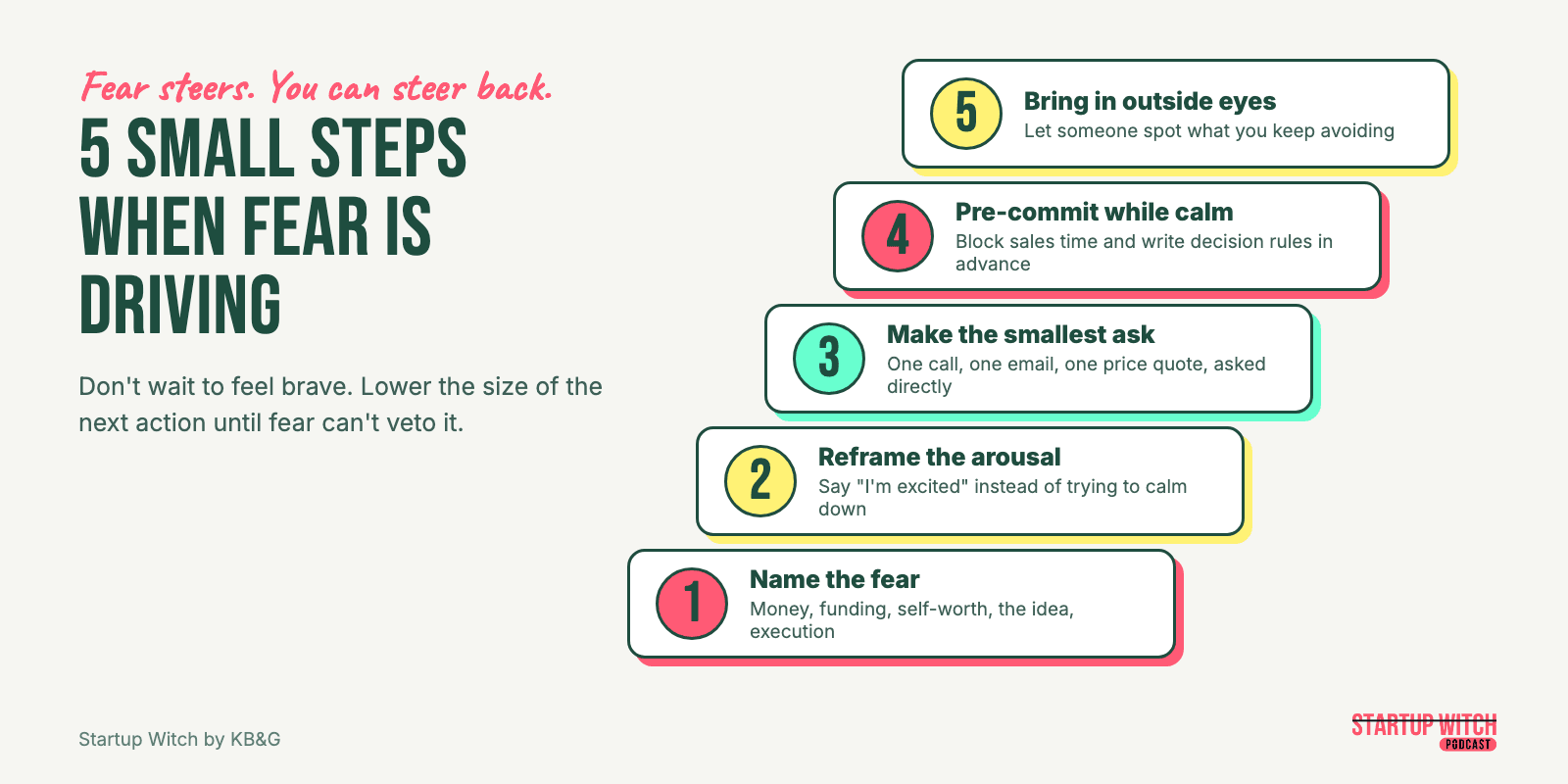
You will not remove fear, and you do not need to. The goal is to stop it steering.
1. Name the fear
Use the seven sources as a checklist. Is it money, funding, self-worth, the idea, social esteem, execution or opportunity cost? Write down which one is active this week and what it is making you avoid. This is the emotional self-monitoring founders in the Cacciotti study used to cope. Fear about the idea's potential becomes a test, such as a customer interview or a pricing page. Fear about your ability becomes a skill gap to fill or delegate.
2. Reframe the arousal instead of trying to calm down
Before a pitch, the instinct is to tell yourself to relax. In experiments involving karaoke, public speaking and maths, people who reappraised anxiety as excitement ("I am excited") performed better than those told to calm down. Students told that arousal helps performance did better on GRE maths practice and on their real GRE months later.
A roughly 30-minute online module combining growth mindset with the idea that stress can be enhancing was tested in six double-blind randomised controlled trials, with the first study including 2,717 participants. It reduced threat-type stress responses, and helped most those who started with the most negative mindsets.
The caveat: the early studies were small, and all of these samples were students, not founders. No study has tested stress reappraisal on founder performance directly. Treat it as transferable evidence worth practising, not proof.
3. Make the smallest next ask
This is the core move. Since procrastination tracks how aversive a task feels, shrink the task until it stops feeling aversive. Not "do sales this week" but "email one past contact asking for 20 minutes". Then make it direct. The ask gap research suggests your "no" forecast is inflated, so test it. Keep a simple log of the yes rate you predicted against the yes rate you got.
4. Set pre-commitments while you are calm
Because stress shifts control towards habit, decide in advance. Block two sales hours on Tuesday morning before the week fills up. Put a cooling-off rule on big decisions like pivoting, firing a cofounder or signing a term sheet, and write your decision criteria while you are calm, so the calmer version of you sets the rules.
5. Bring in outside eyes
Support seeking was one of the four coping strategies founders actually used. Someone outside can see the conversation you have filed under "not ready yet": a peer founder, an advisor, or a mental-health professional if anxiety is affecting your health. Founder-led selling is a common place for these blind spots to hide, which we unpack in Founder-Led Sales Wins Deals and Hides Your Blind Spots.
When You Can't See What Fear Is Steering
The hardest part of fear of failure is that it disguises itself as good judgement. If you suspect something is steering your startup but cannot name it, the Founder Blind Spot Diagnostic by Startup Witch reads your startup in 14 days and names the one thing blocking growth. It costs EUR 750 and is fully refundable.
Frequently Asked Questions About Fear of Failure
Is fear of failure normal for entrepreneurs?
Yes. GEM data shows about two in five adults worldwide are deterred from starting a business by fear of failure, and the share rose between 2019 and 2024. Founders still feel it once they start; it usually changes their priorities rather than stopping them.
Can fear of failure be useful for founders?
Sometimes. Fear about opportunity costs was linked to more persistence, while fear about the idea's potential or your own ability reduced proactivity. Identify which type you are feeling.
How do I stop fear of failure from stopping my startup?
Name the specific fear, then shrink the avoided task to its smallest next ask: one call, one email, one price quote. Make the ask direct, set pre-commitments while you are calm, and get outside eyes on what you might be avoiding.
What percentage of founders have impostor syndrome?
Nobody knows reliably. A systematic review of 62 studies found impostor feelings ranged from 9% to 82%, depending mainly on how they were measured, and none of the studies focused on founders. Be wary of any single figure.
What is loss aversion and how does it affect founders?
Loss aversion is the tendency to feel losses more strongly than equivalent gains. On average, losses feel about twice as heavy, though this varies by person and situation. For founders it can make raising prices, asking for commitments or shipping early feel riskier than it is.