
What Is Founder Sales Training?
Founder sales training is how you, as a technical or operator founder, systematically learn discovery, qualification, pricing, objection handling, and closing so you can sell your own product and then teach your team to do the same. It is not a weekend bootcamp or a playlist of sales advice on YouTube. It is a deliberate practice loop: run calls, record them, review what happened, fix one thing, repeat.
This guide is for B2B SaaS and AI founders doing founder-led sales who were never formally trained in sales. If you built the product but freeze when a prospect asks about pricing, or if your pipeline is full of "interested" contacts who never sign, this is for you. The scope here is practical: call-by-call improvement, specific skills you can train this week, and clear signals for when to bring in outside help, tools, or a founder community that gives you peer feedback and shared examples. Generic sales mindset content and big-enterprise field-sales playbooks that assume a 50-person sales team are out of scope.
To start founder sales training this week: turn on call recording for every sales conversation, build a simple discovery framework with five to seven questions, and review at least two calls before Friday. The investment is small; the compounding effect on your revenue is not.
By the end of this article, you will:
Know the core sales skills most founders lack and how to train them deliberately.
Have a simple training plan for the next 30 days of founder-led sales.
See how poor founder sales habits cascade into your whole go-to-market team later.
Understand when to DIY, when to use tools, and when to hire a coach or your first sales rep.
Have concrete frameworks and checklists to reference as you improve.
Why Founder Sales Training Matters for AI and SaaS Founders
Founder sales training is not a single course or certification. It is the ongoing process of building a deliberate, repeatable system that covers discovery, qualification, pricing, objection handling, closing, and pipeline hygiene, then iterating on that system through practice and feedback. It differs from one-off courses or YouTube binges because its foundation is a loop: practice, record, review, adjust. Theory without reps changes nothing.
This matters for technical and operational founders building AI or SaaS because your buyers are skeptical, your sales cycles are long, and your product is complex. Decision-makers evaluating your tool care about regulatory compliance, integrations, and ongoing support, not just your architecture diagram. Without structured discovery, you misread what buyers actually need. Without feedback loops, you never see why deals die. Most early-stage startups rely on founder-led sales, which means the founder's sales skills (or lack of them) directly determine whether the company finds product-market fit or burns through runway chasing deals that were never real.
Founder-Led Sales vs. Professional Sales Reps
When you sell as a founder, you bring domain authority that no hired sales rep can match. You built the product. You understand the market from the inside. Buyers sense that, and it earns you meetings that a cold-calling SDR would struggle to book.
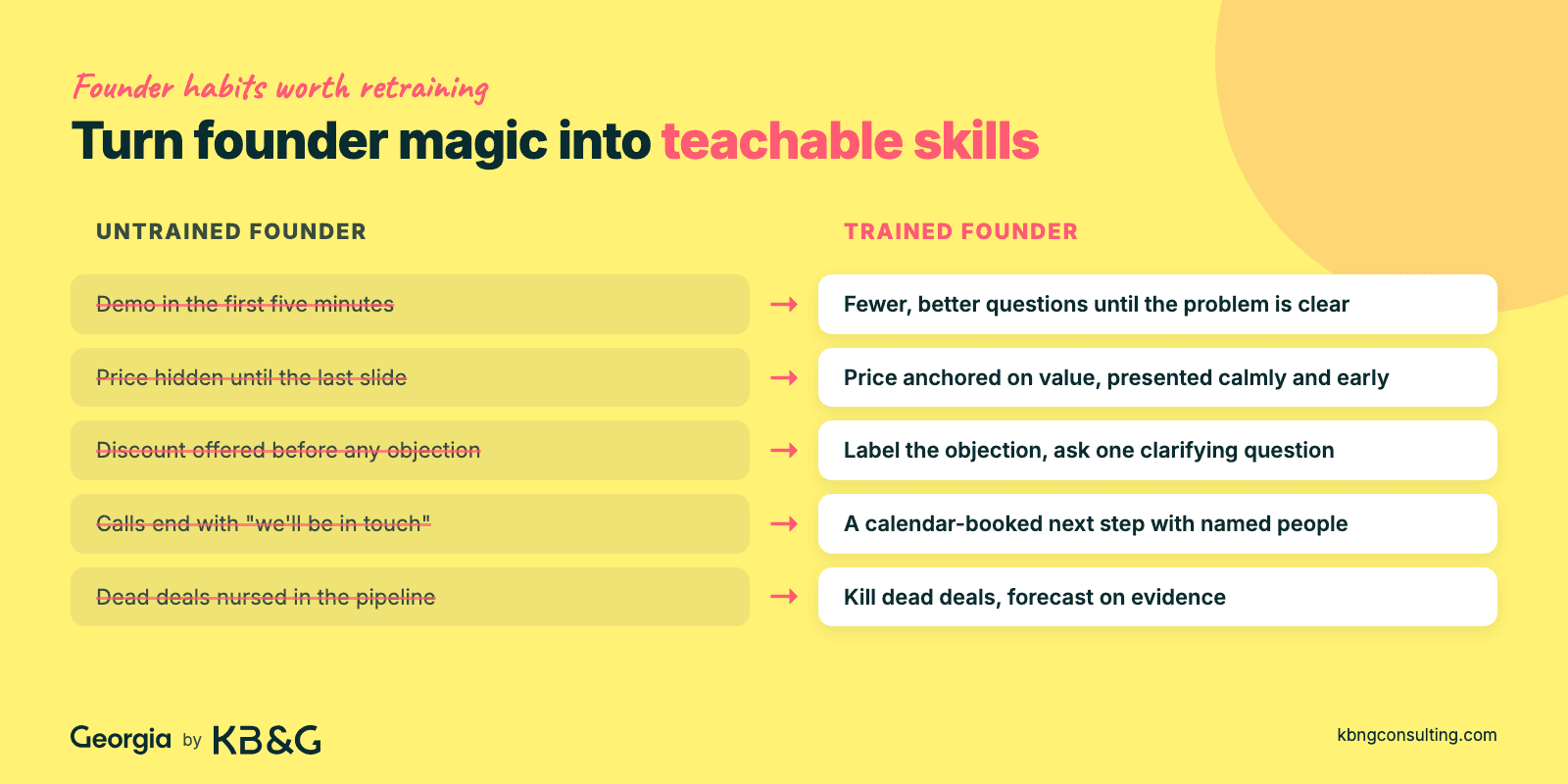
But domain authority is not a sales process. Founders typically jump straight into demos, solve problems live on the call instead of qualifying the opportunity, and skip the step where you confirm whether the prospect has budget, a timeline, or a champion who can push the deal through procurement. These patterns feel productive in the moment; you're "helping." They produce a pipeline full of warm conversations that never convert. Founders should delay hiring salespeople until they understand their sales process well enough to teach it. The reason is simple: if you cannot articulate why you win and lose deals, you cannot teach anyone else to sell your product. Your raw "founder magic" has to become a set of teachable, repeatable skills before you can scale it.
The Core Outcomes of Effective Founder Sales Training
Effective training produces four measurable changes in how you sell:
First, you develop a consistent discovery structure. Every call follows the same diagnostic flow: business context, current workflow, pain quantification, stakeholders, and timeline. This replaces informal chats and premature demos with a process that surfaces real buying signals.
Second, you build clear qualification criteria. You stop chasing every inbound lead and start asking whether each prospect has budget, a painful enough problem, an internal champion, and urgency. The pipeline often shrinks in volume, but the deals that remain are live and closing.
Third, you learn to set clean next steps. Calls stop ending with "we'll be in touch" and start ending with a calendar invite, named participants, and a clear agenda for the next conversation.
Fourth, you maintain an honest pipeline. You update deal stages after every interaction, kill dead deals instead of nursing them, and forecast revenue based on evidence rather than hope.
The goal is not to sound like a sales bro. It is to become the kind of reliable business counterpart that buyers trust with budget. To train any of this, you need to know which skills you are actually training.
The Non-Negotiable Skills Every Founder Must Train
Think of this section as the syllabus for founder sales training. These are the skills we see missing most often in early-stage AI and SaaS startups. Each one describes what "good" looks like and how to spot when it is missing.
1. Discovery That Stays on the Problem, Not the Product
Discovery is a structured conversation to understand a prospect's business pain, context, constraints, and the impact of doing nothing. It is not a demo warm-up. Sales conversations should focus on business problems, not features, and discovery is where most founders fall short.
Good founder discovery covers five elements: the prospect's current workflow (how the task is done today), business impact (cost in time, money, or risk), stakeholders involved in the decision, timeline for change, and success criteria (what would make a new solution stick). Strong discovery starts with research before the call so questions are specific rather than generic.
The typical founder failure mode: you jump into a demo in the first five minutes because you are excited about what you built. The fix is not to fire off a longer checklist of questions. Ask fewer, better questions and follow each answer with real dialogue until you understand the problem.
2. Real Qualification, Not Vibes
Qualification means deciding whether a prospect is a real opportunity or a distraction, using clear criteria rather than gut feeling. A lightweight framework for early-stage founders: Budget (can they pay?), Pain (is the problem bad enough to act?), Champion (who inside will push this forward?), Timing (when can change actually happen?).
When qualification is missing, your pipeline bloats because not all potential customers are equally qualified deals. You invest hours in custom demos for prospects who have no budget. You report a healthy pipeline to investors or co-founders, then watch it evaporate. Tightening your ideal customer profile and asking qualification questions on every call is how you stop filling the pipeline with low-fit trials. Founders should build a three-tiered prospect list for better targeting: tier one for high-fit, high-urgency accounts, tier two for good fit with longer timelines, and tier three for "interesting but unqualified" leads you revisit later.
3. Pricing and Value Conversations Without Apology
A solid pricing conversation looks like this: you anchor on the value your product creates (hours saved, revenue gained, risk avoided), you present price calmly and early enough for the buyer to evaluate trade-offs, and you explore alternatives together rather than apologizing or discounting on the spot.
Common founder errors: hiding price until the last slide of a demo, opening with "I know this might seem expensive," or offering a discount before the prospect even objects. Successful founder-led sales emphasize value communication over feature presentation. Anchor your price on what the problem costs the buyer today, not on what the product cost you to build, and hold it until you have heard enough firm "no"s to know it is genuinely wrong.
Pricing conversations are also positioning training. Every time you articulate why your product is worth a specific number, you sharpen your understanding of where you sit in the market and what value metric (seats, usage, outcomes) best captures what buyers pay for.
4. Handling Objections Without Getting Defensive
Objections are information, not rejection. The four you will hear most at early stage: "We don't have budget right now," "We need to run this past legal/security," "We're already using [competitor]," and "The timing isn't right."
Train a simple pattern: listen fully, label the objection ("It sounds like budget timing is the concern"), ask one clarifying question ("When does your budget cycle refresh?"), then respond or reframe based on what you learn. Live feedback and role-play are the fastest ways to improve here. Keep an objection library as well: a running list of the objections you hear and the responses that worked. Over time it becomes one of your most valuable sales materials.
Untrained founders react in one of three ways: they over-explain the product hoping more features will overcome the objection, they offer to build a custom feature on the spot, or they cave immediately on price. A common version: warm leads go quiet after "I need to send this to my team," because the founder never asked who the team is or what they need to see.
5. Actually Asking for the Close and Next Step
In B2B sales with long sales cycles, "closing the deal" is rarely a single moment. What matters call by call is closing the next step: a specific, mutual commitment that moves the opportunity forward.
Clean next-step closes look like this: "Let's schedule a 30-minute pilot scoping call with your ops lead for Thursday." Or: "I'll send the contract template by end of day; can we block time Friday to walk through it together?" Or: "Can we align your CTO and our engineer on a 20-minute integration review next week?"
The silent killer: calls that "felt good" but end with "we'll get back to you." That phrase kills momentum. Reserve the last few minutes of every discovery call for the next step, so it never gets squeezed out by one more question.
6. Pipeline Hygiene and Honest Forecasting
Pipeline hygiene means updating deal stages after every call, killing dead deals instead of letting them linger, and noting risks honestly. Without it, you cannot plan hiring, fundraising, or product priorities. You end up making decisions based on a fantasy pipeline.
A simple pipeline view and a weekly forecast rhythm are enough at this stage. They also make it possible for the founder's role to shift later, from doing all the selling to coaching and strategy.
Investors expect founder-led sales early in startup growth, and they also expect you to know your numbers. If your pipeline is a black box, your Series A diligence will reflect that. You cannot improve these skills by reading alone. You need structured practice.
How Founders Actually Train These Skills (Not Just Read About Them)
Founder sales training is a practice loop, not a one-time event. You do not read one article, attend one workshop, and graduate. You run the loop weekly while you are still the primary seller, and each cycle makes your next ten calls better than your last ten.
Designing a Lightweight Weekly Sales Practice Loop
A lean weekly loop for a busy founder: run 5 to 10 live sales calls, then spend 1 to 2 hours on review and deliberate practice. That is it. The components break down into call recording, self-review, scripting adjustments, and small experiments you test on the next round of calls.
Record and Review Your Own Calls
Recording sales calls (with consent) is non-negotiable for training yourself and, later, your sales team. If you are not recording, you are relying on memory, and memory is generous with your performance.
When you review, look for specific signals: what share of the call did you talk versus listen? When did you first mention price? How did you handle the first objection? Did you set a clear, calendar-booked next step? Five things are worth tracking on every call: talk ratio, discovery questions asked, objections addressed, clarity on the decision process, and whether a next step was booked.
Review at least one call per week solo. Review a second with a co-founder, advisor, or coach. Call recordings are the most unfiltered form of customer feedback you can get, and that feedback shapes the product as much as the pitch.
Build Simple, Flexible Call Frameworks (Not Rigid Scripts)
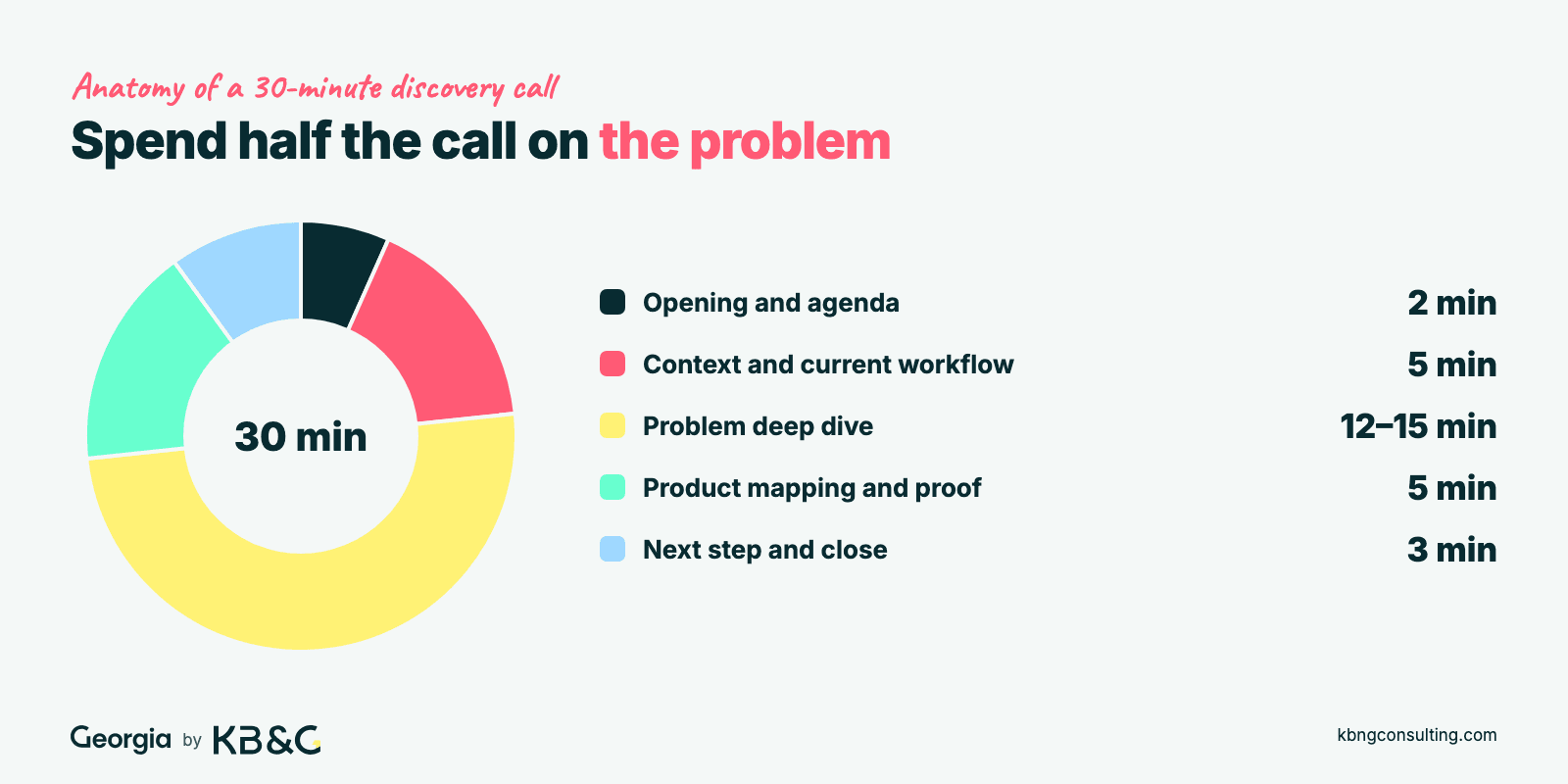
You need skeletons, not word-for-word scripts. Use the framework in live calls, then refine it based on what you learn. A discovery call framework for a 30-minute meeting might look like this:
Opening and agenda setting (2 minutes): confirm time, state purpose, ask what success looks like for the prospect.
Context and current workflow (5 minutes): how do they handle this process today? What tools and people are involved?
Problem deep dive (12 to 15 minutes): what breaks? What does it cost in time, money, or risk? Who else feels the pain?
Product mapping and proof (5 minutes): connect your product to the specific problems surfaced, not a generic demo.
Next step and close (3 minutes): propose a specific next action with a date and participants.
These frameworks become your sales templates for future rep onboarding. They are the first step toward a scalable sales process.
Deliberate Practice: One Skill at a Time
Deliberate practice in sales means choosing one micro-skill per week and measuring whether you improved. Trying to fix everything at once fixes nothing.
A simple four-step method: pick the focus (e.g., "ask stronger 'why now' questions"), set a target (e.g., "ask 'why now' in at least 3 of 5 calls"), run calls, then review and score yourself. Track results in a spreadsheet or a simple doc. You do not need an enablement platform at this stage. You need a notebook and the discipline to look at it, so you can see real improvement rather than just activity. The shift from pitching to diagnosing is a concrete skill you can practise one call at a time.
Using Role-Play to De-Risk High-Stakes Conversations
Live deals are a terrible place to rehearse a pricing conversation for the first time. If you fumble your pricing anchor with a real prospect, that deal may not recover.
Good role-play for a founder lasts 3 to 8 minutes, focuses on a single scenario (e.g., "prospect says budget is locked until Q3"), and includes feedback immediately after. You can do this with a co-founder, an advisor, or an AI tool. Short reps like this sharpen your sales game before high-stakes conversations.
Once this practice loop is running, you can formalize it into a training program that your first hires can plug into.
Turning Your Own Learning Into a Repeatable Founder Sales Training Program
At some point, you shift from "I need to sell" to "I need a simple training program others can follow." This shift matters because your habits, including the bad ones, become your team's habits. If you never review calls, your first AE will not review calls. If you cave on pricing, your sales team will cave on pricing.
Codify What's Working in Your Sales Motion
As you learn, create four core artifacts:
ICP definition: who you sell to, with criteria specific enough that someone else can qualify a lead without asking you.
Discovery question bank: the 15 to 20 questions that surface the information you need, organized by topic (workflow, pain, stakeholders, timeline).
Objection-handling notes: your top five objections with tested responses and supporting evidence.
Pricing one-pager: tiers, value metric, anchor price, and a short rationale for why the price is what it is.
Keep these "just detailed enough" for a first sales rep to follow without drowning in theory. Version them by date so you can see what changed and why over 3 to 6 months of selling. These become your core sales collateral for the team.
Create a Simple Onboarding Path for Future Reps
A 2 to 3 week onboarding plan for your first AE or sales hybrid should include: one week of shadowing your calls and studying your frameworks, one week of supervised calls where they run discovery with you listening, and one week of solo calls with post-call review.
Structure it by milestones: "can run a 30-minute discovery solo," "can explain pricing and handle 3 standard objections," "can close a pilot or next step without intervention." This onboarding path is itself founder sales training. It forces you to make your process teachable, which reveals gaps you did not know existed.
Run Team Call Reviews and Feedback Loops
Once you have even one more person selling, adapt your personal call-review habit into a weekly team ritual. Pick one recorded call, define a skill focus (e.g., objection handling this week), watch a 5 to 10 minute segment together, give specific feedback, and note 1 to 2 concrete improvements for next week.
This ritual sets culture. Your team will mirror your openness to critique. If you let people review your calls and point out where you stumbled, they will accept the same scrutiny. That is how you build a sales engine that improves instead of stagnating.
When to Bring in External Help (Coaches, Advisors, or Fractional Leaders)
Concrete signals that you need targeted help:
Your win rate has plateaued for 3 or more months despite consistent effort.
You keep losing deals late in the process after what seemed like strong early qualification.
Your ideal customer profile shifts every quarter and you are not sure which version is right.
You are spending so much time on tactical sales execution that product and strategy suffer.
Differentiate between options: a one-off training or course works when you need a specific skill (e.g., pricing conversations). Ongoing coaching works when you have call recordings and metrics but cannot see your own blind spots. A fractional sales leader works when you need someone to build the scalable sales process and hire your first reps while you stay focused on product. Outside help only works when it has access to recordings, metrics, and basic documentation. A coach cannot fix a black box.
Common Founder Sales Training Challenges (and How to Fix Them)
Founders struggle to stay consistent with sales training because of time pressure, context switching between product and sales, and the emotional weight of rejection. Each problem below has a concrete fix.
Problem 1: "I Don't Have Time to Train; Only to Sell"
Integrate training into your existing calls. After every call, write one sentence about what you missed. At the end of the week, spend 60 minutes reviewing two recordings and picking one skill to improve. That is about 90 minutes per week in total. Over a quarter, this compounds into better close rates and shorter sales cycles. You are already doing the heavy lifting of running calls; the review layer is what turns selling into learning.
Problem 2: "I Hate Feeling Pushy or Like a Salesperson"
Reframe sales as diagnosis and decision support. You are not pressuring someone into buying something they do not need. You are helping a potential customer figure out whether your product solves a real problem for their business. Use language that feels natural for engineers and operators: "Can I propose a concrete next step?" or "Based on what you described, here is what solving this would look like. Does that match what you need?" Focus on helping, not convincing. The confidence to do this comes from strong discovery; when you understand the prospect's problem deeply, recommending a solution feels like engineering, not selling.
Problem 3: "My Team Copies My Bad Habits"
Your behavior sets the standard. Make "we review calls together" part of your culture from the first hire. When you catch yourself caving on pricing or skipping qualification in a recording, label it out loud during team review: "Here is where I dropped the ball; here is what I should have done."
Problem 4: "Every Deal Feels Unique, So I Can't Systematize"
At early stage, many verticals and buyer types look different on the surface. But patterns emerge: the same objections phrased differently, the same pain themes across industries, the same value metrics mattering to decision makers. Capture these patterns in your artifacts. Build checklists for stages (discovery, pilot, procurement) that flex across verticals. Structure does not kill responsiveness; it frees up mental space for the parts of each deal that genuinely are unique.
Problem 5: "Enterprise and Industrial Buyers Are Intimidating"
Longer cycles, more stakeholders, risk aversion about safety, operations, and data ownership. The same discovery and objection handling skills apply; the number of people and steps increases. Break complex enterprise sales into components: stakeholder mapping (who signs off on what), risk framing (integration, security, ROI), and pilot design that mitigates buyer risk. Enterprise artifacts (MSAs, SLAs, security documents) belong in your preparation before you hire your first AEs. Discovery becomes even more critical when buyers need internal consensus across procurement, operations, legal, and safety teams.
Putting It All Together: A 30-Day Founder Sales Training Plan
This plan assumes you are already running sales calls. It is not about pausing to study; it is about layering structure onto the selling you are already doing, so that every call also teaches you something.
Week-by-Week Focus
Week 1: Discovery and Recording
Turn on recording for every sales and discovery call. Confirm consent, check your tools.
Choose or draft a discovery framework for 30-minute calls with sections: opening/agenda, context, current workflow/problem, business impact, product mapping, next step.
Review 2 calls (your own or a peer's). Identify where you jumped to a solution early, missed a problem question, or failed to set a next step.
Week 2: Qualification and Next Steps
Define your qualification criteria: Budget, Pain, Champion, Timing. Write them on an index card or sticky note visible during calls.
Add 2 to 3 explicit qualification questions to every call. Track whether you actually asked them.
End each call with a specific, calendar-booked next step involving named participants. Measure your adherence at the end of the week: how many calls ended with a booked meeting versus "we'll be in touch"?
Week 3: Pricing and Objections
Draft a pricing script or one-pager: your value metric, tiers, and an anchor price benchmarked against what prospects currently spend. Practise delivering it aloud before any live call.
Build objection battle cards: list your top 5 objections, one tested response for each, and the evidence or proof points you can reference. Treat your pricing as a living experiment, not a permanent decision.
Test pricing conversations with live prospects. Note whether you apologized, whether price came up early enough, and whether you held firm when appropriate.
Week 4: Systematize and Share
Organize your notes, frameworks, and call snippets into a basic Founder Sales Playbook document. Include: ICP profile, discovery questions, pricing rationale, objection responses, and scripts for closing next steps.
Run one full mock call: discovery through pricing through objection through close. Use a co-founder, mentor, or coach, or join a peer review or practice session to pressure-test the playbook. Note where you stumbled and where you sailed through. Refine the playbook based on what you learn.
Review all metrics you have tracked: win rate, cycle length, first-call to second-call advance rate, price objection frequency. Identify the top 1 to 2 skills you still need to improve next month.
This 30-day plan is the first step toward a go-to-market motion built on a repeatable process rather than improvisation.
Where Intelligent Tools Fit into Founder Sales Training
Tools accelerate practice and feedback. They do not replace doing the work. This section covers role-play, call analysis, and coaching aids relevant to B2B sales founders.
Using AI Role-Play to Practise Tough Conversations
AI role-play lets you run simulated buyer conversations where you practise discovery, pricing, and objections in short, repeatable sessions without risking a live deal.
Georgia by KB&G is an AI role-play coach built with sector trainers. Founders and reps practise real sales conversations (holding price, handling price objections, answering "the other supplier is cheaper") in self-paced 3 to 8 minute sessions with real-time coaching, so a new hire can rehearse objection handling before they take a single live call.
Call Recording, Transcription, and Analysis
The basic stack: your video meeting tool (Zoom, Google Meet, or equivalent), recording enabled, transcription, and a simple tagging system for marking key moments. Use transcripts to pull out "golden moments" (strong discovery questions, clean next-step closes) and "red flags" (monologues, defensive responses, missed qualification) for your own learning and team training. This is the raw material that makes coaching, self-review, and onboarding possible.
When Tools Help vs. When They're a Distraction
Useful tools shorten feedback loops, make patterns visible, or enable more practice in less time. If a tool does one of those three things for you, it earns its place.
The trap: investing in enablement platforms, AI call analysis, and sales engagement tools before you are having 5 to 10 meaningful sales conversations per week. At that volume, the bottleneck is not tooling; it is reps. Get the call volume up first, then layer in tools that match your actual sales efforts and bottlenecks.
Conclusion and Next Steps
Founder sales training is a continuous practice of improving discovery, qualification, pricing, objection handling, and closing. Your habits become your team's habits. Your blind spots become their blind spots. The good news: you do not need to become a "natural salesperson." You need a simple system and the discipline to run it. Every sales call is a feedback session if you treat it as one.
Your next steps:
Turn on call recording for all upcoming sales conversations this week.
Write a one-page discovery framework and bring it to every call.
Schedule a 60-minute block to review two calls and pick one skill to improve.
Run at least one role-play session before your next high-stakes pricing or enterprise call.
Start your Founder Sales Playbook document, even if it is a single page with your ICP, top three discovery questions, and top three objections.
From here, related areas worth exploring: pricing and packaging strategy for your specific market, positioning and messaging for AI and SaaS products, and the process of moving from founder-led sales to hiring your first AE.
Frequently Asked Questions About Founder Sales Training
Do I really need formal sales training as a founder, or can I just learn on calls?
You will learn on calls either way. The question is how fast and at what cost. Without minimal structure (recordings, a discovery framework, weekly review), you re-learn the same lessons deal after deal. Structured practice with review compresses months of trial and error into weeks. The first step is not enrolling in a course; it is recording your next five calls and watching them back.
When is the right time to stop doing all the selling myself?
Practical milestones: you have a consistent win rate with a defined ideal customer profile, you have at least a basic playbook documenting your sales process (discovery framework, pricing rationale, objection responses), and you have enough pipeline to keep another person busy. Founders who stay in the sales loop through their early deals understand product-market fit better and can shape their go-to-market strategy before handing off.
How much time should I realistically spend on sales training each week?
60 to 120 minutes. Break it into three blocks: 30 minutes reviewing one of your own recorded calls, 30 minutes preparing or refining a framework or battle card, and 30 minutes of role-play or deliberate practice on a specific skill. This fits alongside product work without derailing your week. The key is consistency; 90 minutes every week beats a 6-hour Saturday workshop once a quarter.
Should I start with a sales course, a coach, or just tools?
Choose based on your current bottleneck. If you have never run structured discovery, start with DIY structured practice: record calls, build a framework, review weekly. If you have recordings and metrics but your win rate has plateaued, targeted 1:1 coaching gives you an outside perspective on blind spots. If your bottleneck is lack of reps and practice, AI role-play fills the gap. Courses work best when you need specific knowledge (e.g., enterprise sales process, negotiation tactics) rather than general motivation.
How do I adapt founder sales training for selling into heavy industry (e.g., mining, infrastructure)?
Heavy industry sales cycles are longer, and safety, operational risk, and data ownership concerns dominate buyer evaluation. Your discovery must include risk mapping (regulatory compliance, operational disruption, data governance) alongside the standard workflow and pain questions. Pilots on live sites are common; you need to negotiate scope, success criteria, and who bears cost if the pilot fails. Stakeholder mapping is more complex: procurement, operations, safety, legal, and sometimes union representatives all influence the decision. The same discovery, qualification, and objection handling skills apply. The difference is that each skill must be applied across more people and more steps, and your sales collateral (MSAs, SLAs, security certifications) needs to be ready before you walk into the first meeting.