
What Is the Fear of Uncertainty?
The fear of uncertainty is the distress people feel when they cannot know how something will turn out, and the urge to remove that feeling before acting. Psychologists study it as intolerance of uncertainty: a stable tendency to find "not knowing" hard to bear, whatever the actual odds.
For founders, it is a daily condition rather than an occasional mood. You do not know whether the buyer will sign, whether the next hire will work out, whether the market you picked exists in the size you hoped. Most early-stage decisions are made with information that will never be complete.
This is the third piece in the Startup Witch series on founder psychology. Founder ego looked at confidence that stops updating. Fear of failure looked at how the dread of a bad outcome steers a founder's week. Fear of uncertainty is the quieter cousin: it is not about a bad outcome, it is about not knowing which outcome you will get.
Here is what this article covers:
- What the research says about why uncertainty feels so bad, and how it links to anxiety.
- The difference between risk and uncertainty, and why that difference changes what you should do.
- What experiments show about how entrepreneurs actually respond to uncertainty (it is not what most people assume).
- How experienced founders make decisions when the odds can't be calculated.
- Six practical moves for founder decision making under uncertainty.
Is Fear of Uncertainty the Same as Fear of Failure?
No. Fear of failure is fear of a specific bad outcome: the company dies, the money is gone, people saw you try and lose. Fear of uncertainty is fear of the gap before any outcome arrives. Many people find the gap harder than the bad news itself.
The two often travel together, but they push founders in different directions. Fear of failure tends to steer you away from risky tasks, such as the sales call or the price rise. Fear of uncertainty tends to keep you circling the decision: one more round of research, one more advisor, one more week before you commit. The first produces avoidance. The second produces delay that looks like diligence.
That is why it is easy to miss. A founder who is avoiding failure knows, at some level, what they are avoiding. A founder who cannot tolerate uncertainty usually believes they are being careful.
Why Does Uncertainty Feel So Bad?
Because the brain treats missing information as a possible threat. Clinical psychologist R. Nicholas Carleton reviewed the evidence and proposed that fear of the unknown may be "a, or possibly the, fundamental fear" underlying anxiety and neuroticism. He framed it as a proposition to test, not a settled fact, but it explains why the feeling is so familiar to so many people.
In a companion paper, Carleton defined intolerance of uncertainty as a person's dispositional incapacity to endure the aversive response triggered by the perceived absence of salient, key or sufficient information, sustained by the associated perception of uncertainty. In plain terms: some people experience "I don't have enough information" as an emergency, and the feeling persists for as long as the uncertainty does.
How intolerance of uncertainty connects to anxiety disorders
Intolerance of uncertainty was first studied as a driver of generalized anxiety disorder, the condition defined by excessive and uncontrollable worry. Later work found it far more widely. A meta-analysis by Gentes and Ruscio (2011) tested whether it was specific to generalized anxiety disorder, a claim that had not been systematically tested before. It found that intolerance of uncertainty was linked to generalized anxiety disorder, major depression and obsessive compulsive disorder, with mostly similar strength.
A treatment study published in the Journal of Clinical Psychology followed patients with several anxiety disorders through the same transdiagnostic therapy. During treatment, intolerance of uncertainty dropped significantly (d = 0.73), about 48% of those who completed treatment showed reliable change, and larger drops predicted lower anxiety and depression afterwards. The sample was small (37 patients randomised), so treat the treatment outcome as encouraging rather than definitive.
Two points matter for founders. First, intolerance of uncertainty is not a diagnosis. Everyone sits somewhere on the scale, and a high score does not mean you have an anxiety disorder. Second, it can change. It is a pattern of responding, not a fixed trait you are stuck with.
If worry is affecting your sleep, your relationships or your health, that is a mental health question, not a productivity one. A GP, a psychologist or a therapist trained in cognitive behavioural therapy is the right first call. Nothing in this article replaces that.
What Are the Signs of Intolerance of Uncertainty in a Founder?
The signs are behaviours that buy a short-term feeling of certainty at the cost of progress. In clinical settings they show up as excessive worry, checking behaviors and reassurance seeking. In a startup they look more respectable. Common patterns include:
- Research that never ends. Another competitor teardown, another survey, another market sizing spreadsheet, long after the useful answers stopped changing.
- Checking behaviors. Refreshing the dashboard, rereading the investor email, asking the team for the same status update twice a day.
- Running worst case scenarios on a loop. The mind wanders to "what ifs" during every quiet moment, and each one gets a new contingency plan that is never used.
- Reassurance seeking. Asking a third advisor the question the first two already answered, hoping the third will make it feel certain.
- Treating ambiguity as bad news. A buyer's slow reply becomes a lost deal. A neutral comment from an investor becomes a rejection. People high in intolerance of uncertainty tend to react negatively to ambiguous information and read it as threatening.
- Over-planning, under-acting. Detailed roadmaps for a product nobody has paid for yet.
- Keeping every option open. Refusing to drop a customer segment or a feature line, because closing a door feels like losing information.
Some of these overlap with social anxiety, where individuals fear negative evaluation by others. For founders the two can merge: the fear is not only "what will happen" but "what will people think of me if I choose wrong". Sales calls, pitch meetings and other social situations are where that combination tends to bite.
None of these behaviours is irrational in isolation. Research has value, checking has value, planning has value. The pattern to watch for is when the activity continues after it has stopped changing your decision.
What Does Uncertainty Mean in Entrepreneurship?
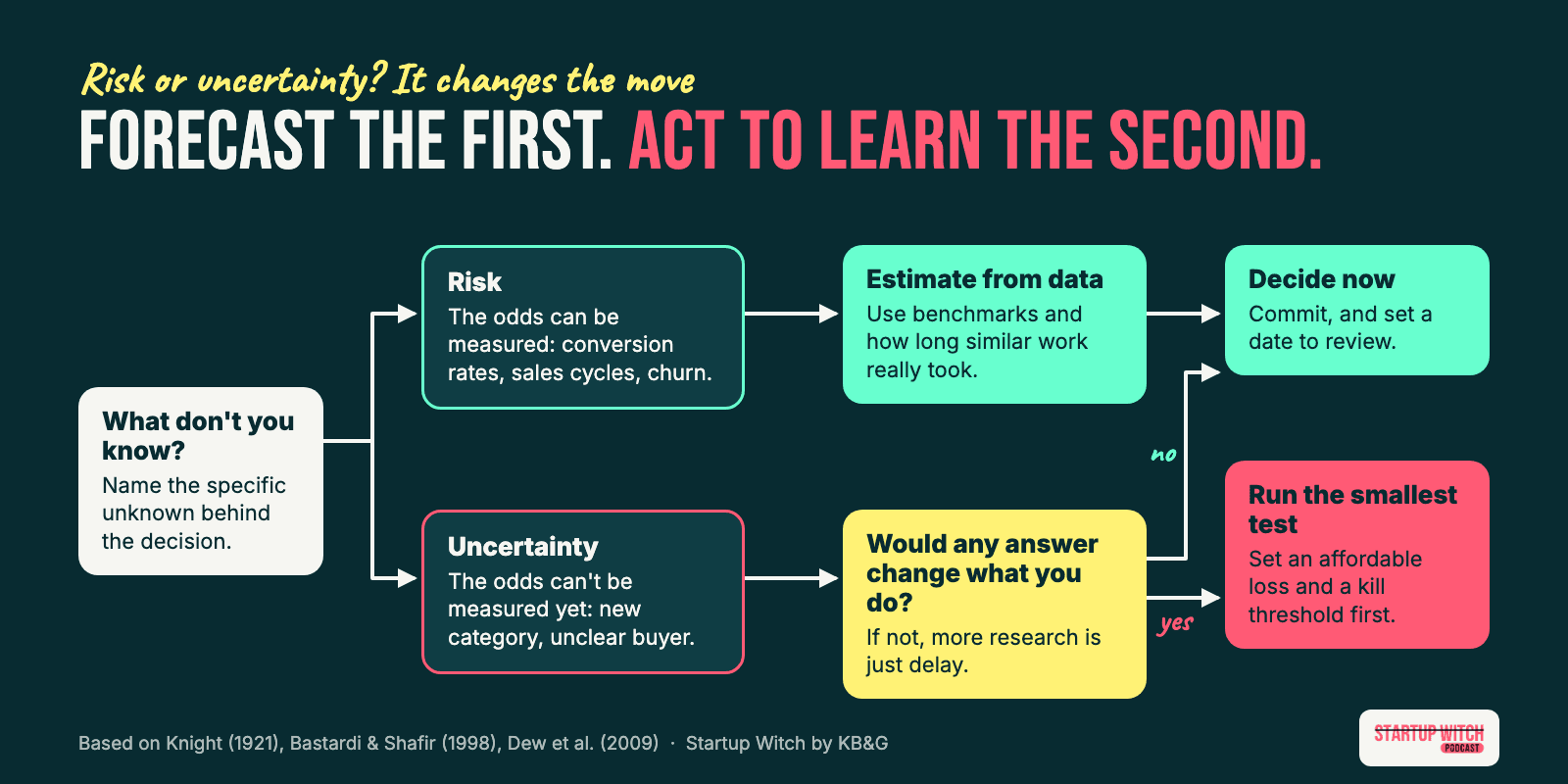
In entrepreneurship, uncertainty means facing outcomes whose odds cannot be measured, as opposed to risk, where they can. The distinction comes from the economist Frank Knight, who argued in 1921 that "risk" really covers two different things. In his words, a measurable uncertainty "is so far different from an unmeasurable one that it is not in effect an uncertainty at all."
That distinction is practical, not academic:
- Risk is a question you can estimate. What share of free trials convert? How long does an enterprise security review take? Others have done it before, so there is data, or you can gather it quickly.
- Uncertainty is a question nobody can estimate yet. Will this new category of buyer exist in two years? How will a market respond to a product that has never been sold before? No amount of desk research produces the answer, because the answer does not exist until someone acts.
Early-stage founders face mostly the second kind. Much of the distress comes from treating it like the first: trying to forecast harder when the right move is to act in a way that creates the missing information.
Are Entrepreneurs Braver About Uncertainty Than Everyone Else?
Not according to the best experiments. The popular image is that founders are wired to love ambiguity. When researchers measure it with real money on the line, that image does not hold up.
A lab-in-the-field experiment in the Netherlands with 2,288 entrepreneurs, managers and employees found that entrepreneurs see themselves as much less risk averse than others. Measured in incentivised tasks, they did not differ in risk aversion or ambiguity aversion. The one trait that set them apart was lower loss aversion: they were less put off by the possibility of losing.
A separate experiment in China compared around 700 CEOs with a control group of about 200 people. The entrepreneurs were more willing to accept strategic uncertainty (trusting partners and competing against others), but they did not differ from ordinary people on risk or ambiguity.
This matters for anyone who feels uneasy about uncertainty and concludes they are not "founder material". The evidence suggests most entrepreneurs feel the same discomfort with not knowing. What differs is their willingness to accept a possible loss and to act alongside other people despite it. That is a behaviour, and behaviours can be practised.
How Do Expert Founders Make Decisions Under Uncertainty?
They act to create information instead of waiting to predict it. The clearest evidence comes from research on what Saras Sarasvathy called effectuation: starting from the means you have and letting goals emerge, rather than fixing a goal and assembling the means to reach it.
In a think-aloud study, 27 expert entrepreneurs and 37 MBA students worked through the same venture problems. The novices followed the textbook: research the market, forecast, plan. The experts considered a broader range of markets, gave less weight to forecasts, limited their bets to what they could afford to lose, and built partnerships early. The study shows how experts think, not that thinking this way causes success, and the sample was small. But the contrast is useful.
Later research links these habits to results. A meta-analysis of studies covering 9,897 new ventures found three effectuation principles positively associated with new venture performance. The studies were correlational, so read it as support, not proof.
The scientific approach: treat beliefs as hypotheses
A second line of research tests a related idea with randomised trials. Researchers at Bocconi trained around a hundred Italian startups to treat their business ideas as theories and test them like scientists. Those startups pivoted more and earned more revenue than the control group. A larger replication across 759 firms in four randomised trials found the approach made founders more likely to terminate weak ideas, with a more complicated pattern on pivots. The robust finding across both is better filtered decisions: founders dropped what was not working sooner.
Observational data points the same way. Startups that adopted A/B testing tools saw performance improve by 30% to 100% after a year of use, according to research by Koning, Hasan and Chatterji. The mechanism the authors describe is simple: experimenting firms launched more products, scaled the promising ones and abandoned the failing ones sooner.
None of this removes uncertainty. It changes the founder's relationship with it. Instead of a fog to be waited out, uncertainty becomes a set of questions to be answered by small, cheap actions.
How to Deal With Uncertainty as a Founder: Six Practical Moves
The way to deal with uncertainty as a founder is to stop trying to feel certain and start taking action that makes the next decision clearer. These six moves come from the research above and from standard approaches used to help people tolerate uncertainty.
1. Name which kind of unknown you are facing
Before you research further, ask: is this risk or uncertainty? If it is risk (a conversion rate, a hiring timeline, a churn benchmark), estimate it with whatever data exists and move on. If it is genuine uncertainty (a new category, an unclear buyer, a market that does not yet exist), stop forecasting and design an action that will generate the information.
2. Ask "would any answer change what I do?"
Before delaying a decision for more data, check whether any realistic answer would change your choice. If not, decide now. Experiments by Bastardi and Shafir found that people often pursue information that would have had no impact on their choice, and once they have pursued it, they let it sway the decision anyway. Waiting for non-diagnostic information costs time twice: once in the delay, and again in a distorted choice.
3. Turn worry into a test with a kill threshold
Uncontrollable worry feeds on open questions. Close them with tests. Write the belief as a hypothesis, decide in advance what result would make you stop, then run the smallest test that can produce that result. A hypothetical example: "We will drop this segment if fewer than five of twenty interviews describe this problem without prompting." The threshold is set while you are calm, so the result decides, not your emotional response on the day.
4. Set an affordable loss before you start
Expert entrepreneurs in the effectuation research asked "what can I afford to lose?" rather than "what will I gain?". Set a ceiling in money, time or reputation for each bet. Inside that ceiling, uncertain outcomes stop being threats, because the worst case is already known and accepted. That is the practical meaning of learning to accept uncertainty: not liking it, but bounding it.
5. Plan with the outside view, and assume your worst case is optimistic
Uncertainty about timing is where founders most often fool themselves. In a classic study, 37 psychology students estimated how long their honours theses would take. Their average best guess was 33.9 days. If everything went as well as possible, they expected 27.4 days. If everything went as poorly as possible, 48.6 days. The theses actually took 55.5 days on average, and only about 30% of students finished by their best guess (the figures are also summarised in Wikipedia's entry on the planning fallacy). Even the worst-case estimate was a week too short.
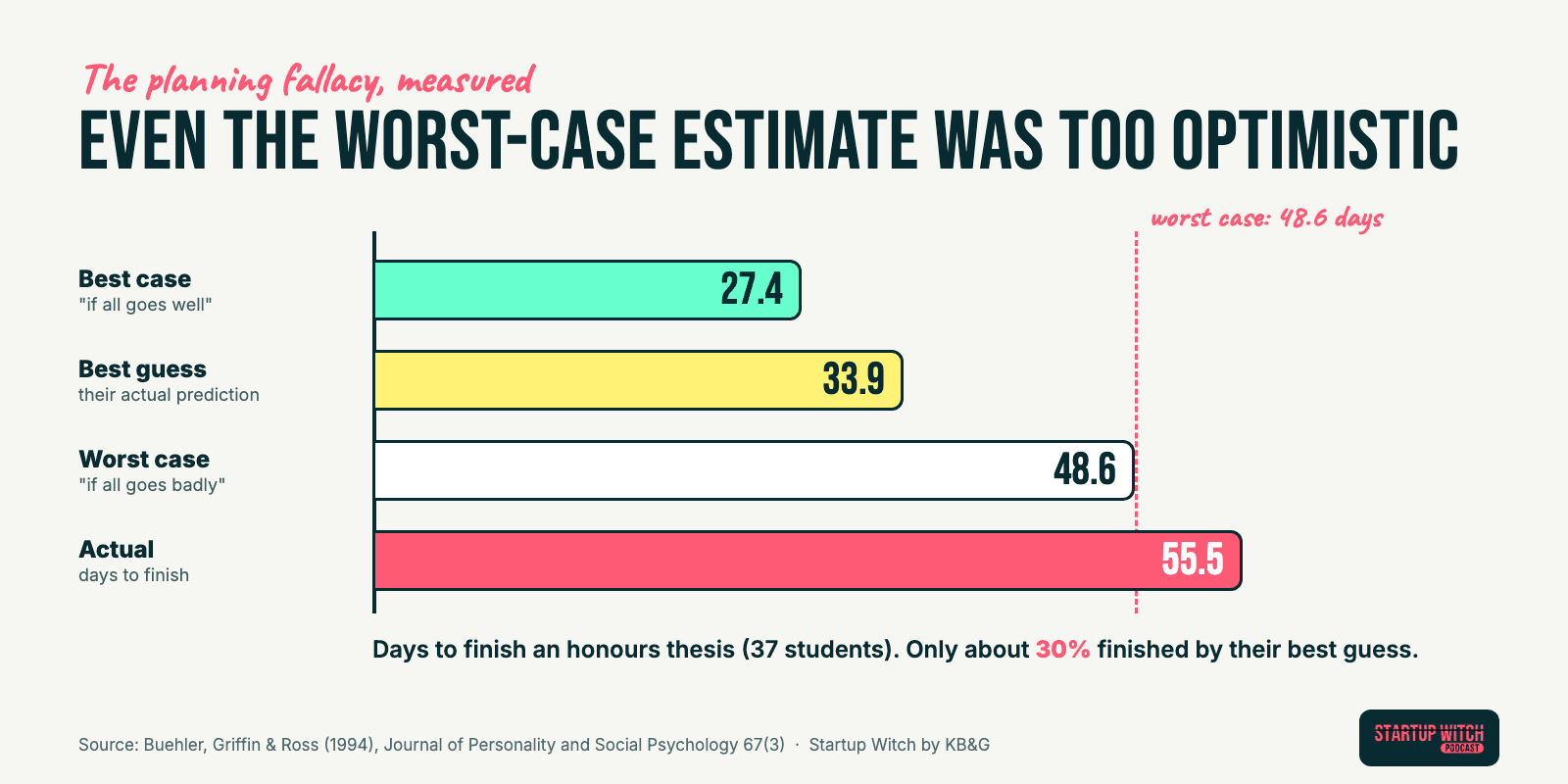
For runway, launch dates and sales cycles, start from how long similar projects actually took for other people, then add a buffer. Your own plan is useful, but it is the optimistic version of reality.
6. Look after the body that is carrying the uncertainty
The physical side of fear of uncertainty is real: tight chest, poor sleep, a mind that will not switch off at night. Standard advice, such as HelpGuide's guide to dealing with uncertainty, helps here, and none of it is glamorous. Take slow, deep breaths when you notice the spiral starting. Bring attention back to the present moment and the next concrete task, rather than the future you cannot see. Exercise regularly. Talk to a loved one, a peer founder or a professional instead of rehearsing negative thoughts alone, but notice if you are asking for the same reassurance again and again.
Worrying can feel like control. It is not. Chronic worrying does not change uncertain situations; it only uses up the attention you need for the things you can control. Notice the negative beliefs underneath ("if I don't know, something bad will happen") and test them against reality. Usually, not knowing for a few more weeks is survivable. Freezing for a few more months often is not.
What Is an Example of Decision-Making Under Uncertainty?
Here is a hypothetical example. A founder of a B2B AI tool has two possible customer segments: mid-sized logistics firms and small manufacturers. Nobody can tell her which segment will buy faster, because the product category is new. There is no benchmark to look up.
Her first instinct is to commission a market study for both segments. That would take two months and produce forecasts built on assumptions about a market that does not exist yet.
Instead, she applies the moves above. She names it as uncertainty, not risk. She asks whether the study would change her decision, and realises she would still need to talk to real buyers whatever it said. She sets an affordable loss: six weeks and a fixed amount of her own time. She writes a kill threshold for each segment: at least three paid pilots or letters of intent from twenty conversations. Then she books the conversations.
Six weeks later, she has a decision based on behaviour rather than forecasts. She may still be wrong. But she is wrong cheaply, early, and with evidence she can learn from. That is the realistic goal of founder decision making under uncertainty: not certainty, but faster, cheaper learning.
How Do You Accept Uncertainty Without Giving Up on Planning?
You accept uncertainty by planning for learning instead of planning for a specific outcome. Accepting uncertainty does not mean having no plan. It means holding the plan loosely and being explicit about which parts are known and which are guesses.
A practical way to do this is to split every plan into three columns: what you know, what you are assuming, and how you will test each assumption. The first column can be planned in detail. The second column gets a test and a deadline. Over time, items move from column two to column one, and that movement is the real measure of progress in an early-stage company.
This also helps with team relationships. Founders who cannot tolerate uncertainty often pass it down as constant changes of direction. Founders who name uncertainty openly ("here is what we don't know yet, and here is how we will find out") give their team something steadier to work with than false confidence.
When Fear of Uncertainty Becomes a Blind Spot
The hardest part of fear of uncertainty is that it looks like good judgement from the inside. Endless research feels responsible. Keeping options open feels strategic. Waiting for one more data point feels prudent. From the outside, it often looks like a company that has not made a real decision in months.
If you suspect something is slowing your startup but cannot name it, the Founder Blind Spot Diagnostic by Startup Witch reads your startup in 14 days and names the one thing blocking growth. It costs EUR 750 and is fully refundable.
Frequently Asked Questions About Fear of Uncertainty
What is the fear of uncertainty called?
In psychology it is usually called intolerance of uncertainty. Researchers also use the broader term "fear of the unknown", which Carleton proposed may be a, or possibly the, fundamental fear behind anxiety.
Why do I have a fear of uncertainty?
Partly because it is a normal human response: missing information is treated as a possible threat. Some people are more sensitive to it than others, and stress, high stakes and past experiences can make it stronger. Founders face constant uncertainty, so even a moderate tendency gets plenty of triggers.
What are the signs of intolerance of uncertainty?
Excessive worry, repeated checking, reassurance seeking, over-planning, procrastination, and reading ambiguous situations as bad news. In a startup it often appears as research that never ends and decisions that keep getting postponed.
How can founders manage intolerance of uncertainty?
Separate risk from true uncertainty, decide whether more information would actually change your choice, turn open questions into small tests with kill thresholds, set an affordable loss for each bet, and plan timelines from how long similar projects really took. If anxiety is affecting your health, speak to a professional; therapy can reduce intolerance of uncertainty.
Do successful entrepreneurs have less fear of uncertainty?
Not on the evidence. Incentivised experiments found entrepreneurs do not differ from managers or employees in ambiguity aversion. They are less loss averse and more willing to act despite strategic uncertainty, which are habits rather than fixed traits.
What is the difference between risk and uncertainty in business?
Risk is when the odds can be measured, for example a known conversion rate. Uncertainty is when they cannot, for example how buyers will respond to a product category that does not exist yet. Risk can be estimated; uncertainty has to be reduced by acting.