
What Is Founder Ego?
Founder ego is the overconfidence, attachment and need to be right that come with building something from nothing. It is useful at the start, when you need belief to act without proof. It becomes a blind spot later, when it makes you overrate your odds, double down on your own bad calls and overvalue what you built.
This article is for founders of early-stage AI, SaaS and industrial tech startups who suspect they are getting in their own way, but can't see exactly where. It is not about being humble for the sake of it. Confidence is fuel. Certainty is the trap.
Here is what you will get:
What the research actually says about founder overconfidence, with sources you can check.
The four ways ego shows up in a startup: rosy odds, doubling down, loving your own product and keeping control.
Why ego is so hard to see from the inside.
Five practical habits that keep your confidence and remove the blind spot.
Why Founders Need Ego (and Where It Turns Against Them)
Nobody starts a company because the spreadsheet says they should. Most new ventures struggle, and founders know that in general. They start anyway, because they believe they are the exception. That belief is not a bug. Without it, very few companies would exist.
The problem is that the same belief that gets you started does not switch off when the evidence arrives. The founder who needed to ignore the doubters in year one keeps ignoring the data in year three. What used to protect you from discouragement now protects you from information.
Researchers have a name for the extreme version: the hubris theory of entrepreneurship. Hayward, Shepherd and Griffin argue that founders whose confidence is built up by past success or praise tend to give their ventures too few resources, because they believe they can make up the difference themselves. It is a theory, not a measurement, but most founders recognise the pattern immediately.
What the Research Says About Founder Overconfidence
Founders rate their own odds far above everyone else's
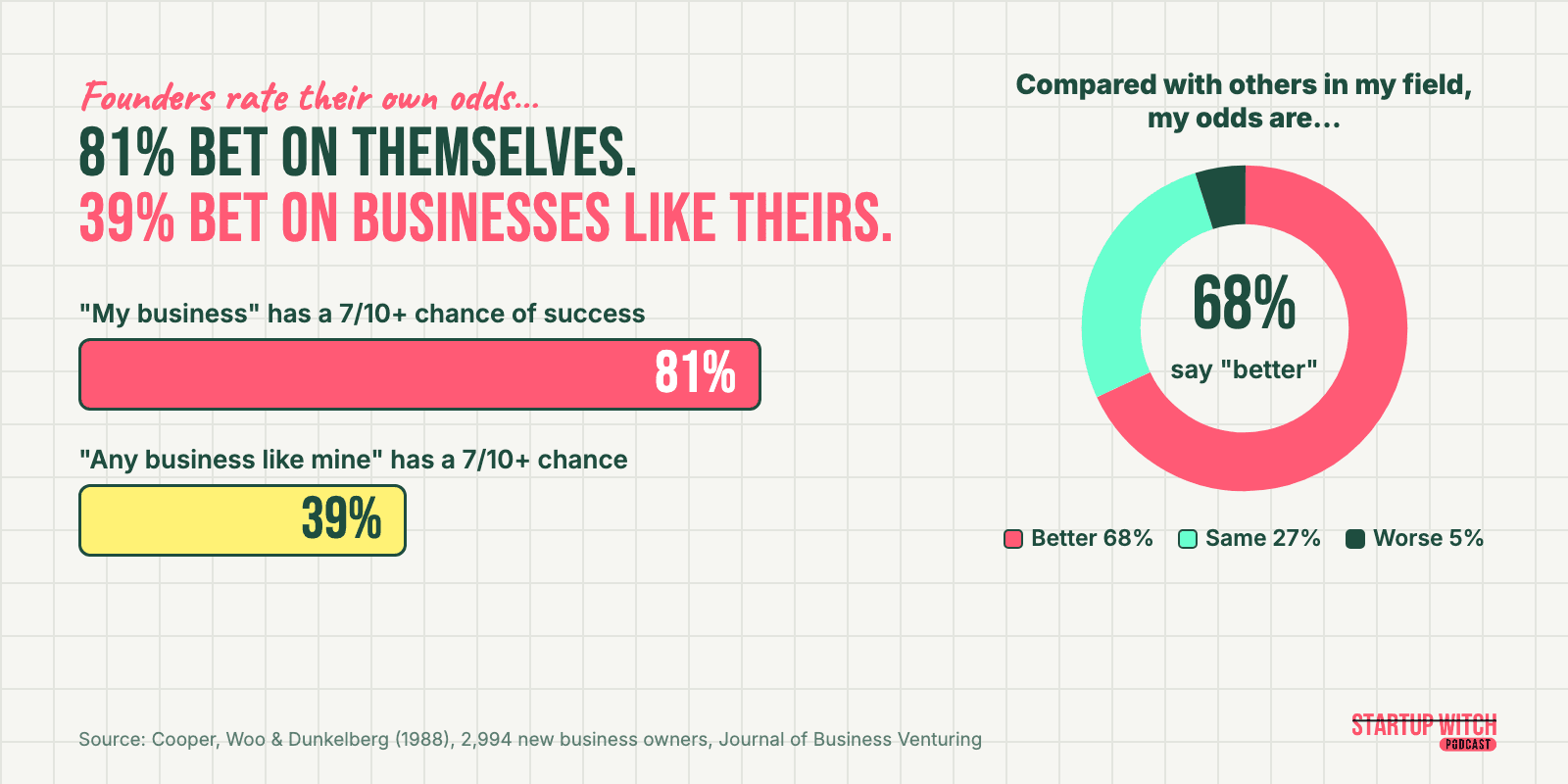
The classic study comes from Cooper, Woo and Dunkelberg, who asked 2,994 new business owners to rate their chances of success. 81% put their own odds at 7 out of 10 or better, and a third said 10 out of 10. When the same people rated the odds of "any business like yours", only 39% gave 7 out of 10 or better. 68% said their own odds were better than others in their field, 27% said the same, and just 5% said worse.
The detail that should worry every founder: the poorly prepared were just as optimistic as the well prepared. Confidence was not tracking readiness.
Feeling skilled matters more than being skilled
A study of over 74,000 interviews across 18 countries from the Global Entrepreneurship Monitor found that believing you have the skills to start a business was the strongest predictor of actually starting one. People who believed it were 1.93 times more likely to be starting a business, and 81% of entrepreneurs believed it, compared with 32% of non-entrepreneurs. That belief had almost no relationship with education. In the published version of the study, countries with more confident would-be founders also had lower survival chances for new ventures. That is a correlation across countries, not proof that confidence causes failure, but it is a useful warning.
Founders update their beliefs slowly
Even when new information arrives, entrepreneurs move slowly. In a study of more than 700 self-employed people in Britain, Simon Parker estimated that they adjusted their expectations by only about one-sixth in response to new information. Experience made no significant difference.
In practice this looks like a founder hearing the same objection from five buyers and treating each one as an exception.
The Four Ways Founder Ego Shows Up in a Startup
Ego rarely announces itself. It shows up as reasonable-sounding decisions. These are the four patterns I see most often, each backed by research on how people decide.
1. Rosy odds: plans built on your forecast, not the base rate
Your runway, hiring plan and fundraising timeline all depend on a forecast. If you rate your odds the way most founders do, every plan built on it is too optimistic. The symptom is a company that is always "one quarter away" from the numbers that justify the last round.
2. Doubling down: putting more into the bet you chose
In Barry Staw's classic experiment, business students who had personally chosen an investment that then performed badly put more money back into it ($13.07M out of $20M) than those who had not made the original choice ($8.89M on average). Later lab replications have been mixed, so treat it as a classic demonstration rather than settled law.
The field evidence is more relevant for founders. Following 1,112 firms over time, McCarthy, Schoorman and Cooper found that entrepreneurs who had started their firm, rather than bought it, and those who were most overconfident were more likely to reinvest and expand, and the effect was stronger when feedback was negative. The effect was small but systematic. Their recommendation: bring in independent advisors who don't share responsibility for the original decision.
3. Loving your own product: the IKEA effect
People value what they built themselves more than identical things they didn't. In Norton, Mochon and Ariely's experiments, people who had assembled an IKEA storage box bid about 63% more for it than people who had not built it. The samples were small and the amounts tiny, but the pattern is familiar: your product, your pitch and your roadmap look better to you than they do to a buyer. The study didn't test founders. The analogy is hard to miss anyway.
4. Keeping control: rich or king
Noam Wasserman studied 6,130 US startups and found that each additional level of founder control (holding the CEO role, controlling the board, or both) was associated with a 17 to 22% lower pre-money valuation. The data are observational, so the founders who keep control may differ in other ways. But the trade-off he describes is real for most founders: you can optimise to stay in charge, or to build the most valuable company. Sometimes those are the same thing. Often they are not.
| Ego pattern | What it sounds like | What it costs | What to do instead |
|---|---|---|---|
| Rosy odds | "We'll close the round by March." | Runway plans that assume the best case | Start from the base rate for companies like yours |
| Doubling down | "We just need to push harder on this segment." | Months spent on a bet that should have been stopped | Set kill criteria before you start |
| Loving your product | "They just don't get it yet." | Features nobody asked for, pitches that don't land | Get blind feedback from people who owe you nothing |
| Keeping control | "Nobody else can do sales like me." | A company that can't grow past the founder | Decide openly whether you are optimising for control or value |
Why Founder Ego Is So Hard to See From the Inside
If ego were obvious, it wouldn't be a problem. Three things make it invisible.
We credit ourselves for wins and blame circumstances for losses. A meta-analysis of 266 studies found this self-serving bias is large and almost universal (an average effect size of d = 0.96, stronger in US samples). So the story you tell yourself about why last quarter went well, or badly, is probably flattering.
Your team often agrees with you. Early employees joined because they believed in you. Pushing back on the founder feels risky. The result is a room where your assumptions are rarely challenged.
Success feeds it. Every closed deal and every funding round confirms that your instincts are good. That is exactly when, according to the hubris research, founders are most likely to under-resource the next stage.
This is why founder blind spots are blind. You can't fix them by thinking harder, because the bias sits inside the thinking.
How to Keep the Confidence and Lose the Blind Spot
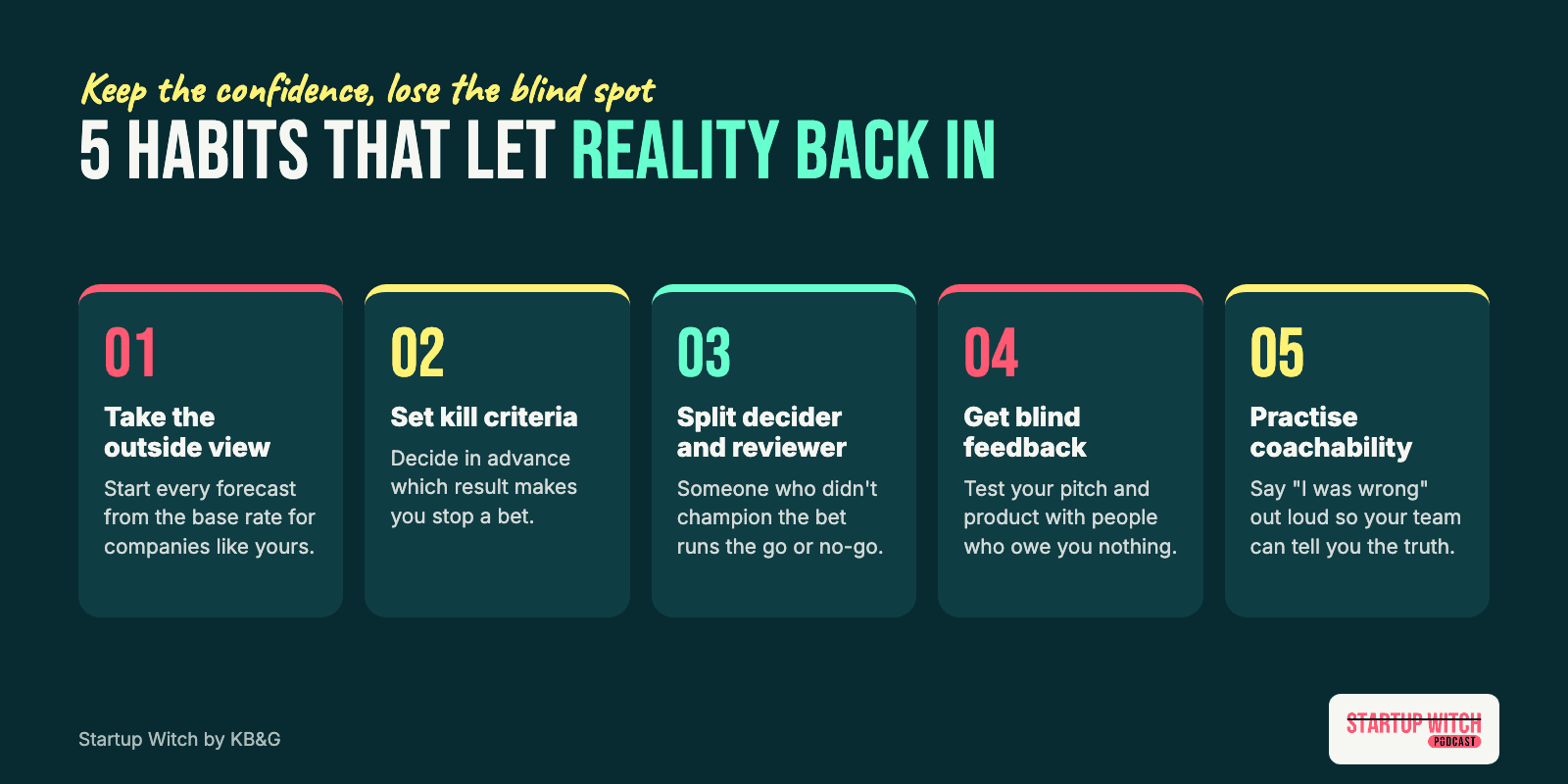
The goal is not to become less confident. It is to build habits that let reality in. These five come straight from the research above.
1. Take the outside view before you forecast
Before you set a target, write down how companies like yours usually do: typical conversion rates, typical time to close, typical seed-to-Series-A rates in your sector. Then write down why you will be different. If you can't explain the gap with evidence, your forecast is your ego talking.
2. Turn beliefs into hypotheses with kill criteria
In a randomised trial with 116 Italian startups, founders trained to treat their ideas as hypotheses and test them were more likely to pivot away from weak ideas (32% compared with 19%) without being more likely to give up. A larger follow-up found the performance benefit again, though not the higher pivot rate. The robust message: testing beats gut feel. For every big bet (a new segment, a pricing change, a major feature), agree in advance what result would make you stop.
3. Separate the person who made the call from the person who reviews it
Escalation is strongest when you were the one who chose. So don't review your own bets alone. Ask a cofounder, board member or advisor who didn't champion the decision to run the go or no-go conversation.
4. Get blind feedback on your product and pitch
Let someone else run some customer interviews. Test your landing page with people who don't know you built it. When you write a post-mortem, list your own decisions before external causes. All of this works against the IKEA effect and the self-serving bias.
5. Practise coachability on purpose
Investors read coachability as a signal. In pitch research by Ciuchta and colleagues, founders who came across as coachable were more attractive to investors, although the evidence that coachability improves company performance is mixed. Inside the company, leaders who openly admit what they don't know and credit others' strengths have more learning-oriented, more engaged teams. Saying "I was wrong about that" in a team meeting is not weakness. It gives everyone else permission to tell you the truth.
A Quick Founder Ego Check
Answer these honestly. Two or more "yes" answers suggest ego is shaping decisions more than you'd like.
Have you missed your own forecast three quarters in a row and kept the same plan?
Is there a segment, feature or partnership you have been "about to crack" for more than six months?
Do you explain lost deals mainly by the buyer, the market or timing?
Would your team tell you if they thought your main bet was wrong?
Are you still the only person who can close a deal?
When You Need Outside Eyes
The uncomfortable truth about founder ego is that you are the person least able to see it. That's not a character flaw; it's how human judgement works. The fix is a structured outside view.
That is exactly what the Founder Blind Spot Diagnostic by Startup Witch is for. It reads your startup in 14 days and names the one thing blocking growth, including the patterns you can't see because you are inside them. It costs EUR 750 and is fully refundable.
Frequently Asked Questions About Founder Ego
Is founder ego always bad?
No. Some overconfidence is what gets companies started. The problem starts when confidence stops responding to evidence: when forecasts, bets and product decisions no longer change after the data comes in.
What is the difference between confidence and overconfidence in founders?
Confidence is believing you can figure it out. Overconfidence is believing you already have. In practice, a confident founder sets targets and changes course when they're missed. An overconfident founder keeps the target and explains away the miss.
How do I know if my ego is hurting my startup?
Look for repeated patterns rather than single mistakes: the same missed forecast, the same objection from buyers, the same bet that is always about to pay off, or a team that rarely disagrees with you. Those are signs that your beliefs are updating more slowly than your market.
Can a founder become less overconfident?
You can't switch off a bias, but you can design around it. Base rates before forecasts, pre-agreed kill criteria, independent reviews of your own bets and blind customer feedback all reduce the damage, according to the research on escalation and on hypothesis-driven founders.
Why do smart founders fall for ego traps?
Because intelligence doesn't protect against these biases, and success makes them stronger. Smart founders are often better at building convincing explanations for why the evidence doesn't apply to them.