
Most startups celebrate the first invoice. In mining tech, the more important milestone is the first site that will say, by name and on the phone, "we used it and here is what happened". That is your first reference customer, and for a startup selling to mines it is worth more than the revenue attached to it.
Mines buy what other mines have proven. A small deal that produces a usable reference opens the next ten doors. A larger deal that produces nothing you can name opens none. This article is about getting the first kind.
You will find:
- why mining companies lean so hard on customer references
- the four tests that make a reference usable
- how to pick the first site (it is not always the friendliest one)
- how to structure the first deal so a reference is written into it
- the mistakes that quietly waste a first customer
What Is a First Reference Customer?
A first reference customer is the first real customer who adopts your product and agrees to vouch for it to other buyers. Wikipedia's entry on reference customers describes a reference customer as one that agrees to publicly endorse a vendor's product. The important word is "agrees". A happy customer who will not be named is a nice relationship. It is not a reference.
For a mining tech startup the first reference does three jobs at once. It proves the product works in a live operation, not a demo. It gives your sales team a story with a site name attached. And it gives the next buyer someone to call who is not you.
Why Do Mining Companies Want Customer References Before They Buy?
Mining companies want references because a failed deployment can stop production, hurt someone, or both, and the person who approved it answers for that. A reference transfers some of that risk to a peer who went first.
This is not a stereotype. Mining people say it about themselves. Writing in the AusIMM Bulletin in 2015, a Rio Tinto general manager for surface mining and automation described how avoiding unnecessary technical risk has led to a common culture of being a "fast follower" in the industry, with companies keen to be "first to be second".
Survey data says the same. In GlobalData's research on AI adoption reported by Mining Technology, roughly 45% of respondents named the need for the technology to be proven as a primary barrier, second only to cost at around 50%. We go through more of those adoption numbers in our mining technology statistics roundup.
Mines are not unusual in this, only more extreme. A Gartner survey of 771 B2B buyers found they value third-party interactions 1.4 times more than digital interactions with the supplier, and reading customer references is one of those third-party interactions. Your website is the supplier talking. A reference is someone else talking.
Inside a mine, four groups each want that someone else for their own reasons:
- Operations worry about uptime. They want to know your system did not slow the cycle, break the shift handover or need babysitting.
- Safety wants to know nothing you install creates a new hazard, and that crews accepted it.
- Procurement wants a precedent. A comparable site that bought you makes the paperwork easier to justify, and it is one of the questions in mining vendor prequalification.
- The sponsor wants cover. If it goes wrong, "the site down the road had good results" is a defensible decision; "the founder was convincing" is not.
That is why a first reference customer often matters more than first revenue. Revenue proves someone paid. A reference proves it worked somewhere that looks like here.
What Makes a Reference Usable in the Mining Industry?
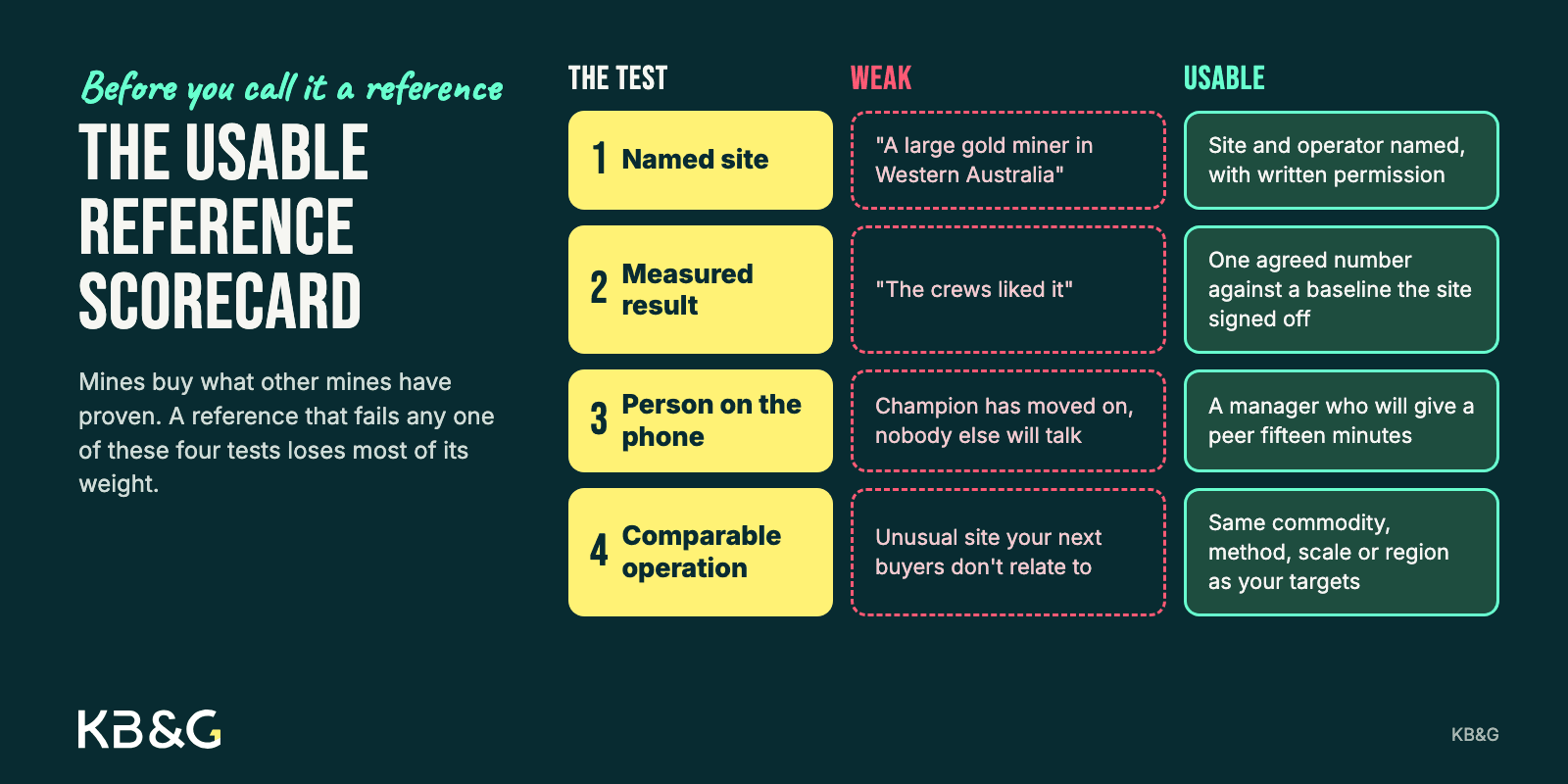
A usable reference passes four tests: a named site, a measured result, a person willing to take a call, and an operation that other buyers see as comparable. Miss any one and the reference gets weaker fast.
1. A named site
"A large gold miner in Western Australia" is a rumour. "Site X, operated by Company Y" is a reference. Mining is a small industry and buyers check. If the customer will only be described anonymously, you have a testimonial, which helps a little, not a reference, which helps a lot.
2. A measured result
Adjectives do not survive procurement. "The crews liked it" is customer feedback; it is not evidence. A usable reference has a number the site agrees with: hours of downtime avoided, a reduction in a specific incident type, time saved on a report, tonnes moved. It needs a baseline and a measurement period, both agreed before you started.
3. A person who will take the call
The single most valuable thing in mining sales is a superintendent or manager at a live site who will spend fifteen minutes telling a peer what happened. Case studies are read. Phone calls are believed. Find out early who that person will be, and whether their company's media or legal team needs to approve them speaking.
4. A comparable operation
Buyers discount references that do not look like them. An open pit copper mine will ask whether your underground coal result applies. A tier one operator may ignore a small quarry. Comparability covers commodity, mining method, scale, jurisdiction and, for software, how the data and systems are set up. You cannot match every buyer, but your first reference should match the buyers you most want next.
How Do You Pick the Right First Site?
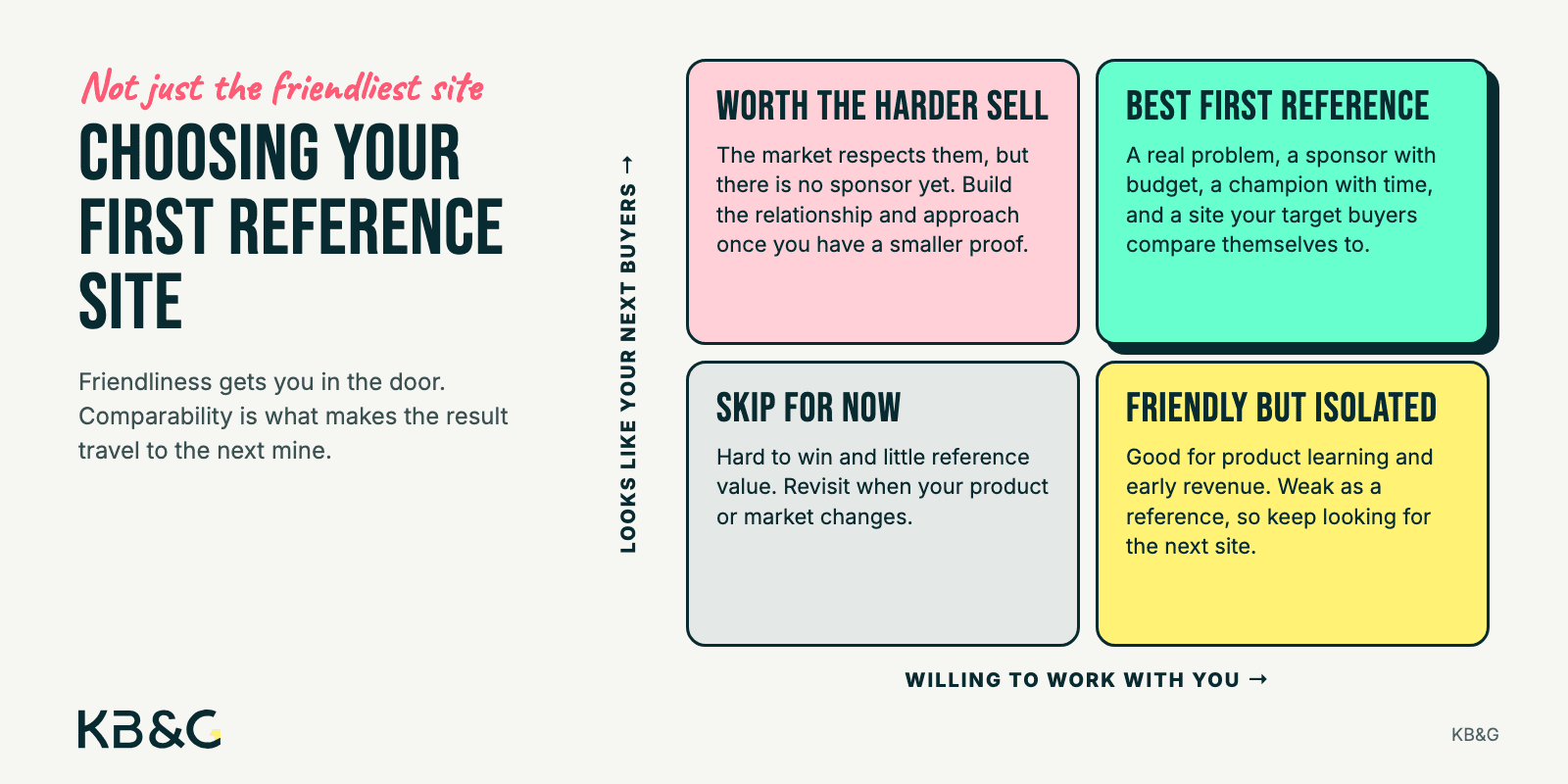
Pick the site that the buyers you want next will compare themselves to, among the sites willing to work with you. Friendliness gets you in the door. Comparability is what makes the result travel.
Founders usually pick the friendliest site: the manager they met at a conference, the operation where an old colleague works, the small site that answered the cold outreach. That is understandable. Early sales are time consuming and a warm door is a gift. The trap is that a friendly site nobody else compares to produces a reference nobody else cares about.
Score candidate sites on two questions before you commit:
- How willing are they? Is there a real problem, a sponsor with budget, and a local champion who will make time?
- How much does the rest of your target market look like them? Same commodity, method, scale and region as the next ten sites on your list?
The best first site scores well on both. If you must trade, a slightly harder site that the market respects is usually worth more than an easy one it ignores. Mid-tier miners often sit in a good spot: comparable enough to larger operations to count, with shorter decision making chains than a global group.
Check a few practical things too. Does the site have the remaining mine life to still be running when your reference is needed? Is it about to change owner, which can freeze approvals? Is your product's value visible within the length of a pilot, or does it need a year of data? Our guide on how to sell software to mining companies covers finding the people inside these sites; here the focus is on choosing which site to bet on.
How Do You Structure the First Deal So It Produces a Reference?
Structure the first deal so the reference is a written deliverable, not a hoped-for side effect. That means four things agreed before the work starts.
Agree success metrics up front
Write down one to three outcomes, how each will be measured, the baseline, and the period. Have the site sign them off. If the outcome is met, there is nothing left to argue about later, and the site has already agreed what "it worked" means. This is also the best protection against the open-ended trial we describe in pilot purgatory.
Put reference rights in the contract
Ask for a clause that allows you to name the customer as a user, subject to the outcome being met. It can be conditional and limited: name and logo only, no financial terms, approval of any wording. Large mining companies have standard positions on publicity, so ask early, while you still have something to trade. Asking after the project ends, when you have nothing left to offer, rarely works.
Get case-study permission in principle
Separately from naming rights, agree that if the result is achieved, you will jointly write a short case study and the site will review it. Agree who on their side approves it (often corporate communications, sometimes legal) and roughly how long that takes. Knowing that in advance saves months.
Have a site champion and a sponsor above them
The champion makes the project work day to day: answers questions, gets crews on board, tells you when something is going wrong. The sponsor sits above them, owns the budget and can say yes to a reference. You need both. Champions move jobs often in mining, and a project with only a champion can stall the week they leave. A sponsor who has seen the result can still sign off.
A hypothetical to make it concrete: a startup agrees a three month paid trial at one mid-tier open pit site. The contract lists two measured outcomes, a baseline taken in the first two weeks, naming rights if both outcomes are met, and a commitment to a two page case study reviewed by the site's communications team. The maintenance superintendent is the champion; the general manager is the sponsor and has agreed to one reference call per quarter. The revenue is small. The reference is the point.
Paid matters, by the way. A modest fee gives the deal a budget line, an owner and a procurement record, which is exactly what other customers will ask about later. For how founders fund the gap before those fees grow, see mining tech funding.
What Mistakes Waste a First Reference Customer?
The most common mistakes are free pilots with no metrics, references that cannot be named, and sites nobody else compares to. Each one can leave you with a satisfied customer and nothing to show the next buyer.
Free pilots with no metrics. Free feels like a way to lower the barrier. In practice it removes the budget owner, the procurement record and the reason to measure anything. When the trial ends, everyone agrees it was "interesting", and there is no number to quote.
References that cannot be named. Some companies have blanket no-publicity policies. Find out before you start, not at the end. If the answer is a firm no, you can still take the work, but treat it as revenue and learning, and keep looking for a reference elsewhere.
Picking a site nobody else compares to. A unique operation, an unusual commodity or a very small site can be perfect for product discovery and still useless as a reference to your real target market. Know which role a site is playing.
Letting the result go undocumented. Teams get busy, the champion moves on, the data sits in a spreadsheet. Write the summary while the result is fresh and the people who produced it are still there.
Over-using the reference. A site manager who gets five calls a month from your prospects will stop answering. Protect them: brief them before each call, send only qualified buyers, and thank them properly.
How Do You Use the Reference Once You Have It?
Use the reference sparingly and specifically: match it to buyers who look like it, and keep the customer relationship healthy so it stays available. A reference is an asset you maintain, not a logo you collect.
- Lead with the result, not the logo. A named site plus one measured outcome is your opening line in meetings with new customers.
- Offer the call late. Save the reference call for buyers who are close to a decision, not for first meetings.
- Keep the customer close. Keep improving the product with their feedback. Customer satisfaction at the reference site is what keeps them willing to speak.
- Track who has spoken to whom. Even a simple sheet will do before you have proper CRM systems. You need to know which references have been used, by which prospects, and when.
- Plan the second reference. The first reference makes the second sale easier; choose that second site to cover a different commodity, method or region so your proof widens.
Founders often run this part themselves for a long time, which works until the founder becomes the only person who knows where the references are. We wrote about that pattern in founder-led sales and its blind spots.
What Does This Look Like From Our Side?
We build for mines ourselves, so this is not theory. Canary Waves by KB&G is voice-to-data safety intelligence that runs passively on a site's existing two-way radio, with no new hardware and no change for crews. It transcribes radio traffic tuned to site slang and flags things like near-miss language, hazards, protocol breaches and signs of fatigue. It has been proven in early MVP pilots on real mine sites, and every lesson in this article about metrics, naming and comparability applied to us too.
Frequently Asked Questions
How do you get your first customer for mining technology?
Start with a specific problem at a specific type of site, find a sponsor who owns that problem and a budget, and offer a short, paid, well-scoped trial with agreed metrics. Mid-tier operators and single sites are usually more reachable than a group-wide agreement. Prepare your prequalification pack before you need it, so paperwork does not stall a willing buyer.
Should my first reference customer be my biggest customer?
Not necessarily. The first reference should be the most comparable credible site you can win, not the largest. A well-documented result at a respected mid-tier operation can carry more weight with your next buyers than a vague trial at a global miner that will not let you use its name.
Is a free pilot ever a good idea?
Only when the metrics, the naming rights and the next step are agreed in writing anyway. Without those, a free pilot tends to produce goodwill and no evidence. A small fee is usually the cleaner signal for both sides.
What if the customer will not let us name them?
Ask what they can allow. Some sites will take a reference call but not appear in marketing; some allow a description by commodity and region. Those are weaker but still useful. If the answer is no to everything, treat the deal as revenue and learning, and keep looking for the site that will become your reference.
How long does it take to get a first reference customer in mining?
It depends on the site, your product and how quickly results show. What you control is the structure: agree metrics and reference rights at the start, measure during the trial, and write up the result as soon as it is in. That removes months of waiting at the end.