
Mining tech funding had a good 2025. Equity financing for mining and metals technology nearly doubled, and the headlines were full of nine-figure rounds. Read past the headlines, though, and the picture is narrower: a handful of very large rounds, a lot of national-security money, and a long tail of software and AI companies raising sensible, unglamorous amounts.
We build AI products for mining, so we watch this closely. Here is where the money actually went, who wrote the cheques, and what it means if you are raising now.
How Much Funding Goes Into Mining Tech?
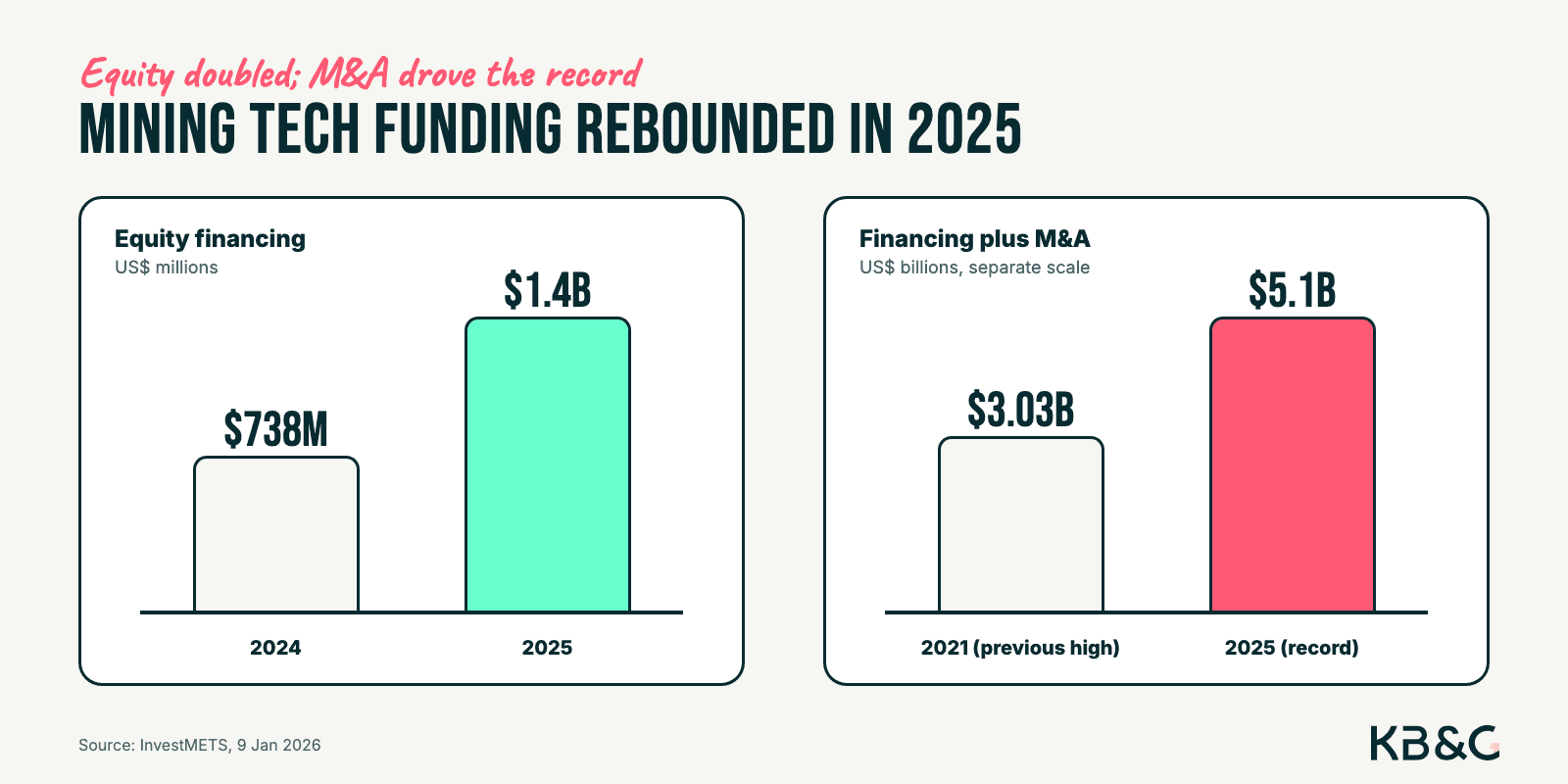
Equity financing in global mining and metals tech reached US$1.4 billion in 2025, up from US$738 million in 2024, according to InvestMETS data published on 9 January 2026. Counting M&A, total deal value hit a record US$5.1 billion in 2025, beating the previous high of US$3.03 billion set in 2021. Most of that record was acquisitions (about US$3.7 billion), not venture money.
The short version:
- 2025 equity financing was about 90% higher than 2024, after two weak years.
- Three rounds (KoBold Metals, Redwood Materials, Mariana Minerals) add up to roughly US$1.2 billion between January 2025 and August 2026.
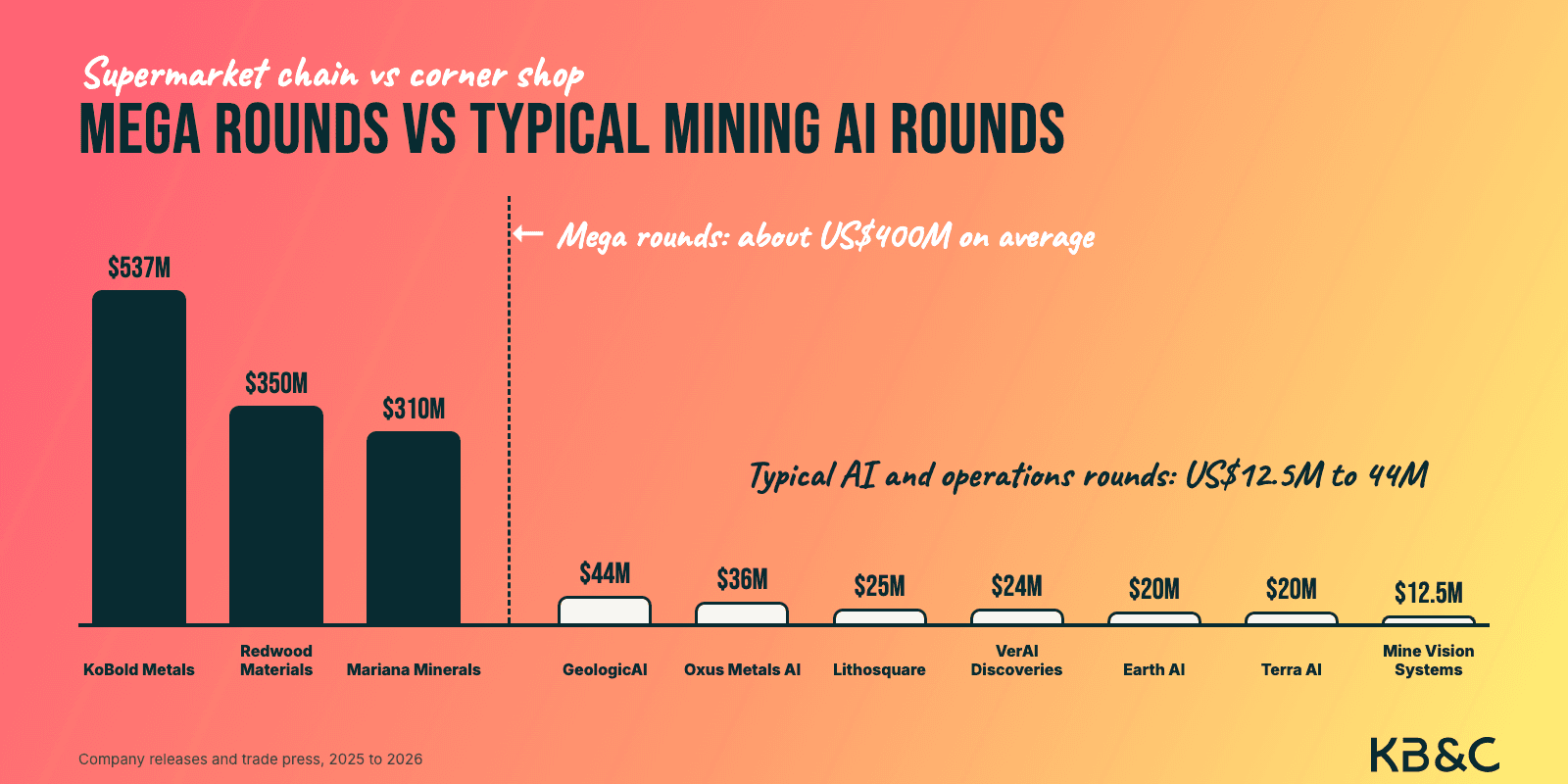
- Typical AI and software rounds in mining sit between US$12 million and US$44 million.
- Public finance commitments for critical minerals dwarf venture capital by more than 40 times.
- Miners' venture arms mostly join rounds rather than lead them, and slow adoption remains the real constraint.
Did Mining Venture Capital Really Rebound in 2025?
Yes, from a low base. InvestMETS called 2023 a "gap year" (October 2023), and the IEA said in May 2025 that start-up funding in critical minerals was "showing signs of a slowdown" in 2024.
Then 2025 turned. The IEA's Global Critical Minerals Outlook 2026 says venture capital "recovered" in 2025 and is increasingly targeting AI for exploration and extraction. The odd part: the same report says total critical-minerals investment fell 9% in 2025. So start-up money rose while the industry's own capital spending shrank. Investors were betting on new methods, not on more of the old ones.
The record US$5.1 billion headline needs a pinch of salt. Wabtec's purchase of Evident's inspection business (US$1.78 billion), Weir buying Micromine (US$800 million) and Caterpillar buying RPMGlobal (US$735 million) did most of the lifting (InvestMETS, January 2026). That is consolidation, not a venture boom.
A word on sources. InvestMETS, PitchBook and the IEA all define "mining tech" differently, so we do not splice their numbers into one series. Where they overlap, we use the conservative figure.
Where Did the Mining Tech Funding Actually Go?
Mostly into a few very large rounds for companies that find, own or process the metal itself, not companies that sell software to miners.
- KoBold Metals raised a US$537 million Series C at a US$2.96 billion valuation (January 2025), led by Durable Capital Partners and T. Rowe Price. An SEC filing later showed about US$163 million sold toward a further US$200 million (The Logic, November 2025). We use the filed figure, not the larger numbers floating around.
- Redwood Materials raised a US$350 million Series E led by Eclipse (October 2025).
- Mariana Minerals, a software-first miner and refiner, raised a US$310 million Series B led by Khosla Ventures (August 2026), reportedly at a US$1.5 billion valuation.
- Phoenix Tailings raised a US$76 million Series B led by Envisioning Partners (2025).
- Vulcan Elements raised a US$65 million Series A led by Altimeter Capital (August 2025).
- GeologicAI raised a US$44 million Series B led by Blue Earth Capital (July 2025).
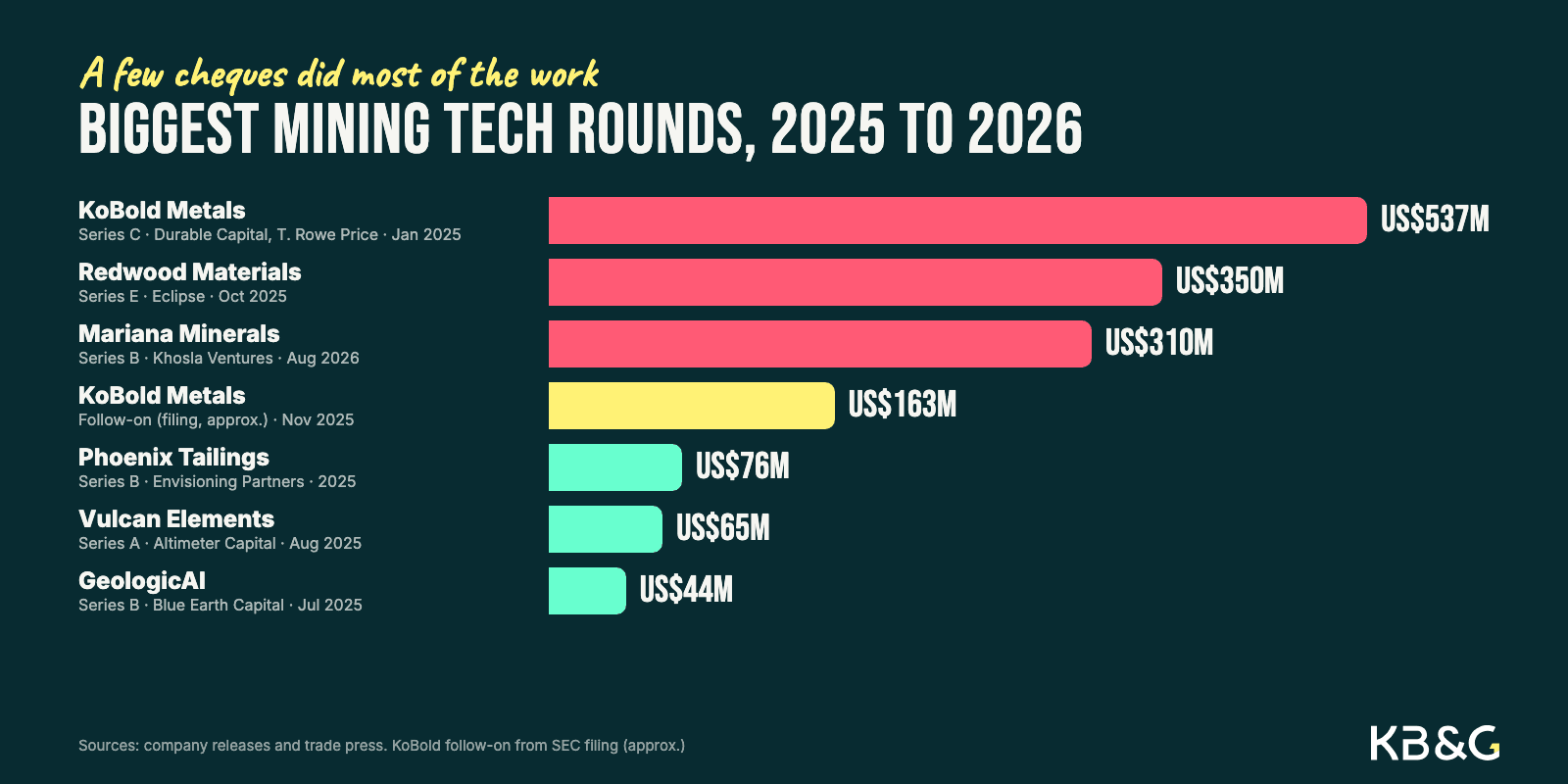
Notice the pattern. AI exploration, refining, recycling and magnets. Companies that end up holding a commodity, or that a defence department cares about. We found no 2024 to 2026 round above US$50 million for automation, electrification or safety tech. Those companies tend to get bought instead.
How Big Is a Typical Mining AI Round?
Much smaller than the headlines suggest. The rounds most mining software and AI founders will recognise look like this:
- Oxus Metals AI: about US$36 million (closed July 2026, company-stated).
- Lithosquare: US$25 million (May 2026).
- VerAI Discoveries: US$24 million Series B first close (February 2025).
- Earth AI: US$20 million Series B (January 2025).
- Terra AI: US$20 million (June 2026).
- Mine Vision Systems: US$12.5 million Series A (November 2025), one of the few operations-side rounds.
The three mega rounds average roughly US$400 million. The typical AI round is around US$20 million to US$25 million. That is a gap of more than 15 times, and it matters: if your pitch deck benchmarks itself against KoBold, you are comparing a corner shop with a supermarket chain because both sell milk.
Note also how few of these companies sell software into operating mines. Exploration AI gets funded because a discovery is a binary, valuable event. Operations AI has to prove value inside someone else's plant, on someone else's schedule. Investors price that in.
Who Invests in Mining Technology?
Four groups, with quite different habits.
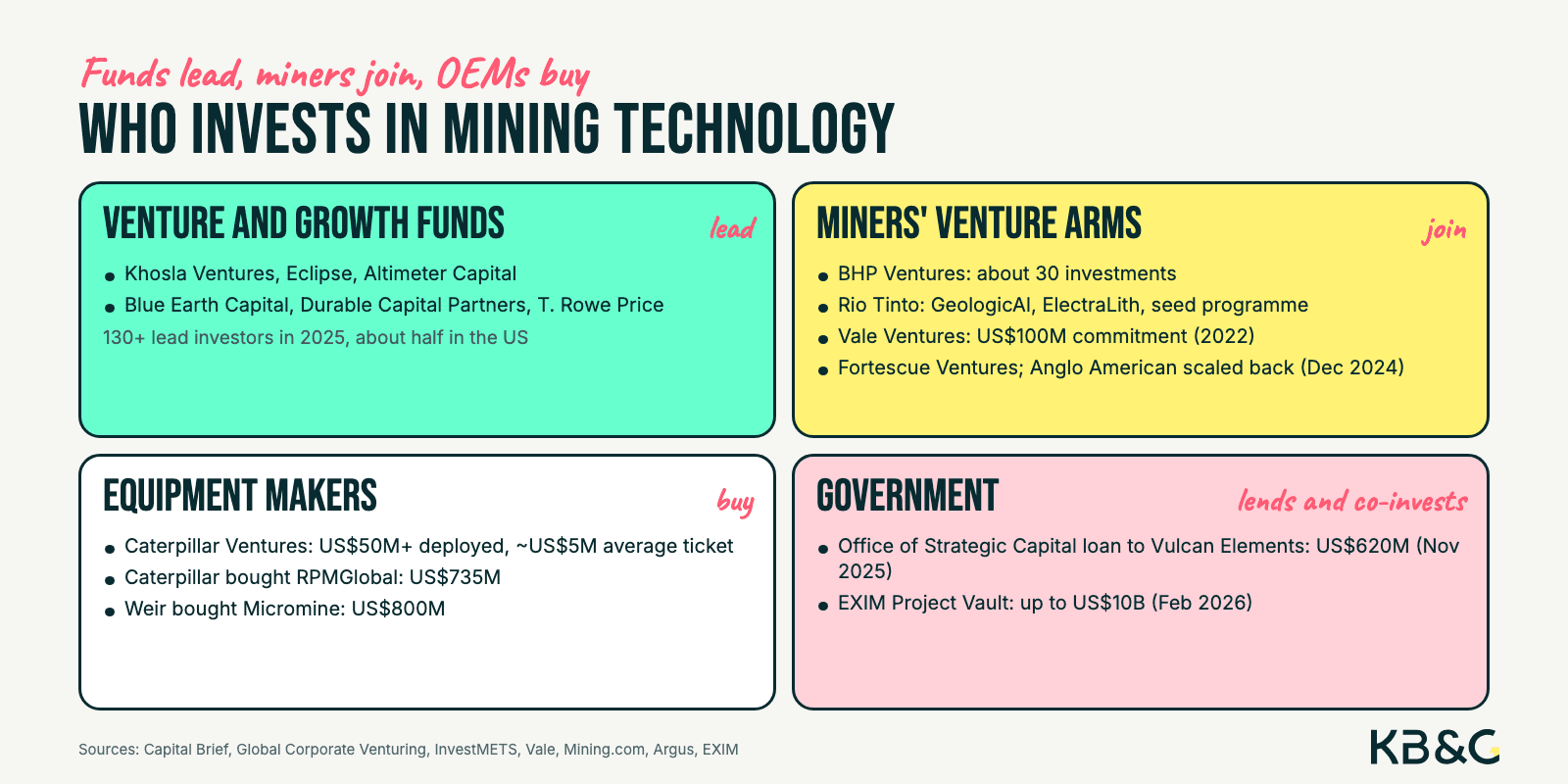
Venture and growth funds lead. Khosla Ventures, Eclipse, Altimeter, Blue Earth Capital and crossover investors such as T. Rowe Price wrote the lead cheques in the rounds above. InvestMETS counted more than 130 lead investors in 2025, about half of them American.
Miners' corporate venture arms join. BHP Ventures is the busiest: it reports about 30 investments (Capital Brief, December 2025) and appears in GeologicAI, Terra AI and Mariana Minerals. In none of those did it lead. Rio Tinto joined GeologicAI and ElectraLith's A$27.5 million Series A (January 2025), and runs an A$14.4 million seed programme with Founders Factory (April 2024). Vale Ventures launched in 2022 with a US$100 million commitment. Fortescue Ventures invests in physical AI, electrification and critical minerals (fund size not public). And not every arm survives: Anglo American scaled back its decarbonisation venture unit in December 2024.
Equipment makers mostly buy. Caterpillar Ventures deployed more than US$50 million last year with average tickets trending toward US$5 million (June 2026). Meanwhile Caterpillar paid US$735 million for RPMGlobal and Weir paid US$800 million for Micromine (InvestMETS, January 2026). The message for founders: an OEM is more likely to be your acquirer than your lead investor.
Governments act like investors now. More on that below.
Why Is Critical Minerals Startups Funding So Concentrated?
Because national security has entered the cap table. PitchBook data reported by Bloomberg shows VCs put more than US$628 million into US rare-earth startups in 2025, 90% of global funding in that category and a jump of nearly 3,000% on 2024 (February 2026).
Venture money follows government money. Vulcan Elements is the cleanest example: a US$65 million Series A in August 2025, then a US$620 million conditional loan from the Pentagon's Office of Strategic Capital in November 2025. The government cheque was nearly ten times the venture one.
If your product helps produce a strategic metal, the money is there. If it makes a haul road 4% more efficient, you are in a different, quieter market.
How Does Public Money Compare With Mining Venture Capital?
It is not close. The IEA estimates public finance commitments for critical minerals in advanced economies at about US$65 billion in 2025, over four times the 2023 level. Global mining-tech equity financing that year was US$1.4 billion. The comparison is not like for like (commitments are not payouts, and the IEA itself notes "a considerable gap" between the two), but the order of magnitude is the point.
The programmes a company can actually reach:
- United States: an EXIM loan of up to US$10 billion for Project Vault (February 2026), and DOE funding notices worth "nearly US$1 billion" (August 2025).
- Canada: a proposed C$2 billion Critical Minerals Sovereign Fund over five years (Budget 2025), and the enhanced SR&ED expenditure limit raised to C$6 million (proposed in Budget 2025).
- Australia: an initial A$1.2 billion Strategic Reserve, taking total government investment through the Critical Minerals Facility to A$5 billion (April 2025).
- European Union: RESourceEU, about €3 billion over 12 months (December 2025), and 47 strategic projects under the Critical Raw Materials Act with €22.5 billion of expected capex (March 2025). Some outlets cite a larger count including projects outside the EU; we stick to the confirmed 47.
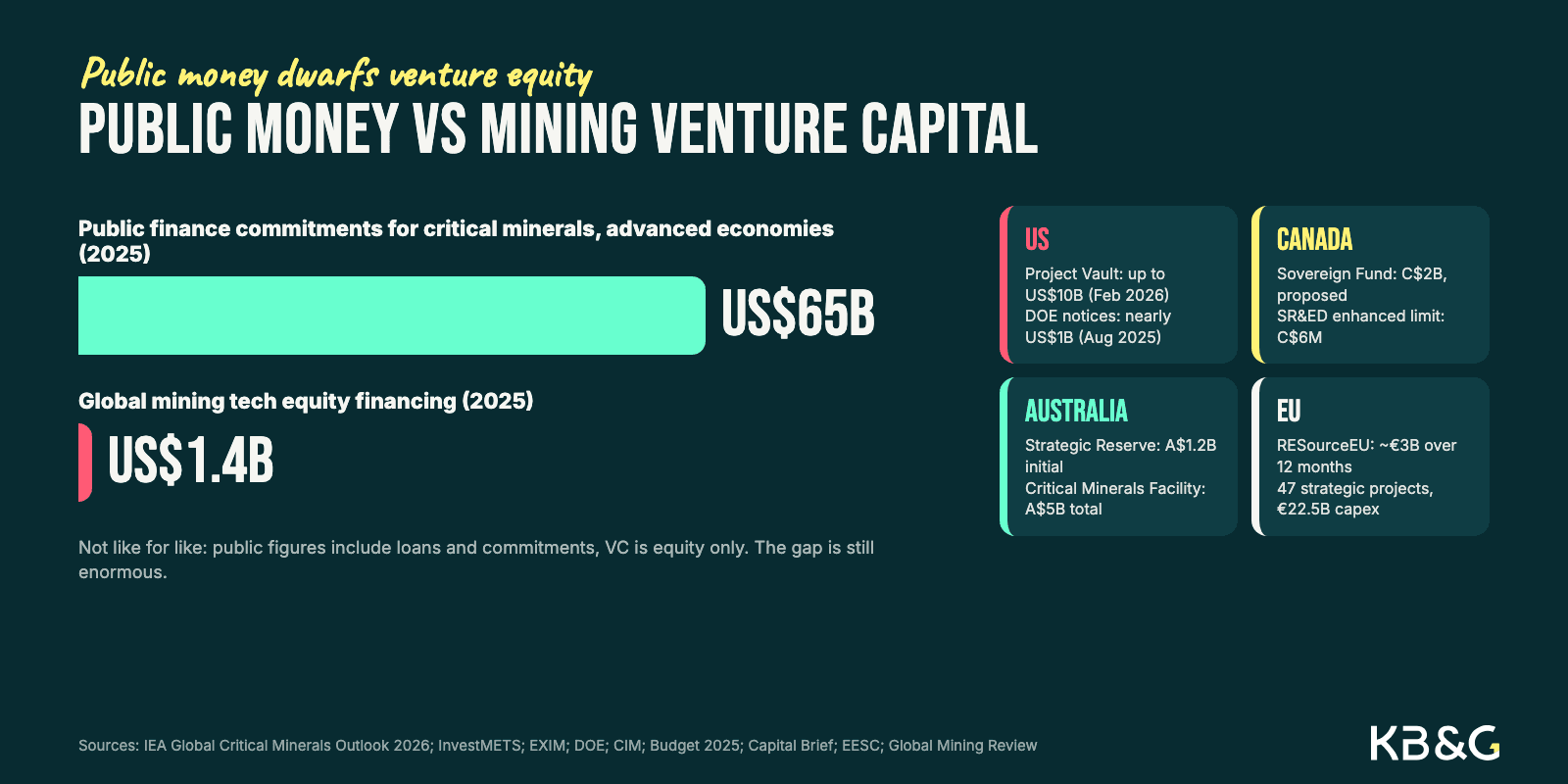
Most of this money goes to projects, processing plants and supply chains, not to software. But software companies that serve those projects are closer to it than they think. A funded refinery still needs process control, a funded mine still needs planning tools.
What Slows Down Mining Technology Investment?
Not the technology. The buyer.
Investors have said for years that the mining-tech sales cycle is "too long and therefore too risky to invest in" (Canadian Mining Journal, August 2023). Ian Rountree of Cantos, an Earth AI investor, put it more bluntly: "If your customer's sales cycle is longer than 18 months, you are de facto dead" (Latitude Media, January 2026). Anyone who has waited for a mine site's procurement team will not argue.
Investors also want pilots to be paid. Mark Frayman, a former head of BHP Ventures, told InvestMETS that customer adoption risk sits on top of technology risk, and that investors want paid pilots (August 2024). A free pilot proves that a site will accept free things. That is not a business model; we wrote more on this in our piece on pilot purgatory.
The best public conversion data comes from Canada's MICA programme: of 70 supported projects over five years, 21 reached commercial deployment, about 30% (March 2026, self-reported by the programme). That is with an accelerator's help. Plan accordingly.
This also explains the funding concentration. Full-stack companies like KoBold and Mariana sell a commodity, not a licence, so they skip the procurement queue entirely. Investors pay a premium to avoid our industry's sales cycle. Fair enough.
Summary: Rounds and Programmes at a Glance
| Round/Programme | Amount | Date | Source |
|---|---|---|---|
| Mining and metals tech equity financing, global | US$1.4B (2024: US$738M) | 2025 | InvestMETS |
| Financing plus M&A, global (record) | US$5.1B (2021: US$3.03B) | 2025 | InvestMETS |
| KoBold Metals Series C | US$537M | Jan 2025 | Pulse 2.0 |
| Redwood Materials Series E | US$350M | Oct 2025 | ESG Today |
| Mariana Minerals Series B | US$310M | Aug 2026 | Company release |
| GeologicAI Series B | US$44M | Jul 2025 | Company release |
| US rare-earth startups, VC total | US$628M+ | 2025 | Bloomberg via Energy Connects |
| Public finance commitments, advanced economies | ~US$65B | 2025 | IEA |
| Project Vault EXIM loan (US) | Up to US$10B | Feb 2026 | EXIM |
| Critical Minerals Sovereign Fund (Canada) | C$2B (proposed) | Nov 2025 | CIM Magazine |
| RESourceEU (EU) | ~€3B | Dec 2025 | EESC |
What This Means for Founders
- Benchmark against the right rounds. For mining software and AI, US$12 million to US$44 million is the realistic range. The US$300 million rounds belong to companies that own the metal.
- Treat the sales cycle as a financing problem. If your runway is shorter than your customer's procurement process, the maths ends badly. Our notes on go-to-market strategy for AI startups cover how to shorten it.
- Charge for pilots. Investors ask for paid pilots because they convert. Unpaid ones mostly produce slide decks.
- Do not wait for a miner's venture arm to lead. Bring a lead investor; use BHP Ventures, Rio Tinto or Vale as the strategic signal and the route to site access.
- Look at public money first. Even allowing for the fact that loans and commitments are not the same as equity, the gap is enormous, so it is worth mapping your product to the projects governments are funding.
If you are building an AI product for operating mines and want a partner who has sat through the procurement meetings, KB&G co-builds AI products with founders through our Innovation Studio.
Frequently Asked Questions
How much venture capital went into mining tech in 2025?
InvestMETS reports US$1.4 billion of equity financing in global mining and metals tech in 2025, up from US$738 million in 2024. Including M&A, deals totalled a record US$5.1 billion.
Who are the biggest mining tech investors?
Lead investors in the largest recent rounds include Durable Capital Partners, T. Rowe Price, Khosla Ventures, Eclipse and Altimeter Capital. Among miners, BHP Ventures is the most active, followed by Rio Tinto, Vale Ventures and Fortescue Ventures.
Does BHP invest in startups?
Yes. BHP Ventures reports about 30 investments and has joined recent rounds for GeologicAI, Terra AI and Mariana Minerals, usually as a participant rather than the lead.
Is mining corporate venture capital a good first investor?
It is a useful second one. Corporate arms bring site access and credibility, but they rarely lead, and units can be cut when strategy changes, as Anglo American showed in December 2024.