
You start Monday with a clear plan. By lunchtime you've answered messages, helped your team solve a problem, spoken to a customer and joined two meetings you hadn't planned for. By Friday you've barely touched the work you thought would make the biggest difference to your business. Sound familiar?
The frustrating part is that you're not sitting around doing nothing. You're working long hours, making decisions and keeping the company running. But if someone asked you what had materially changed in your business over the past month, would you have a clear answer? Very often the reason is not your time management. It's that too much of the company still runs through you.
What Is a Founder Bottleneck?
A founder bottleneck is when the business can only move as fast as you can make decisions, because the important ones still have to go through you. Your team can be busy and capable, and the work can still pile up at the same point: your approval, your judgement, your calendar.
It rarely looks like a problem from the inside. It looks like being responsible. You join the sales call because the deal matters. You settle the disagreement because someone has to. You explain, again, what should take priority. Each moment is reasonable. Together they create a company that depends on one person to move forward, which is what people mean by founder dependency.
Busy vs Productive: Is a Full Week the Same as Progress?
No. There's a difference between keeping a business running and moving it forward, and when you're a founder it's surprisingly easy to confuse the two. You can fill an entire month with completed tasks and still have no better understanding of why sales aren't growing, why customers aren't converting, or why your team can't move forward without you.
That's why I pay attention not just to what got done, but to what has actually changed. Are customers making buying decisions more readily? Is your sales process becoming easier to repeat? Is your team solving more problems independently? Those are much more meaningful signs of progress than a full calendar. I've written the longer version of this in why strong founders get stuck. Here I want to look at one specific reason the week disappears: you've become the bottleneck.
How Do Founders Become the Bottleneck Without Realising It?
You become the bottleneck because the thing that made you effective in the early days never got handed over. When you started your company, being involved in everything was probably an advantage. You knew the customers, understood the product and could make decisions without waiting for anyone else.
Then you hired people to help you grow. Developers, a salesperson, perhaps an operations manager. You delegated tasks because you wanted to free up your time and focus on the bigger picture and the vision.
Yet your team still asks you to approve decisions, join sales calls, resolve disagreements and explain what should take priority. You may have handed over the work, but the responsibility for deciding what happens next still sits with you. This is the transition many founders face, and it's where delegation often breaks down.
Why Doesn't Delegation for Founders Work When You Only Hand Over Tasks?
Because a task without the decisions around it still needs you. Imagine you've hired a salesperson, but they keep asking you to join meetings with potential customers. You might assume they need more training or experience. That could be true. But there's another possibility: your sales process depends on knowledge that exists only in your head.
Perhaps you know which questions reveal a serious buyer, how to explain the product's value, or when to challenge a customer's assumptions. Your new hire doesn't know those things yet, because the business has never made them explicit.
Or maybe the problem runs deeper. You haven't agreed on exactly which customers you're targeting, so the salesperson is trying to sell to people with very different needs. In that situation, hiring another salesperson won't necessarily solve anything. You may simply create another person who needs your involvement.
The same pattern appears in product development and operations. Employees can execute their tasks perfectly and still struggle to make progress if they don't understand the outcome they're working towards, or which trade-offs they have the authority to make.
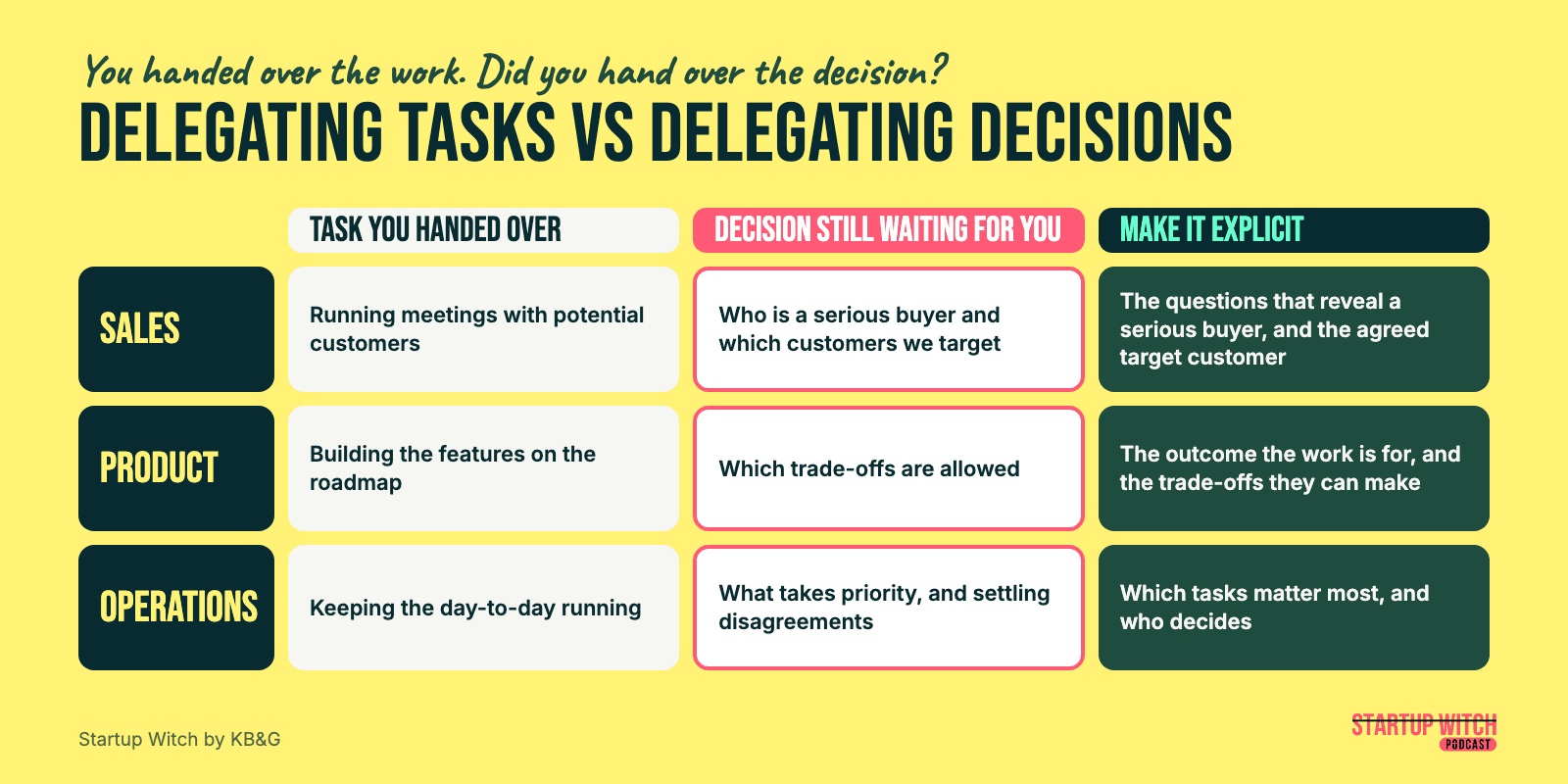
Delegation isn't just about transferring tasks. It's about creating enough clarity for other people to make good decisions without asking you to approve every step. That's where real empowerment and accountability come from: people can only be accountable for decisions they're actually allowed to make.
Does Delegation Actually Affect Growth?
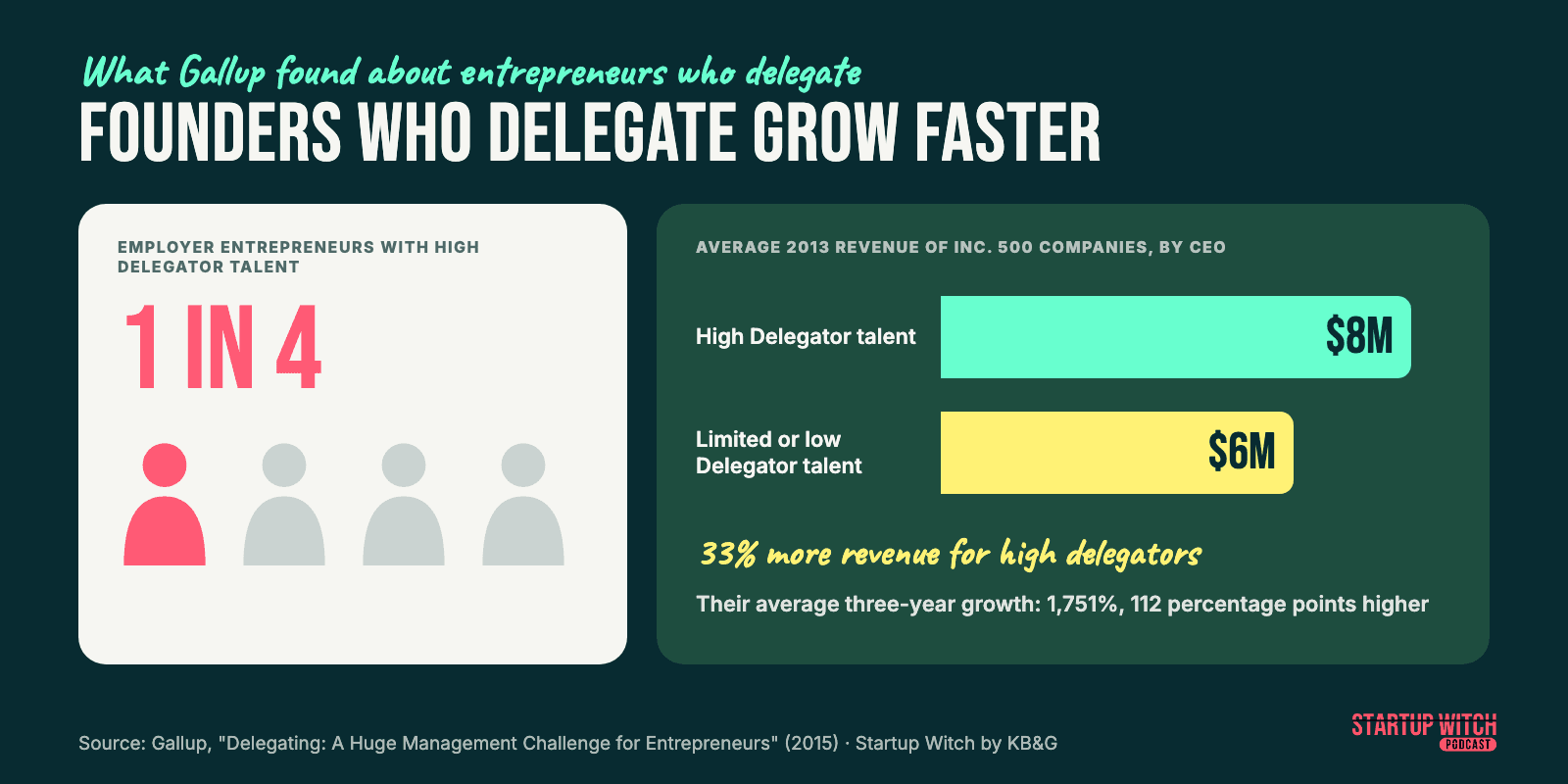
The outside research points the same way. When Gallup studied 143 CEOs on the Inc. 500 list, those with high "Delegator" talent posted an average three-year growth rate of 1,751%, 112 percentage points higher than CEOs with limited or low Delegator talent, and generated 33% more revenue in 2013 ($8 million versus $6 million). The same Gallup piece notes that only one in four employer entrepreneurs have high levels of that talent. It's a correlation in one group of fast-growing companies, not proof, but it's hard to ignore.
Control over the big decisions shows up in value too. In a study of 6,130 American startups, Noam Wasserman found that each additional level of founder control (controlling the board and/or the CEO position) reduced the startup's pre-money valuation by 17.1 to 22.0 percent on average, and the effect was especially strong once a startup was three years old or more. That's about formal control rather than who answers the daily questions, but the managerial point in the paper is the same one: what helps in the early days can hold the company back as it grows.
How Do You Tell If You Are the Bottleneck?
Watch what keeps coming back to you. A few signs:
- The same questions return to your plate every week, from the same people.
- Your salesperson wants you on the call before a deal can move.
- Disagreements in the team wait until you settle them.
- Work is "done", but nothing ships or closes until you approve it.
- The important work you planned on Monday is still untouched on Friday.
If the same questions keep coming back to you, don't immediately assume you need better people. Look at why the business still depends on you to answer them. That is the root cause worth finding, not the individual question.
Why Does Prioritising Feel Impossible as a Founder?
Prioritising feels impossible when you don't understand what's actually holding the business back. Let's say you've realised you need to stop reacting to every problem and start working more strategically. You sit down to plan the next quarter. Sales need attention, the product roadmap is growing, your marketing isn't delivering the expected results, and someone on your team may need replacing.
Which one should come first? You can probably make a convincing argument for every option. That's the trap.
- If sales are weak, you might invest in lead generation. But if the people you're attracting don't understand your offer, more leads may simply produce more unsuccessful sales conversations.
- If customers keep requesting features, you might expand the roadmap. But if those requests come from people who aren't representative of your target market, you could spend months building something that doesn't help you acquire the customers you need.
- If your team isn't delivering the results you expected, you might hire someone more experienced. But if responsibilities are unclear and every important decision still requires your approval, the new hire may run into exactly the same problems.
Each solution addresses something visible. The question is whether it addresses the reason the business isn't progressing. When you can't answer that, prioritisation becomes a guessing game. You follow whichever problem feels most urgent, switch direction when something else demands attention, and keep adding work without resolving the uncertainty behind your decisions.
How Should You Prioritise as a Founder?
Before asking what to do next, ask yourself what you need to understand first. That might mean investigating why customers aren't buying, identifying which part of your sales process isn't working, or understanding why your team can't make decisions independently.
The answer will be different for every business. That's precisely why generic productivity advice can only take you so far. A better to-do list doesn't help if the list itself is built on a guess.
Why Is Treating the Symptom Such an Expensive Mistake?
One of the most expensive mistakes a founder can make is treating the most visible symptom as the actual problem. Take a hypothetical example: you spend €4,000 a month on marketing, get thousands of website visitors and make very few sales. It's tempting to conclude that you need more traffic or a better landing page.
But perhaps you're attracting the wrong audience. Maybe visitors understand the product but don't see enough value to pay for it. Or perhaps the person using the product isn't the person who decides whether the company buys it. Each explanation points towards a different solution.
The same applies when your team is overwhelmed. You might assume you need another employee, when the real problem is that nobody knows which tasks matter most. Or you might try to improve your own productivity, when the business has become so dependent on your decisions that no time-management system can solve the underlying issue.
What If Your Team Could Practise Before the Real Conversation?
There's another reason founders end up involved in everything: important skills are harder to apply in real situations than they look in theory. Your salesperson may understand how to handle objections but freeze when a customer challenges the price. Your team may know the principles of negotiation and still struggle when a conversation becomes uncomfortable. You may have explained the process several times, and the same mistakes keep appearing with actual clients.
Knowing what to do and being able to do it under pressure are two different things. That's why practice matters, and why we built Georgia, an AI role-play coach built with sector trainers. Your team rehearses realistic sales conversations, like holding your price or hearing "the other supplier is cheaper", in 3 to 8 minute self-paced sessions with real-time coaching. Instead of relying on you to join every call or correct every interaction afterwards, they build team confidence through practice, before the mistakes affect real deals.
How Do You Stop Being the Bottleneck?
Start by looking honestly at the past month:
- What has actually changed in your business? Not what got done. What changed.
- Which decisions still depend on you? Write them down.
- What keeps returning to your plate? That pattern tells you where clarity is missing.
- Which important question have you been putting off because you're too busy dealing with everything else?
Sometimes you genuinely need more capacity. Sometimes your team needs training, your product needs work or your sales process needs to improve. But before committing more time and money, you need to understand which problem you're trying to solve and why it matters. You don't need to solve every problem at once. You need to identify the one that deserves your attention first.
Where the Founder Blind Spot Diagnostic Fits
This is why I created the Founder Blind Spot Diagnostic by Startup Witch. Before you spend more money, hire another person or commit to another major initiative, it helps to understand what you're actually trying to fix. The diagnostic reads your startup in 14 days and names the one thing blocking growth. It costs EUR 750 and is fully refundable. Not another generic list of things startups should do to grow, but a clear answer on where to focus first.
Frequently Asked Questions
Is it true that being busy is not always productive?
Yes. You can complete dozens of tasks in a week and change nothing that matters. Judge the week by what changed in the business, not by how full your calendar was.
What are some good examples of delegation?
Good delegation hands over the decision along with the task. A salesperson who knows which customers you're targeting and which questions reveal a serious buyer can run the meeting without you. One who only has the meeting slot will keep asking you to join.
Should I hire more people to fix a founder bottleneck?
Not before you know why the work is stuck. If every important decision still requires your approval, a new hire may simply become another person who needs your involvement.
Your Business Doesn't Need You Everywhere
Working longer hours isn't a reliable way to measure how much you're contributing to your company's growth. The goal isn't to disappear from your business. It's to stop being the place where every decision waits. Your business doesn't need you to be involved in everything. It needs your attention where it makes the biggest difference.