
There is a particular kind of stuck that I find much more interesting than simply not knowing what to do. The company is moving, you are making decisions, things are getting done, and somehow the result stays almost the same. If your startup is not growing while everyone is working flat out, this post is for you. Not because you lack ideas, but because you probably have too many of them.
Why Do Strong Founders Get Stuck?
Strong founders get stuck because they are so good at solving problems that they start solving before they have diagnosed what the problem actually is. The solutions create visible activity, the activity feels like progress, and the one outcome that matters quietly stays where it was.
From the inside, it doesn't feel like a problem. There is always something demanding attention, so the day fills up naturally. Then a few months pass, you look back, and the thing you actually wanted to change hasn't changed much at all.
Why Does Being Good at Solving Problems Become a Trap?
One of the advantages of being a founder is being able to deal with uncertainty. Something breaks, you figure it out. A customer has a problem, you get involved. The product needs something, you build it. That ability is incredibly useful.
But a person who is very good at solving problems can start solving before they have really established what the problem is. Imagine sales have slowed down. The first instinct might be to bring in more leads, improve the sales process or hire somebody better at selling. All plausible. But "sales are slow" isn't a diagnosis. It's an observation. There is still a missing piece between the symptom and the decision, and until that piece is understood, every solution is partly a guess.
Is Busy the Same as Progress? The Build Clock vs the Market Clock
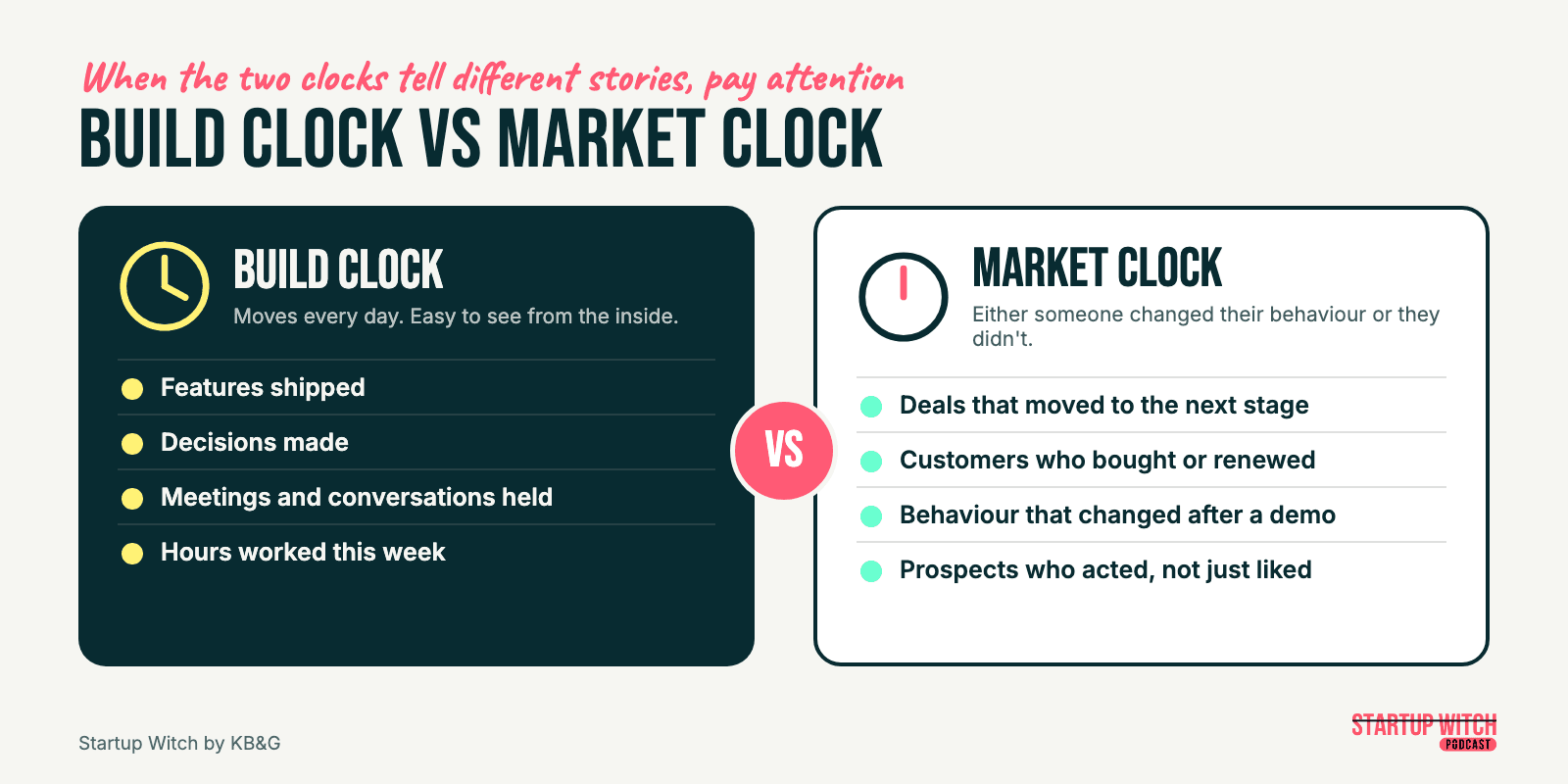
I don't think being busy is a problem by itself. Building a company is busy. The problem starts when the amount of work becomes the main evidence that things are moving forward. You can work sixty hours a week and still see very little change in the market.
Internal progress is very visible: you remember the decisions you made, the things you built, the conversations you had. Market progress is less forgiving. Either someone changed their behaviour or they didn't. That's why I separate the build clock and the market clock. The build clock can move every day. The market clock might not move at all. If those two clocks have been telling different stories for a while, pay attention to that before adding more work.
Why Is My Startup Not Growing When the Team Is Working So Hard?
Often because the problem lives one layer above the thing you're looking at. A founder says, "We don't have enough sales." The next sentence is often, "We need more leads." That sounds like a plan, but it is actually an assumption about where the problem lives.
- Maybe the funnel isn't getting enough people.
- Maybe enough people enter, but they're the wrong people.
- Maybe the right people arrive and don't understand the offer.
- Maybe they understand it and still don't see enough reason to buy.
- Or maybe the sales conversations are fine until the follow-up, and that's where everything disappears.
You don't need a giant framework to work this out. Look at what is actually happening. Where did the last few deals stop moving? What did the customer say? What changed between the people who moved forward and the people who didn't? The mistake is trying to solve the whole thing before finding the point where it broke. The symptom is rarely where the problem lives.
| What you hear yourself say | What it really is | Questions that move you toward a diagnosis |
|---|---|---|
| "Sales are slow." | An observation | Where did the last few deals stop moving? What happened right before? |
| "We need more leads." | An assumption about where the problem lives | Are we short of people, or short of the right people? |
| "Customers liked the demo." | Positive feedback, not behaviour | What did they actually do afterwards? |
| "We're too busy." | Build clock evidence | Has the market clock moved in the same period? |
| "We've tried everything." | A pattern worth reading | If five approaches gave the same result, what do they have in common? |
What Can Sales Practice Teach You About Diagnosing Your Startup?
A lot of our work on Georgia, our AI role-play coach built with sector trainers, comes from the same observation. People can be very good at explaining what they know. That doesn't tell you what happens when they have to use it.
Someone can explain how to handle an objection perfectly. Then a real customer says, "That's too expensive," and the conversation goes somewhere completely different. Maybe they start talking too much. Maybe they defend the price before understanding what the customer means. Maybe they offer a discount just to get out of the uncomfortable moment. None of that is visible when you ask someone how they would handle it. It becomes visible when the situation actually happens.
That's why Georgia uses simulation and practice, in 3 to 8 minute self-paced sessions with real-time coaching. Not because a simulation can reproduce reality perfectly. It can't. The point is to create enough of the real situation to see how someone behaves when there is something at stake. The same principle works for founders: when something isn't working, look for a way to observe the problem rather than just explain it.
Do You Really Need More Customer Interviews?
I sometimes hear, "I've already spoken to twenty customers. I know what they think." Maybe. But collecting opinions is not the same as understanding behaviour. Someone can tell you they like the product and never buy it. Someone can have a very positive conversation with you and do absolutely nothing afterwards.
Outside research on the intention and behaviour gap points the same way. A meta-analysis of 47 experiments by Webb and Sheeran found that a medium-to-large change in intention (d = 0.66) led to only a small-to-medium change in behaviour (d = 0.36). Moving what people intend to do moves what they actually do by a lot less.
So the useful part is what happens after the conversation: did interest turn into action? Positive feedback feels reassuring. Behaviour is usually more informative. Sometimes the uncomfortable signal is the useful one.
Why Do Capable Founders Stay With the Wrong Explanation for Too Long?
Once you've invested a lot of yourself in a company, everything is connected. The product affects the pitch. The pitch affects the sales conversation. The sales conversation affects what you think customers want, and that affects what you build next. So if the first assumption is wrong, the next few decisions can still look perfectly logical. Nothing looks obviously broken. You just keep making reasonable decisions from a bad starting point.
The research is not flattering. In a study of 1,112 new firms, McCarthy, Schoorman and Cooper found that founders who had started their firms, and those who were strongly overconfident, were significantly more likely to decide to expand, with the effect stronger when market feedback was negative. And Simon Parker found that self-employed people in Britain adjusted their expectations in the light of new information by only 16 percent. Roughly one sixth. The rest is the belief they already had.
I've experienced that myself. I've backed a direction and stayed with it longer than I should have because there was always another explanation for why it hadn't worked yet. Looking back, the expensive part wasn't making the wrong call. It was taking too long to question the call. Now I'm much more interested in what evidence would make me change my mind before I commit another quarter to something.
Is Being Stuck a Problem With Your Character?
Usually not, so don't make it about your character. A company isn't moving, so the founder starts thinking about discipline, focus, being more organised, pushing harder. But sometimes there is nothing wrong with the amount of effort. The effort is simply going into something that isn't changing the outcome. Both situations feel almost identical from the inside, and you can be exhausted in both. That is why "work harder" is such an incomplete answer. Sometimes the useful move is to stop for a moment and figure out what deserves the work.
What Should You Do When Your Startup Is Not Growing?
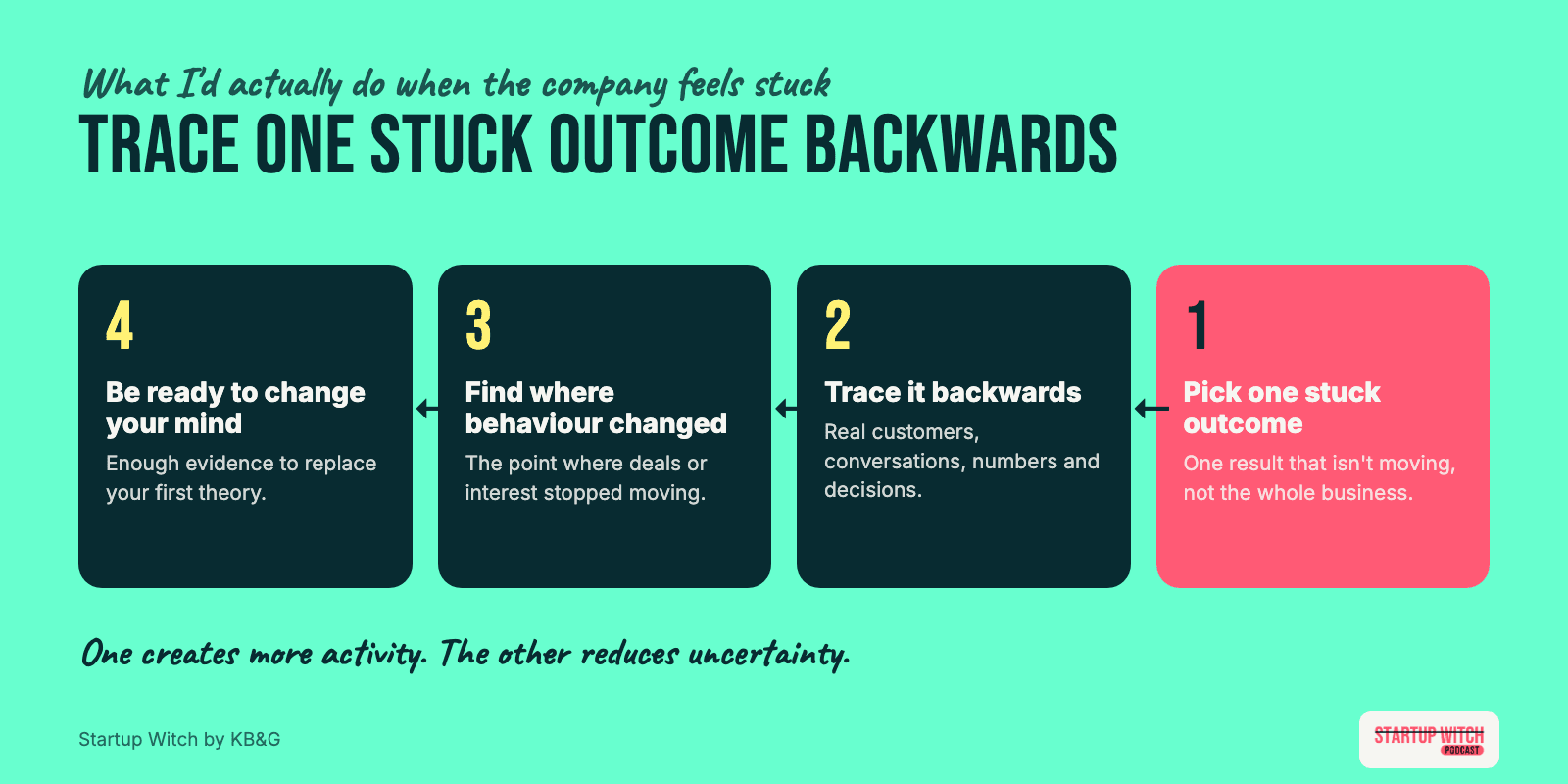
If the company had been stuck for a while, I wouldn't start with another list of things to fix. Here is what I would actually do.
- Pick one outcome that isn't moving. One. Not the whole business.
- Trace it backwards. Not theoretically. Literally. Look at the actual customers, conversations, numbers or decisions that led to it.
- Find the point where the behaviour changed. That's more useful than explaining the entire business at once.
- Be ready to change your theory. The goal isn't to prove your first theory right. You want enough information to be comfortable changing it.
If sales are down, look at where the recent deals stopped. If customers aren't converting, look at what happened between interest and commitment. If a launch went nowhere, look at what people did rather than what they said they liked.
And look at what you've already been doing. If you've tried five ways of getting customers and the result looks the same, that's information. If every sales conversation feels positive but nobody moves forward, that's information too. At some point, the pattern becomes more interesting than any individual event.
There is outside evidence that disciplined questioning changes what founders do. In a randomised trial with 116 Italian startups, Camuffo and colleagues taught one group to frame hypotheses and test them rigorously: 19 of 59 of those startups pivoted to a new idea, against 11 of 57 in the control group (about 32 versus 19 percent), and the hypothesis testers performed better. That's what a diagnosis is for.
Do You Need a New Strategy, or a Better Diagnosis?
When growth slows down, the natural response is another channel, another hire, another product idea, another experiment. Sometimes that is exactly what you need. But sometimes the company doesn't need a new strategy yet. It needs a better understanding of why the current one isn't working. One creates more activity. The other reduces uncertainty. When you're already doing a lot, reducing uncertainty is often worth more than another task on the list.
For the wider founder habits that keep companies small, read why startups get stuck. This post is narrower: finding the exact point where things stopped moving.
How Does the Founder Blind Spot Diagnostic Find Where It Breaks?
This is the thinking behind the Founder Blind Spot Diagnostic by Startup Witch. You don't need another person arriving with a generic list of things to improve. First, understand what is actually happening inside your company. Then find where the pattern breaks. Then decide what deserves attention first. The diagnostic reads your startup in 14 days and names the one thing blocking growth, for EUR 750, fully refundable.
The process is consistent. The blind spot it finds is different every time. "Individual approach" doesn't really tell you anything; the proof is whether two founders go through the same process and come out with completely different findings. Not more advice, but enough clarity to make a better decision about what happens next.
Frequently Asked Questions About Startups That Aren't Growing
Why is my startup not growing even though we work hard?
Because effort and outcome run on different clocks. If the build clock keeps moving while the market clock doesn't, the effort is probably going into something that isn't changing the outcome.
Should I buy more leads or hire a salesperson when sales are slow?
Not yet. "Sales are slow" is an observation, not a diagnosis. Find where the last few deals stopped first.
How do I know if customer feedback is reliable?
Watch what people do after the conversation. Positive feedback feels reassuring, but behaviour is more informative.
Should I change strategy when growth stalls?
First understand why the current one isn't working. A new strategy creates activity. A better diagnosis reduces uncertainty.
So, Why Do Strong Founders Get Stuck?
I don't think there is one answer. Sometimes it's the market, the product or distribution. Sometimes the founder has simply been looking at the wrong part of the problem, and that one is hard to notice because everything around it looks reasonable. When that happens, don't ask "What should we do next?" straight away. Look at what actually happened. Find where movement stopped. Then decide what deserves attention.
Because being wrong isn't the most expensive mistake a founder can make. The more expensive mistake is being wrong, and being capable enough to keep building in the wrong direction for another six months.