
What Is Speak-Up Culture in Mining?
Speak-up culture in mining is the daily practice of every person on site, from operators and contractors to supervisors and visitors, raising hazards, near misses and unsafe conditions early, through any channel, without fear of blame or career damage. It matters because frontline workers are usually first to spot weak signals of risk, such as unusual ground noise, overloaded trucks or near-collisions at ramp intersections, but hierarchy and production pressure routinely stop those signals from reaching decision-makers.
This article is written for safety managers, supervisors, superintendents and operations leaders on mine and quarry sites, covering surface and underground operations across metals, coal and aggregates. The focus is on day-to-day operational speak-up about hazards, behaviours and conditions, not on formal whistleblowing about fraud or legal grievance processes. The scope includes psychological safety, stop-work authority, radio communications and measurement of whether people actually feel safe raising concerns.
When people closest to hazards stay silent, weak signals go undetected until they escalate into serious injuries, equipment failures or forced shutdowns.
Here is what you will learn:
Why workers stay silent even when they see hazards, and what drives that silence
What good speak-up culture looks like on a pit bench, in a processing plant or underground
Specific supervisor behaviours that invite or shut down open safety dialogue
How radio traffic serves as an untapped data source for hazard and concern visibility
Ways to measure whether people on your site are genuinely speaking up, beyond formal report counts
Understanding Speak-Up Culture in Mining
Speak-up culture sits inside broader safety culture and critical risk management. In practice, it is the degree to which a person on your site will voice a concern about a slippery ramp at dawn, unclear instructions in a pre-start meeting, vibration in a crusher that feels wrong, or missing guards in a workshop. Strong safety culture shapes decision-making in mining operations because it determines whether those observations reach someone who can act on them before a fatal or serious injury event unfolds.
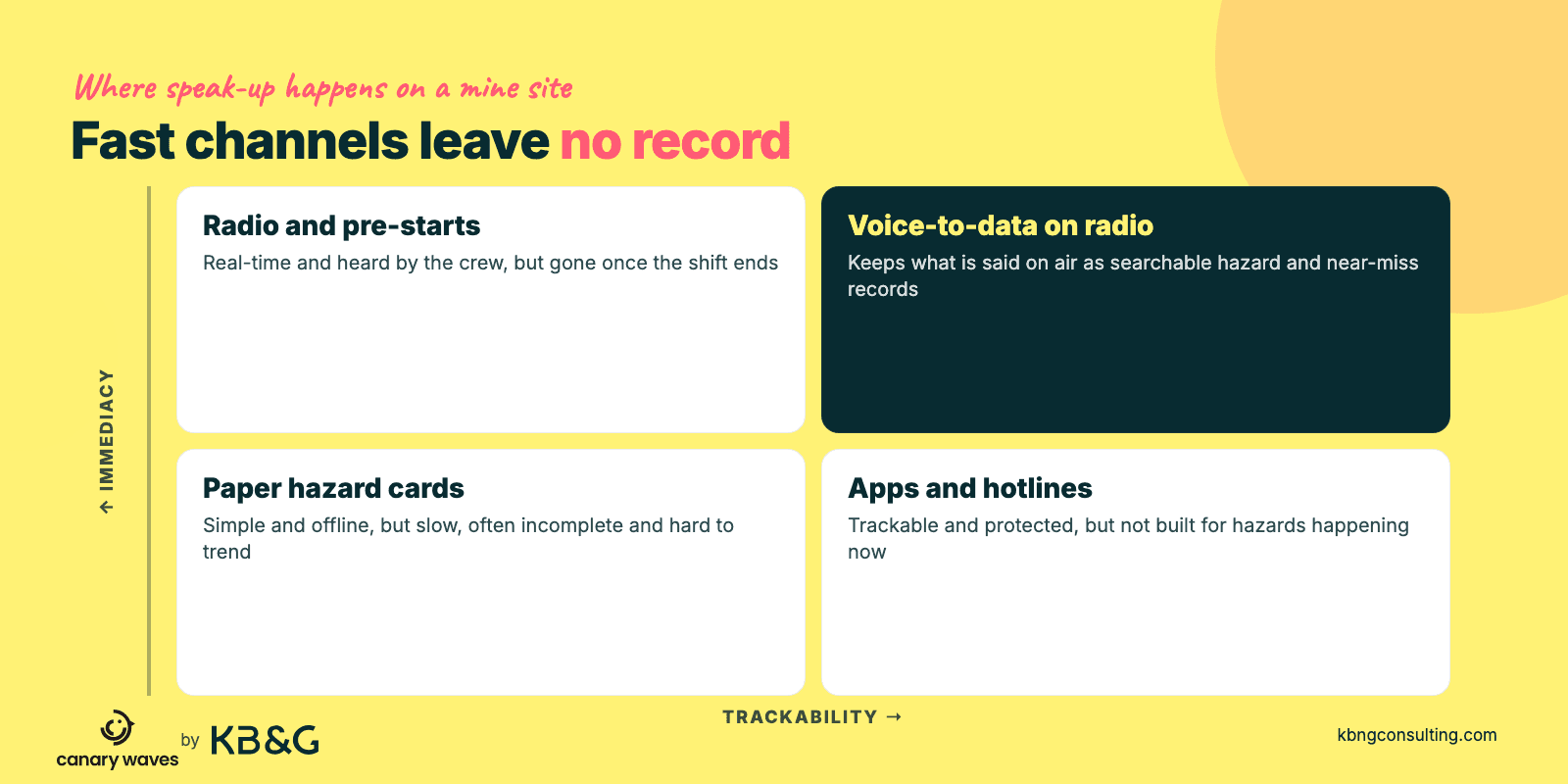
"Speaking up" is not limited to filling out a hazard card or lodging a report in incident software. It includes informal channels: a radio call to the supervisor about soft ground on a dump crest, a comment during a toolbox talk, a question asked in the crib room. Both informal and formal channels are essential. One provides immediacy; the other provides trackability and accountability.
Psychological Safety on Site
In a mining context, psychological safety means the shared belief among a team or crew that someone can ask a question, admit uncertainty, call out an unsafe practice or refuse a task without being ridiculed, punished or sidelined. It is what allows a new driller to challenge a long-standing down-the-hole practice, or a contractor fitter to refuse to sign off equipment that "has always run that way."
Amy Edmondson's research on work teams found that team psychological safety is associated with learning behaviour, such as asking questions, seeking feedback and talking openly about errors, and that this learning behaviour in turn supports team performance. Translated to mining, this means better near-miss detection, earlier escalation of ground-control issues and more realistic risk assessments during job safety analyses.
First-line leaders, including shift supervisors, leading hands and control room operators, make or break psychological safety through their micro-behaviours. When a supervisor thanks someone for raising a concern, others take note. When the same supervisor rolls their eyes or says "we've done this a hundred times," the team learns silence is the safer option.
Formal Whistleblowing vs Everyday Speak-Up
Whistleblowing typically involves reporting fraud, corruption or systemic misconduct through protected, often external channels. Everyday speak-up is about immediate, tactical operational hazards and weak signals: "I don't feel safe on this ramp," "the guard has come off," "there's water pooling near the switchgear."
Mature whistleblower frameworks do not automatically mean operators feel safe calling a stop on a dig face. Governance and anonymous hotlines serve as backstops for systemic misconduct; they do not replace real-time, informal speak-up where a haul truck driver radios a concern about visibility at an intersection.
Understanding this distinction helps leaders design practical mechanisms that work in the pit, not just on paper. The next section examines why that distinction carries real consequences for safety, production and workforce retention.
Why Speak-Up Culture Matters in Mining Operations
Psychological safety and speak-up culture connect directly to the outcomes operations leaders are measured on: serious injury and fatality prevention, production stability, licence to operate and retention of skilled workers.
Preventing Serious Injuries and Fatalities
Frontline workers often detect weak signals before formal systems do. Unusual ground sounds near a highwall bench, a near-miss between a light vehicle and a water cart at a ramp intersection, or recurring spillage around a conveyor transfer point are all observations that happen in real time on shift. The typical pattern is that those signals are voiced informally, over the radio or in the crib room, but never make it into an incident database or a risk review.
Workers need to feel safe saying "this control is missing or doesn't work here," even if paperwork says it is in place. Near misses should be reported as learning opportunities rather than occasions for blame. When speak-up is working, the difference shows up in scenarios like these:
Open-cut highwall: An operator hears cracking near a bench, radios the supervisor, and stop-work allows the geotechnical team to assess before a collapse injures the crew.
Underground drift: A contract electrician spots water pooling near electrical equipment, raises the concern, and work pauses before an electrocution hazard develops.
Processing plant: An operator reports abnormal vibration in a crusher early enough for planned maintenance, avoiding a bearing failure that would force an unplanned shutdown and put people at risk.
Production Reliability and Cost
The trade-off between safety and production is false. When concerns are suppressed, equipment failures occur, unplanned downtime accumulates and repair costs exceed what a controlled pause would have cost. A plant operator raising abnormal vibration enables early maintenance rather than catastrophic failure. A dozer operator reporting soft ground on a dump crest prevents loss of a haul road or damage to an expensive machine. Blasts get delayed because of misfires spotted during tie-in that were raised by a shotfirer but dismissed by the supervisor.
Open communication allows controlled slowdowns and targeted maintenance that prevent much bigger, costlier shutdowns. The cost of a short pause to verify ground conditions is small compared to a multi-day shutdown triggered by a wall failure that workers had been talking about on the radio for days.
Retention, Engagement and Licence to Operate
In tight labour markets, particularly in FIFO and remote operations, being a site where people feel heard and protected when they raise concerns helps attract and keep skilled workers. Creating a safe environment to raise concerns is a competitive advantage when competing for talent.
Communities and regulators increasingly scrutinise whether mining companies act on internal concerns about environmental and social risks. A tailings-related concern raised by an operator and acted on early avoids regulatory investigation. Dust or noise complaints identified by workers and addressed before external escalation protect the operation's licence to operate.
These outcomes make the case for why speak-up culture matters. The next question is: what stops it from happening?
Why Workers Stay Silent in Mining
Most miners care about safety. Yet many remain silent because the perceived cost of speaking up, in terms of job security, reputation and team relationships, outweighs the perceived benefit. Silence is often rational self-protection, not apathy.
Hierarchy, Supervisory Power and Contractor Status
Mining operations run through layered hierarchies: operators and offsiders, leading hands, supervisors, superintendents, mine managers, corporate leaders. Information flows upward slowly, and decision authority concentrates at the top. Contractors, service crews and labour-hire staff sit outside the formal culture and often feel especially vulnerable. A contractor who spots missing fall protection may worry that "making noise" means losing future shifts or not being invited back to site.
Subtle retaliation patterns reinforce silence without requiring overt punishment. Workers fear undesirable rosters, being labelled "not a team player," exclusion from overtime or training, or simply being seen as someone who slows the job down. An apprentice unsure about challenging an experienced jumbo operator faces a calculation: raise the concern and risk the relationship, or stay quiet and hope it works out. Companies need clear policies against retaliation, and supervisors who visibly live by them.
Production Pressure and "Get It Done" Culture
Daily production pressure (meeting tonnes to mill, strip ratios, development metres, ship loading targets) creates an environment where raising safety concerns that slow operations feels like a direct threat to the team's success. Language from leaders reinforces this: "we can't afford another delay," "we're behind the plan." Workers hear these phrases as a clear signal: don't slow us down.
The choice workers face is concrete. Stop a shovel because brakes are overheating and hold up a queue of haul trucks, visible lost production that everyone notices, or push through and hope nothing goes wrong. When the cost of speaking up is visible and immediate, and the cost of staying silent is invisible until something fails, silence wins.
Blame, Past Experience and Cultural / Language Barriers
Previous negative experiences train people to stay quiet. Being written up for raising a small issue, watching a colleague blamed for an outage they reported, or sitting through an investigation that felt like a prosecution rather than a learning exercise: these experiences accumulate. Workers with a history of seeing others punished for raising concerns draw the obvious conclusion.
Cultural and language factors add complexity. Many mining crews include workers for whom English is a second language, and who may feel less confident challenging instructions over the radio. In some cultures, direct confrontation of a senior person is considered disrespectful, which shows up as silence even when people see risk. Barriers related to language and cultural norms must be addressed directly.
Good stop-work policies and supervisor responses can counteract these pressures, but only if they are lived on the ground, not just laminated on the wall of the crib room.
Stop-Work Authority in Practice
Stop-work authority is the formal right and expectation that any worker can halt a task they believe is unsafe, regardless of their position and without negative consequences. On paper, most mining companies have this policy. On the ground, many workers doubt the promise of "no blame" when they halt production.
Designing Realistic Stop-Work Policies
Effective stop-work policies are written in plain language, include trigger examples relevant to pit, plant and underground settings, and define simple steps for both the person stopping work and the supervisor responding. Trigger examples should be concrete: uncontrolled energy sources, unverified isolations, lightning within a defined radius, high winds affecting crane lifts, visible ground movement, or unclear permits.
Policies must explicitly protect contractors and visitors, not only permanent employees. Reporting channels should be accessible and allow for anonymity to encourage workers to report. Where the workforce includes people for whom English is a second language, translations and plain-language versions are necessary.
A credible stop-work policy includes these non-negotiable elements:
Clear, situation-specific triggers written in language operators use
Explicit protection from reprisal for every person on site, including contractors
A defined escalation process with timeframes for resuming work
Visible commitment from senior leadership, demonstrated through action, not just posters
A post-stop-work debrief process that captures what was found and communicates outcomes
How Supervisors Respond in the Moment
The supervisor's reaction when someone exercises stop-work authority determines whether anyone will do it again. Body language, tone of voice and choice of words in front of the crew all carry weight.
Consider two scenarios on a pit bench where a crew member stops work because of visible cracks near a highwall:
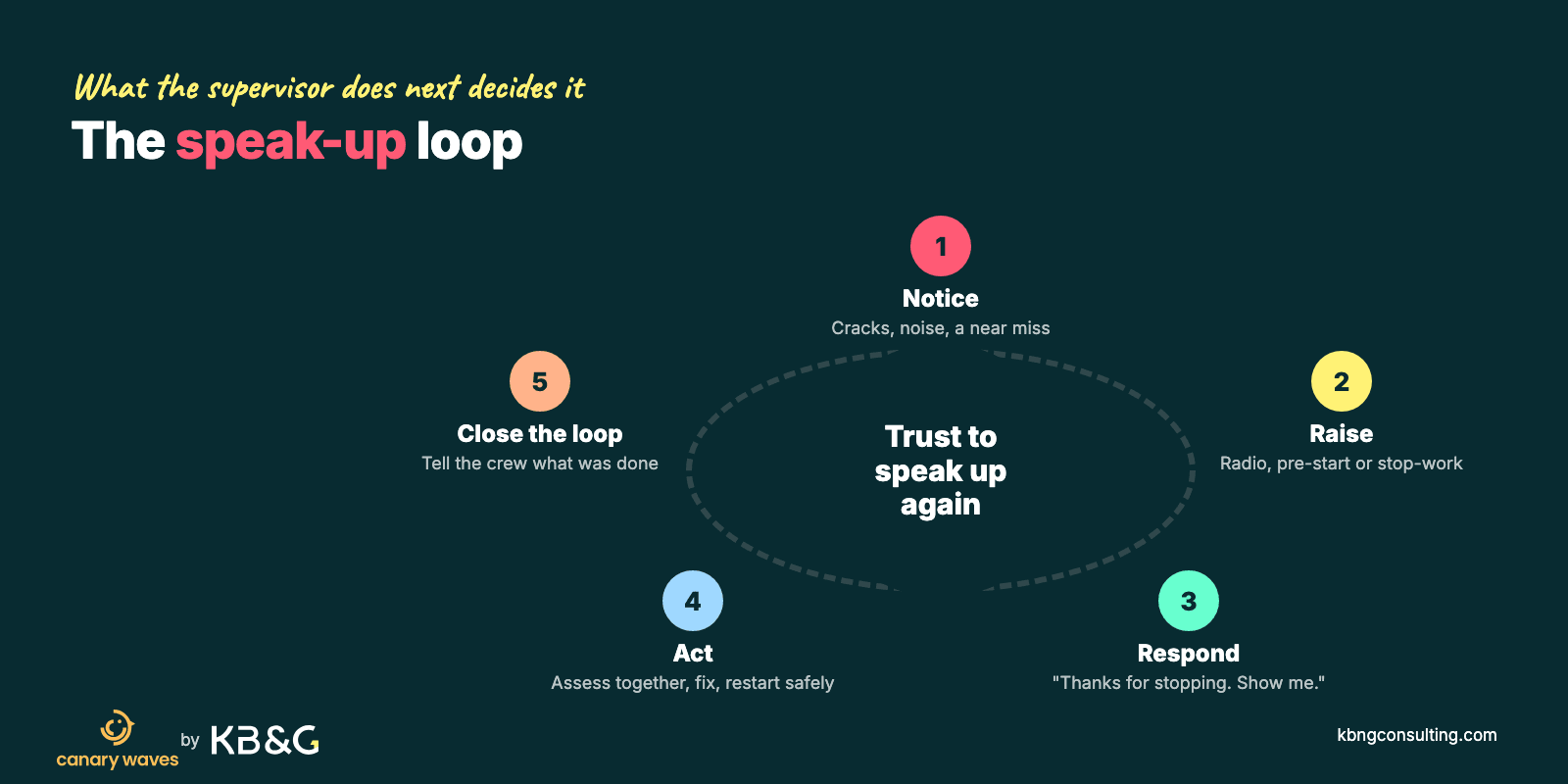
Supportive response: The supervisor says, "Thanks for stopping. Show me what you saw. Let's move back, assess this together and work out how to make it safe before we restart." The crew sees that speaking up is respected. The next person who sees something will raise it.
Dismissive response: The supervisor sighs and says, "We've done this job a hundred times. There are always cracks. Let's get on with it." The crew sees that stopping the job carries social cost. Future concerns go unspoken.
Practical scripts help supervisors build the right habits: "Thank you for stopping the job. Tell me what you saw and let's figure out how to make this safe before we restart." Or: "Who else sees this differently? What would you need to feel safe continuing?"
Post-stop-work debriefs capture what triggered the stop, what was found, what changes were made and what the team learned. Communicating outcomes back to the shift closes the loop and reinforces that the stop was worthwhile.
Reinforcing Stop-Work Through Systems and Recognition
Site systems should make stop-work easy to document and resolve: simple reporting workflows, debrief templates, quick decision pathways for resuming work with safety input, and a process to escalate unresolved issues. Feedback from management after issues are reported builds trust and encourages future reporting.
Recognition matters, but framing matters more. Mentioning stop-work events in pre-starts and shift briefings should focus on what the team learned, not on individual heroism. The goal is to normalise cautious stops as a standard practice, not to celebrate rare acts of bravery. A balanced approach avoids glorifying unnecessary stoppages while making clear that the organisation prefers a cautious stop to a serious incident.
These systems and recognition patterns connect stop-work to the broader set of supervisor behaviours that build, or erode, speak-up culture across every shift.
Supervisor Behaviours that Build Speak-Up Culture
On most mine sites, supervisors and leading hands are the culture carriers. Their daily habits (what they ask, how they listen, how they respond to bad news) either invite or shut down speak-up. This section is a practical guide for supervisors to apply on their next shift.
Everyday Communication Habits
Specific, observable behaviours make the difference. In pre-starts, asking open questions ("What might go wrong with this job today? What hazards are new?") and then pausing for input after giving instructions signals that challenge is welcome. Normalising uncertainty with phrases like "What might I be missing?" or "Who sees this job differently?" lowers the barrier for quieter team members to contribute.
Radio communication presents a different challenge. Radio traffic tends to be compressed and one-way. Supervisors can counteract this by slowing down, using names and call signs, and explicitly inviting feedback: "I'm sending you down the ramp; if anything doesn't feel right, radio me straight away." Over time, these habits encourage workers to use the radio to raise real-time concerns rather than saving them for the end of shift, or not raising them at all.
Following up on raised concerns closes the loop. Workers need to hear what was done, even if the answer is "not yet, here's why."
How to Respond to Mistakes and Near Misses
Supervisors need to distinguish between reckless violations and honest mistakes. Only the former warrants discipline; the latter is a learning opportunity. When someone reports a near miss or admits an error, a calm, fact-finding response ("Help me understand what happened") preserves psychological safety. "Why did you do that?" does not.
Training should include methods for handling conflicts when concerns are raised by workers. A simple, repeatable debrief structure supports this:
What we planned
What actually happened
What we learned
What we will change
Sharing near-miss stories at pre-starts, with the focus on what the system allowed to go wrong rather than who made the mistake, builds a learning culture. Supervisors set the tone for how that reporting is received.
Including Contractors, New Starters and Quiet Voices
Contractors, apprentices, new-to-site workers and people with language barriers are least likely to speak up and most likely to be exposed to unfamiliar risk. A few practical actions help.
Rotating who speaks first in pre-starts prevents quieter voices from always deferring. Pairing new starters with experienced "safety sponsors" gives them a point of contact they can approach without feeling they are going over someone's head. Supervisors who deliberately check in with quieter team members during the shift, asking privately if they have concerns, surface information that would otherwise stay hidden.
Contractors should be included in toolbox talks and safety discussions on equal footing, not as an afterthought. When contractors are treated as outsiders in the safety conversation, the operation loses access to observations from people who work across multiple sites and often bring a useful perspective.
Beyond behaviour, leaders need mechanisms and data to see whether these efforts are working.
Measuring Whether People Really Speak Up
Many sites rely on lagging indicators (TRIFR, LTIFR) and formal report counts to assess safety culture. These metrics have value, but they often miss what people actually say day-to-day on the radio, in the crib room and during shift handovers.
Traditional Metrics and Their Limits
Common measures include hazard reports per headcount, near-miss report numbers, safety observations, stop-work events and safety suggestions per hours worked. Each has a role. None tells the full story.
High hazard report numbers can reflect a strong reporting culture or an unusually hazardous workplace. Low numbers can mean conditions are well controlled or that under-reporting is severe. Without context, the numbers mislead.
Questions to ask of your existing data:
Are near misses being reported in a timely way, or clustered at the end of the month?
Do reports contain enough detail to act on, or are they vague one-liners?
Are raised hazards being closed out, and within what timeframe?
How do report volumes compare across pit, plant, underground, and between contractor and permanent crews?
Trending and segmentation by department, shift and employment type reveal patterns that site-wide averages hide.
Qualitative Signals from the Field
Observation in pre-starts and toolbox talks reveals who speaks, who waits and whether supervisors invite challenge. If the same three people talk in every pre-start and the rest stay quiet, that is a signal about culture, not about the quality of the briefing content.
Periodic, independent listening tours, where someone outside the direct reporting line walks the site and talks with operators, maintainers and contractors, surface concerns that formal channels miss. Short, targeted pulse surveys with questions about comfort raising hazards, confidence in stop-work protection and trust in supervisors provide another data point. Regulators have started doing this at industry scale: Queensland's industry-wide survey of safety reporting culture asked mine workers why they do, or do not, report near misses and early warning signs.
Narrative feedback adds depth: a worker who says "I heard rumbling underfoot but didn't want to be 'that guy'" reveals more about culture than any report count. Combining stories with numbers gives leaders a clearer picture of whether people feel safe speaking up.
Capturing Informal Speak-Up over the Radio
A lot of genuine speak-up in mining happens informally over two-way radios: reports of near misses, emerging hazards, confusion about plans, requests for clarification. This traffic is rarely transcribed, searched or analysed. Once the shift ends or the channel clears, the information is gone.
The consequence is that leadership gets an incomplete view of risk. Patterns in hazard mentions, recurring concerns about specific locations or conditions, and differences in communication culture between shifts or crews remain invisible until an incident forces attention.
Voice-to-data tools that transcribe radio traffic can close part of this gap, turning what people say on air into searchable records of hazards, near misses and concerns. They only work if they are deployed transparently and crews understand what is captured and why.
Implementing a Speak-Up Culture Program on Site
Building speak-up culture is a continuous improvement effort that takes months, not weeks, to show durable change. Success requires alignment between policy, supervisor competency, worker participation and measurement. No single initiative, whether a new app, a poster campaign or a training day, is sufficient on its own.
Step-by-Step Approach for Leaders
Diagnose current state: Review existing incident, near-miss and hazard records. Conduct listening tours with operators, maintainers and contractors. Run a baseline pulse survey on psychological safety and reporting culture. Look at what people say on the radio versus what shows up in formal systems.
Clarify non-negotiables: Define the safety values the site will not compromise on. Establish stop-work expectations. Secure visible leadership commitments: senior leaders publicly support speak-up, and supervisors are evaluated partly on how they respond to safety concerns, not only on production output.
Equip supervisors: Provide targeted training on psychological safety, how to respond to concerns and how to run pre-starts that invite input. Use real site examples and coaching, not generic slide decks. Give supervisors practical scripts and tools they can use on the next shift.
Make it easy to speak up: Ensure reporting channels are simple and accessible. Confirm that the stop-work policy is clear and available in relevant languages. Include contractors and visitors in all communication processes. Address barriers related to literacy and language directly.
Respond visibly: Close the loop on raised concerns. Share what was done and what was not yet done, with reasons. Recognise cases of good speak-up and stop-work in pre-starts and shift briefings. Host debriefs that focus on learning.
Measure, adjust and repeat: Track both leading and lagging indicators. Analyse by shift, location and employment type. Monitor informal voice data if available. Adjust targets, behaviours and interventions based on what the data shows. Iterate.
Choosing and Combining Tools and Channels
Different channels serve different purposes. The right combination depends on what your operation needs for immediacy, tracking and accessibility.
Channel | Strength | Limitation |
|---|---|---|
Face-to-face (pre-starts, toolbox talks) | Immediate, allows clarification and body language | Not recorded; depends on who is present |
Two-way radio | Real-time, reaches dispersed crews | Rarely captured; compressed communication |
Paper hazard cards | Simple, no connectivity needed | Slow, hard to trend, often incomplete |
Digital apps / hazard reporting systems | Trackable, searchable, integrates with incident management | Requires connectivity; may not suit gloves/PPE |
Anonymous hotlines | Protects reporter identity; backstop for serious concerns | Not suited to real-time operational hazards |
Voice-to-data tools | Captures informal voice traffic; reveals communication patterns | Requires transparent deployment and workforce trust |
Selection criteria for mining settings include ease of use with gloves and PPE, availability of radio or wireless connectivity, support for multiple languages, offline functionality and integration with existing incident management systems.
A blended approach works best: informal channels for immediate hazard raising, formal channels for tracking and accountability, and voice-to-data tools to bridge the gap between what people say on the radio and what appears in the reporting system. Process, leadership behaviour and technology need to fit together; none works in isolation.
Common Speak-Up Culture Challenges and How to Address Them
Even committed operations hit predictable obstacles when trying to shift speak-up culture. Anticipating them makes the difference between sustained progress and another program that fades after launch.
"We Already Have Good Numbers, So We Don't Need This"
Low incident counts or high hazard report volumes are sometimes taken as proof that safety culture is strong. But low incident numbers can mask under-reporting, and high report counts may reflect volume without quality. The solution is to interrogate data quality: compare formal reports with what workers say informally, on the radio and in conversations. Run a short pulse survey asking whether people feel safe raising concerns. Test for silent hazards by asking crews what they would report if they knew nothing would happen to them.
Supervisor Resistance or Overload
Supervisors may see speak-up initiatives as adding paperwork or slowing production. Some feel exposed by a program that invites scrutiny of how they respond to bad news. Involving supervisors in co-designing the approach, rather than handing them a finished program, builds ownership. Focus on two or three specific behaviours rather than a wholesale cultural overhaul. Remove low-value administrative tasks to free up time. Provide coaching and recognition rather than additional reporting requirements.
Worker Cynicism and "Seen It All Before"
Past failures, unaddressed reports and programs that launched with fanfare and disappeared within a month breed cynicism. Long-serving FIFO crews have often watched several safety initiatives come and go. Start by closing long-open loops: act on old concerns that were raised and never resolved. Deliver a few visible, quick wins. Be transparent about what the operation can and cannot fix, and invite workers to help prioritise what gets addressed first. Credibility is rebuilt through follow-through, not through announcements.
Technology Rollouts That Don't Reach the Pit
New reporting apps or analytics tools designed at head office sometimes fail at the coalface. Poor connectivity, gloves that don't work on touchscreens, interfaces that assume literacy in English, and noise environments that interfere with voice recognition all create barriers. Test tools with actual operators and maintainers before deployment. Ensure hardware and software fit the conditions of the pit, the plant and the workshop. Feed insights from any new tool back into decisions that workers can see, such as road maintenance priorities or shift resourcing. Technology that captures data but produces no visible action erodes trust.
Sustained speak-up culture is a continuous practice, not a one-off project. Each of these challenges can be managed if leaders expect them and plan accordingly.
Conclusion and Next Steps
Speak-up culture in mining is about what workers feel safe saying in the pit, on the radio and in the plant. It is one of the strongest defences against serious harm and unstable operations. Policies and posters matter far less than how a supervisor responds when someone brings bad news, and whether the organisation acts on what it hears.
Practical next steps you can take this month:
Observe two pre-start meetings and note who speaks, who stays silent and whether the supervisor invites input.
Run a short, anonymous pulse survey asking how comfortable people feel raising hazards and using stop-work authority.
Pick one supervisor behaviour, such as "thank people for bad news," and coach all supervisors to use it consistently this week.
Review how hazard and near-miss data compares with what people say over the radio or in informal conversations.
Explore tools that capture informal speak-up, including voice-to-data solutions, and assess fit for your operation.
If much of your site's speak-up already happens on the radio, that is the gap Canary Waves by KB&G is built for. It runs passively on your existing two-way radio, with no new hardware and no change for crews, transcribes radio traffic tuned to site slang, and flags hazards, near-miss and proximity language, protocol breaches and abusive or bullying conduct across channels, so concerns said on air can reach the people who can act on them. It has been proven in early MVP pilots on real mine sites.
Related topics worth exploring next include critical control management, contractor safety integration, investigations that build trust rather than assign blame, and soft-skills development for frontline leaders.
Further Research
Psychological Safety and Learning Behavior in Work Teams (Amy Edmondson, Administrative Science Quarterly, 1999): the foundational study of team psychological safety. Her book The Fearless Organization applies the idea to workplaces more broadly.
NIOSH: Assessing the Impact of Safety Climate Constructs on Worker Performance in the Mining Industry, based on a survey of 2,683 workers across 39 mine sites measuring factors such as supervisor support, coworker communication and worker proactivity.
The State of Safety Reporting Culture in Queensland's Mining Industry (Queensland Government): the first industry-wide survey of why mine workers do, or do not, report near misses and early warning signs.