
Management Burnout Is a System Problem, Not a Personal One
Feb 24, 2026
Management burnout is no longer a personal failure but a systemic organisational risk. Rising workplace stress, heavy workloads, and distributed teams are driving emotional exhaustion, reduced professional efficacy, and employee burnout, weakening mental health, employee engagement, and productivity.
In this blog, we examine why management burnout is accelerating, drawing on organizational psychology, public health, and employee burnout statistics, and outline what organizations must rethink to reduce burnout and protect employee well-being.
From pressure to pathology: How management burnout actually rises
Stress is a short-term response to high demands. Chronic workplace stress occurs when work-related stress is persistent and embedded in the work environment. In 2024, 56% of leaders reported burnout, while 43% of companies lost half their leadership teams. The World Health Organization defines job burnout as an occupational phenomenon caused by prolonged exposure to chronic work-related stress, not by poor work-life balance or personal failure.
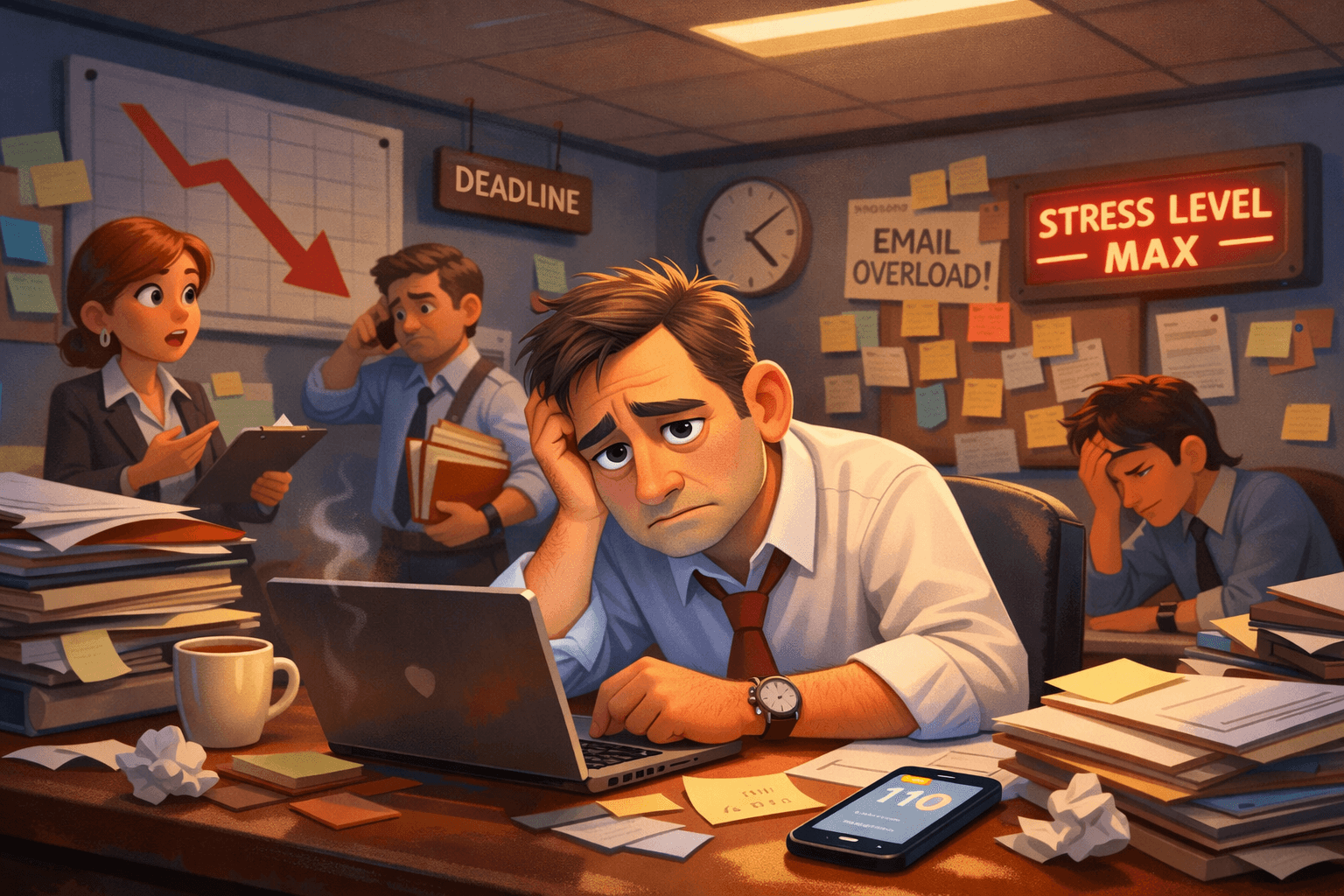
Core dimensions of management burnout
Management burnout forms through three reinforcing dimensions:
Emotional exhaustion caused by sustained high stress and energy depletion
Mental distance is marked by disengagement from one’s job and workplace culture
Reduced professional efficacy leading to lower job satisfaction and confidence
Employee burnout statistics show managers report higher burnout rates than individual contributors (Gallup).
Why managers face a higher burnout risk
Managers absorb pressure from both leadership demands and burned-out employees. Balancing performance, mental health support, and personal life increases leaders' risk of burnout, accelerating negative impacts across workers and teams.
The hidden multiplier effect: When burned-out managers create burned-out employees
How leadership burnout spreads downward
When managers experience burnout, its effects rarely stay contained. Emotional exhaustion and reduced professional efficacy reduce a leader’s ability to support employees, make sound decisions, and manage work stress. A new study finds that job burnout has reached 66%, an all-time high, and suggests that return-to-office mandates may further exacerbate stressors for workers. This pressure quickly leads to higher employee burnout, poorer mental health, and lower engagement.
Workplace stress as a cultural amplifier
Burnout among management reshapes workplace culture. Under chronic stress, leaders default to reactive management, inconsistent expectations, and short-term decision-making, increasing workplace burnout and mental health challenges across teams. Workers experience a declining work-life balance and increasing strain on their personal lives and physical health.
The burnout feedback loop
Burned-out managers create burned-out employees, who require more support and oversight. This cycle intensifies work-related stress, reduces job satisfaction, and has lasting negative effects on employee well-being and organizational performance.
What the data actually says: Burnout rates, warning signs, and notable differences
Key findings from employee burnout data
Employee burnout is now a systemic workforce issue rather than an exception. Recent data highlights the scale and persistence of burnout across workers:
48% of employees report feeling burned out at work: Nearly half of the global workforce experiences exhaustion severe enough to affect engagement, motivation, and performance.
76% experienceburnout at least once: Burnout is cyclical rather than rare, reinforcing the need for continuous mental health and well being support.
34% report lower engagement due to stress and fatigue: Burnout and stress reduce collaboration, creativity, and decision quality.
52% of burned-out employees are actively job hunting: Chronic workplace stress significantly increases turnover risk.
$438B in lost productivity globally: Disengagement driven by burnout now represents a major economic cost.
Notable differences across roles and age
Burnout levels vary significantly. Younger workers report higher stress and burnout than older cohorts, while managers experience greater strain than individual contributors. Health care workers in emergency departments and other acute care settings consistently report the highest burnout levels.
Pre-COVID vs post-COVID patterns
Compared to pre-COVID survey data, more employees now report burnout when working remotely. While flexibility has improved work-life balance for some, blurred work boundaries have increased workplace stress for many.
Beyond mental health rhetoric: The real costs of management burnout
Performance erosion inside leadership roles
Management burnout quietly degrades performance long before leaders exit. Reduced professional efficacy manifests as slower decision-making, risk aversion, and declining judgment quality. As burnout and stress persist, managers struggle to prioritise, coach, and sustain employee engagement. This erosion drives lower job satisfaction not only among leaders but also among the teams they oversee, amplifying workplace burnout across the organisation.
Physical and operational fallout
Burnout is not only a mental health issue. Chronic stress is strongly linked to physical fatigue, sleep disruption, and declining physical health. Burned-out managers take more sick days, experience higher absenteeism, and are more likely to disengage while still working. These patterns disrupt continuity, slow execution, and increase pressure on remaining workers, especially in high-stress environments such as health care settings and emergency room operations.
A business continuity and public health risk
At scale, management burnout becomes a structural threat. Lost productivity, leadership turnover, and stalled decision-making directly affect business continuity. At the same time, widespread burnout contributes to broader public health concerns, increasing mental health issues and long-term strain on health care systems. When leadership capacity weakens, organisations lose resilience. Addressing burnout is therefore not an HR initiative alone, but a core operational and public health imperative that demands executive attention and systemic intervention.
Why traditional fixes fail: The limits of perks, resilience training, and mental health days
Why individual support is not enough
Most corporate responses to burnout focus on the individual. Mental health days, wellness apps, and resilience training assume employee burnout is a personal capacity issue. Yet employee burnout statistics and systematic reviews consistently show burnout is driven by work environment design, job roles, and chronic workload, not individual weakness. When workers return from a mental health day to the same pressures, they quickly experience burnout again.
The benefits–stress mismatch
Mental health benefits are often disconnected from daily work realities. Access to therapy is of little help when workplace stress affects schedules, staffing levels, and performance expectations. This misalignment is especially visible among remote workers and younger workers, who face blurred work-life boundaries and constant availability. In health care settings, health care workers report some of the highest burnout levels globally, despite expanded mental health support in many health care organizations.
Reporting without resolution
Encouraging employees to report burnout is important, but insufficient. Without structural change, reporting becomes performative. Workers name stress, leaders acknowledge it, and nothing changes. To prevent burnout, organizations must develop strategies that address root causes such as workload, role clarity, and decision rights. Until systemic issues are resolved, workplace burnout will persist regardless of perks or programs.
Rethinking the system: How organizations can prevent and reduce management burnout
Designing healthier work environments
Preventing management burnout starts with redesigning the work environment, not adding more coping mechanisms. Sustainable workload models, clear role boundaries, and realistic expectations reduce workplace burnout at the source. When managers consistently experience burnout, it signals structural overload, not individual weakness. Healthier systems protect both mental health and long-term performance, especially in high-pressure sectors such as health care, where health care workers face compounding stress.
Detecting burnout risk early through feedback
Employee feedback is one of the earliest indicators of emerging burnout. Regular pulse checks, qualitative feedback loops, and manager self-reporting help organizations identify burnout risk before it escalates. Burnout rarely appears suddenly; it builds through repeated friction, unresolved tension, and chronic pressure. Organizations that listen early can reduce burnout before it spreads across teams and workers.
Equipping managers with real support
Managers cannot prevent employee burnout if they lack authority, clarity, and tools. Beyond mental health benefits, leaders need practical, scalable support to handle difficult conversations, conflict, and performance issues without avoidance. This is where Georgia plays a critical role.
As an AI role-play platform, Georgia helps managers and teams practice high-pressure conversations in a safe, structured environment. By building communication confidence and reducing tension before it escalates, Georgia directly addresses root causes of management and office burnout, helping organizations support workers more effectively and sustainably.

From survival to sustainability: Building resilient leadership in the modern workplace
Resilient leadership requires redefining success beyond constant availability and crisis response. Sustainable performance comes from protecting focus, boundaries, and mental health in everyday work, not as exceptions. Embedding mental health resources into daily operations normalizes support and reduces workplace burnout before it escalates.
Organizations that successfully manage burnout equip leaders with practical tools, not just policies. Georgia plays a direct role in this shift. By giving managers and teams a structured, AI-powered space to practice difficult conversations, manage tension, and build communication confidence, Georgia helps organizations move from survival mode to sustainable leadership, where performance, well-being, and resilience reinforce one another.
Final Thought
Management burnout is a structural risk, not a temporary reaction to pressure. Preventing it must become a core leadership principle embedded in how work is designed and managed. Organizations that address burnout systemically improve engagement, well-being, and performance. Breaking the cycle requires practical tools for high-pressure conversations.
To prevent management burnout and office burnout, book a demo with Georgia and see how AI-powered role-play helps leaders reduce stress and lead effectively.