
Mining Safety Shares: Topics, Tips, and Best Practices
Jul 19, 2026
Mining Safety Shares: Topics, Tips, and Best Practices
Mining safety is often treated as compliance work, but that approach creates dangerous blind spots. In mining operations, serious hazards build gradually, and many accidents happen after workers stop noticing warning signs. Effective safety shares keep hazard recognition active and make safety part of everyday decision-making instead of a routine checklist.
In this article, we’ll explore why mining safety shares matter, important toolbox talk topics, and how stronger safety communication helps miners work safely and prevent accidents.
What Is a Mining Safety Share?
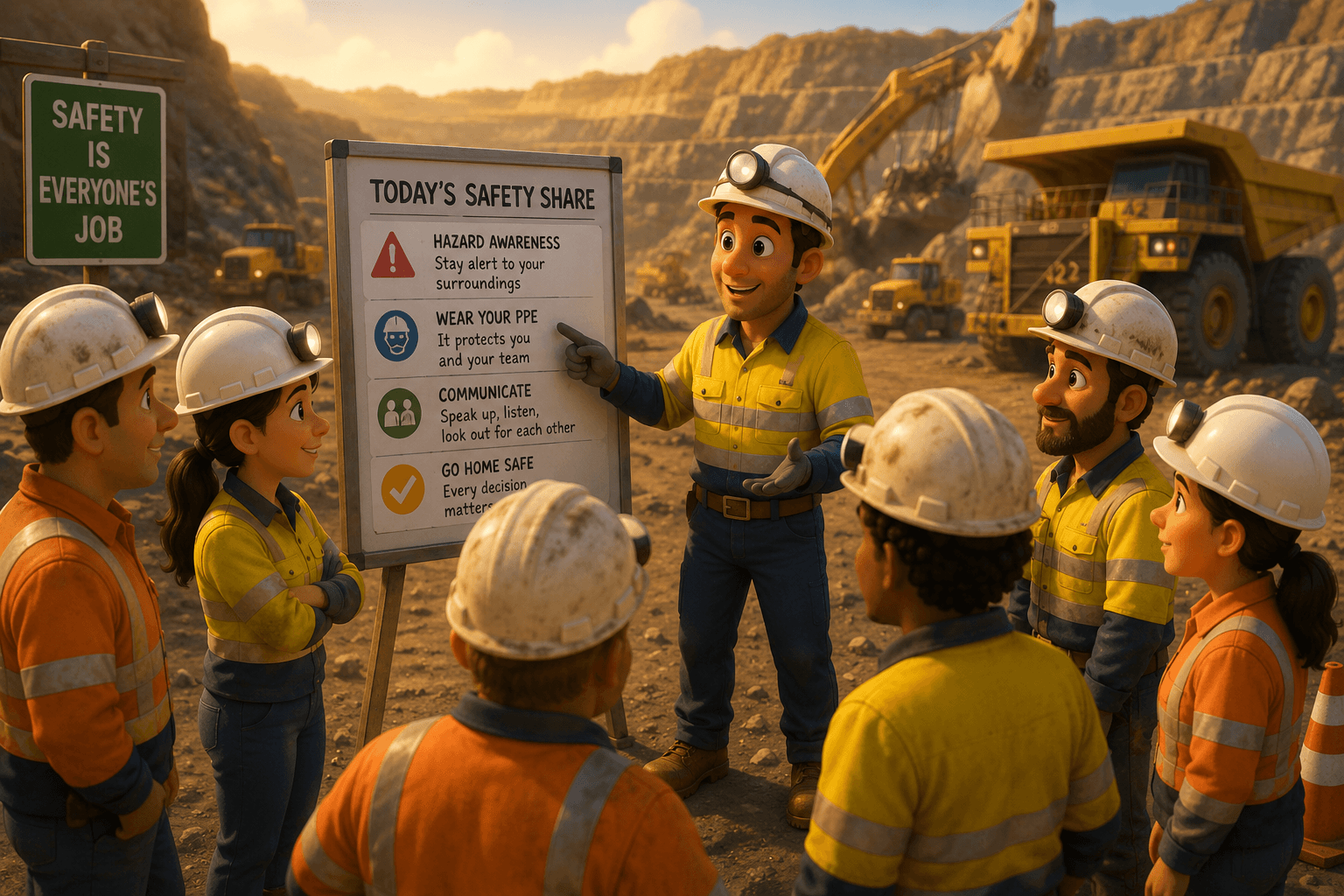
A mining safety share is a short discussion focused on hazards, unsafe conditions, or lessons learned before work begins, covering MSHA safety topics. Unlike formal safety meetings, safety shares are designed to keep mine safety relevant, immediate, and connected to actual mining operations.
More Than a Toolbox Talk
Toolbox talks often focus on procedures or compliance. Safety shares work best when they encourage workers, contractors, office staff, and mine operators to openly discuss risks and work safely in changing mining conditions.
Why Safety Shares Matter
Consistent safety communication helps prevent accidents before they escalate into serious injuries. It sharpens hazard recognition, reinforces emergency procedures, and strengthens mine safety and health compliance without making safety feel repetitive or disconnected from daily work.
Why Mine Safety Shares Matter
Mining safety shares help keep workers mentally engaged in environments where routine can easily hide serious hazards.
The Importance of Daily Safety Awareness
Mine safety in high-risk environments: Mining is responsible for approximately 15,000 fatal accidentsannually, accounting for nearly 8% of global fatal occupational accidents.
Changing mining conditions: Ground instability, equipment failures, dust exposure, and human error can quickly lead to accidents if workers lose awareness.
Shift-start hazard recognition: Safety shares help miners identify potential hazards before work begins and encourage employees to work safely throughout the shift.
How Safety Shares Improve Safety Culture
Strong safety shares encourage accountability and open communication between workers, contractors, supervisors, and mine operators. They support compliance with MSHA regulations and the Mine Act while helping sites build a proactive safety and health culture rather than react after incidents occur.
Key Benefits for Mining Operations
Prevent injuries and property damage: Regular safety communication reduces risky behavior and reinforces safe procedures.
Improve risk assessment practices: Workers become more aware of hazards and changing site conditions.
Reinforce proper use of PPE: Safety shares remind employees to inspect and properly maintain personal protective equipment.
Increase operational efficiency: Confident, informed workers perform tasks more safely and consistently.
Common Mining Safety Topics for Safety Shares
The most effective mining safety shares focus on risks that workers slowly normalize over time. Many serious mining accidents happen after crews become too comfortable with familiar hazards.
Hazard Recognition and Risk Assessment
Changing ground conditions: Fresh cracks, subtle wall movement, unusual water seepage, or vibration changes often appear before cave-ins occur, yet these warning signs are frequently ignored during production-heavy shifts.
False sense of routine: Experienced miners sometimes become less responsive to hazards because repeated exposure makes unsafe conditions feel normal.
Near-miss reporting: Small incidents involving loose rock, slipping equipment, or visibility problems should never be dismissed since they often signal larger system failures developing underground.
Personal Protective Equipment (PPE)
Respirator misuse: Dust exposure becomes dangerous long before miners visibly notice airborne particles. Poor respirator seals and facial hair regularly compromise protection without workers realizing it.
PPE fatigue: Hearing protection and gloves are often temporarily removed during high-precision tasks, which is exactly when workers are most at risk of sudden injury.
Ladder Safety and Working at Heights
Three points of contact failures: Most ladder falls happen during descent, not ascent, because workers rush after long shifts or carry tools improperly.
Surface instability: Wet boots, loose gravel, and vibration from nearby heavy equipment can destabilize ladders even when they are correctly positioned.
Equipment, Fire, and Environmental Hazards
Stored energy risks: Lockout/tagout failures often involve residual hydraulic or pneumatic pressure that workers assume has already discharged.
Flammable gases and dust: Methane buildup and suspended dust particles can ignite far from the original ignition source in confined mining operations.
Heat stress warning signs: Fatigue, slowed reaction time, and poor judgment often appear before workers recognize physical symptoms of heat stress.
Canary Waves in Mining Safety
Canary birds were once used in underground mining because they reacted to toxic gases before miners could detect danger. Today, technology refers to the early warning signs that often precede serious mining incidents.
Why Mining Technology Matters
Most mining accidents are preceded by smaller warning signals such as communication breakdowns, repeated near misses, fatigue, or unusual equipment behavior. Canary Waves uses AI-powered radio analysis to detect these patterns in real time before they escalate into serious hazards.
Using Canary Waves in Safety Shares
Many mining safety shares fail because they only repeat rules workers already know. Discussions using Canary Waves data are more effective because they focus on weak signals that crews may overlook during routine operations. A delayed radio response, confusion during equipment passes, repeated mentions of visibility issues, or frustration in operator communication can all point to deeper safety risks developing on-site.
Integrating these observations into toolbox talks helps miners improve hazard recognition and creates a stronger reporting culture without waiting for accidents to happen first. It also gives mine operators real operational insight instead of relying only on incident reports filed after the damage is done.
Want to modernize your mining safety strategy with Canary Waves? Book a call with KB&G Consulting to explore smarter safety communication systems for mining operations.
Examples of Effective Mining Safety Shares
Short Daily Safety Share Examples
PPE inspection reminder: Focus on worn straps, damaged seals, and improper respirator fit since most PPE failures happen gradually, not suddenly.
Electrical equipment safety check: Ask crews to identify temporary fixes, exposed wiring, or lockout shortcuts that have become “normal” under production pressure.
Proper use of fire extinguishers: Review extinguisher access points regularly because blocked or poorly positioned units are common during active shifts.
Heat stress awareness: Discuss mental fatigue and slower reaction time, since workers often miss cognitive symptoms before physical exhaustion appears.
Ladder safety reminder: Reinforce descent safety because experienced workers are more likely to rush when climbing down after long shifts.
Toolbox Talk Topics for Mining Teams
Confined space hazards: Review atmospheric testing failures and communication breakdowns before entry permits are approved.
Underground ventilation safety: Discuss airflow changes after blasting, as poor ventilation often develops first in isolated tunnel sections.
Fall protection: Focus on anchor point placement because improperly positioned tie-offs still allow dangerous swing falls.
Haul road safety: Analyze blind spots, dust visibility, and radio discipline during equipment passing procedures.
Emergency evacuation drills: simulate blocked escape routes, as real emergencies rarely follow planned evacuation paths.
Chemical handling procedures: Review incompatible storage practices and delayed contamination reporting during busy shifts.
What Makes a Good Safety Share?
Relevant to current mining conditions: Address active site risks instead of repeating generic safety policies that workers already tune out.
Short, clear, and actionable: One practical takeaway is more effective than long compliance-heavy discussions.
Focused on real incidents or lessons learned: Near misses create greater behavioral change than hypothetical examples.
Encourages employee participation and discussion: Workers closest to operations are often the first to spot warning signs, long before supervisors do.
Best Practices for Conducting Mining Safety Shares
Keep Safety Shares Consistent
Start every shift or meeting with a safety topic: Tie discussions to current site conditions rather than repeating generic reminders.
Reinforce safe work practices daily: Repetition is most effective when focused on reducing operational risks.
Encourage Open Communication
Allow workers to share concerns and observations: Ask frontline crews first since operators usually detect weak warning signals earliest.
Remove fear of reporting unsafe conditions: Treat near-miss reporting as operational intelligence, not blame assignment.
Use Real Incidents and Near Misses
Real-world examples improve knowledge retention: Recent site incidents feel more credible than corporate safety scripts.
Lessons learned help prevent accidents: Focus discussions on what was missed before the incident escalated.
Combine Safety Shares With Training
Support formal safety and health training programs: Use safety shares to reinforce field application, not repeat classroom content.
Reinforce procedures discussed during toolbox talks: Connect procedures directly to current production pressures and site hazards.
Adapt Topics to Different Mining Operations
Surface mining: Prioritize haul road visibility, fatigue, and heat stress discussions.
Underground mining: Focus on ventilation changes, confined spaces, and communication failures.
Exploration sites: Address remote work isolation and inconsistent ground conditions.
Processing facilities: Emphasize lockout/tagout shortcuts and chemical exposure risks.
Use Technology to Detect Early Warning Signs
Monitor operational communication: Review radio communication patterns for confusion, delayed responses, or repeated safety concerns.
Leverage real-time safety intelligence: Platforms like Canary Waves help identify leading indicators buried in daily radio chatter before incidents occur.
Strengthen hazard recognition: Use communication data to improve toolbox talks and focus on risks crews are actively encountering on site.
Final Thought
Mining safety shares are one of the simplest ways to prevent accidents before they escalate into serious injuries or fatalities. Strong communication, hazard awareness, and consistent safety discussions help miners recognize risks earlier and respond more effectively under pressure.
Mining companies that treat safety shares as a daily operational habit, not a compliance task, build stronger safety cultures and safer long-term mining operations.
Meta title: Mining Safety Shares: Topics, Tips, and Best Practices
Meta description: Improve mine safety with effective safety shares, toolbox talks, hazard awareness, and proactive safety culture tips.