
What Is Founder Behaviour Under Pressure?
Founder behaviour under pressure is what a founder actually does when runway shortens, a deal slips or an investor goes cold: not what they believe about themselves, but the response that shows up first. For most founders that response is not a fresh decision. It is a default, a well-practised way of coping that once worked and now runs on its own.
The usual defaults are familiar. Doing it all yourself. Fixing instead of diagnosing. Defending instead of asking. Going quiet. None of them looks like panic. Each one feels like competence in the moment, which is exactly why it is hard to catch.
This is the fourth piece in the Startup Witch series on founder psychology, after founder ego, fear of failure and fear of uncertainty. Those posts looked at what drives founders. This one looks at what founders do when the pressure hits, and why knowing better rarely changes it.
What this article covers:
- What the research says about habits, stress and why people fall back on old responses.
- The four default behaviours founders show most often under pressure, and what each one costs.
- Why insight alone does not change the pattern, and what does: noticing it, early and specifically.
- A practical way to pre-decide your response to the pressure moments you can already predict.
Why Do Founders Fall Back on Default Behaviour Under Stress?
Founders fall back on default behaviour under stress because stress shifts the brain away from deliberate, goal-directed choice and towards habit. That is not a character flaw. It is how people are built, and the research on it is fairly consistent.
Start with how much of ordinary life already runs on habit. Psychologist Wendy Wood, whose diary studies tracked what people did hour by hour, told NPR that about 43% of everyday actions are done repeatedly, almost every day, in the same context. Treat the exact figure as an illustration rather than a constant, but the point holds: a large share of what anyone does is not decided fresh.
Habits are also triggered by the situation, not by intention. In Wood and Neal's model, once a habit has formed, perceiving the context triggers the response without a mediating goal. An earlier review describes habitual action as something that can start without intention and runs to completion with minimal conscious control. In plain terms: the cue fires, the response runs, and the reasoning arrives afterwards.
Stress makes this stronger. In a study of 80 students at Ruhr University Bochum, Schwabe and Wolf put half the participants through a stressful task (holding a hand in ice water while being watched and evaluated) before they learned two actions that earned food rewards. When one reward was later made less appealing, the stressed group kept performing the action anyway. They behaved out of habit, and they also knew less about which action led to which outcome.
A fair caveat: human lab measures of habit are fragile. A separate team reported five failed attempts to induce habits in humans through overtraining, using similar methods. That work tested training length, not stress, but it is a reason to read the stress studies as a strong tendency, not a law.
At the level of teams and companies, the pattern has a name. Staw, Sandelands and Dutton's review of the threat-rigidity effect found evidence across individuals, groups and organisations of "a restriction in information processing and constriction of control under threat conditions". Under threat, people take in less and hold on tighter. Later studies show that some organisations respond to threat with change instead, so this is a tendency too. But it describes the founder in a bad month uncomfortably well.
Why Pressure Hits Founders Harder Than Most Leaders
Pressure hits founders harder because the business is not just their job. For many founders the company carries their savings, their reputation and a good part of their self-worth, so a business threat registers as a personal one.
Three things make founder stress different from ordinary leadership under pressure:
- Identity. A missed quarter can feel like a verdict on you, not on the plan. That raises the emotional stakes of every piece of bad news, and the anxiety drains energy you need for the decision itself.
- Uncertainty. Early-stage founders make high-stakes calls with thin evidence, often alone. We covered how that plays out in fear of uncertainty.
- Few brakes. In a larger company, a manager's first reaction gets filtered by peers, a board and process. In a ten-person startup, the founder's first reaction often becomes the company's decision by default.
There is also a quieter reason. Founders built the company on habits that worked. The same instincts that got the first product shipped or the first customers signed are the ones that fire when things go wrong. That is the competency trap: James March argued that adaptive processes, by refining what already works faster than exploring what might work better, are likely to become effective in the short run but self-destructive in the long run. Under pressure, founders exploit their strengths harder, even when the problem calls for something else.
If stress is affecting your health, sleep or mood, that is a separate and serious matter. Our piece on startup founders and stress covers it, and professional support is a normal step, not a last resort.
The Four Default Behaviours Founders Show Under Pressure
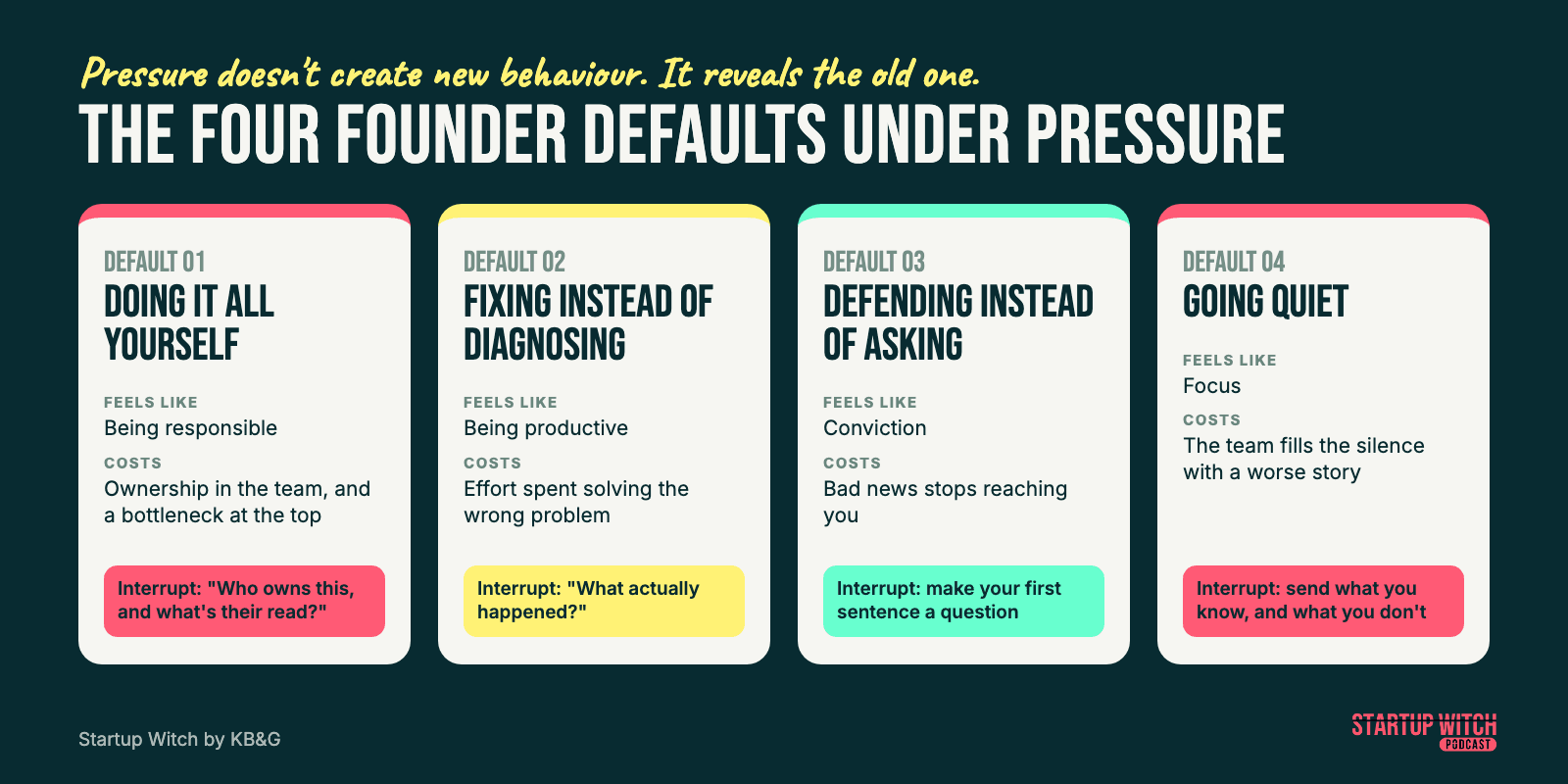
The four most common default behaviours under pressure are doing it all yourself, fixing instead of diagnosing, defending instead of asking, and going quiet. Most founders have one dominant default and a second that shows up when the first stops working.
1. Doing it all yourself
When pressure rises, the founder takes back the sales calls, rewrites the deck, reviews every pull request and joins every customer escalation. It feels responsible. It is the "constriction of control" from the threat-rigidity research, in a founder's calendar.
The cost is real and measurable at company level. In a study of 6,130 American startups, Noam Wasserman found that each additional level of founder control (holding the board and/or the CEO role) was linked to a 17.1% to 22.0% lower pre-money valuation, with the effect stronger once the startup was three or more years old. The study is correlational, so it does not prove that control causes lower value. Weaker companies may simply keep founders in control because nobody pushes for change. But it is a reason to treat control as a cost you are paying, not a free default.
Founders who never let go also tend not to stay. In Wasserman's analysis of 212 American startups from the late 1990s and early 2000s, 50% of founders were no longer CEO by year three, only 40% were still CEO in year four, and fewer than 25% led their company through its IPO. The data are old, but the dilemma is not: the habits that protect your control in a crisis can cost you the company you are protecting.
2. Fixing instead of diagnosing
A deal is lost and the founder ships a feature. Churn ticks up and the founder rebuilds onboarding. The fix comes from the founder's strongest skill, not from an understanding of the problem. For technical founders that skill is usually building, which is why the code editor feels calmer than the pipeline review.
The research on founding teams shows how deep this runs. Beckman and Burton found that a founding team's prior functional experience predicts the backgrounds of later executives and the company's structure, and that narrowly experienced teams have trouble adding functional expertise not already embodied in the team. They also found that creating placeholder roles, to be filled properly later, did not substitute for the experience itself. A team of builders keeps solving problems by building.
The tell: the fix arrives before anyone has asked what actually happened. We go deeper into this in Startup Decision Making Beats Shipping Another Feature.
3. Defending instead of asking
An investor questions the numbers. A senior hire challenges the roadmap. A customer says the product is not ready. The founder explains, justifies and corrects. The conversation ends with the founder having won the argument and learned nothing.
This is the "restriction in information processing" side of threat rigidity. Under threat, people narrow what they take in, and challenge feels like attack. The long-term cost is that people stop bringing bad news. Amy Edmondson's study of 51 work teams found that team psychological safety, a shared belief that the team is safe for interpersonal risk-taking, was associated with learning behaviour, and that learning behaviour in turn linked psychological safety to performance. A founder who defends every challenge is teaching the team that challenges are unsafe. The founder ego post covers the biases that make this feel justified.
4. Going quiet
Some founders do the opposite of taking over. They withdraw. Updates to the team get shorter, investor updates get skipped, the hard conversation with a co-founder slides another week. From the inside, it feels like focus: "I'll communicate once I have a plan."
From the outside, silence is not neutral. Teams read the founder's mood closely, and when there is no information, people fill the gap with their own story, usually a worse one. Going quiet also cuts the founder off from the people most likely to spot what they are missing. It is the information-narrowing effect again, by a different route.
Silence also shapes culture. In a small team, the founder's communication in a crisis becomes the environment everyone works in. If the founder goes quiet in adversity, the team learns that hard news is something you sit on, and that lesson outlasts the crisis.
Why Knowing Better Doesn't Change Founder Behaviour Under Pressure
Knowing better does not change founder behaviour under pressure because the default runs before the knowledge does. Insight lives in deliberate thinking. The default is triggered by the situation, and under stress the situation wins.
This is why founders can describe their pattern perfectly in a calm conversation and repeat it the following Tuesday. They are not lying and they are not slow learners. The habit research says the cue triggers the response "without a mediating goal". Good intentions are a goal. They are simply not in the loop when the cue fires.
A hypothetical example makes it concrete. Imagine a founder who knows they over-control. They have read the books and they agree with their board. Then a key customer threatens to churn on a Friday afternoon. Within an hour the founder has taken over the account, rewritten the proposal and told the account manager to "leave it with me". Each step felt necessary. Only on Monday does it become clear that the pattern ran again.
The useful shift is from "I should behave differently" to "I can see when it starts". Noticing is a skill that works in the gap between cue and response, and it can be practised. The next section shows how.
How Leaders Manage Pressure Moments: Notice, Name, Pre-Decide
Leaders manage pressure moments best by deciding their response before the moment arrives, not during it. Most founder crises are predictable in type, if not in timing: a lost deal, a missed number, a hard investor question, a key person leaving. That makes them plannable.
Step 1: Keep a short pressure log
For two or three weeks, write down every moment you felt the pressure rise. Three columns are enough: what triggered it, what your first reaction was, and what it cost. Do not analyse. Just record. Most founders find the same two or three triggers and the same one or two defaults on repeat. That repetition is the evidence you need.
Step 2: Name your default and its cue
From the log, name the pattern in one line: "When a deal slips, I take over the account." "When an investor pushes back, I argue." The cue matters more than the behaviour, because the cue is what you can see coming. Naming it turns an invisible habit into something you can catch a few seconds earlier.
Step 3: Pre-decide with if-then plans
For each named cue, write the response you want in "if X, then Y" form. This is called an implementation intention, and it is one of the best-supported techniques in behaviour change. A meta-analysis of 94 independent tests by Gollwitzer and Sheeran found a medium-to-large effect on goal attainment (d = 0.65). The same review found these plans help people start, stay on track and disengage from failing courses of action. Like most meta-analyses of its time, it did not fully correct for publication bias, so treat 0.65 as an upper estimate. The direction is still clear.
Some examples:
- If a deal slips, then I ask the account owner what they think happened before I suggest anything.
- If an investor challenges a number, then my first sentence is a question, not an explanation.
- If I want to fix something by building, then I write down the problem in one sentence and check it with one customer first.
- If I have not updated the team for a week during a crisis, then I send a short note with what I know, what I don't, and when I'll know more.
Step 4: Give the new response months, not weeks
Changing a default takes longer than most founders expect. In the best-known study of habit formation, Lally and colleagues asked 96 volunteers to repeat a simple daily behaviour in the same context for 84 days, and analysed data from 82 of them. The time to reach near-maximum automaticity ranged from 18 to 254 days. The figure usually quoted, 66 days, is the typical time among participants whose data fitted the model well.
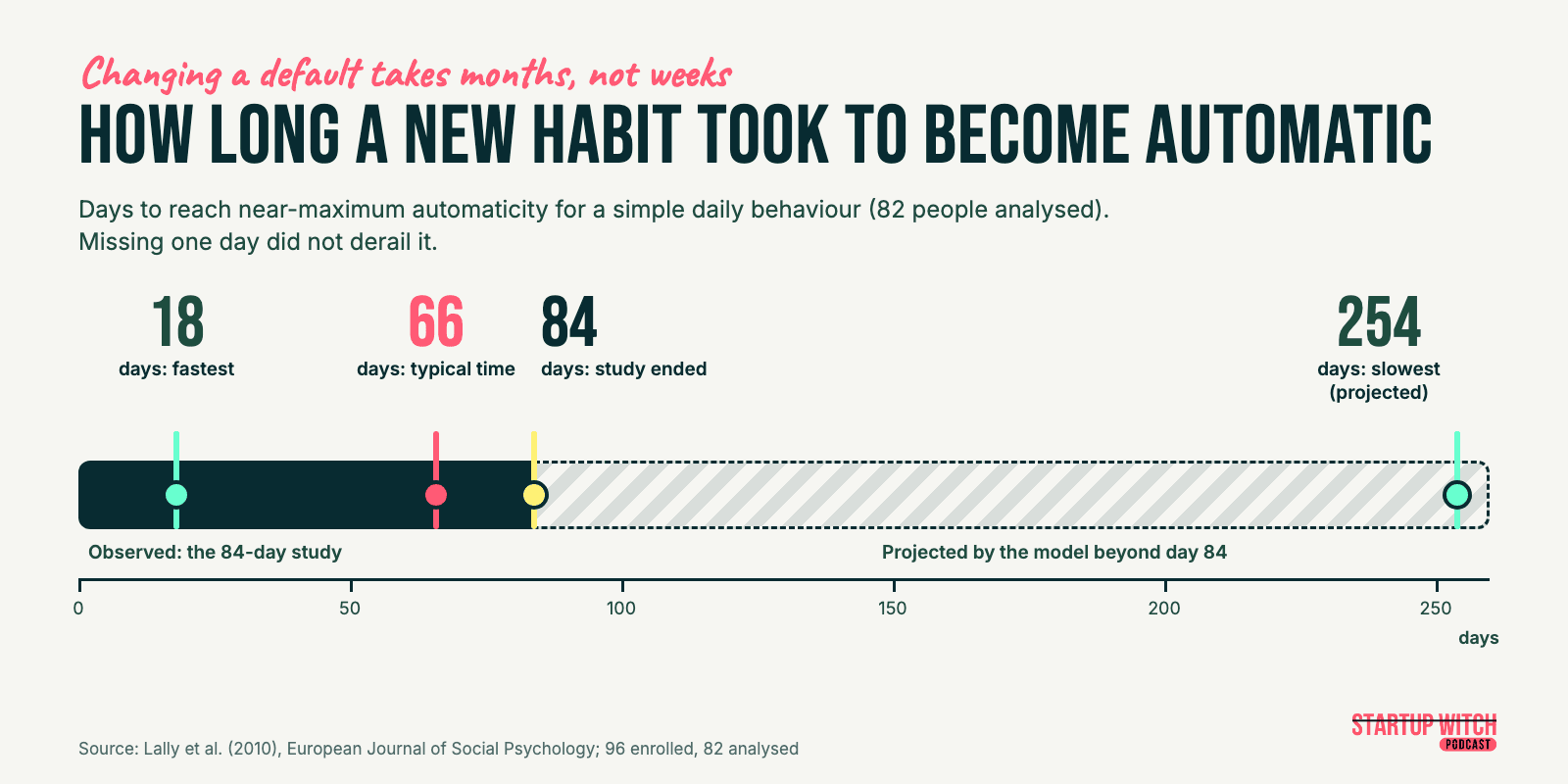
The caveats matter. Anything beyond 84 days, including the 254, is a model projection rather than an observation. The behaviours were simple ones like drinking water after breakfast, not complex work responses like holding a hard conversation with an investor. Lally herself says the 66-day figure does not hold for "most people most of the time". The useful finding for founders is a different one: missing one opportunity did not materially affect habit formation. A relapse on a bad Friday does not reset the process. Plan for a three-month horizon and keep going.
Step 5: Build psychological safety so bad news reaches you early
Your response to bad news sets the norms for the next piece of bad news. If the first person to report a slipped deal gets questioned like a suspect, the second person waits longer. The Edmondson research above links psychological safety to learning behaviour, and a founder's reaction in pressure moments is where a team learns whether it is safe.
Three simple practices help:
- Thank the person for raising it before you investigate it.
- Ask what they think happened before you say what you think.
- Assign one owner and one deadline to each open pressure decision, so the problem does not drift back to you by default.
Step 6: Ask someone outside to watch for the pattern
Founders are the worst-placed people to see their own default, because it feels like good judgement while it runs. A co-founder, a board member or a peer founder who knows your pattern can name it in real time. Give them permission in advance: "If you see me taking over an account, tell me." Then respect the answer when it comes, especially when it is inconvenient.
What Founder Behaviour Under Pressure Looks Like in Practice
The table below maps common pressure moments to the default that usually fires, what to notice, and a replacement response worth practising.
| Pressure moment | Typical default | What to notice | If-then replacement |
|---|---|---|---|
| A big deal slips | Doing it all yourself | You have taken over the account within the hour | If a deal slips, I ask the owner for their read first |
| Churn or a bad metric | Fixing instead of diagnosing | A solution exists before anyone has defined the problem | If I want to build a fix, I talk to one affected customer first |
| An investor or hire challenges you | Defending instead of asking | You are explaining while they are still talking | If I am challenged, my first sentence is a question |
| Runway or funding worry | Going quiet | Team and investor updates have stopped | If a week passes without an update, I send a short one anyway |
| A key person resigns | Doing it all yourself | You have quietly absorbed their role | If someone leaves, I name an interim owner within two days |
Is Founder's Syndrome the Same as Default Behaviour Under Pressure?
Not quite. Founder's syndrome is an informal term, not a clinical diagnosis, for a founder who keeps too much control as the company grows: decisions bottleneck through them, strong hires leave, and the company stops growing past what one person can manage. It describes a long-term state.
Default behaviour under pressure is the mechanism that often produces it. Every crisis in which the founder takes back control, and nobody names the pattern, makes the next takeover feel more normal. Over a few years that adds up to the symptoms people call founder's syndrome. The way out is the same: notice the default in specific moments, pre-decide a different response, and hand over real decision areas with clear outcomes rather than approval rights.
When the Pattern Is Hard to See From the Inside
The hardest thing about founder behaviour under pressure is that it feels like leadership while it is happening. Taking over feels responsible. Building the fix feels productive. Defending the plan feels like conviction. Going quiet feels like focus. If you suspect a default is shaping your startup but cannot name which one, an outside read helps. The Founder Blind Spot Diagnostic by Startup Witch reads your startup in 14 days and names the one thing blocking growth. It costs EUR 750 and is fully refundable.
Frequently Asked Questions About Founder Behaviour Under Pressure
What does it mean to react under pressure?
Reacting under pressure means responding to a threat with your first, practised response rather than a considered one. Research on stress suggests people shift towards habitual behaviour when stressed, so the reaction you see in a crisis is usually your default, not your best judgement.
How do founders react under pressure most often?
The four most common patterns are doing it all yourself, fixing instead of diagnosing, defending instead of asking, and going quiet. Most founders have one dominant default. Keeping a short pressure log for a few weeks is the quickest way to find yours.
How can a founder be a good leader under pressure?
Decide your response before the pressure moment arrives. Name the cues that trigger your default, write if-then plans for them, respond to bad news with questions before answers, and ask someone you trust to point out the pattern when they see it.
Can you change your default behaviour under stress?
Yes, but slowly. In the best-known habit study, the time for a new behaviour to become automatic ranged from 18 to 254 days, and missing a single day did not derail the process. Plan for months, not weeks, and expect relapses on bad days.
Is founder stress a sign something is wrong with the founder?
No. Stress is a normal response to high stakes and uncertainty, and falling back on habits under stress is a general human tendency. It becomes a problem when the same default keeps costing the company, or when stress is affecting your health. In that case, professional support is a sensible step.