
Most mining tech founders would rather be building. Selling to mines is slow, the meetings are full of people who have seen a hundred vendors, and the first "yes" can take longer than your seed round lasts. So the temptation is to hire a salesperson early and get back to the product.
Resist it. In mining technology, founder-led sales is not a phase you endure until you can afford someone else. It is how you find out what you are actually selling, to whom, and why they buy. This article covers why the founder has to carry the first deals, what the founder has to learn while doing it, and how to tell when it is time to hand over.
You will find:
- why mines need to hear from the founder in the early deals
- the skills a technical founder has to build, fast
- what the founder should keep even after the first sales hire
- the signals that say you are ready to hand over, and a simple handover sequence
- the mistakes that turn founder-led selling into a bottleneck
What Is Founder-Led Sales in Mining Technology?
Founder-led sales in mining technology means the founder personally runs the early deals: the first conversations with sites, the discovery, the scoping, the commercial terms and the close. Not as a figurehead who turns up for the final meeting, but as the person who owns the pipeline.
What changes in mining is how long it lasts and how much rides on it: long cycles, a wide buying group, and products that often touch safety or production.
Why Must Mining Tech Founders Sell the First Deals Themselves?
Because in the early deals the mine is buying the founder's judgement as much as the product, and nobody else in your company can stand in for that yet. There are five reasons it matters more in mining than in most markets.
1. The buyer is taking a real risk
A failed deployment at a mine can cost production or create a hazard, and the person who approved it answers for that. Early on there is no track record to point to, so the buyer looks at the people instead. They want to see that whoever built this understands what happens at the face, in the pit or in the control room. A founder who can answer the hard technical question on the spot is the closest thing a startup has to a reference.
2. The cycle is long enough to outlast a hire
Writing in the Canadian Mining Journal, Steve Gravel notes that sales cycles in mining routinely stretch over 12 to 24 months, with budgets and priorities shifting along the way. A salesperson hired before you know how a deal closes may never see one close during their first year. You will not learn from them whether the problem was the person, the pitch or the product.
3. Buyers give you very few conversations
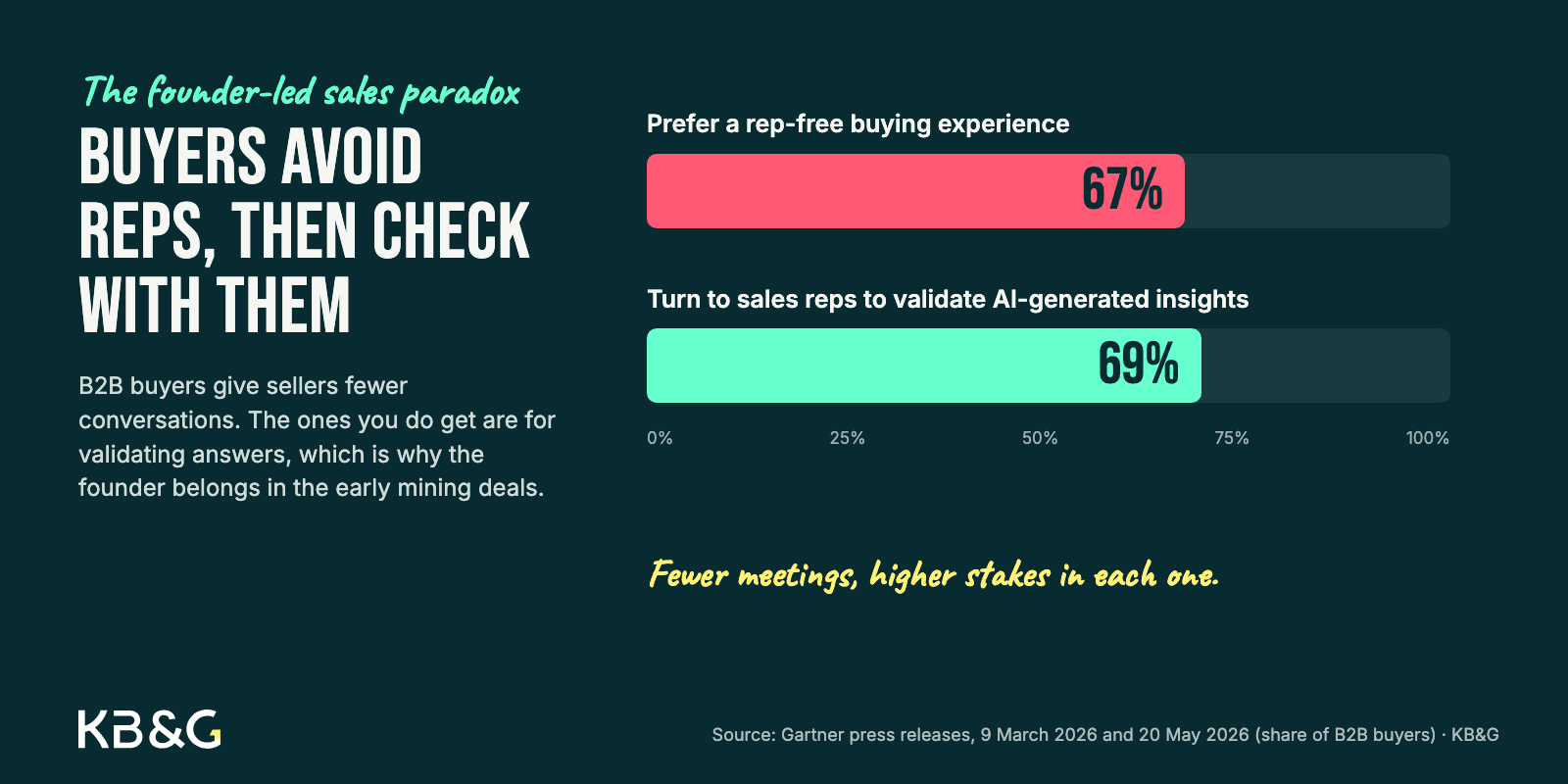
B2B buyers increasingly avoid salespeople altogether. Gartner reports that 67% of B2B buyers prefer a rep-free experience. Yet in a separate release, Gartner found that 69% of B2B buyers turn to sales reps to validate AI-generated insights. Read together, the meetings you do get are not for pitching. They are for checking. A mining superintendent who agrees to an hour with a startup wants answers that hold up, and early on the founder is usually the only person who has them.
4. Every early deal is product research
The first deals tell you which problem gets budget, which stakeholder kills deals and what the site will pay. That belongs in the product and the pricing, not in a salesperson's notebook.
5. Early deals get shaped, not sold
The first mining contracts are rarely standard. Scope gets narrowed to avoid control systems, a trial gets redesigned around a shift pattern, pricing gets restructured to fit how the site spends money. Those calls change what the company is committing to. Only someone with the authority to make them should be in the room.
Is Mining Different From Other B2B Markets?
Yes, in degree rather than kind. Mining stretches every part of founder-led selling: more people in the decision, more caution about anything new, a longer wait for the purchase order.
Cost and capability are still what mines say holds them back. In GlobalData's 2025 survey of 162 operating mines, reported via GlobeNewswire, the cost of the technology and the skills required were the main barriers to adoption, with 48% citing cost, down from 53% in 2024. Neither barrier is answered by a slide deck. They are answered by a conversation about what the site actually needs, what it can run with the people it has, and how to make the first phase cheap enough to approve. That is a founder conversation.
The buying side is covered in detail in how to sell software to mining companies. Here the focus is on the seller: you.
What Does a Mining Tech Founder Have to Learn to Sell?
The founder has to learn to run a sales process, not just a good meeting. Most technical founders are already credible in the room. What they lack is the discipline around it.
Discovery before demo. Engineers want to show the product. Mines want to be asked about their problem first. Learn to spend the first meeting on questions: what happens now, what it costs, who feels it, what has been tried. A demo given before you understand the problem answers questions nobody asked.
Speaking the site's language. Production, availability, shift handover, permits, inductions. Gravel's point in the same Canadian Mining Journal piece is that the sector needs sales skills that let teams speak the language of the mine. If your vocabulary is "platform", "AI-driven" and "insights", you sound like every other vendor. If it is tonnes, hours and incidents, you sound like someone who has been underground.
Qualifying hard. Interest is cheap at mining conferences. Learn to ask early who owns the budget, what the decision process is, and what would have to be true for a purchase order this financial year. Then believe the answers.
Holding price. Founders discount because they want the logo. In mining, a free or cheap trial often removes the budget owner and the procurement record that would make the deal real. We cover the pilot side of this in pilot purgatory. The founder skill is simpler: name a price and stop talking.
Following up like it is the job. With 12 to 24 month cycles, most of the work happens between meetings. A short written summary after every conversation, a named next step and a date. Founders who rely on memory lose deals they never knew were at risk.
Writing it down. Every question asked, every objection, every reason a deal stalled. This becomes the playbook your first hire inherits. If it exists only in your head, there is nothing to hand over.
Starting the paperwork early. The first serious buyer will send a supplier questionnaire. Knowing what is in it before they ask is part of selling. Our guide to mining vendor prequalification sets out what to prepare.
If this list feels uncomfortable, that is normal. We wrote about why selling became the founder's job in sales for tech founders.
When Should a Mining Tech Founder Hand Over Sales?
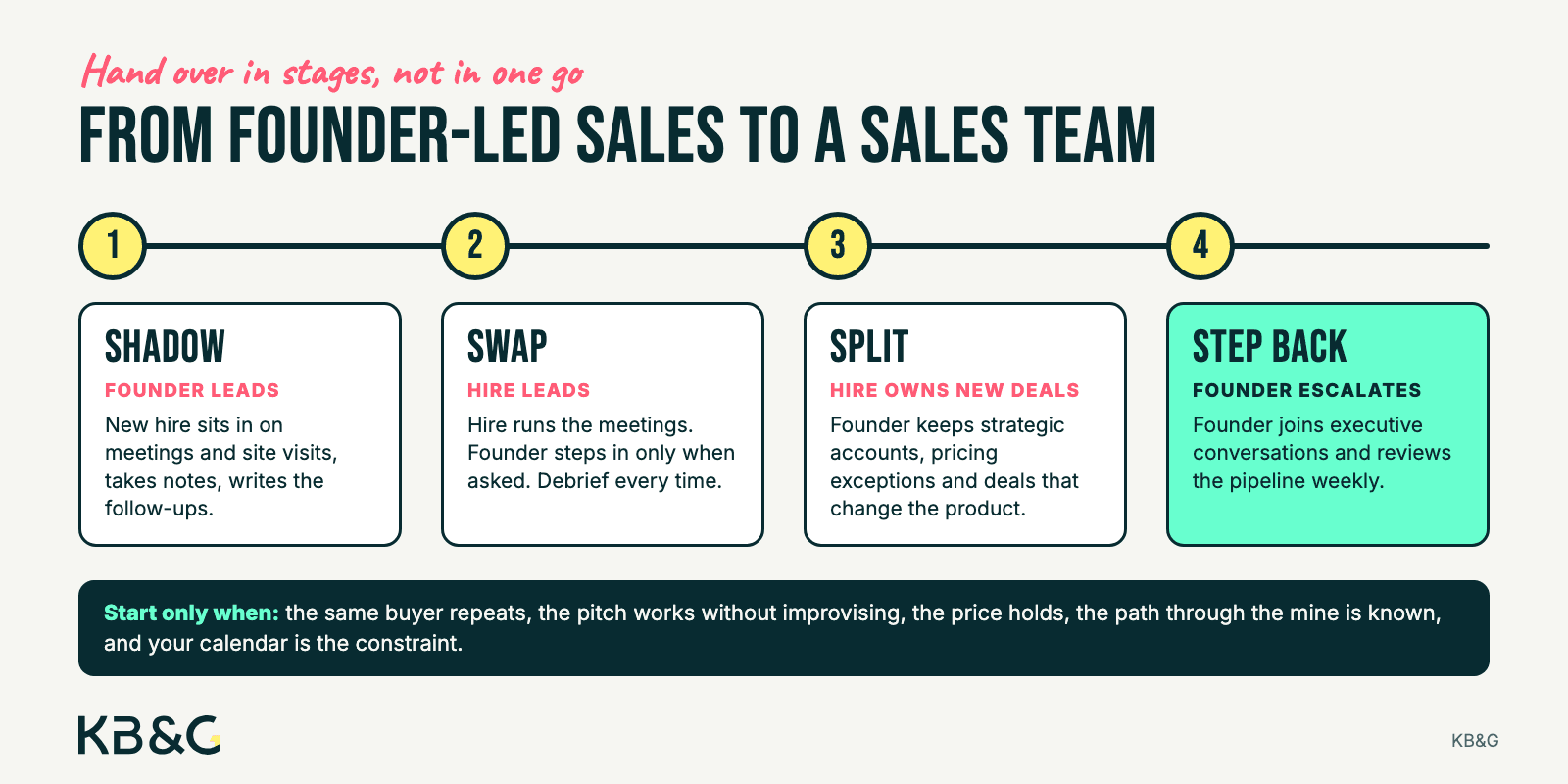
Hand over when deals have become repeatable and your own time, not demand, is what limits the pipeline. Not at a revenue figure, not after a funding round, and not because you are tired of travelling to site.
The signals to look for:
- The same buyer, more than once. Several closed deals with the same type of site, the same sponsor role and the same core problem.
- A pitch that works without you improvising. You could write down the first meeting, the questions and the usual objections, and someone else could follow it.
- A price that holds. Deals close at roughly the same price and structure, without a bespoke negotiation each time.
- A known path through the mine. You know which stakeholders appear, in which order, and what each one needs to see.
- Your calendar is the constraint. Qualified opportunities are waiting because you cannot get to them, not because they do not exist.
If several of these are missing, a salesperson will mostly be paid to rediscover them. Hiring too early is the more expensive mistake, because you lose a year finding out that the problem was never the salesperson.
How Do You Hand Over Without Losing the Deals?
Hand over in stages, with the founder still in the room for a while, and judge the new hire on activity and learning before revenue. A long cycle means the first closed deal may come late, so you need earlier measures to tell whether it is working.
- Shadow. The new hire sits in on your meetings and site visits, takes the notes and writes the follow-ups.
- Swap. They run the meetings, you sit in and only step in when asked. Debrief after every one.
- Split. They own new opportunities end to end. You keep the strategic accounts, pricing exceptions and any deal that changes what the product does.
- Step back. You join for executive conversations and escalations only, and review the pipeline weekly.
Who you hire matters. For mining, someone who has sold into mines before, or who has worked in operations and can talk to a superintendent as a peer, will usually learn your product faster than a generalist will learn the industry. A first hire also needs your existing conversations and introductions, not a cold list.
A hypothetical to make it concrete: a founder has closed four paid trials with mid-tier open pit operators, all sponsored by a maintenance manager, all solving the same downtime problem. The founder has written down the discovery questions and the three objections that come up every time. That founder is ready to hire. A founder with two deals at very different sites, each negotiated from scratch, is not. The second founder needs more deals, not more people.
What Should the Founder Never Fully Hand Over?
The founder should keep the relationships that shape the company: the first reference sites, the largest accounts, the pricing model and the decision about which problems the product will and will not solve. A salesperson can manage a pipeline. Only the founder can decide what the company is selling.
Stay close to the field too. Founders who stop going to site lose the feedback that made their early deals work.
What Mistakes Turn Founder-Led Sales Into a Bottleneck?
The common mistakes are hiring too early, never building a process, and staying the only person who can close. Each one is easy to spot in hindsight.
Hiring to avoid selling. If the honest reason for the hire is that you dislike selling, the hire will inherit an unclear pitch and an unproven buyer, and will probably fail.
Closing on charisma. Founders win early deals on belief. That does not transfer. We describe this pattern in founder-led sales and its blind spots: a strong close rate can hide the fact that nobody else could repeat it.
Mistaking pilots for pipeline. A list of friendly trials with innovation teams can look like traction. Without budget owners and agreed outcomes, it is a list of conversations.
Running out of runway first. Long cycles burn cash. Plan your funding around how long mining deals actually take, not how long you hope they take. Our article on mining tech funding covers the options.
Not Sure Which of These Is Holding You Back?
Founders are usually the last to see their own sales blind spot, because it is the habit that won them the first deals. The Founder Blind Spot Diagnostic by Startup Witch reads your startup in 14 days and names the one thing blocking growth. It costs EUR 750 and is fully refundable.
Frequently Asked Questions
How long should founder-led sales last in a mining tech startup?
Until deals are repeatable, which in mining usually takes longer than in other B2B markets because each cycle is long. Judge it by the signals, not the calendar: the same buyer type, a stable price, a known path through the mine and a founder whose time is the constraint.
Should a technical founder or a commercial co-founder lead sales?
Whoever the mine will trust on the hard questions. Often that means the technical founder leads discovery and the technical side, while a commercial co-founder runs the process, follow-up and terms. What matters is that a founder owns the pipeline and both hear what customers say.
What should my first sales hire in mining look like?
Someone who already speaks the industry's language, ideally with experience selling into mines or working in operations, and who is comfortable closing rather than only prospecting. Give them your existing conversations and a written playbook, and expect a ramp period that reflects mining's long cycles.
Is founder-led sales just a startup phase?
The intensity is a phase. The involvement is not. Even with a sales team, founders of mining tech companies stay close to key accounts, pricing and product direction, because that is where the company's judgement lives.
Related Reading
- Founder-Led Sales Wins Deals and Hides Your Blind Spots
- How to Sell Software to Mining Companies
- Pilot Purgatory: How AI and Industrial Tech Startups Can Turn Enterprise Pilots Into Revenue
- Your First Reference Customer in Mining Matters More Than Your First Revenue
- Mining Vendor Prequalification: What Tech Startups Need Before the First Pilot