
The quote went out on Tuesday. It was accurate, it was on time, and the site manager said it "looked good". Now it is three weeks later and the inbox is silent. You have two options in your head: send another "just checking in" email and feel like a nuisance, or quietly mark the job as lost and move on.
Both are common in construction, building materials and B2B industrial sales. Neither is a plan. This guide covers how to follow up on a quote in a way that keeps the deal moving without chasing: why follow-up fails, a cadence you can put in a calendar, messages that add value, what to say when the customer went with someone cheaper, and when to walk away.
How Do You Follow Up on a Quote?
You follow up on a quote by agreeing the next step before you send it, confirming it arrived within a day or two, then sending a small number of short, spaced messages that each give the customer something useful, and closing the file politely if nothing comes back before the quote expires.
That is the short version. The rest of this article is the detail: what "useful" means for a contractor or a buyer at a merchant, how often to make contact, and what each message should say.
In this article you will get:
- the real reasons a quote follow up goes nowhere
- a follow-up cadence from the day you send the quote to the day it expires
- the difference between chasing and adding value, with examples
- short quote follow up email examples and subject lines you can adapt
- a reply to "we went with someone cheaper"
- clear signals that it is time to stop
Why Does Follow-Up After Sending a Quote Fail?
Follow-up after sending a quote usually fails for one of five reasons, and only one of them is that the customer said no.
1. The rep is afraid of being annoying
Most reps do not stop following up because they have decided the job is lost. They stop because the next message feels awkward. They worry they will sound desperate, so they wait for the customer to make the first move.
Research suggests that worry is often overdone. In a series of experiments with more than 5,900 participants published in the Journal of Personality and Social Psychology, people who reached out to others significantly underestimated how much the recipients appreciated being contacted, and the gap was larger when the tie between them was weak. The study was about social contact rather than sales, so do not stretch it too far. But it is a useful check on the voice in your head that says one more message will ruin everything.
2. "Just checking in" gives the customer nothing to do
A message that says "just touching base on the quote" asks the customer to stop, remember the job, find the quote and write a reply, all for your benefit. Busy people put that kind of email at the bottom of the pile. The follow up email that gets a response is the one that is easy to answer or that solves a problem they already have.
3. The decision is not one person's
The person who asked for the quote is rarely the only person deciding. On a construction job it might be the estimator, the project manager, the quantity surveyor and the client. In a plant or a mine it might be maintenance, procurement and finance. Gartner reports that the typical buying group for a complex B2B purchase involves six to ten stakeholders, and that in a survey of more than 250 B2B customers, 77% rated their latest purchase as extremely complex or difficult. Silence often means your contact is stuck inside that process, not that they have forgotten you.
4. They are comparing multiple quotes
Contractors and buyers routinely collect multiple quotes. If yours looks like the others, the only visible difference is the price at the bottom. A follow up that clarifies what you included, and what the others may have left out, is often the only chance to make that comparison fair.
5. Nobody agreed what happens next
This is the most common and the easiest to fix. If the quote went out with "let me know if you have any questions", the customer has no reason to reply and you have no natural reason to call. The fix happens before you send the quote.
What Should You Do Before Sending a Quote?
Before sending a quote, agree three things with the customer: when they will decide, who else is involved, and when you will next speak. Most of the work of following up is done in this conversation, not afterwards.
On the call or on site, ask:
- "When do you need to decide by?" In construction this is often a bid date or a programme date. In materials supply it may be a pour date or a delivery window.
- "Who else will look at this?" Find out whether the estimator, the project manager or procurement will see it, and whether you can send anything that helps them.
- "Can I call you on Thursday to walk through it?" A booked quick call is worth more than any follow up email you will write later.
Then put the answers into the quote itself. State how long the price is valid and the date the quote expires. List what is included and, just as important, what is excluded. Name the next step in writing: "I will call you on Thursday at 10 to go through the scope." Now your first follow up is not an interruption. It is the thing you both agreed.
What Is a Good Quote Follow-Up Cadence?
A good quote follow-up cadence is short, spaced and tied to the customer's decision date: a receipt check within a day or two, one or two value messages over the next fortnight, a decision check, and a final reminder before the quote expires. After that, you close the file.
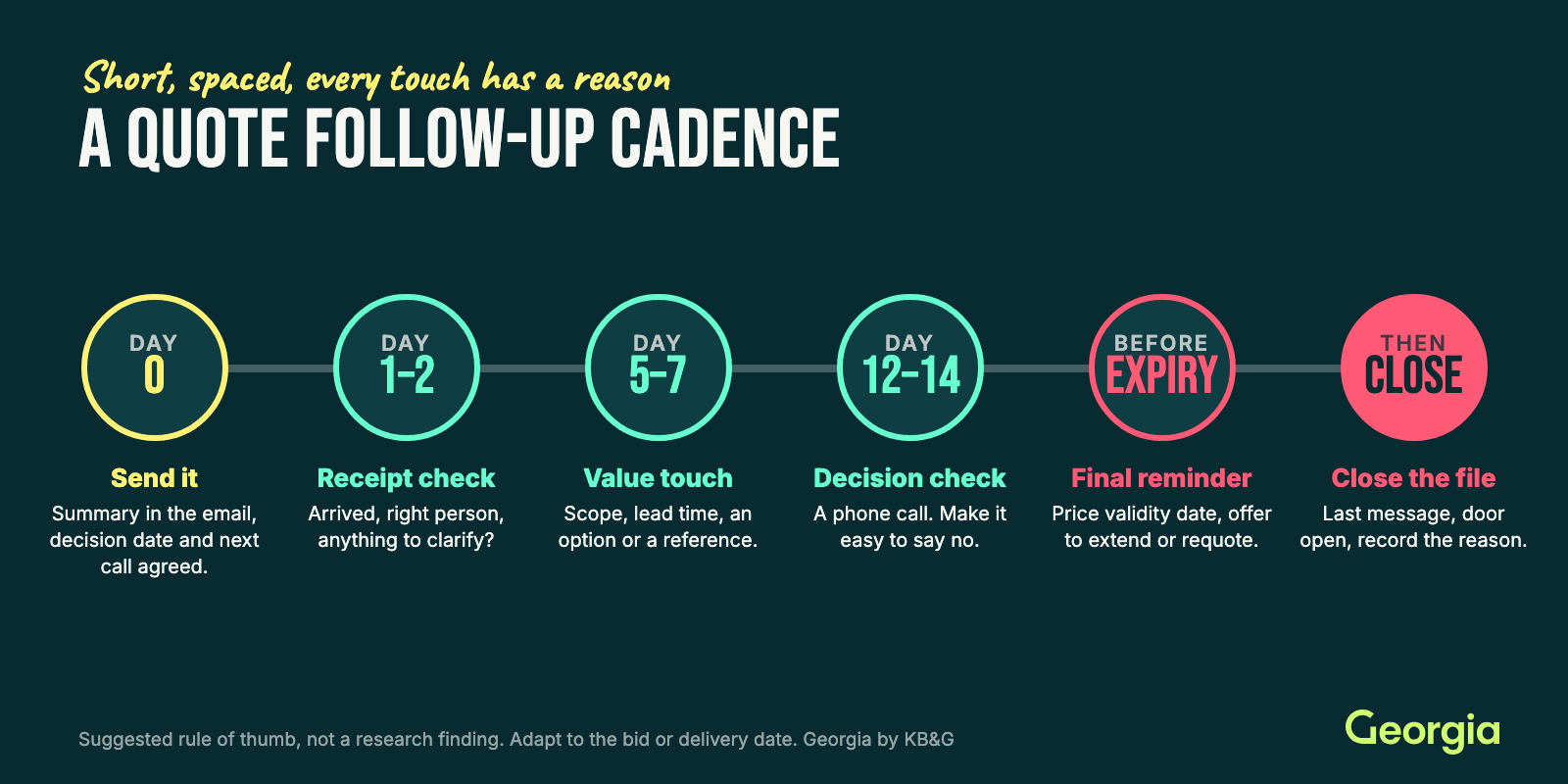
Here is a starting point. It is a practical rule of thumb, not a research finding, so adjust it to the job. A pour next week needs a faster rhythm than a framework agreement that will be decided next quarter.
- Day 0, sending the quote. Send it with a two-line summary in the body of the email, the decision date you agreed, and the time of your next call. Do not just attach a PDF with "please find attached".
- Day 1 to 2, receipt check. A quick call or a short message to confirm it arrived, reached the right person and opened. Ask one question: "Is there anything in the scope you want me to clarify?"
- Day 5 to 7, value touch. Send something useful: a clarification on exclusions, a lead time update, an alternative specification, a relevant reference. This is your main follow up.
- Day 12 to 14, decision check. Ask directly where the decision stands and make it easy to say no. This is often a phone call rather than an email.
- Before the quote expires, final reminder. Tell them the price validity date is coming, what happens after it, and offer to extend or requote if the timing has moved.
- After expiry, close the file. Send a short last message that leaves the door open, record the outcome and the reason, and stop.
That is four or five contacts over two to three weeks, each with a reason. You will see a well-known statistic claiming that most sales need five or more follow-ups. It appears on many sales blogs, but we could not trace it to any published study, so we have not relied on it here. Plan your number of touches around the customer's timeline and the value you can add, not around a figure nobody can source.
Speed matters most at the very start. A widely cited Harvard Business Review study of how companies respond to online sales enquiries concluded that most companies are not responding nearly fast enough. The same logic applies to a quote: the receipt check in the first day or two catches problems while the job is still fresh in the customer's mind.
Construction bid follow up: work back from the bid date
For a subcontractor or supplier pricing into a main contractor's tender, the calendar is set for you. The main contractor has its own deadline with the client, so your construction bid follow up should work backwards from it.
- Before the bid date: check your price has been received and is being used. Offer to answer questions on scope, exclusions or alternatives while the estimator is still building the tender. This is the moment when additional information is genuinely welcome.
- After the bid date: ask when the main contractor expects to hear from the client. Then go quiet until that date. Chasing a main contractor who is waiting on the client only wastes both your time.
- After award: if they won, ask when packages will be let and who will place yours. If they lost, ask whether they can share why, and thank them for including you.
For UK public sector tenders run under the Procurement Act 2023, unsuccessful bidders in a competitive tendering procedure receive an assessment summary explaining how their tender was scored. Read it properly. It is free feedback you would otherwise have to chase.
Chasing vs Adding Value: What Should a Follow Up Email Say?
A follow up email should give the customer something they can use or a question they can answer in one line. If it only reminds them that you exist, it is chasing.
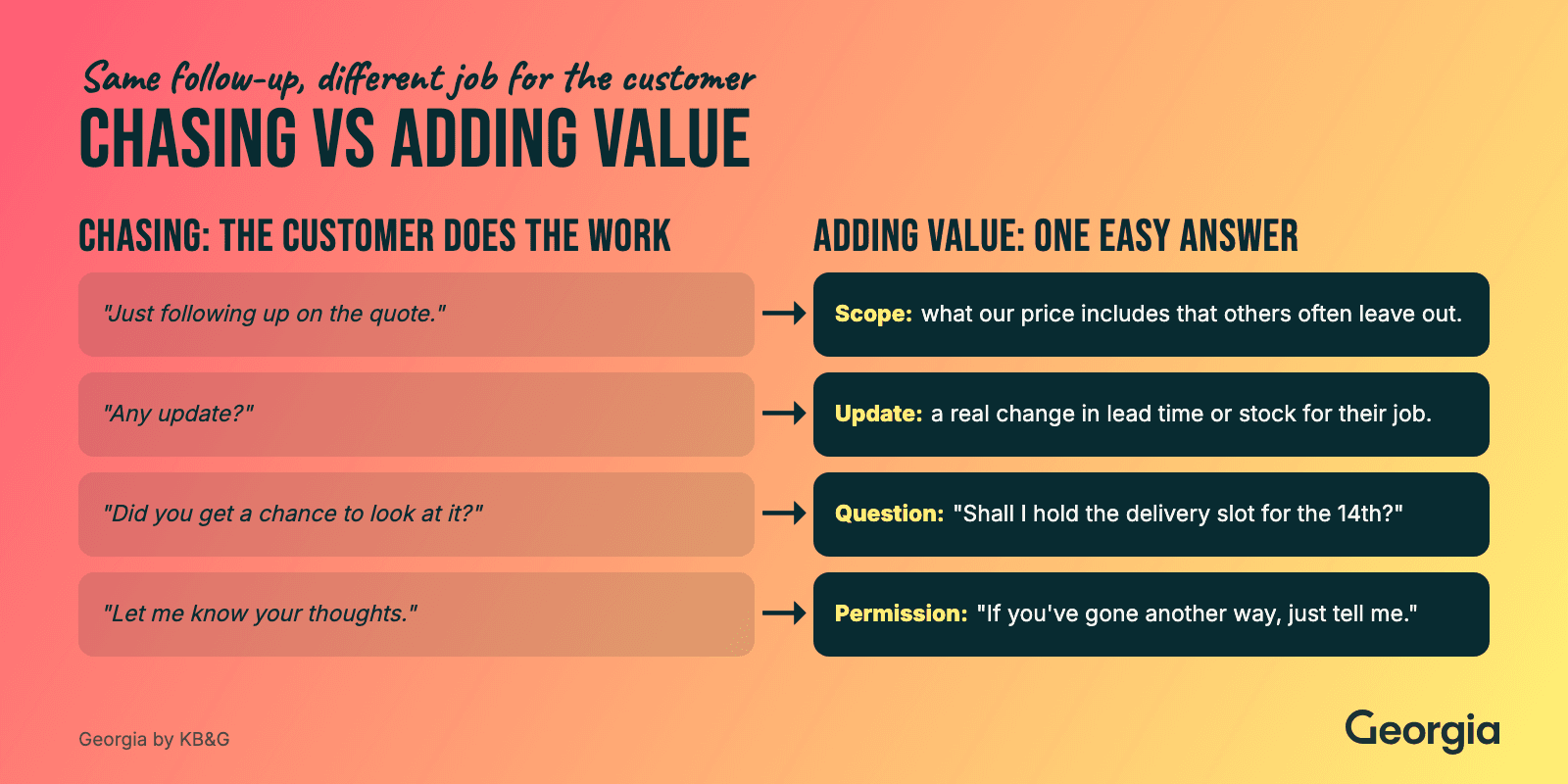
Chasing messages sound like this: "Just following up", "Any update?", "Did you get a chance to look at the quote?", "Touching base". They put the work on the customer and offer nothing new.
Value messages do one of these things:
- Answer an unstated question. What is the lead time? Is the price fixed? What happens if the programme slips? Who unloads on site? If you have been asked it on other jobs, answer it before this customer has to.
- Clarify scope. Point out what you included that others often exclude: delivery, offloading, testing, waste removal, commissioning. This is the honest way to make multiple quotes comparable.
- Share a material update. Stock levels, a mill or plant shutdown, a price change notified by a manufacturer. If it is real and it affects their job, it is welcome.
- Offer an option. An alternative specification, a phased delivery, a different payment schedule. This often unlocks a stalled decision without touching your price.
- Help the other decision makers. A one-page summary for the client, a datasheet for the engineer, a method statement for the site manager.
- Ask a clear question. A clear call to action with a yes or no answer. "Shall I hold the delivery slot for the 14th?" is easy to answer. "Let me know your thoughts" is not.
The aim is not a clever sales pitch. It is to be the supplier who makes the customer's job easier. That is also how you win more deals without cutting the price.
Quote Follow Up Email Examples You Can Adapt
These quote follow up email examples are written for this article. They are not tested templates with response rates attached, so adapt the wording to your trade and your customer. Keep each one short enough to read on a phone on site. Reply in the same thread as the original quote so the customer does not have to search for it.
1. The receipt check (day 1 to 2)
Subject line: Your quote for [site / job]: arrived OK?
Hi Sam, a quick note to check the quote for the Riverside job reached you and the attachments opened. Delivery is included to site with offloading. One thing worth confirming: are you still working to the 14th for the first pour? I will call Thursday at 10 as agreed. Best regards, Alex
2. The scope clarification (day 5 to 7)
Subject line: What is and isn't in the Riverside price
Hi Sam, when you compare quotes it can be hard to see what each one covers, so here it is on one line: our price includes delivery, offloading by crane, test certificates and collection of pallets. It excludes temporary works. If another quote looks lower, it is worth checking whether those items are in it. Happy to answer questions on any of it. Alex
3. The material update (when there is real news)
Subject line: Lead time update for the Riverside job
Hi Sam, a quick heads-up: the manufacturer has told us lead times on this product are lengthening from next month. We can still hold your delivery date if the order is placed by the 30th. No pressure either way, I just did not want it to surprise you later. Alex
Only send this kind of message when it is true. An invented deadline is the fastest way to lose a customer's trust.
4. The decision check (day 12 to 14)
Subject line: Riverside: still on your list?
Hi Sam, I know the decision may not be yours alone. Where does it stand? If the job has moved or you have gone another way, that is fine, just tell me and I will close it off my side. If it is still live, is there anything the client or your QS needs from me? Alex
Giving the customer permission to say no takes the pressure off and usually gets a straighter answer than another gentle reminder.
5. The final reminder before the quote expires
Subject line: Riverside price valid until Friday
Hi Sam, a final reminder that our price for Riverside is valid until Friday the 28th. After that we would need to requote, as material costs may have moved. If your timing has changed, tell me the new date and I will see what I can do. Alex
6. The last message (closing the file)
Subject line: Closing off the Riverside quote
Hi Sam, I have not heard back, so I will assume Riverside has gone another way or been put on hold, and I will stop chasing. If it comes back, or another job comes up, I would be glad to price it. Thanks for including us. Alex
This message is polite, final and leaves the door open. It also tends to get replies from customers who meant to answer weeks ago.
Which Email Subject Line Gets a Quote Follow Up Opened?
The email subject line that works best names the job and the reason for the message. The customer is scanning a crowded inbox. "Follow up" tells them nothing. "Riverside: lead time update" tells them why to open it.
- Use the site name, job number or their reference, not yours.
- Say what is inside: "scope clarification", "price valid until Friday", "delivery slot for the 14th".
- Avoid ALL CAPS, exclamation marks and words like "urgent" or "final offer". They read as a generic email and can trip a spam filter.
- Reply in the same thread for the receipt check, so the original quote is right there. Start a new thread for a genuinely new subject, such as a revised or new quote.
Should You Follow Up by Phone, Email or Text?
Use more than one channel. Email is the record; the phone is where things actually move. In construction and industrial sales, many decisions are made by people who spend their day on site and read email in the evening, if at all.
A practical split: send the quote and the value messages by email so there is a written record of scope, price and dates. Make the receipt check and the decision check as a phone call. A quick call lets you hear hesitation, ask a follow-up question and deal with a price objection while it is still a conversation. If they do not answer, leave a short voicemail with the job name and one reason to call back, then send a quick note by email or text that says the same thing.
Keep your notes. Writing down what was said on each call, and what you promised, means the next message builds on the previous conversation instead of starting from scratch.
How Do You Respond to "We Went With Someone Cheaper"?
Respond to "we went with someone cheaper" by thanking them, asking one honest question about how the decision was made, and leaving the door open. Do not argue, and do not drop your price after the decision has been made.
An example reply:
Thanks for letting me know, Sam, I appreciate you telling me rather than going quiet. Can I ask one thing so I can price better next time: was it the headline number, or was there something in the scope or the lead time that made the difference? Either way, if anything changes on delivery or the job grows, I would be glad to help.
Why this works:
- It gets you information. You learn whether you lost on price, scope, timing or relationship. That shapes your next quote far more than guessing.
- It keeps you on the list. Cheaper suppliers sometimes cannot deliver. The supplier who left on good terms gets the call when that happens.
- It protects your margin. Offering a discount after you have lost tells the customer your first price was padded. They will remember on the next job.
If the decision has not been made yet and they say your price is too high, that is a different conversation. Our guide on how to handle price objections covers the five kinds of "too expensive" and how to trade rather than discount.
When Should You Stop Following Up on a Quote?
Stop following up on a quote when the customer has told you no, when the quote has expired and your last message has gone unanswered, or when the job has clearly moved on without you. Persistence past that point stops being professional and starts costing you time you could spend on live work.
Signs it is time to walk away:
- You have made four or five contacts over two to three weeks, each with a reason, and heard nothing.
- The decision date you agreed has passed and the customer will not give you a new one.
- You see the job on site with another supplier's product, or hear that the package has been let.
- The only way to move forward is a discount you cannot justify.
Walking away does not mean disappearing. Send the closing message, record why the quote was lost (or that you do not know), and put a reminder in your calendar for a month or two later. Contractors who went quiet on one job may be pricing the next one. A quote that sits in your pipeline as "pending" for six months makes your forecast look healthier than it is; our article on building a startup sales system calls this a pipeline full of ghosts.
Should You Use Automated Follow Ups?
Automated follow ups are fine for reminders and poor for anything else. A system that reminds you to call on day two, or that sends a price validity reminder before the quote expires, saves real time. A sequence of identical "just checking in" emails sent to every customer does the opposite: it is chasing at scale, and customers can tell.
Use automation to make sure follow-up happens. Write the value messages yourself, for the job in front of you.
Practise the Follow-Up Call Before You Make It
Most reps know what a good follow up should sound like. The hard part is saying it on the phone when the customer answers, sounds busy and says "your price is too high". That moment is where people fold: they offer a discount nobody asked for, or they mumble "no worries" and hang up.
The fix is repetition. Rehearse the opening of the decision check call, the reply to "we went with someone cheaper" and the reply to "your price is too high" until they come out naturally. A colleague can play the customer, as described in our guide to sales role-play training. Founders selling on their own can use the same approach; see how to get your first 10 customers for how early follow-up turns interest into orders.
If your team needs more practice than a manager has time to give, Georgia by KB&G is an AI role-play coach built with sector trainers. Reps practise in 3 to 8 minute self-paced sessions with real-time coaching, including scenarios like holding price, handling price objections and answering "the other supplier is cheaper". It is a way to rehearse the follow-up call and the "your price is too high" reply before the real customer is on the line.
Frequently Asked Questions
How do you politely follow up on a quote?
To politely follow up on a quote, keep the message short, name the job, give one useful piece of information and ask one easy question. Use a friendly tone, and give the customer permission to say no. Politeness is less about soft words and more about not wasting their time.
How long should you wait to follow up after sending a quote?
Make the first follow up within one or two days to confirm the quote arrived and reached the right person. After that, space messages about a week apart and tie them to the customer's decision date. Treat these as rules of thumb, not research results.
What can you say instead of "just following up"?
Say why you are writing. "A quick clarification on scope", "a lead time update for your job", "your price is valid until Friday" or "shall I hold the delivery slot?" all give the customer a reason to read on and something to answer.
How do you follow up on a bid proposal?
Follow up on a bid proposal by confirming receipt, offering clarification while the estimator is still pricing, asking when the award is expected, and then waiting until that date. If you lose, ask for feedback. In UK public procurement, read the assessment summary you receive.
How many times should you follow up on a quote?
Usually four or five contacts over two to three weeks, each with a clear reason, ending with a final message before or just after the quote expires. If the customer gives you a later decision date, follow their timeline rather than a fixed number.
Should you send a new quote if the old one expired?
Only if the customer asks or the job is still live. A new quote is a good reason to get back in touch, but check whether prices, lead times or scope have changed first, and say clearly what is different from the original quote.