
What Is a Price Objection?
A price objection is any moment when a buyer pushes back on what you are asking: "your price is too high", "the other supplier is cheaper", "can you do better?". It is rarely only about the number. Usually it means the buyer has a budget limit, does not yet see enough value, is comparing you with a cheaper alternative, is testing you, or is not the person who decides. Learning how to handle price objections means finding out which of those you are facing before you touch the price.
This guide is for B2B salespeople, sales leaders and founders who sell. That includes reps at building materials, aggregates and equipment suppliers who hear "too expensive" from contractors every week, and SaaS founders who keep closing deals at a discount they never planned to give.
You will get:
- Why good reps fold on price, and what research on loss aversion, silence and anchoring says
- The five kinds of "too expensive" objection, with what to ask and what to say for each
- A step-by-step method for price objection handling on a live call
- Exact phrases for "the other supplier is cheaper" and "can you do better on price?"
- How to trade concessions instead of discounting, and how to quote without giving away margin
Why Reps Discount Before Anyone Asks
Most discounting is not forced by the buyer. The buyer frowns at the quote, the line goes quiet, and the rep fills the gap with "we could probably look at something on price". Nobody asked. Three forces drive this.
Loss aversion. People weigh losses more heavily than equal gains. A 2024 meta-analysis in the Journal of Economic Literature, pooling 607 estimates from 150 articles, put the mean loss aversion coefficient at 1.955: a loss feels roughly twice as heavy as a gain of the same size. On a call, losing the deal feels personal while a few points of margin feel abstract, so reps protect the deal and give away the margin.
Fear of silence. A pause after you state your price feels like rejection. It usually is not. Research from MIT Sloan's Jared Curhan and colleagues, published in the Journal of Applied Psychology, tracked silences of at least three seconds in negotiations and found that breakthroughs were more likely right after those pauses than at any other point. The benefit came from better thinking, not intimidation.
No walk-away point. If you do not know, before the call, the lowest price and the worst terms you would accept, every push from the buyer feels like it might be the last chance. Reps without a floor negotiate against themselves.
Discounting also compounds. A study in Industrial Marketing Management on software sales found that a salesperson's previous discount works as a reference point for the discount they offer the next customer. Give 15% once to escape an awkward moment, and 15% starts to feel normal. If you track discounting as a training metric (we covered that in measuring sales training ROI), this is why the number creeps.
The Five Kinds of "Too Expensive"
"Too expensive" is a symptom, not a diagnosis. From a site manager, a procurement lead or a startup CFO it can mean five different things. Answer the wrong one (defending value to someone with a hard budget cap, or cutting price for someone who was only testing you) and you lose the deal or waste margin.
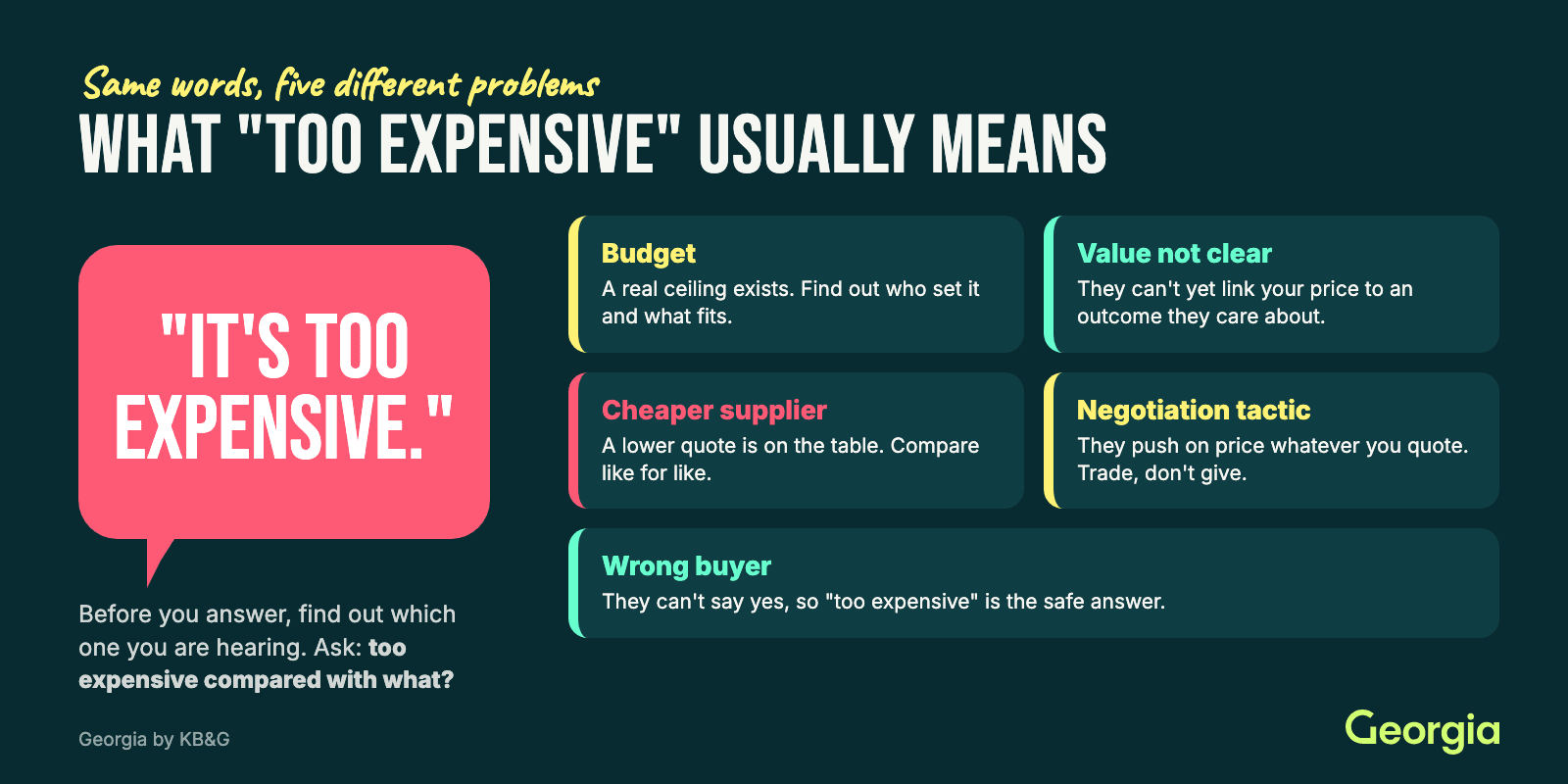
| Type of objection | What it really means | What to ask | What to say |
|---|---|---|---|
| Budget | There is a real ceiling, and your number is above it. | "What budget has been set for this, and who set it?" | "Let's see what fits inside that number by changing scope or timing." |
| Value not clear | The buyer does not yet connect your price to an outcome they care about. | "Compared with what you get, which part feels overpriced?" | "What does a delayed pour or a failed rollout cost you today?" |
| Cheaper supplier | They have a lower quote and want to know why yours is worth more. | "Is their quote for exactly the same scope, delivery and terms?" | "Let's compare like for like before we talk numbers." |
| Negotiation tactic | They will push on price whatever you quote. It is part of their job. | "If price were where you need it, is there anything else stopping us?" | "If we change volume, terms or timing, the number can change." |
| Wrong buyer | The person in front of you cannot say yes, so "too expensive" is the safe answer. | "Who else will weigh in on this decision?" | "Shall we walk your finance lead through the numbers together?" |
Most real objections are a mix. The point is to ask before you answer.
How to Handle a Price Objection, Step by Step
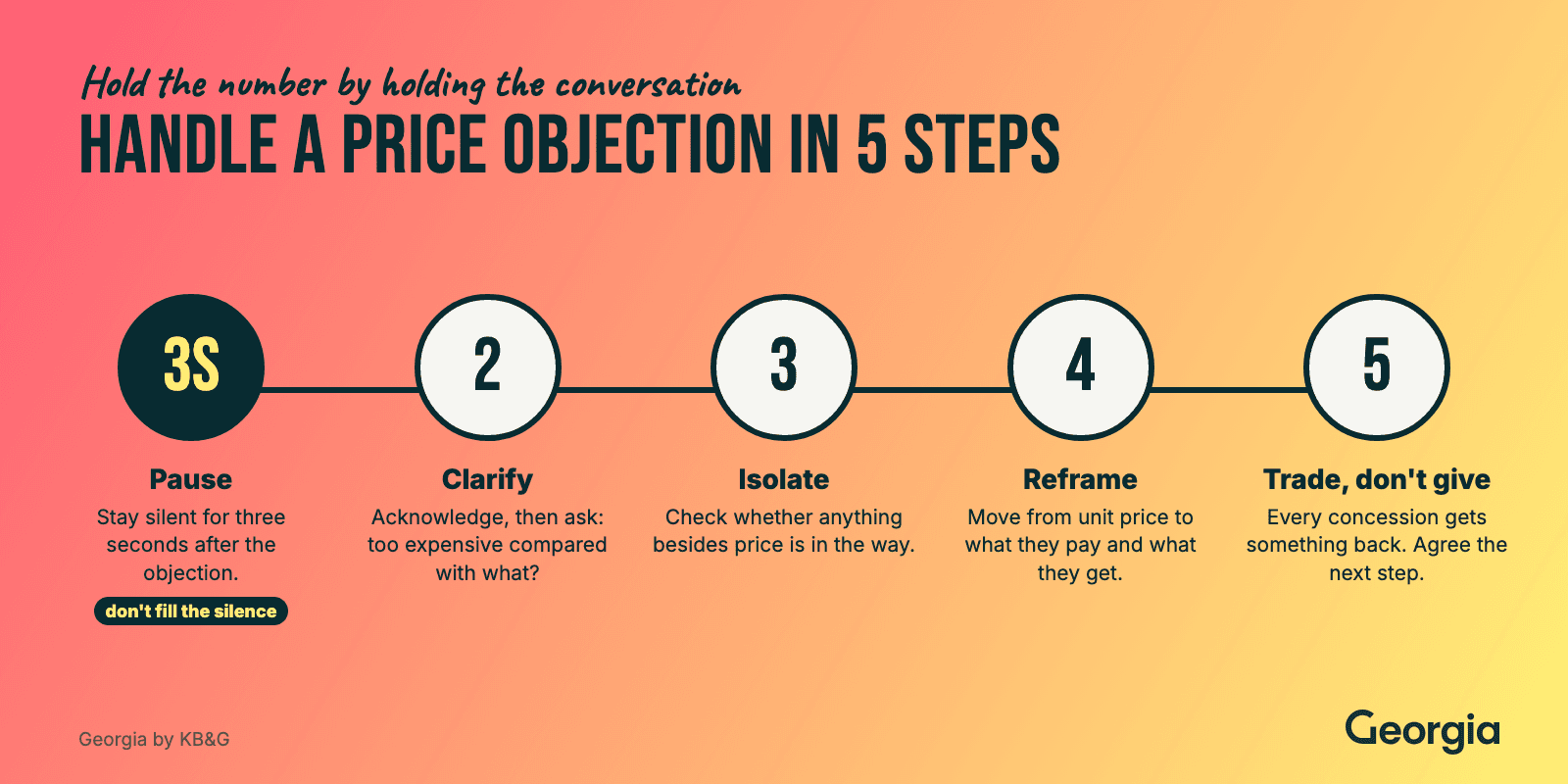
- Pause. Say nothing for three seconds. You are not conceding; you are giving the buyer space to add something, and they often do ("we've only got so much left on this job").
- Acknowledge and clarify. "That's fair to raise. Too expensive compared with what?" One neutral question tells you which type you face.
- Isolate. "Apart from price, is there anything else that would stop us going ahead?" If the answer is yes, price is not the real objection, and discounting will not close the deal.
- Reframe on total cost and value. Move the conversation from unit price to what the buyer actually pays and gets: delivery reliability, rework, downtime, implementation time, risk.
- Trade, don't give. If something has to move, it moves in exchange for something. Then agree a clear next step before the call ends.
There is no step where you lower the price to see what happens. Holding the number means holding the conversation: while you are asking questions, you are not discounting.
Exact Phrases for the Two Hardest Moments
"The other supplier is cheaper"
This is the most common B2B price objection in industrial buying. Say you supply ready-mix concrete and a contractor tells you the plant across town is €6 a cubic metre cheaper on a 3,000 m³ job. That is €18,000, and it sounds decisive. It usually is not, because the two quotes are rarely for the same thing.
- "Thanks for telling me. Can I ask what's included in their price: delivery windows, pump hire, testing, wait time on site?"
- "If their trucks arrive an hour late on a pour day, what does that cost you in crew time?"
- "I'm not going to pretend we're the cheapest. What I can tell you is what you get for the difference, and you can judge whether it's worth it."
For a SaaS founder, "Tool X is half your price" often hides months of setup or a seat model that doubles next year. Ask before you defend anything.
"Can you do better on price?"
This is often a reflex, not a demand. Your answer should cost them something too.
- "That's the price for this scope. What would you want to change to get to a different number?"
- "I could look at it if we moved to a two-year term. Is that something you'd consider?"
- "If you can commit the full volume for the season now, I can talk to my side about the rate."
Then stop talking. The pause after your answer matters as much as the answer.
Trade Concessions Instead of Giving Discounts
A discount given for nothing teaches the buyer that pushing works. A concession traded for something (the give-get) teaches them that every change has a price. Before any negotiation, write two short lists:
- What you can give: rate per unit, payment terms, delivery flexibility, onboarding hours, a longer price lock, an extra user tier.
- What you want back: a longer contract, larger committed volume, faster payment, a case study or reference, a signature by a specific date, a wider scope.
Rank both lists by what each item costs you and what it is worth to them. The best trades are cheap for you and valuable for the buyer. Extended payment terms might cost a large supplier little but matter a lot to a contractor with tight cash flow.
Always phrase concessions as conditional: "If you can do X, then I can do Y." Never the other way round. And make every concession smaller than the last, so the buyer can see you are approaching your limit.
The arithmetic is why this matters. Say your list price is €40,000 and your gross margin is 25%, so you keep €10,000. A 5% discount takes €2,000 off the price and all of it comes out of your margin: you now keep €8,000. To earn the same €10,000 of gross profit, you need to sell 25% more. A small discount on price is a big discount on profit.
How to Quote Without Giving Away Margin
Many price objections are set up by the quote itself.
Anchor deliberately. The first number in a negotiation shapes everything after it. A 2025 meta-analysis of 90 studies with more than 16,000 participants, led by researchers at Leuphana University with co-authors including Adam Galinsky, found a correlation of 0.62 between the size of the first offer and the final agreement. The same research found the limits: very ambitious first offers led to more impasses and left the other side feeling worse, and the effects were smaller in complex, multi-issue deals. Anchor confidently, with a number you can explain, not one designed to shock.
Consider a narrow range. Columbia Business School researchers Daniel Ames and Malia Mason ran five studies on range offers and found that people who opened with a "bolstering" range (their real target plus a little above it) got better deals than those who named a single number, without being seen more negatively. In practice: "For this volume, we're typically between €40,000 and €43,000, depending on delivery schedule."
Quote options, not one number. Three packages (for example standard delivery, priority delivery, and priority with on-site support) move the question from "is this too much?" to "which one fits?". If the buyer wants the lower price, they take the smaller scope. You never cut the price of the same thing. If you are a founder still working out your tiers, our guide to SaaS pricing strategy goes deeper on packaging.
Know your floor before you send it. Write down your walk-away price and terms. If you cannot write it down, you are not ready to negotiate.
What to Do After the Call
- Send a short recap the same day. Restate scope, price and next steps. Do not reopen the price in writing unless you are trading something.
- Follow up on the bid with value, not a discount. "Following up on the quote" invites "any movement on price?". Instead, send something useful: a delivery plan for their programme, an answer to a question they raised, a comparison of what is included.
- Log the objection type. Note which of the five it was and what worked. Over a quarter, the pattern shows whether the gap is value, targeting or confidence.
- Review your discounts. Look at what you gave, what you got for it and whether the buyer asked first. This belongs in the objection handling section of your startup sales system playbook, not in someone's memory.
Practise Before the Live Call
All of this is easy to agree with and hard to do when a buyer you need says "that's too much". The pause, the clarifying question and the conditional trade have to be habits, and habits come from repetition, not from reading a script.
That is why we keep returning to sales role-play training: short, specific rehearsals of the exact moments that cost you margin. Pick one objection type, one skill (say, "ask two questions before mentioning price") and run it until it feels boring. If you are building a programme for a whole team, our guide on how to train a sales team covers how to fit this into a weekly rhythm.
If your reps need more repetitions than a manager has time to give, Georgia by KB&G is an AI role-play coach built with trainers from mining, building materials and construction. Its 3 to 8 minute self-paced sessions include scenarios like holding price when a contractor leans on you, quoting without giving away margin, answering "the other supplier is cheaper" and following up on a bid, with real-time coaching and alternative phrasing as you go.
Frequently Asked Questions About Price Objections
What is the best response to "your price is too high"?
A short pause, then a neutral question: "Too high compared with what?" The answer tells you whether you are dealing with a budget limit, unclear value, a cheaper competitor, a negotiation tactic or the wrong buyer. None of them starts with a discount.
Should I ever give a discount?
Yes, but only in exchange for something of real value to you: a longer term, a bigger committed volume, faster payment, a reference or a firm signing date. A discount for nothing trains buyers to push harder next time and, as research on reference discounts suggests, makes your next discount larger too.
How do I handle B2B price objections from procurement teams?
Expect them, and do not take them personally: pushing on price is part of a procurement lead's job. Make sure the quote separates price from scope, find out who else is involved in the decision, and offer options rather than defending a single number.
How is handling the "too expensive" objection different for a founder?
Founders often discount because every deal feels existential and they set the price themselves, so a cut feels harmless. It is not: early discounts become your reference price for future customers. Decide your floor and your give-get list before the call.
Related Reading
- Sales Role Play Training: How to Build Reps Who Don't Freeze on Real Calls
- Startup Sales System: How to Turn Founder Hustle into a Repeatable Machine
- Sales Training ROI: How to Know If Your Sales Training Is Actually Working
- SaaS Pricing Strategy: How Early-Stage Founders Should Price, Package, and Test