
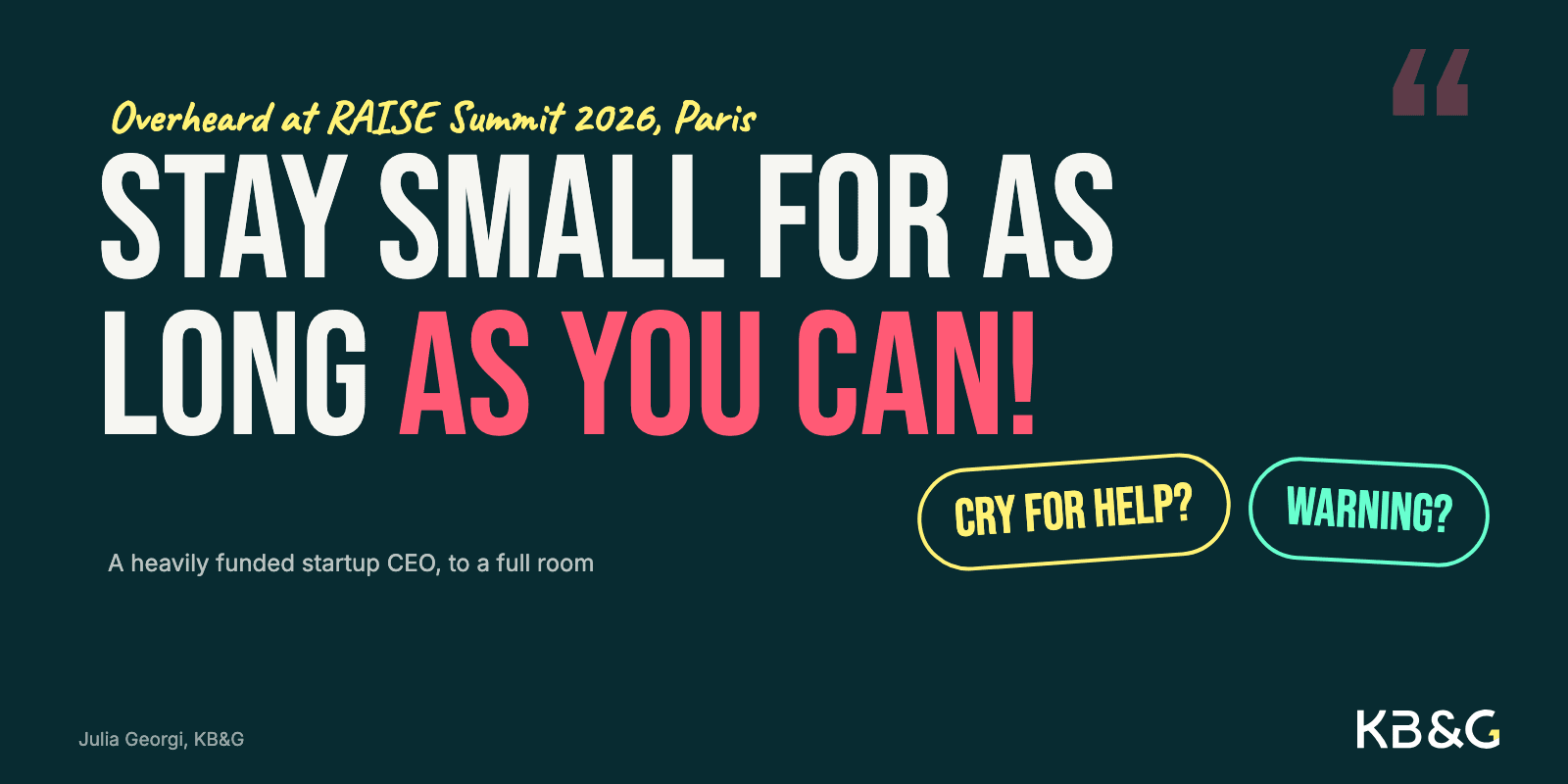
At RAISE Summit 2026 in Paris, the CEO of a heavily funded startup told the room: "Stay small for as long as you can!"
I wrote it down and have been chewing on it ever since. Was it a cry for help? Was it a warning? Coming from someone who had raised more money than most founders ever will, it was not the line I expected.
It is also the most useful sentence I have heard about how to fund a mining tech startup. So this post uses it as a thread.
What is the best way to fund a mining tech startup?
For most mining tech startups, the best funding order is customer money first (paid pilots), then non-dilutive grants and R&D tax credits, then a small equity round, ideally with a miner or equipment maker following rather than leading. Large venture rounds fit capital-intensive plays that must build a plant or own an asset. Everyone else should raise only what their sales cycle can survive.
That is the short answer. The rest of this post is about why, and how to sequence it.
Why would anyone tell founders to stay small?
Because big money is not free. It arrives with a plan attached, and the plan is usually growth on the investor's timetable, not the customer's.
Raise a large round and three things happen. Your burn rises to match it. Your board expects the next milestone before the next round. And you start hiring sales people for a market that buys at the speed of a safety committee.
In most software markets that pressure is survivable. In mining it is dangerous, because the buyer's clock and the investor's clock run at very different speeds.
Investors know this. Angel investors and VC fund managers have described the mining tech sales cycle as "too long and therefore too risky to invest in", according to Canadian Mining Journal (August 2023). Ian Rountree of Cantos was blunter: "If your customer's sales cycle is longer than 18 months, you are de facto dead" (Latitude Media, 8 January 2026).
Now compare that with what mining actually does. Komatsu's autonomous haulage went from trials at Codelco in 2005 to commercial launch in 2008, roughly three years, and that was a product from one of the largest equipment makers on earth (IISD/IGF, December 2025).
And conversion is not guaranteed even when you get in. Canada's MICA programme reports that of 70 projects it supported over five years, 21 reached commercial deployment, about 30% (Canadian Mining Journal, 30 March 2026). That figure is self-reported by the programme, and it has no timelines attached, but it is the best public funnel we have.
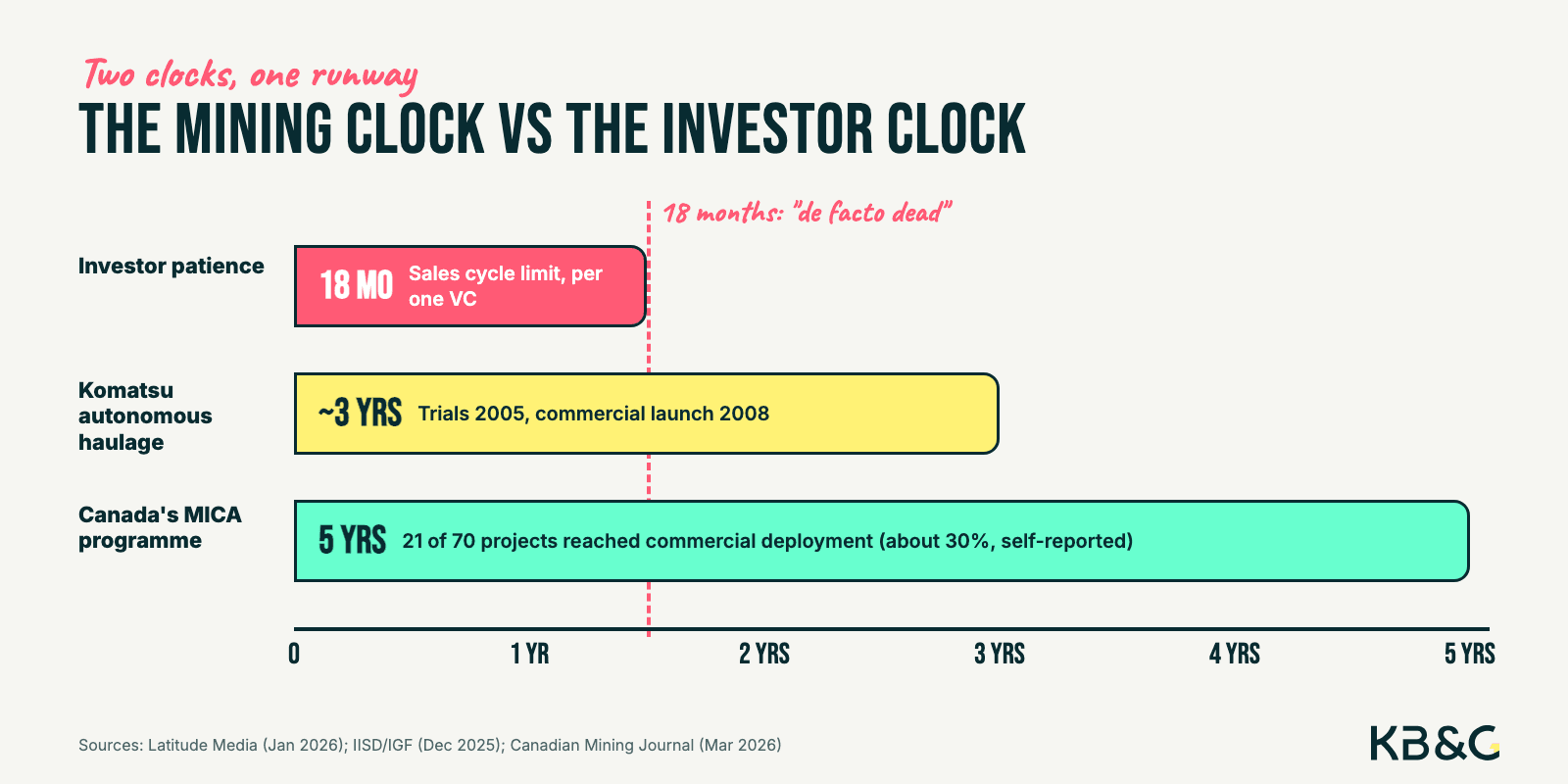
Put those together and the maths is unkind. If your runway is 18 months and your buyer needs three years, a big round does not buy you time. It buys you a faster way to run out of it.
What funding options does a mining tech startup actually have?
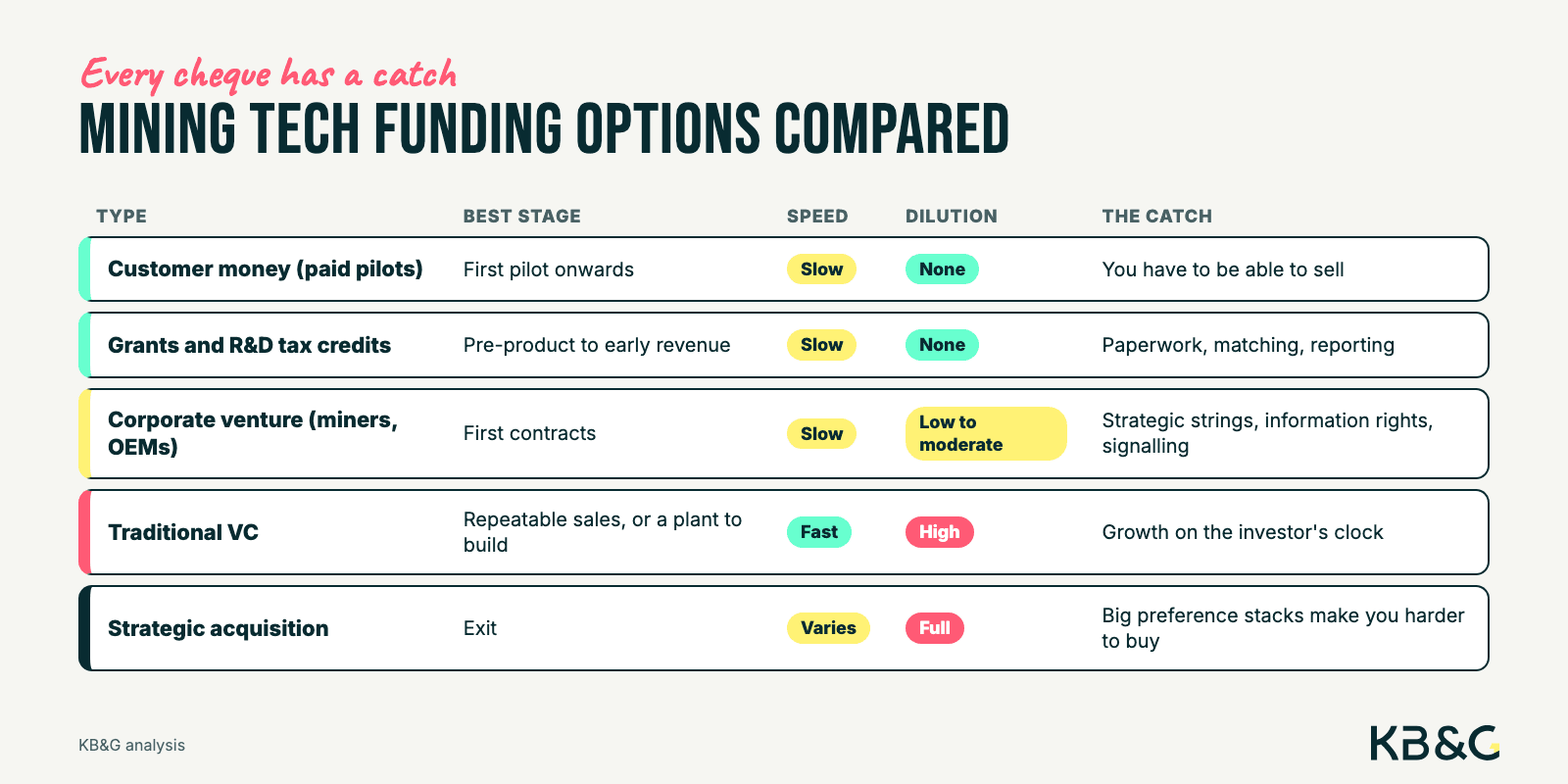
Five, broadly. Each has a catch, and the catch matters more than the cheque size. (For who is writing the cheques right now, see our companion piece on mining tech funding in 2026.)
1. Customer money: paid pilots and early contracts
This is the cheapest capital you will ever raise. It costs no equity and proves the one thing every later investor will ask about: will a mine pay for this?
Investors say so openly. Mark Frayman of Orion Industrial Partners, formerly head of BHP Ventures, told InvestMETS (12 August 2024) that customer adoption risk sits "on top of" technology risk, that investors want pilots "to be paid pilots", and that traction comes from "plug and play" technologies.
An unpaid pilot is a donation with a logo. A paid one is a signal. Price it, scope it, and agree in writing what success looks like and what happens next if you hit it. We wrote about the other side of this in pilot purgatory.
The catch: it is slow, and you have to be able to sell. If you cannot, read how to sell software to mining companies before you read a term sheet.
2. Non-dilutive funding: grants, loans and tax credits
Governments are spending heavily on critical minerals, and some of that money reaches startups directly. The trick is picking programmes that fit what you actually build, rather than bending your roadmap to fit a call.
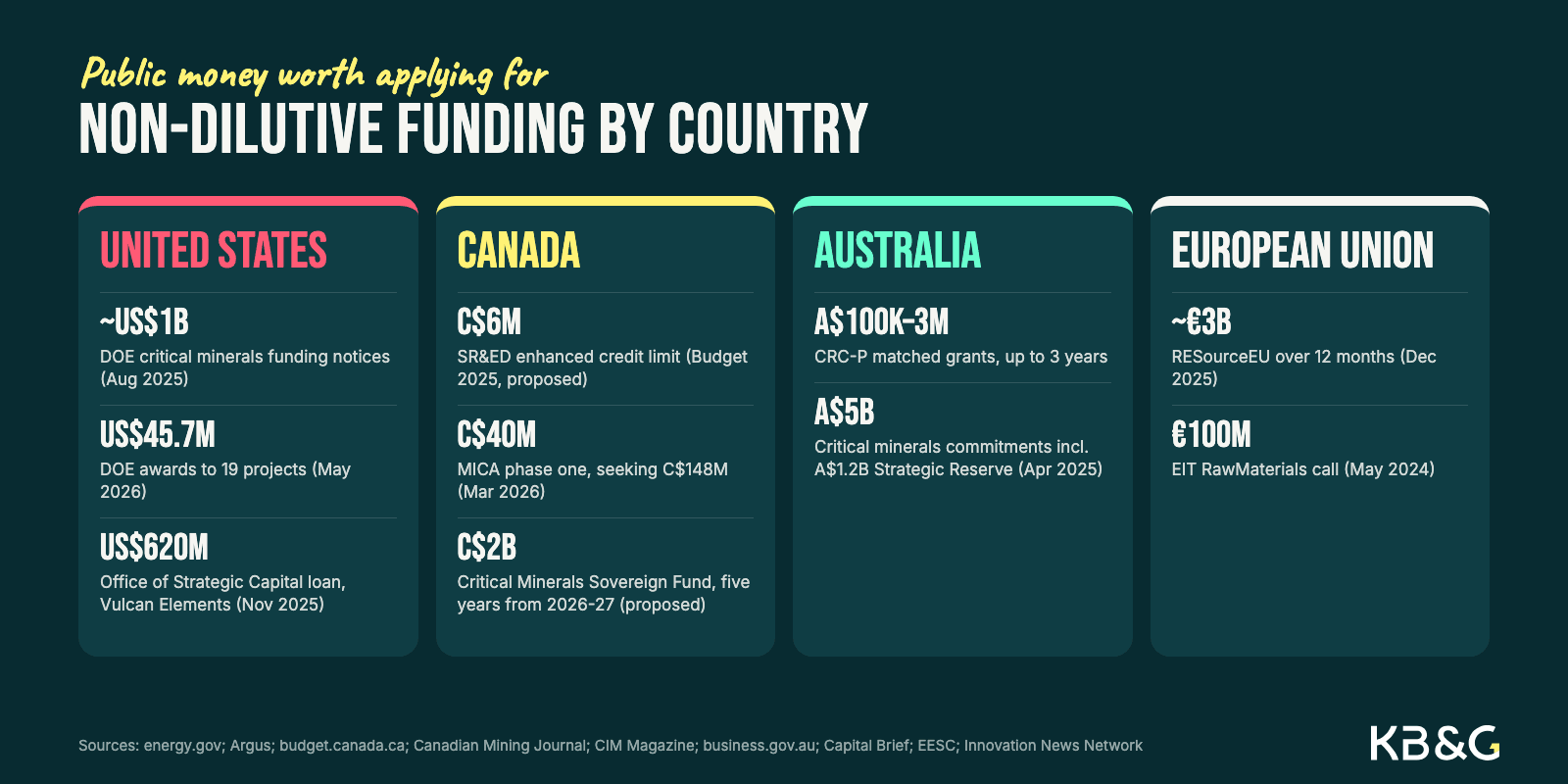
In the US, the Department of Energy announced "nearly $1 billion" in critical minerals and materials funding notices on 13 August 2025, including a US$50M accelerator, and in May 2026 awarded US$45.7M to 19 projects under its critical materials programme (energy.gov). At the heavy end, the Office of Strategic Capital offered conditional loans of US$620M to Vulcan Elements and US$80M to ReElement (Argus, 21 November 2025).
In Canada, Budget 2025 proposed raising the expenditure limit for the enhanced 35% refundable SR&ED credit to C$6M (Budget 2025 tax measures). MICA ran its first phase on C$40M and is seeking C$148M for a second (Canadian Mining Journal, March 2026). Budget 2025 also proposed a C$2B Critical Minerals Sovereign Fund over five years from 2026-27 (CIM Magazine, November 2025).
In Australia, CRC-P grants offer matched funding of A$100k to A$3M for up to three years; Round 19 closed on 12 May 2026 and included up to A$20M for AI projects (business.gov.au). For project builders, the government's critical minerals commitments total A$5B, including a A$1.2B Strategic Reserve (Capital Brief, April 2025).
In the EU, RESourceEU brings about €3B over 12 months from EU budgets, the EIB and Horizon Europe, adopted in December 2025 (EESC). EIT RawMaterials launched a €100M call for high-impact projects in May 2024 (Innovation News Network, 16 May 2024).
The catch: paperwork, matching requirements and reporting. Grants are slow money too. They reward patience, which is rather the point of staying small.
3. Corporate venture capital from miners and OEMs
Corporate venture capital in mining is real but modest. BHP Ventures has made about 30 investments from BHP's own balance sheet (Capital Brief, 4 December 2025). Vale Ventures launched with a US$100M commitment (Vale). Caterpillar Ventures deployed more than US$50M last year, with average tickets "trending toward $5m" (Global Corporate Venturing, 22 June 2026).
The attraction is obvious: site access, data, and a buyer who already knows your name. The catches are less obvious.
- Strategic strings. A miner investing in you may expect early access, preferred terms or a say in your roadmap.
- Information rights. Your board pack now travels to a company that may compete with, or buy from, your other customers.
- Signalling. Rival miners may read one miner's stake as a reason not to buy from you.
- Slower decisions. Corporate investment committees answer to corporate calendars.
- Units get cut. Anglo American scaled back its decarbonisation venture unit in December 2024 as part of "portfolio simplification" (Global Corporate Venturing, 3 December 2024).
Our view: let corporate venture follow, not lead. BHP Ventures took a strategic stake alongside Khosla Ventures in Terra AI's US$20M raise in June 2026 (Terra AI release). That is the healthy pattern.
4. Traditional venture capital
VC fits a specific shape of company: one that must spend heavily before it can sell anything, and that can plausibly become very large. Think refineries, processing plants, exploration companies that own the asset. For those models, Frayman's question in the same InvestMETS interview is the right one: "is project-finance available?"
For software and services sold into operating mines, VC fits later than most founders think. Raise after you have paid customers and a repeatable sale, not to discover whether you have one.
5. Strategic acquisition, the exit nobody puts in the deck
Equipment makers in mining tend to buy rather than invest. In 2025 Caterpillar bought RPMGlobal for US$735M and Weir bought Micromine for US$800M (InvestMETS, 9 January 2026).
That matters for funding. If your likely exit is a strategic buyer, a modest cap table and real revenue make you easier to buy. A huge preference stack makes you harder.
Which money fits your stage?
Start with what you need to prove next, not with who is offering money. These questions do most of the sorting.
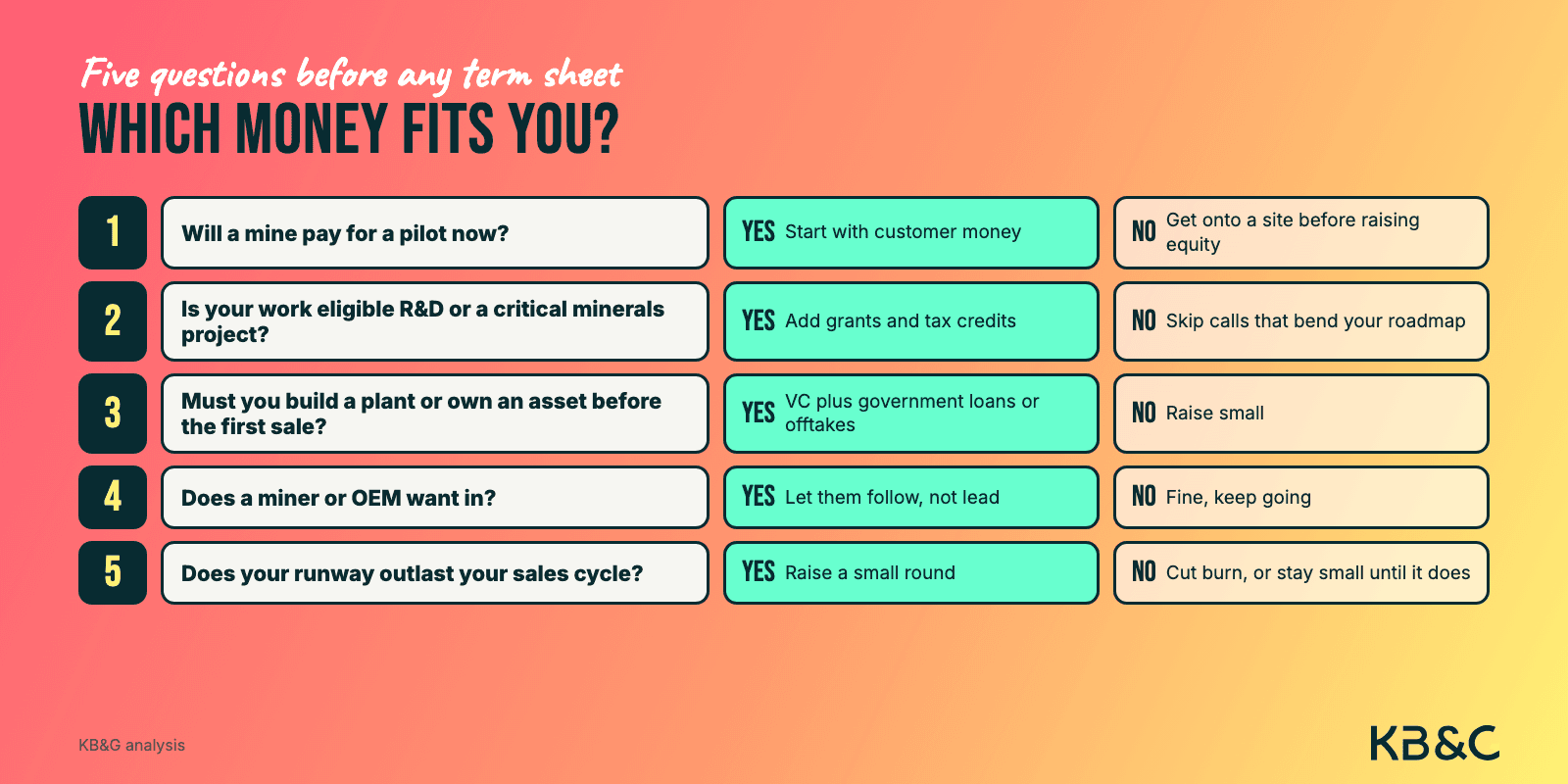
- Pre-product: grants, R&D tax credits, founder money. Use the time to get onto a site.
- First pilot: customer money. Paid, scoped, with a conversion clause.
- First contracts: a small round, possibly with a corporate investor following.
- Repeatable sales or a plant to build: venture capital, plus government loans or offtakes if you are capital-intensive.
How do you stay small on purpose?
Staying small is not the same as staying poor. It is sequencing: raising each kind of money when it is cheapest for you.
- Paid pilot first. It funds the work and creates the evidence.
- Grant or tax credit next. Use the pilot as proof for the application and let public money fund the next stage of R&D.
- Small round last. Raise enough to cover a full sales cycle with margin, not enough to hire ahead of demand.
Then keep burn low enough that a slow procurement process is an inconvenience, not an extinction event. If growth has stalled despite all this, the problem is usually not money; see why your startup is not growing.
What should you prepare before asking anyone for money?
- Your real sales cycle. Measured from first meeting to signed purchase order, not to "positive feedback".
- Pilot economics. What the mine pays, what it costs you, and what converts it into a contract.
- Vendor readiness. Safety, insurance and onboarding paperwork; mines will ask, so read up on mining vendor prequalification.
- Eligible R&D records. Tax credit claims live or die on contemporaneous records.
- A runway that outlasts the sales cycle. If it does not, fix that before you fix anything else.
So was it a cry for help or a warning?
I think it was both.
A cry for help, because it sounded like someone living with the weight of the money: the burn, the board, the next milestone. Big rounds are celebrated in public and carried in private.
A warning, because the rest of us still get to choose. Nobody forces a mining tech founder to raise on an 18-month runway against a three-year buyer.
What founders should take from it: capital is a tool with a clock inside it. Pick money whose clock matches your customer's. Start with customers, add public money, raise small, and only go big when the business genuinely needs a plant, not when the market merely has a mood.
If you are building an AI product for industry and want a partner rather than a cheque, KB&G's Innovation Studio co-builds AI products with founders. And if you suspect something other than funding is holding you back, the Founder Blind Spot Diagnostic reads your startup in 14 days and names the one thing blocking growth (EUR 750, fully refundable).
Frequently Asked Questions
Are there grants for mining technology startups?
Yes. Examples include US Department of Energy critical minerals funding notices, Canada's SR&ED tax credit and the MICA programme, Australia's CRC-P grants (A$100k to A$3M, matched) and EU funding through RESourceEU and EIT RawMaterials. Check eligibility carefully: many large programmes target processing projects rather than software.
Should a mining tech startup take money from a miner's venture arm?
Often yes, but as a follower in a round led by someone else. Corporate venture brings site access and credibility, and also information rights, signalling risk and slower decisions. Anglo American's cutback in December 2024 shows these units can change direction.
How long is the sales cycle in mining?
There is no reliable public average. One well-documented case, Komatsu's autonomous haulage, took about three years from trial (2005) to commercial launch (2008). Investors warn that cycles longer than 18 months are fatal for a typical venture-backed runway.
When does venture capital make sense for a mining tech startup?
When you must spend heavily before your first sale, such as building a plant or owning an asset, or when you already have paid customers and a repeatable sale. Before that, customer money and non-dilutive funding are usually cheaper.