
Ask a salesperson how to handle a price objection and most will give a textbook answer: pause, ask what "too expensive" means, find out what the customer is comparing against, then talk about value. Then a real customer says "that's too expensive" and the same person defends the price, talks for two minutes without stopping, or offers a discount just to make the moment end.
That is not a knowledge problem. The person knew the answer. It is a problem of applying a skill under pressure, and it has a name: the knowing-doing gap.
This article covers where the term comes from, what training transfer research says about why training often doesn't change behaviour, why pressure pulls people back to their defaults, how to see the gap, and how to close it.
What Is the Knowing-Doing Gap?
The knowing-doing gap is the distance between what people know they should do and what they actually do. The term comes from Stanford professors Jeffrey Pfeffer and Robert I. Sutton, whose book The Knowing-Doing Gap: How Smart Companies Turn Knowledge into Action was published by Harvard Business School Press at the end of 1999.
Pfeffer and Sutton were writing about organisations: why companies that know what works still fail to act on it. The barriers they describe include talk that substitutes for action (plans, meetings and presentations treated as if they were the work), fear, destructive internal competition, and measuring the wrong things.
The same pattern shows up in a single person in a single conversation. A rep who has sat through a training program on objection handling has the knowledge. What they lack is the behaviour when a real person pushes back. Better training materials don't fix that, because the missing piece was never information.
Why Doesn't Training Change Behaviour?
Training often doesn't change behaviour because learning something in a training context and using it on the job are two different events, and the second one depends on far more than the course. Researchers call the second event training transfer.
The classic definition comes from Timothy Baldwin and Kevin Ford's 1988 review in Personnel Psychology. They described the conditions of transfer as two things: generalisation of what was learned to the job, and maintenance of the trained skills over time. In short, it is the degree to which trainees effectively apply the knowledge, skills and attitudes gained in training to their work. Baldwin and Ford grouped the influences on transfer into three areas: trainee characteristics, training design and the work environment.
How much actually transfers? Less than most managers assume, and less precisely than most articles claim. In a survey published by Alan Saks and Monica Belcourt in 2006, training professionals from 150 organisations reported that 62% of employees apply training material on the job immediately after training, 44% after six months and 34% after one year.
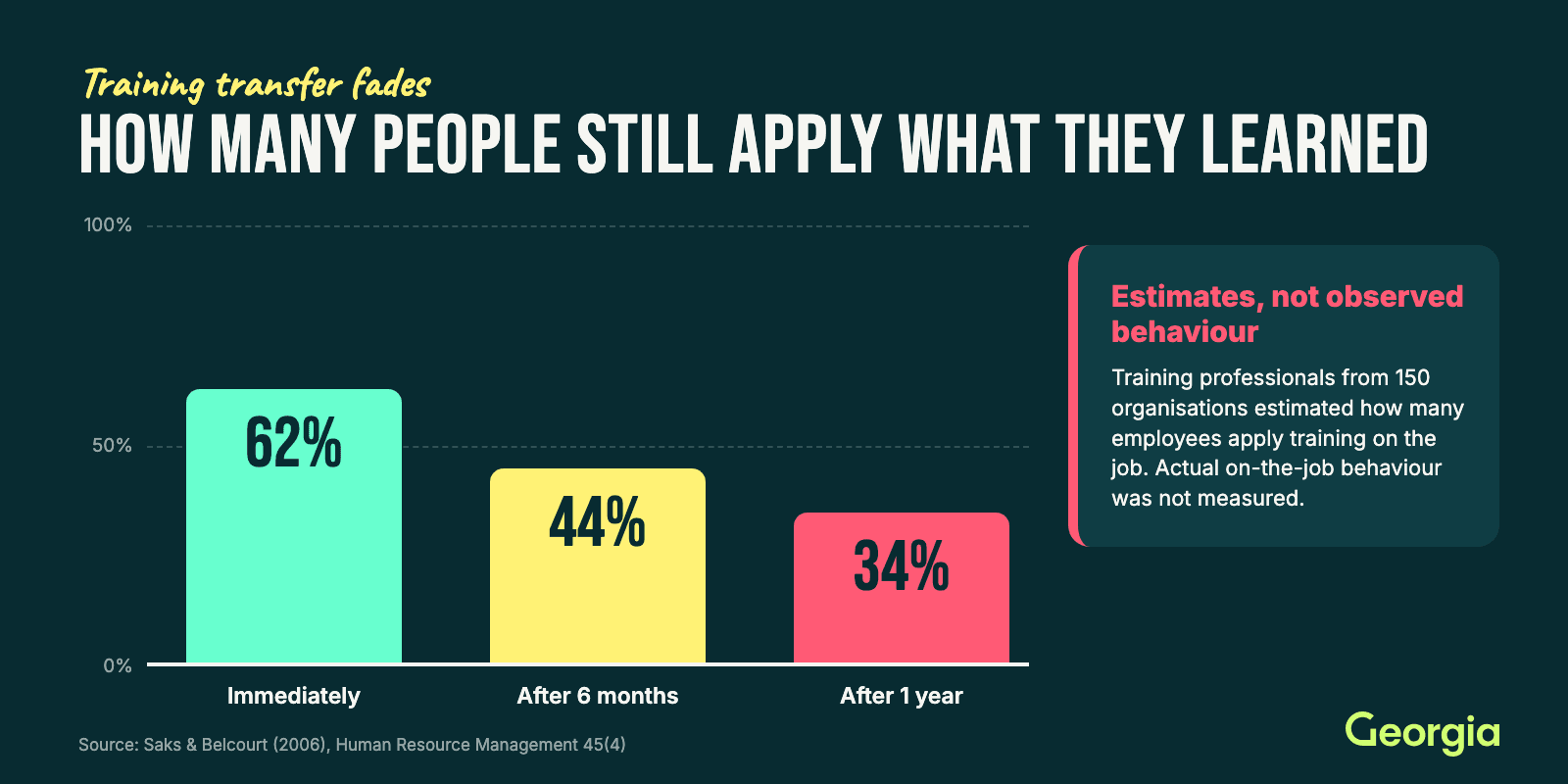
Two cautions. Those figures are estimates by training professionals, not observed behaviour. And the often-quoted claim that only 10% of training transfers has, according to Ford, Yelon and Billington, no solid empirical basis. The honest summary: a large share of trained skills fade or never show up at work, and nobody has a precise number.
The biggest research synthesis to date is Blume, Ford, Baldwin and Huang's meta-analysis of 89 empirical studies. It confirmed positive relationships between transfer and cognitive ability, conscientiousness, motivation and a supportive work environment. One finding matters a lot for sales and supervisory skills: most predictors had stronger relationships with transfer for open skills, such as leadership, than for closed skills, such as using a piece of software. Open versus closed skills is the key distinction here. A software procedure is the same every time. A price objection never is.
A plain-language summary of this research by the Quality Improvement Center for Workforce Development, written for human services agencies, adds a few useful findings:
- Trainee factors: learning goal orientation, job involvement and greater knowledge post training are linked to more transfer. In Gegenfurtner et al., mastery avoidance goals and performance avoidance goals hurt it.
- Work environment characteristics: Hughes et al. found that supervisor, peer and organisational support, coaching and feedback, and even facing supervisor sanctions improve transfer by increasing trainee motivation. A positive transfer climate matters.
- Training design features: voluntary participation and a learner-centred approach are linked with better transfer.
The research also separates maximum versus typical transfer. In Huang et al. (2015), maximum transfer is what trainees can do when prompted to give their best effort. Typical transfer is what they will do on an ordinary day, unprompted. The knowing-doing gap lives in the space between the two. Near transfer (applying a skill to highly similar job tasks) is easier than far transfer (applying it to a situation that looks different), and a live customer conversation is almost always further from the classroom than it seems.
If you want the cost side of this, including the forgetting curve and why one-off workshops underperform, we covered it in Sales Training ROI. This article is about a narrower problem: the skill that is still there, but doesn't show up when it counts.
Why Does Pressure Trigger Old Defaults?
Pressure triggers old defaults because stress weakens the brain systems that run deliberate, effortful behaviour, and newly learned skills depend on exactly those systems.
Neuroscientist Amy Arnsten's review in Nature Reviews Neuroscience describes the prefrontal cortex, which supports our highest-order thinking, as the brain region most sensitive to stress. Even quite mild, acute, uncontrollable stress can cause a rapid loss of prefrontal abilities. A customer pushing back on price is uncontrollable in the moment, and that is enough.
What does the brain fall back on? Whatever is most practised. Research on choking under pressure makes this concrete. In experiments by Sian Beilock and colleagues, pressure harmed maths performance only on unpractised problems that demanded heavy working memory. When problems had been practised until the answers came straight from memory, choking disappeared. Problems practised once or twice still fell apart under pressure; problems practised 50 times did not.
The lesson travels beyond maths. A skill used twice in a role-play is a high-demand, unpractised response. Defending the price or giving ground is a response rehearsed for years. Under extreme pressure, or just during high pressure periods like quarter-end, the rehearsed response wins.
We looked at the same mechanism from the founder's side in Founder Behaviour Under Pressure. External pressures such as targets add to it, but the core problem is a new skill never practised enough to survive stress.
What the Knowing-Doing Gap Looks Like in Practice
The gap looks like a competent person doing something they would criticise if they watched it on video. Two hypothetical examples show the pattern.
A sales example: "That's too expensive"
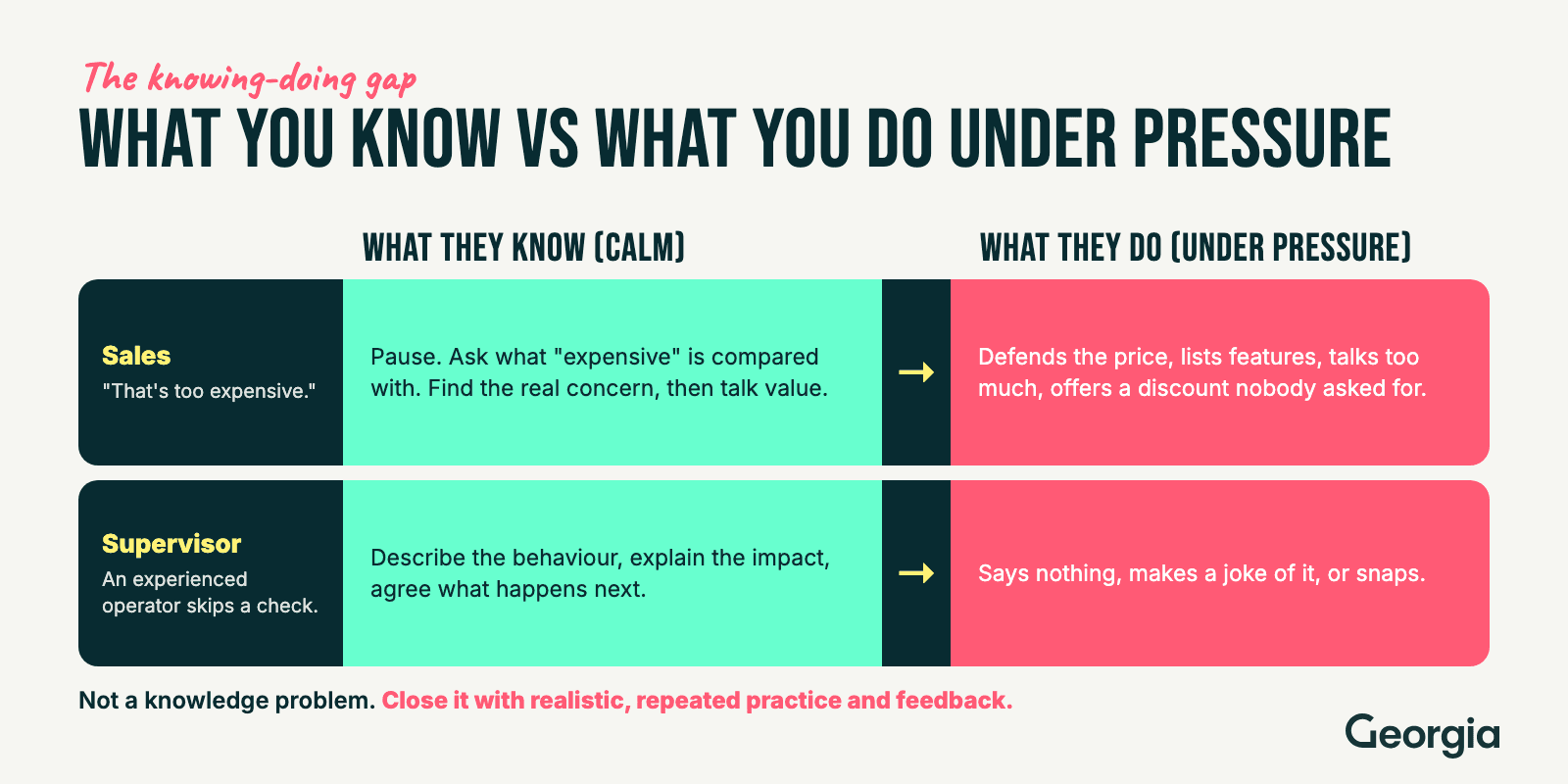
Imagine an account manager selling equipment to a construction firm. In training, she correctly explained that a price objection is a request for information, and that the first move is a question. On a real call, the buyer says the quote is well above a competitor's. She feels the deal slipping. Within a minute she is listing features, explaining the cost of materials and, before the buyer has asked, saying she can "look at the numbers".
She knew every step. The pressure moment fired her default: justify, then concede. Our guide to handling price objections covers what to say instead. Knowing what to say is the easy part.
A frontline example: the supervisor and the standards slip
Now imagine a newly promoted shift supervisor. He has completed a course on feedback: describe the behaviour, explain the impact, agree what happens next. On a busy shift he sees an experienced operator, his peer a month ago, skip a check. He says nothing, makes a joke, or snaps. None of those is what he was trained to do, and all of them feel safer in the moment than a calm, direct conversation.
We wrote about why managers avoid these conversations in Manager Stress.
How Do You See the Knowing-Doing Gap?
You see the knowing-doing gap by watching what people do in a realistic situation, not by asking them what they would do. Self-report measures the knowing side. It cannot measure the doing side.
In the Blume et al. meta-analysis, transfer relationships were consistently inflated when outcomes were measured by the same source in the same measurement context, such as trainees rating themselves straight after a course. Other report measurement methods, such as manager observation, recorded calls or simulation, give a more honest picture. A post-course knowledge test tells you almost nothing about the next hard call.
Practical ways to assess transfer potential and the actual gap:
- Listen to real calls or meetings. Find the moment pressure arrives and note the person's first move.
- Run a short, realistic simulation. Use a real objection and a buyer who doesn't follow a script.
- Compare typical and maximum transfer. If someone handles the scenario well when told it is a test, but not on ordinary calls, the skill exists but isn't yet automatic.
- Assess the transfer climate. A rep praised for "saving" a deal with a discount learns that the discount works.
Fields where mistakes are costly, such as aviation, emergency rooms and policing, lean heavily on simulation for the same reason: how someone says they would act under stress is a weak guide to how they actually will.
How to Close the Knowing-Doing Gap
You close the knowing-doing gap by practising the specific behaviour, under conditions that feel like the real moment, often enough that it becomes the default, with feedback after each attempt. More information does not help. More repetitions of the right kind do.
1. Practise the pressure moment, not the topic
Pick the few moments where the gap costs most: "that's too expensive", "the other supplier is cheaper", the first 30 seconds of a hard conversation with a crew member. Hands-on tasks and scenario-based demonstrations beat lectures here, because they rehearse the behaviour, not the explanation.
2. Make it realistic enough to be slightly uncomfortable
If practice is too easy, it trains maximum transfer, not typical transfer. Stress exposure helps. A meta-analysis of stress inoculation training by Saunders, Driskell, Johnston and Salas, covering 37 studies and 1,837 participants, found it reduced performance anxiety and improved performance under stress, with no significant limits on applying it in workplace training settings.
3. Repeat it in short, spaced sessions
As the Beilock findings suggest, a response practised many times survives pressure. Short sessions spread over weeks build that repetition without taking people away from their job tasks. Our guide to sales role-play training covers how to structure them.
4. Give specific feedback after every attempt
This is the core of deliberate practice, the idea from Ericsson, Krampe and Tesch-Römer (1993): structured activities designed to improve a specific aspect of performance, with feedback and repetition. Keep expectations honest: a later meta-analysis by Macnamara, Hambrick and Oswald found deliberate practice explained 26% of the variance in performance in games, 21% in music, 18% in sports, 4% in education and less than 1% in professions. Practice matters, but at work the environment matters too.
5. Show good and bad examples, and train the managers too
A meta-analysis of 117 behaviour modelling training studies by Taylor, Russ-Eft and Chan found that knowledge effects decayed while effects on skills and job behaviour held or grew. Transfer was greatest when trainees saw both positive and negative models, practised with scenarios they generated themselves, set goals, had superiors who were also trained, and worked in an environment with rewards and sanctions. If a manager discounts on every call, the team will too.
6. Treat it as continuous learning, not an event
A one-off course rarely shifts a default that took years to form. Build a few minutes of practice into the normal week, before a pricing call or at the start of a shift, and treat it as workforce development rather than a separate human resources initiative.
Where Georgia Fits
Practising pressure moments is hard to organise: managers rarely have time to play the difficult customer every week. Georgia by KB&G is an AI role-play coach built with sector trainers. Sessions take 3–8 minutes, are self-paced and give real-time coaching. Scenarios include holding price, price objections, "the other supplier is cheaper" and supervisor conversations: the moments where the knowing-doing gap tends to show.
Frequently Asked Questions About the Knowing-Doing Gap
What does the knowing-doing gap mean?
It is the gap between knowing what to do and actually doing it. Pfeffer and Sutton coined the term for organisations that know what works but fail to act on it. It applies equally to individuals who know a skill but fall back on old habits under pressure.
What does training transfer mean?
Training transfer is the degree to which people apply the knowledge, skills and attitudes gained in training to their actual work, and keep applying them over time. Baldwin and Ford's 1988 review set out this definition, covering generalisation and maintenance.
What are the different types of training transfer?
The research distinguishes maintenance versus generalisation (does the skill last, and does it work in new situations), near versus far transfer (similar tasks versus different ones) and typical versus maximum transfer (what people do normally versus what they can do when prompted).
What three factors are critical for transfer of training to occur?
Baldwin and Ford grouped them as trainee characteristics (such as ability and motivation), training design (such as realistic practice and feedback) and the work environment (such as manager support and a positive transfer climate).