
What Is Sales Onboarding at a Startup?
Sales onboarding is the process of getting a new sales rep from their first day to selling on their own: knowing the customer, the product, the sales process and the conversations that win or lose deals. At a large company that means a sales onboarding program run by sales managers and a sales enablement team. At a startup it usually means the founder, a shared drive and a few weeks of shadowing.
That difference matters. In a startup, the first sales process was never designed. It grew out of the founder's own calls. The founder knows why customers buy, but much of that knowledge lives in their head, not in any document. So when the first or second sales hire arrives, the founder hands over the deck, the pricing sheet and the CRM login, and assumes the rest will follow.
It often does not. This article is for founders onboarding a new salesperson for the first time. It covers:
- Why sales onboarding fails when the founder's instincts were never written down.
- What sales ramp time really looks like, according to research rather than vendor benchmarks.
- What to hand over before day one: why customers buy, where deals stall, and which wins depended on you personally.
- A practical 30/60/90 sales onboarding plan for a first sales hire.
- Why practice has to come before live sales calls, and how to tell whether onboarding is working.
Why Does Onboarding a New Salesperson Fail When the Founder Sold First?
It fails because the founder transfers information but not judgement. The deck explains the product. It does not explain why a particular buyer cared, what made the problem urgent that quarter, or which question turned a polite meeting into a pilot.
Founders rarely think of these things as skills. They notice when a prospect describes a problem badly and reframe it. They know which feature to skip with an operations manager and which to lead with for a CFO. They hear hesitation before it becomes an objection. None of that is in the playbook because the founder has never had to explain it.
Researchers call this tacit knowledge: knowledge that is hard to put into words and is usually passed on through shared experience rather than documents. The philosopher Michael Polanyi's observation that people know more than they can tell describes founder-led sales almost exactly.
The result is a familiar pattern. The new hire learns the product knowledge quickly, runs the meetings and hears interest. Then deals stall, or close at a lower rate than the founder's did. The founder concludes that they hired the wrong person. Sometimes that is true. More often, the hire was asked to reproduce results without being shown how those results were produced.
There is a second, quieter cause. Some early deals depended on the founder personally. A customer bought because they knew the founder, trusted their industry background or wanted to back a young company. Those sales were real, but a new sales rep cannot repeat them by repeating the pitch. If nobody separates those wins from the repeatable ones, the new hire is measured against a number that was never available to them.
How Long Is Sales Ramp Time, Really?
Longer than most founders plan for. "Ramp" in sales is the period between a new hire's start date and the point where they sell at full productivity. Founders often budget one quarter for it. The research suggests a much longer curve.
Across roles in general, Gallup says that, in its experience, new employees typically take around 12 months to reach peak performance potential. For salespeople specifically, a study in the Journal of Personal Selling & Sales Management by Peasley and Hochstein treated the first 18 to 24 months after hire as the ramp-up period, and found that the way early-tenure reps split their effort between prospecting, conversion, retention and account growth shaped their sales growth.
Most organisations do not handle that period well. Gallup reports that only 12% of U.S. employees say their company does a good job of onboarding, and only 29% of new hires say they feel fully prepared and supported to excel in their role afterwards.
The cost of getting it wrong is high for a startup with one or two sales hires. Gallup cites SHRM estimates that employee turnover can be as much as 50% in the first 18 months, and separately estimates that replacing an employee can cost one-half to two times their annual salary. Those are figures across all roles, not just sales. But for a seed-stage company, losing a first sales hire after a year also means losing a year of sales cycle data and starting the ramp again.
The practical conclusion: do not judge a first sales hire on full quota at day 90. Judge them on whether they are learning the right things in the right order. The 30/60/90 sales onboarding plan below is built around that.
What Has to Transfer From the Founder to the First Sales Hire?
The why behind the sales process has to transfer, not just the steps. Before you write a single onboarding checklist, sort what you know into three piles: what already transfers, what can transfer if you write it down, and what will stay with you no matter what.
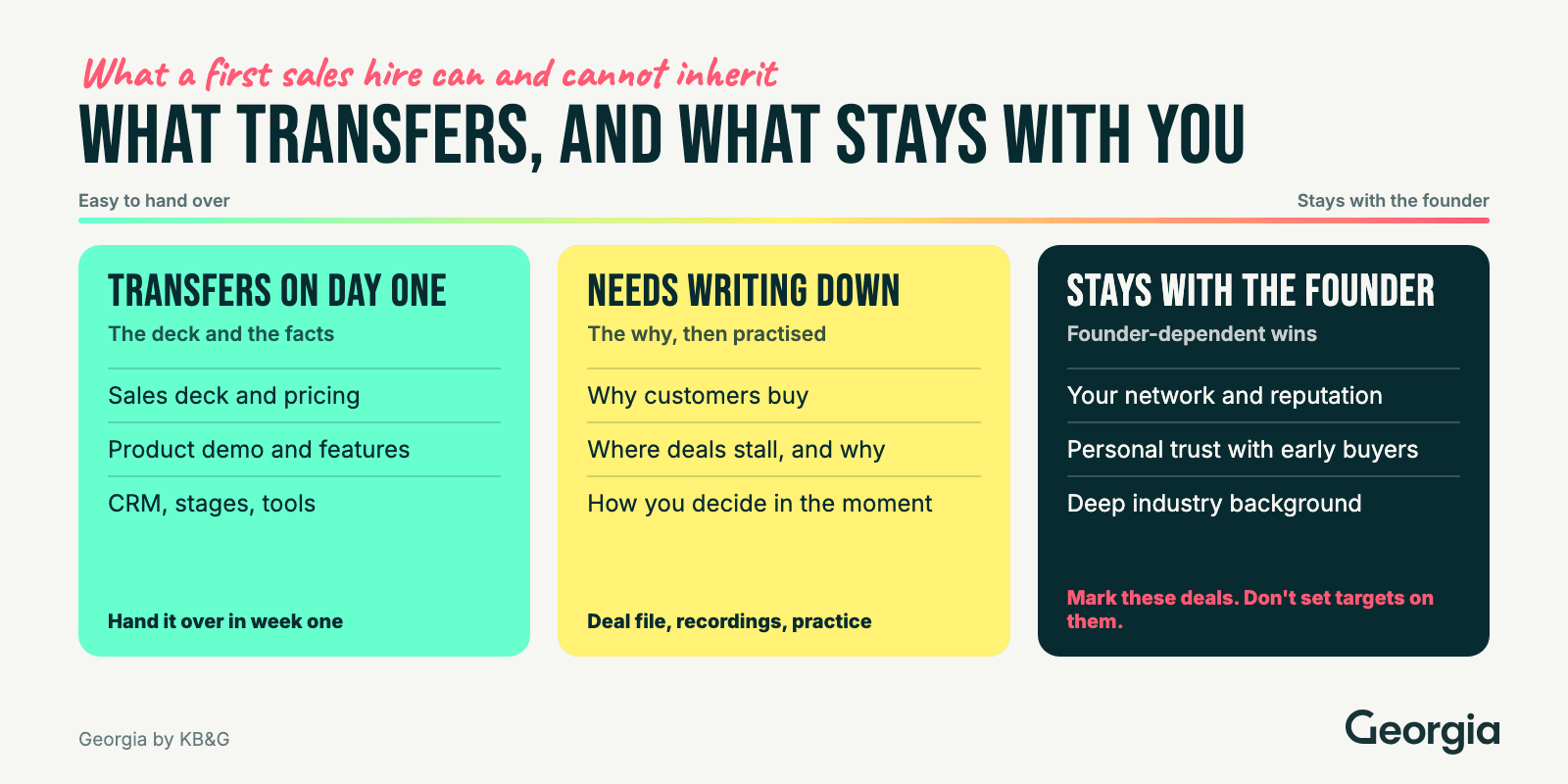
1. Why customers buy
Not which features they like, but which problem they were trying to solve, what made it urgent, and what they needed to believe before saying yes. Customers rarely buy because of technical decisions. They buy to save time, cut a cost, reduce a risk or make someone's job easier, and different buyers in the same account care about different things.
Write this up deal by deal. For your last ten closed deals, note the trigger, the problem in the customer's words, who decided, the main concern and what resolved it. Patterns will appear that you never saw while selling: a particular role that always converts, a problem that always comes with budget, a company size that never does.
2. Where deals stall and why
Wins teach less than founders think. Go through the deals that went quiet too. Did they stall after the first meeting because the wrong person attended? After the proposal because there was no reason to act now? At procurement because security questions arrived late? Each stall point needs a different response, and your new hire needs to know which ones are normal for your sales cycle and which are warning signs.
If you have never reviewed lost deals this way, start before you hire. It is the same diagnosis we describe in building a startup sales system: find where the process breaks before you add people to it.
3. What depended on you personally
Be honest about which deals came through your network, your reputation or your industry background. Mark them in the deal list. They still count as revenue, but they should not set the new hire's targets or define your ideal customer profile. This is often the most uncomfortable part of the handover, and the most useful. We cover the founder side of this in Founder-Led Sales Wins Deals and Hides Your Blind Spots.
4. How you make decisions in the moment
This is the hardest layer: the questions you ask when an answer is vague, when you walk away from a deal, when you hold price and when you give a little. You cannot write a script for it. You can explain your reasoning on recordings of real calls, and you can let your new hire practise it. More on that below.
Before Day One: A Sales Onboarding Checklist for Founders
An effective sales onboarding process starts before the new hire's first morning. Most of this is founder work, and most of it is writing.
| Item | What it contains | Why it matters |
|---|---|---|
| Deal file | Last 10 to 20 deals, won and lost: trigger, buyer, concern, outcome, founder-dependent or not | Shows why customers buy and where deals stall |
| Customer language sheet | How buyers describe the problem, in their words, by role | Stops the new rep leading with features |
| Call recordings with commentary | Three good calls and two bad ones, with your notes on what you were thinking | Turns instinct into something a person can study |
| Stall and objection map | The five most common stall points and objections, with what has worked | Gives the rep a starting point for objection handling |
| Sales process and stages | Stages, exit criteria and what "qualified" means in your company's sales process | Creates clear expectations and shared language |
| Tools and access | CRM, calendar, email, demo environment, pricing approval rules | Removes avoidable delays in week one |
| Ramp goals | What success looks like at 30, 60 and 90 days, in activity and learning, not only revenue | Stops both of you judging progress on the wrong measure |
Keep the sales tech stack simple at this stage. A first sales hire needs a working CRM and a place to find answers, not five new tools to learn alongside the product.
A 30/60/90 Sales Onboarding Plan for Your First Sales Hire
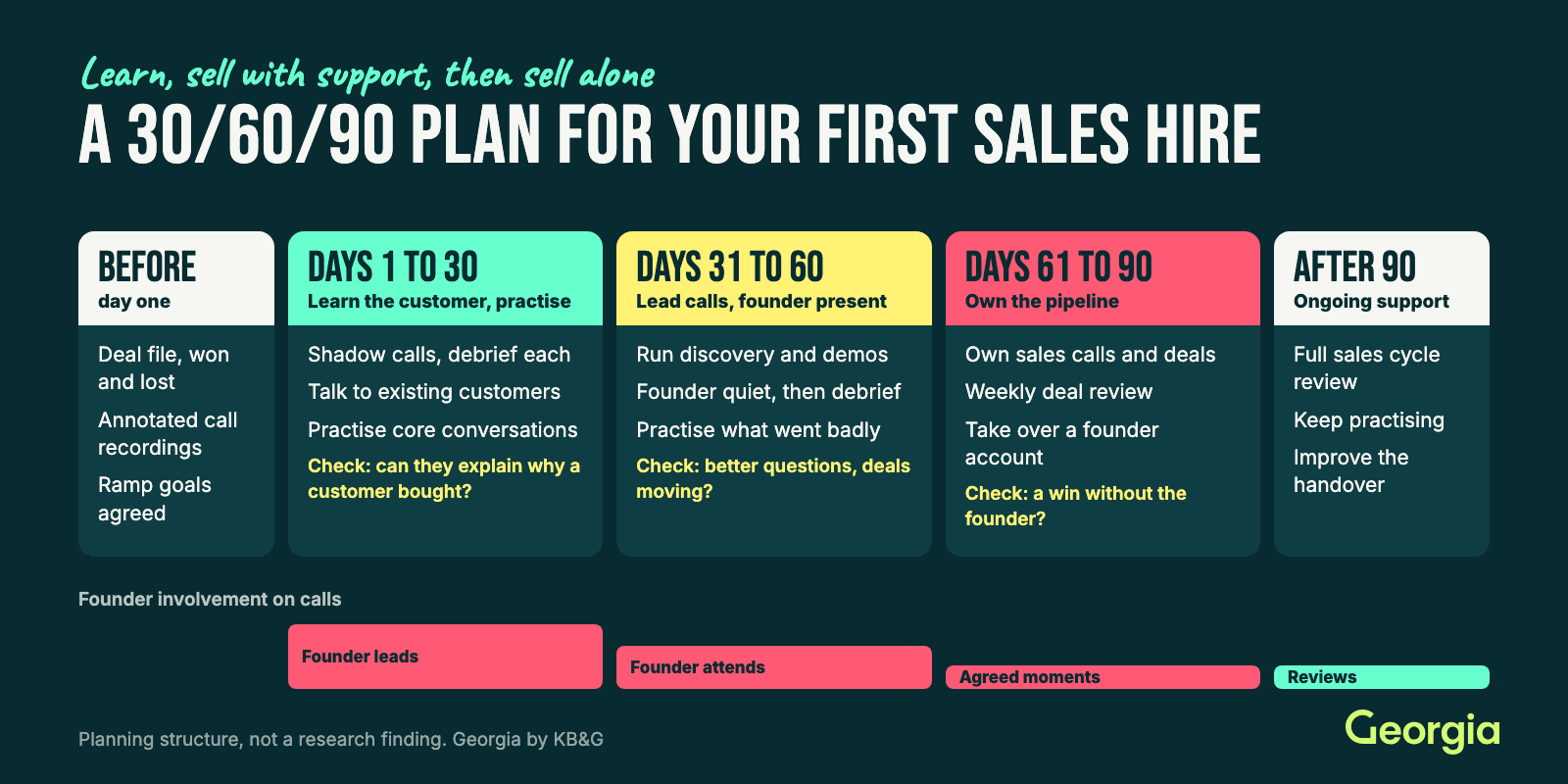
A 30/60/90 onboarding plan splits the first three months into learning, supervised selling and independent selling, with a review at each step. It is not a guarantee of full productivity at day 90. Given the ramp research above, treat day 90 as the point where the new hire runs their own pipeline with less support, not the point where they match the founder.
Days 1 to 30: Learn the customer, then practise
- Read the deal file and listen to the annotated recordings. Ask the new hire to write back, in their own words, why your top three customer types buy.
- Shadow live sales calls, with a short debrief after each one: what the customer said, what the founder did and why.
- Talk to two or three existing customers directly, ideally with customer success or whoever looks after accounts. Hearing the problem from a buyer teaches more than any training materials.
- Practise the core conversations before running them live: discovery, the first demo, the most common objection, a price question. Use mixed examples, good and bad.
- Learn the product deeply enough to demo it, but not more. Product knowledge without customer context produces feature tours.
Checkpoint at day 30: can the new hire explain, without slides, why a specific customer bought and what nearly stopped them? If not, more selling will not help yet.
Days 31 to 60: Run calls with the founder in the room
- The new hire leads discovery calls and demos. The founder attends, stays quiet unless the deal is at risk, and debriefs afterwards.
- Agree in advance what the founder will and will not step in on. Stepping in at every pause teaches the customer to wait for the founder.
- Keep practising the conversations that went badly on live calls that week. This is where skill development actually happens.
- Start owning a small set of new opportunities from first contact, so the hire sees a full sales cycle rather than fragments.
- Update the deal file together. The new hire will notice patterns the founder no longer sees.
Checkpoint at day 60: is the hire asking better questions on calls, and are their deals moving between stages for the reasons you expect?
Days 61 to 90: Own the pipeline, with weekly review
- The new hire runs their own pipeline and sales calls. The founder joins only for agreed moments: senior stakeholders, unusual pricing, key accounts that depended on the founder.
- Run a weekly deal review focused on stall points and next steps, not only on forecast.
- Hand over at least one founder-dependent account, with an introduction call and a clear explanation to the customer.
- Agree goals for months four to six, including which parts of the sales motion the hire will help redesign.
Checkpoint at day 90: the question is not "Have they hit quota?" but "Can they win a deal the founder was not involved in, and explain why it closed?"
Why Practice Has to Come Before Live Sales Calls
Because knowing what to do and doing it under pressure are different skills. A new rep can read that they should explore a price objection rather than defend the price. When a real buyer says "That's more than we expected", many will still start justifying the number.
Training research supports structured practice. A meta-analysis of 117 studies of behaviour modelling training found that its effects on skills and job behaviour held steady or even increased over time, while declarative knowledge faded. Transfer to the job was strongest when trainees saw both positive and negative examples, practised with scenarios they generated themselves, set goals, and when their managers were also trained.
That maps neatly onto a startup. Show the new hire your bad calls as well as your good ones. Let them bring their own difficult situations into practice instead of generic scripts. Set one specific goal per week. And treat the founder as the manager who also needs to learn how to coach, not just how to sell.
For how to run practice sessions well, see our guide to sales role play training. For keeping skills sharp once onboarding ends, how to train a sales team covers continuous learning and reinforcement.
How Do You Know If Sales Onboarding Is Working?
Look at leading signs of learning before revenue, because revenue lags by at least one sales cycle. Useful measures of onboarding effectiveness for a first or second sales hire:
- Explanation: can they explain why recent deals were won or lost, in the customer's terms?
- Question quality: are discovery calls producing information that changes the next step, not just confirming interest?
- Stage movement: are their opportunities moving between stages at a similar rate to the founder's, once founder-dependent deals are removed?
- Independence: how often does the founder need to step in, and is that falling?
- Feedback into the process: has the new hire changed anything in the deal file, the qualification criteria or the pitch?
Ask the new hire for feedback on the onboarding program at days 30 and 90 as well. They know better than you which parts of the handover were missing. That is how a first onboarding plan becomes a better sales onboarding process for the second and third hires.
Common Mistakes Founders Make With Sales Onboarding
- Handing over the deck instead of the reasoning. The deck is the output of your thinking. The new hire needs the thinking.
- Hiring for experience and skipping onboarding. An experienced salesperson still does not know your customers. Gallup reports that when managers take an active role in onboarding, employees are 3.4 times as likely to feel their onboarding was successful. At a startup, the founder is that manager.
- Studying only the wins. Lost and stalled deals tell the new hire where the real risks are.
- Setting targets from founder-dependent deals. Remove them from the baseline first.
- Letting the first live calls be the practice. Your best prospects are not a training ground.
- Taking calls back too soon. If the founder rescues every hesitant moment, the customer learns to wait for the founder and the hire never learns to recover.
Practise the Hard Conversations With Georgia
The part of sales onboarding that documents cannot cover is rehearsal. Georgia by KB&G is an AI role-play coach built with sector trainers. New hires run 3 to 8 minute, self-paced sessions with real-time coaching on scenarios such as holding price, price objections and "the other supplier is cheaper", so the first time they hear those lines is not on a live call with a prospect you cannot afford to lose.
Frequently Asked Questions About Sales Onboarding
What is the 30-60-90 rule in sales onboarding?
It is a way of splitting a new hire's first three months into stages: roughly learning and practice in the first 30 days, supervised selling in the next 30, and independent selling with regular review in the last 30. It is a planning structure, not a guarantee that a rep will be fully productive by day 90.
What does ramp mean in sales?
Ramp is the period between a salesperson's start date and the point where they sell at full productivity. Sales ramp time depends on the sales cycle and the complexity of the product. Research on early-tenure salespeople has treated the first 18 to 24 months as the ramp-up period.
What are the 4 C's of onboarding?
In Talya Bauer's framework, described by SHRM, the four levels are compliance, clarification, culture and connection, from least to most effective. For a first sales hire, clarification (what success looks like) and connection (access to customers and the people who know them) matter most.
How long should sales onboarding take for a first sales hire?
Plan a structured 90 days, then continued support and review until the hire has completed at least one full sales cycle. Gallup's experience is that new employees typically take around 12 months to reach peak performance, so ongoing support after day 90 is part of onboarding, not an extra.
Should the founder stay involved after the first sales hire is onboarded?
Yes, but in a defined role. The founder should join for agreed moments, such as senior stakeholders or accounts that depended on them, and run regular deal reviews. Constant involvement stops the new hire from building their own judgement.
Is an experienced salesperson easier to onboard?
They usually learn the sales process and tools faster. They still need the why: your customers, your stall points and the deals that depended on you. Experience elsewhere can even get in the way if the sales methodology they used before does not fit how your customers buy.