
How to Choose the Right Business Partner
Feb 9, 2026
Choosing the right business partner is often more important than having a great idea. The wrong partner creates friction, slows execution, and introduces early risk, while the right one strengthens decision-making and delivery.
In Episode 2 of Startup Witch, Julia Georgi, founder of KB&G Consulting, shares a clear, practical checklist for choosing a business partner. This episode covers when you actually need a partner, the only valid reasons to bring one on, and how to spot red flags early before they turn into costly mistakes.
Do You Really Need a Business Partner?
“If it’s not skill, not connection, not money… then what?”
The first question founders must answer is simple but uncomfortable: why do you need a business partner at all? This decision has nothing to do with age or luck. It requires honest analysis. If you already have the skills, connections, and money to move forward, you may not need a partner and can hire instead.

Many founders seek partners because of confidence gaps rather than real capability gaps. Fear of going alone or uncertainty about personal strengths may feel like valid reasons, but they are not a strong foundation for a partnership. These issues are often better addressed through experience, coaching, or trusted advice than by sharing ownership of the business.
The Only 3 Valid Reasons to Bring on a Partner
When deciding how to choose a business partner, the starting point is brutally simple. There are only three valid reasons to bring someone in as a partner. Anything else should be treated as a warning sign, not a justification.
Skills: A partner makes sense only if they bring a critical skill you do not have and cannot easily hire for early on. The skill must be proven and available. Interest or excitement does not matter if they cannot consistently contribute time and effort.
Connections: A partner is justified if they bring relevant connections that can be used immediately to move the business forward. Connections based on reputation or indirect access are weaker than they appear.
Money: Money is a valid reason only if the partner has direct access to the funds and can commit them. Perceived wealth is irrelevant. What matters is actual, reliable capital.
Why Anything Else Is a Red Flag
If the reason is fear, lack of confidence, or discomfort going alone, those are personal challenges, not business needs. In those cases, sharing ownership creates risk instead of solving the real problem.
How to Test If a Potential Cofounder Is Reliable
Before committing to a partnership, founders need a simple way to assess whether a potential cofounder can actually deliver.
Promises vs Actual Delivery
Reliability shows up in behavior, not in enthusiasm or good intentions. Watch whether a potential cofounder keeps promises and delivers what they say they will.
Short Trial Periods Before Commitment
A practical way to test reliability is to work together for a short period before making any long-term decisions. Trying a collaboration for a few months helps reveal how someone manages time, handles pressure, and follows through once the initial excitement fades.
Why Access to Resources Matters More Than Perceived Status
What matters is not how impressive someone appears, but whether they actually have access to the skills, connections, or money they promise. Real contribution beats perceived status every time.
Legal Alignment Before You Build Anything
Clear legal alignment early sets the foundation for trust, execution, and long-term stability in any business partnership.
Exit scenarios: Discuss what happens if one partner decides to leave, can no longer contribute, or wants to exit the business. Clarifying this early avoids emotional and financial conflict later.
Equity expectations: Agree on how ownership is split and why. Equity should reflect real contribution and responsibility, not assumptions or goodwill.
Investor readiness: Even simple written agreements show alignment. When meeting investors, having clarity on roles, equity, and commitments signals seriousness and reduces perceived risk.
A Simple Early-Stage Partner Evaluation Framework
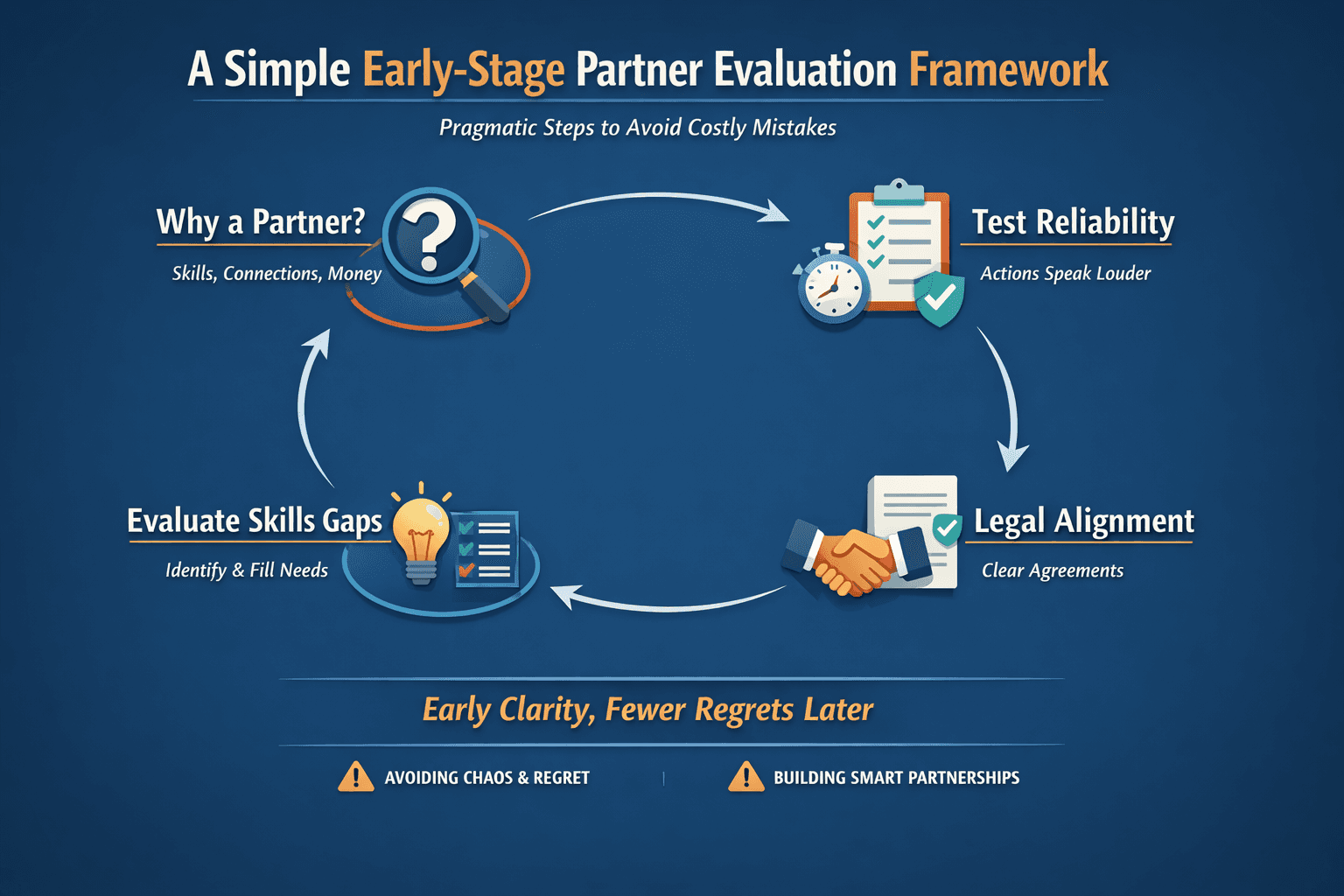
Here’s a pragmatic early-stage startup evaluation framework designed to reduce partner selection mistakes. It combines practical analysis with intuition and luck. The framework focuses on understanding why a partner is needed, testing reliability through behavior, and clarifying expectations early.
Why Most Teams Skip This and Regret It Later
Most early teams skip structured evaluation because it feels uncomfortable or unnecessary at the start. However, avoiding these conversations early makes problems harder to fix later. The framework exists to help founders create clarity from day one, when alignment is still easy to establish.
The Pie-Slicing Method for Fair Equity
The pie-slicing method offers a practical way to align on equity by making contributions visible from the start. As you track what each partner actually puts in, such as time, effort, or delivered outcomes, it replaces assumptions with transparency. This clarity helps teams adjust expectations early and prevents resentment or misalignment as the business grows.
The Self-Awareness Trap
This concept highlights the gap between intention and behavior in partnerships. People often overestimate their abilities or availability, and those mismatches can quietly damage collaboration. Observing how someone actually works and follows through over time provides a far more reliable basis for trust than interviews or promises.
Mapping Skill Gaps From Day One
Mapping skill gaps early helps founders understand what the startup truly needs to operate. By listing all required skills and identifying what is missing, teams can make informed decisions to learn, hire, or add another partner. Addressing gaps early prevents delays and avoids the need for reactive fixes later.
Performance Reviews and Early Red Flags
Regular, lightweight performance reviews keep partners aligned and accountable. Simple check-ins on what was delivered versus what was planned surface issues early and support better execution. If these conversations consistently feel uncomfortable or are avoided, it is often an early warning sign of deeper alignment problems.
Final Takeaway
Choosing the right business partner comes down to clear reasoning and early structure. Bring on partners only for skills, connections, or money, test reliability through action, align expectations early, and use simple frameworks to avoid hidden gaps and conflict.
For deeper context and real founder insights behind these lessons, watch Startup Witch. It offers practical guidance to help you avoid common partnership mistakes and build with clarity from the start.
Startup Witch is a podcast hosted by Julia Georgi, where she shares unfiltered lessons from real startup execution, exposing what founders are rarely told about building, outsourcing, and scaling companies.
KB&G Consulting is a strategy and execution consultancy helping B2B companies turn vision into results by aligning pricing, operations, systems, and delivery at scale.