
Every induction says it. Every toolbox talk repeats it. "You have the authority to stop the job." Then the shift starts, the trucks queue, the supervisor is on the radio asking how long, and the person who noticed something odd decides it is probably fine.
This is the pattern behind a lot of incident reports: they knew what to do, so why didn't they do it? This article looks at stop work authority in mining and other high-risk work from that angle. Not the policy, which most sites already have, but the ten seconds in which a worker decides whether to use it.
You will get:
- what stop work authority is, and what regulators in the US and Australia actually require
- why workers don't stop work, including what a survey of 293 mineworkers found
- what makes a stop work authority program work in practice
- how to tell whether it is alive on your site, without relying on survey answers
What Is Stop Work Authority?
Stop work authority (SWA) is a workplace safety rule that empowers employees with the right, and usually the expectation, that any worker can halt a task they believe is unsafe, without penalty, until the hazard has been looked at and controlled. It applies to everyone on site, not just supervisors: operators, contractors, visitors and the newest person on the crew.
The principle is simple. No job is so urgent that the task cannot be done safely. If a worker sees unsafe conditions, a perceived unsafe condition they cannot rule out, or a task that feels wrong, they stop it, say why, and the work stays stopped until someone with the right knowledge has checked it. A good SWA program also protects equipment, but its main job is to prevent accidents: it prevents injuries by catching the problem before an accident occurs.
Does OSHA or MSHA Require Stop Work Authority?
Not in those words, at least not for most land-based work in the US. What the law gives workers is a narrower right to refuse dangerous work, and a broader duty on employers.
Under the OSH Act, employers must provide a workplace free from recognized hazards that are causing or likely to cause death or serious physical harm. OSHA's guidance on the right to refuse dangerous work sets a high bar: where possible you have asked the employer to fix it, you genuinely believe in good faith that an imminent danger exists, a reasonable person would agree there is a real danger of death or serious injury, and there is not enough time to deal with it through regular enforcement channels such as an inspection request.
For mines, MSHA lists among miners' rights the right to refuse to work in conditions you believe are unsafe, unhealthy, or illegal, after notifying the operator and giving them a chance to address it. Section 105(c) of the Mine Act protects miners from retaliation for exercising their safety rights; MSHA's guidance on miners' rights covers how those complaints are handled.
Offshore is where SWA became an explicit rule. US offshore operators must include it in their safety management systems: under 30 CFR 250.1930, procedures must give all personnel the authority, without fear of reprisal, to stop work or decline a task when an imminent risk or danger exists.
In Australia, the model occupational safety laws developed by Safe Work Australia give workers the right to cease or refuse unsafe work (section 84 of the WHS Act) where they have a reasonable concern about a serious risk from an immediate or imminent hazard, and let trained health and safety representatives direct that unsafe work stop (section 85).
Industry bodies go further than the law. IOGP's Start Work Checks are built on the idea that workers should confirm safeguards before starting, not just stop once something looks wrong. As one Chevron safety lead put it in an IOGP article on Start Work Checks, this is "almost 'start work' authority".
So the legal floor is imminent or immediate danger. Sites with a strong safety culture set the bar much lower: if you are not sure, stop and ask.
Why Don't Workers Stop Work, Even When They Know They Can?
Because knowing you have the right and using it in front of your crew are two different things. The best evidence for mining comes from a study of South African mines by Coulson, Stewart and Saeed (2019), published in the Journal of the Southern African Institute of Mining and Metallurgy. It surveyed 293 workers at 14 mines, with focus groups and interviews alongside.
Of the 45% of workers (132 people) who had faced a workplace they judged too dangerous to work in, 65% did not go back to it. But almost a third, 32%, ended up back in that workplace anyway. Very few (4%) kept quiet. Most spoke to someone, and the person they told most often was their supervisor (71%), followed by colleagues (58%).
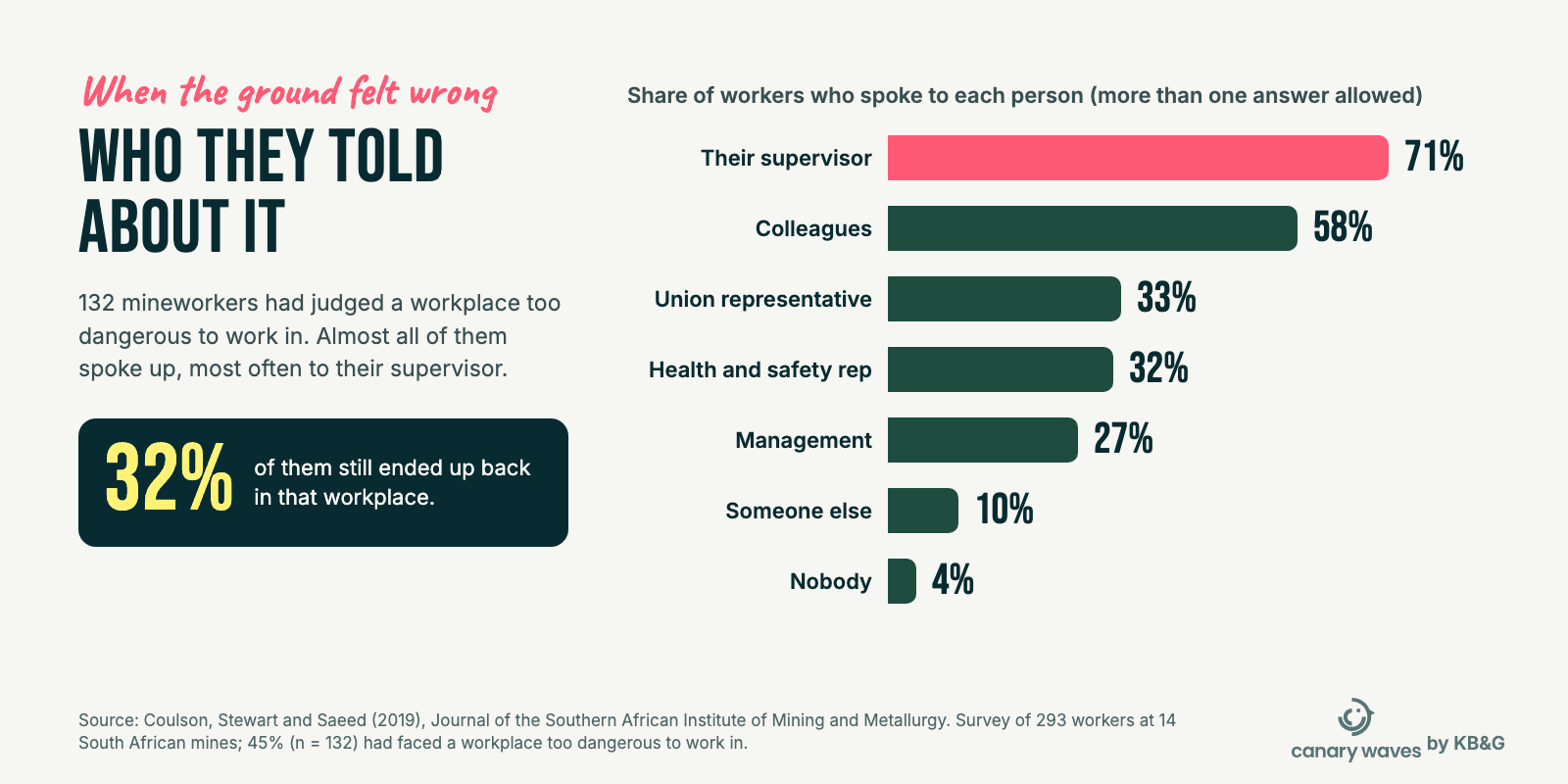
In other words, the problem was not silence. People raised it. Then something between the conversation and the decision sent a third of them back in. The study and the US Chemical Safety Board's offshore findings point to the same few forces.
Production pressure
The South African authors put it bluntly: production bonuses "pitch production against safety". In the CSB's Macondo investigation report (Volume 4), the board notes that stopping work is hardest while the work is under way, when time and economic pressure are highest, and cites its earlier Tosco Avon refinery investigation, where workers felt pressure not to stop because of production pressures and the economic cost.
Hierarchy and the supervisor's first reaction
If the supervisor is the first person most workers tell, the supervisor's reply is the stop work program. Workers in the South African study described supervisor threats and being "in trouble" for exercising the right. Nobody needs to be threatened twice. One "just get on with it" over the radio teaches a whole crew what the policy really means. This is why speaking up and stopping work are the same problem; we cover the wider pattern in speak-up culture in mining.
Fear of being wrong
Stopping work means betting your credibility that the hazard is real. The CSB describes the trap clearly: a worker can face criticism for stopping work, or blame for failing to stop it if an accident occurs. That is shifting safety responsibility onto the person with the least information. The CSB also notes that, at Macondo, the crew's stop work programs existed, but without a clear understanding of the risks workers were less likely to call a stop. As one person put it, "they don't know what they don't know."
Contractors
Contract workers were the least likely to make the call in the South African study. Offshore, the CSB cites BSEE's investigation of the 2012 Black Elk platform explosion, where contractors did not stop work because they feared losing their jobs. If a contractor's next job depends on not being "difficult", your SWA policy is a laminated card.
Fatigue and normalisation
Tired people notice less, and a hazard seen every shift stops looking like one. See fatigue in mining.
The CSB's summary is the line every site should pin up: simply requiring a stop work program "does not guarantee the workforce will actually use it."
What Happens in the Ten Seconds Before Someone Stops Work?
A decision to stop is usually a short private negotiation. The diagram below is an illustration, not research data, but most people who have worked on a site will recognise it.
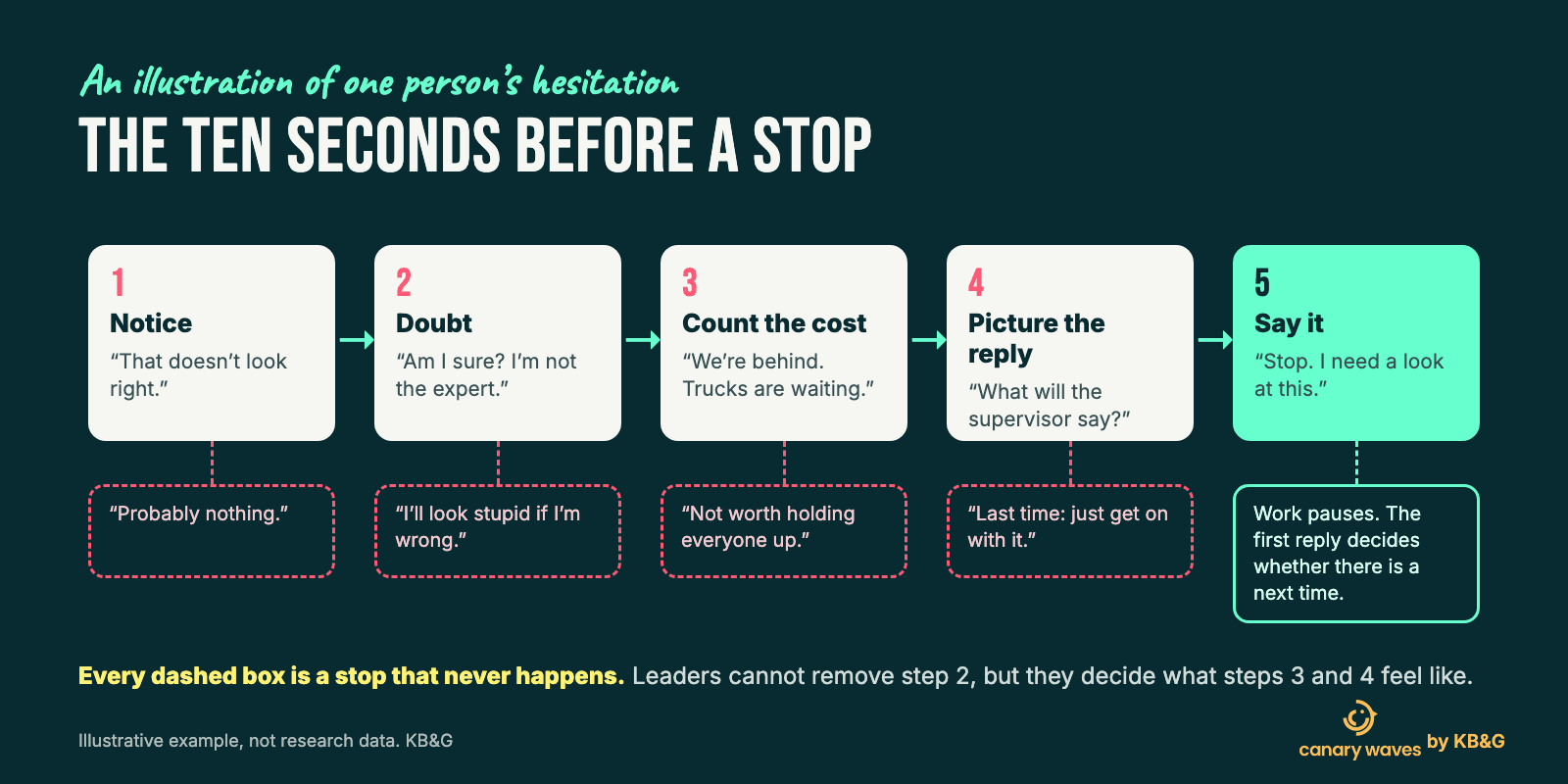
Each step has an exit. Training mostly addresses the first step, hazard recognition. The exits at steps three and four are created by leaders, and only leaders can close them.
What Makes Stop Work Authority Actually Work?
The most effective tools are not new forms. They are what leaders do in the minutes after someone uses the authority.
Get the first response right. The person who stops the job should hear "thank you, let's look" before anything else. Not "how long will this take", not a sigh, not silence. Decide the exact words in advance, because under pressure supervisors fall back on habit.
Recognise the stop, not just the catch. If you only praise stops that turned out to be justified, you teach people to be certain before they speak. Recognise good-faith stops that found nothing. That is the price of the ones that find something.
Review without blame. Ask what made the stop necessary and what made it hard. Write down what was fixed and tell the crew. A stop that disappears into nobody's inbox will not be repeated. The same discipline applies to near-miss reporting in mining.
Lower the threshold. The CSB argues that imminent risk should not be the only trigger, and that losing a critical barrier should justify a stop even when danger is not yet imminent. Name your triggers: a missing isolation, fall protection not in place, a hot work permit that does not match the job, a radio call that cannot be heard.
Include contractors explicitly. Put SWA in contracts and say plainly that no contractor will lose work for a good-faith stop.
Practise the conversation. This is the part most programs skip.
What Should Stop Work Authority Training Include?
Stop work authority training should practise the conversation, not just explain the policy. Most SWA training covers employee rights, the procedure and what counts as a hazard, then ends. Nobody practises the actual moment: interrupting a senior operator, or answering a stop calmly when you are behind schedule.
Useful training includes:
- short scenarios where workers say the words out loud: "Stop. I need a look at this."
- scenarios for supervisors receiving a stop under pressure, including one that turns out to be nothing
- contractors in the same room, or the same scenarios
- a debrief of real stops on your site, with names removed if needed
Simulation is a legitimate fix here, because the skill is conversational. For the supervisor side, Georgia, our AI role-play coach built with sector trainers, runs short 3 to 8 minute sessions with real-time coaching, including supervisor conversations, so leaders can rehearse their first response before they need it.
How Can You Tell If Stop Work Authority Is Alive on Your Site?
Look at what people do, not what they say in surveys. Almost everyone will tick "I feel able to stop work". The evidence is in the stops.
- How often do stops happen? A site with no recorded stops is rarely a site with no hazards.
- Who calls them? If every stop comes from supervisors or safety staff, the authority has not reached the crew. Check contractors separately.
- What happened afterwards? Was the hazard fixed, was the person thanked, was the crew told?
- How did work resume? Who decided, and was the original concern resolved first?
- Do the same people stop twice? A first stop is courage. A second one means the first went well.
The richest evidence is often in radio traffic. Hesitation sounds like something: a half question to control, a "might be nothing", a long pause before a reply. Those moments are where SWA lives or dies, and most sites never hear them back. More on that in radio communication in mining.
Supervisor pushback that crosses into intimidation is a safety problem as well as a conduct one; see bullying and harassment in mining.
Stop Work Authority Safety Share: A Two-Minute Talk for Your Next Pre-Shift Meeting
If you need a mining safety share for this week, this one works well at a pre-shift or toolbox meeting. Read it out, then ask the question at the end and wait for an answer. For more ideas, see our list of mining safety shares, topics and tips.
The share: "Every one of us has the authority to stop a job that doesn't look right. Most of us have never used it. Not because we've never seen something wrong, but because in the moment we talk ourselves out of it. We think: probably nothing. I'm not the expert. We're behind. What will the supervisor say? Today I want to make one thing clear. If you stop a job and it turns out to be fine, that is a good stop. Nobody here will be asked why you wasted time. Supervisors, the way you react to the first stop decides whether there is a second one."
Ask the crew: "When was the last time you had that 'that doesn't look right' feeling, and what did you do next?"
Supervisor follow-up: thank the first person who answers, log any stop raised this shift, and report back at the next meeting on what changed because of it.
Hearing the Stops That Nearly Happened
Canary Waves by KB&G is voice-to-data safety intelligence that runs passively on your existing two-way radio, with no new hardware and no change for crews. It transcribes radio traffic, tuned to site slang, and flags near-miss language, hazards, tone shifts that suggest strain, abusive conduct and holding calls. For stop work authority, that gives you a view of the tone shifts and holding calls around a moment of doubt, not just the stops that were formally logged. It has been proven in early MVP pilots on real mine sites.
Frequently Asked Questions About Stop Work Authority
Does everyone have stop work authority?
On a site with a proper SWA program, yes: every employee, contractor and visitor, regardless of rank or tenure. In law, the scope varies. US offshore rules give it to all personnel; onshore, OSHA and MSHA provide narrower rights to refuse dangerous work.
When should stop work authority be exercised?
Whenever a worker believes a task cannot be done safely: an imminent danger, an unexpected change, a missing control, or anything that feels wrong and cannot be explained. Act immediately; investigate after the work has stopped.
Does OSHA require stop work authority?
Not as a named program for most industries. OSHA requires employers to keep the workplace free from recognized hazards and protects a worker's right to refuse work in narrow conditions of imminent danger. SWA programs go beyond that minimum, which is why they work best as company policy.
What are the steps of stop work authority?
Most procedures follow the same pattern: stop the task, make the area safe, notify the person in charge, assess the hazard together, fix it, resume only when it is resolved, and record and share what happened.